
Thoughts on the Division Operation


Among the four basic arithmetical operations, division is easily the most complex, and it is the one with which children have the most difficulty. In this regard, I would like to share the following thoughts with readers on how division can be taught. They may be regarded as alternatives to the way division was presented in the pullout of an earlier issue. In particular, the following questions have been addressed:
- Why do we proceed from left to right in division whereas all the other operations proceed from right to left?
- What is the role of place value in the standard division algorithm?
- How do we estimate the quotient when the divisor has two or more digits?
Points 1 and 2 are connected. The argument I use with students is that it is just a matter of efficiency. In the case of addition and subtraction, a left to right algorithm will not be efficient, as illustrated below.
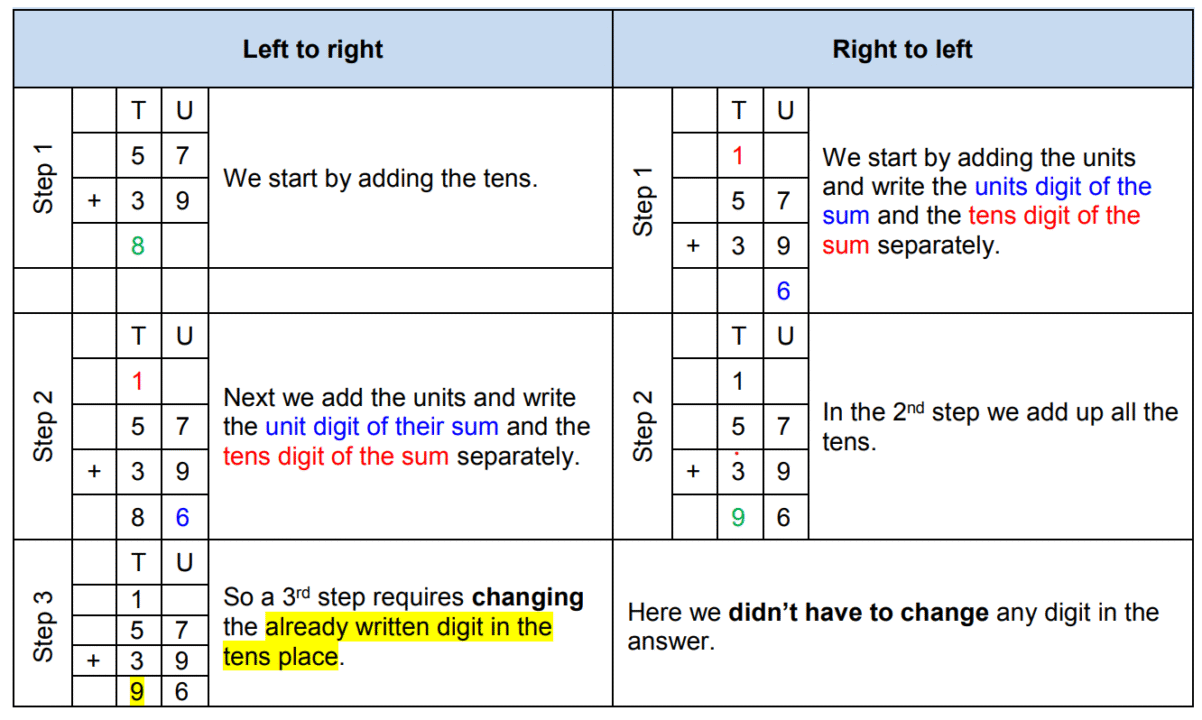
A similar situation arises in subtraction as well. But because of the variety of cases which arise, I have doubts on whether to teach or even demonstrate this to children.
For division a right to left algorithm is not the most efficient one, as shown below.
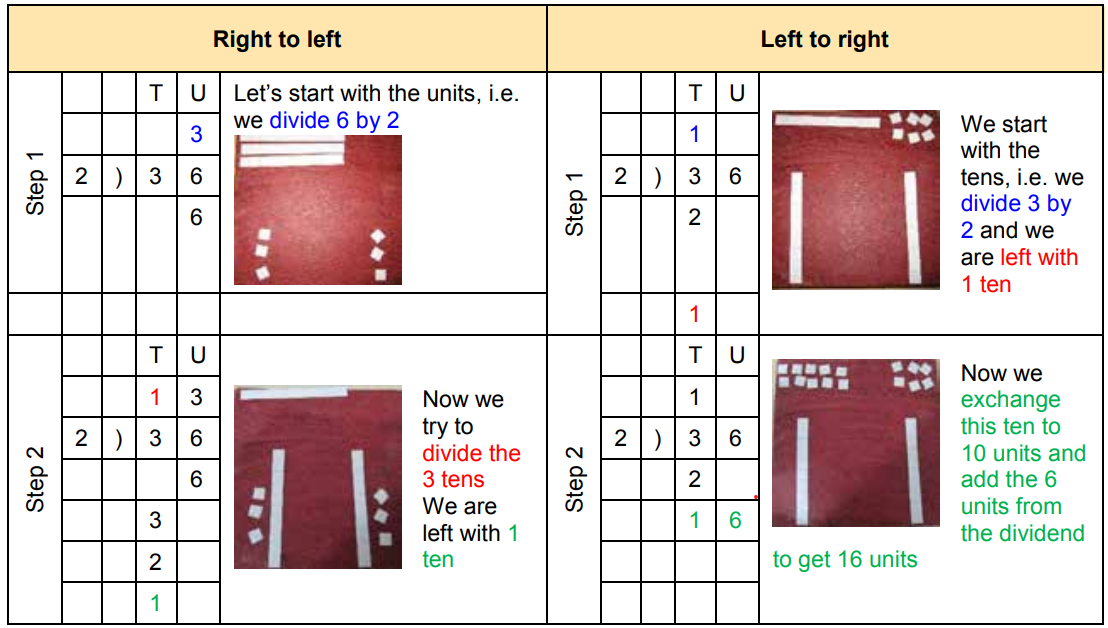
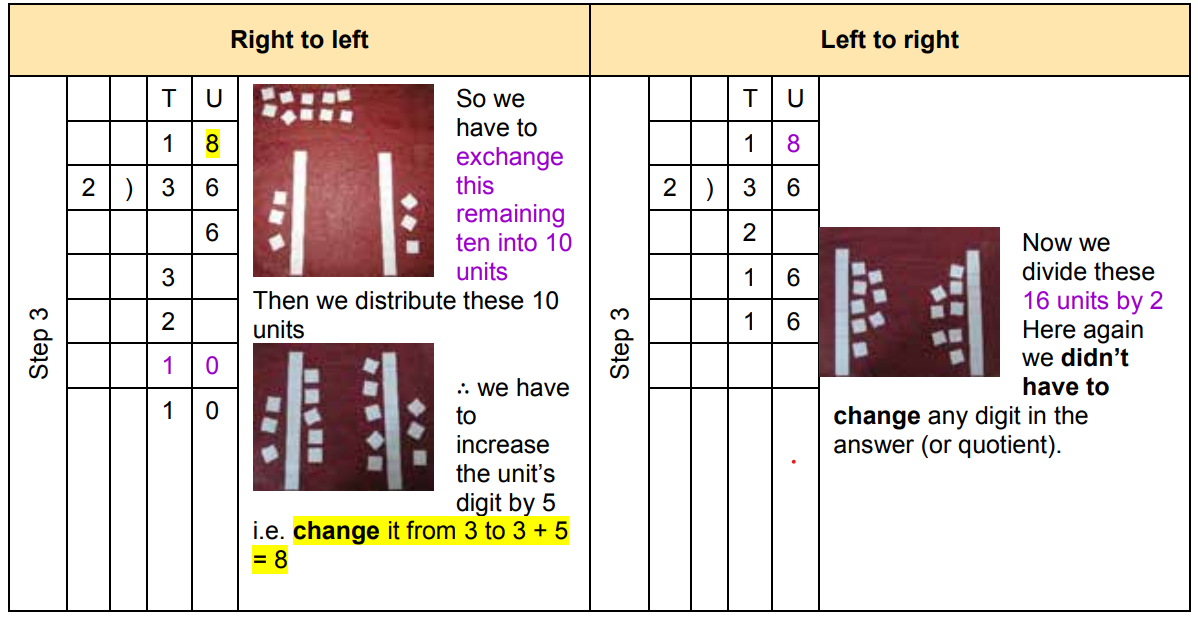
Note: The exchange of units is not obvious in the algorithm and students benefit if the teacher demonstrates the conversion from tens to units by using material manipulatives such as flats and longs or bundles of ten
So if we show these to students or, even better, get them to work out both ways – left to right and right to left – and then reflect on the efficiency of each method, they will have a much better understanding of why the standard algorithms are the way they are.
I have tried to document how place value is invoked in the standard division algorithm with a detailed step by step demo of both long and short methods simultaneously showing 8643 ÷ 7 at https://sites.google.com/apu.edu.in/mathspace/numbers-and-operations#h.614qgwxuw56 (scroll down to “Division with 4-digit dividend”)
When the division algorithm is taught, we generally use the shorter version of the division algorithm that violates the subtraction rules that a child has learnt.

Point 3 is important since division is the only place where the standard algorithm requires estimation. For addition, subtraction and multiplication, no matter how large the numbers are, there is no need for estimation
The strategy is multi-pronged as rounding can go either way. So we need to start with 2 digit divisors and round them to the nearest tens in order to estimate. Naturally, it is a good idea to give children enough practice with divisors that are multiples of 10, e.g. 40, 70 etc., before going into general 2 digit divisors. Next, if the divisor is 62, we can round it to 60 and look for the highest multiples less than the dividend in each step. Similarly, if the divisor is 37, it should be rounded to 40. Of course, numbers ending in 5 like 85 are always tricky – you can use either 80 or 90. It is also important to highlight here that the difference at each step should be less than the divisor. The estimation steps are as follows:
| Estimation steps | Example: 256 ÷ 36 | Example: 256 ÷ 33 |
| 1. Round off divisor to the nearest multiple of 10 | 36 rounded off to 40 | 33 rounded off to 30 |
| 2. Estimate quotient (or quotient digit) at that step using the estimate | 256 ÷ 40 (or 25 ÷ 4) ≈ 6 | 256 ÷ 30 (or 25 ÷ 3) ≈ 8 |
| 3. Calculate quotient digit × actual divisor | 6 × 36 = 216 | 8 × 33 = 264 |
| 4. Check a. if quotient digit × divisor > dividend: decrease quotient digit by 1 and repeat step 3 b. if not, proceed to check dividend – quotient digit × divisor > divisor: increase quotient digit by 1 and repeat step 3 c. If dividend – quotient digit × divisor ≤ divisor proceed to step | Check: a. 216 < 256 b. 256 – 216 = 40 > 36 ⇒ quotient = 6 + 1 = 7 Go back to step 3 using 7 as the quotient digit | Check: a. 264 > 256 ⇒ quotient digit= 8 – 1 = 7 Go back to step 3 using 7 as the quotient digit |
| 5. Complete division step with the (modified) quotient | 7 × 36 = 252, i.e. 256 ÷ 36 = 7 remainder 4 | 7 × 33 = 231, i.e. 256 ÷ 33 = 7 remainder 25 |
I welcome suggestions from readers