
Trials with Triangles


Problem
We gave the following problem to the students: use two copies of a scalene right-angled triangle and make shapes by joining them together and without any folding, cutting or overlap of the triangles. The triangles had to be joined such that edges join each other in full.
We split the students into groups and asked them to explore the problem and then to trace whatever shapes they obtained in their notebooks and name some real life objects similar to the shapes they had drawn. They took up the task with enthusiasm. Not even a single student seemed uninterested. We had to repeat the instructions for quite a few students, despite having written the problem on the board and explained it to them through demonstrations.
After 15-20 minutes, we asked them to show us their drawings. Most of them could draw 3-4 shapes. One shape that many of them missed was the parallelogram (Figure 6) which was not made by joining the shortest sides. After we had drawn all the possible shapes on the board, we asked the students to make the shapes that they had missed. We noticed that some of them (including teachers) struggled with shapes when they were drawn in an orientation differing from the ‘usual’ one. For example, we typically draw a parallelogram in such a way that two opposite sides are ‘horizontal’ (i.e., parallel to the ground). When we showed a slanted parallelogram, many found it difficult to identify the shape. We see from this how important it is for a teacher to develop flexibility in visualisation of shapes.
 Figure 0 |
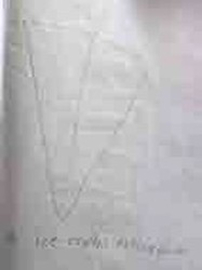
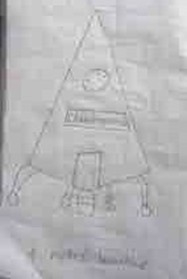
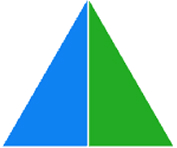 Figure 1: Mountain, birthday cap, nose, pizza slice, paper rocket |
 Figure 2: Envelope, cell phone, board, table |
 Figure 3: Sailor’s compass, thunderbolt, kaju katli, diamond |
 Figure 4: Ray fish, sleeping mountain, glider, roof of a house |
 Figure 5: Kite, aerial view of a ship, rocket, ice crystal falling down (hailstones) |
 Figure 6: Buttons outside an elevator, bogie of a train |
When we asked how we could be sure that there are just six possible shapes that can be made using the two scalene right-angled triangles, not many could argue the matter convincingly. But some students were quite clear in their thinking: “There are three sides to each triangle and two congruent sides can be joined in two ways – the second way is by flipping one shape. Thus, three times two gives six ways of constructing shapes.” The next question was to check if they would get the same answer if the two congruent right-angled triangles were isosceles. That made them reframe their reasoning in a better way. I leave it to the reader to guess what that reasoning could be.
The next question was this. Imagine these shapes to be racing tracks; you must choose one of them. There are a few ice creams kept for those who finish running around the perimeter of the shape of their choice. Assuming that you are keen to have the ice cream, which track would you choose?
Except for one fifth-grade student who came up with the answer almost instantly, no one else could arrive at the correct reasoning. Some of the common answers given were:
- As we have made all the shapes using the same two triangles, it should not matter which track you choose.
- Choose any of the two triangles because the triangles have three sides and all the other four are quadrilaterals.
- Choose the triangle that is smaller in height.
- Choose a triangle because then you have to make only three sharp turns (as compared to four sharp turns in the case of a quadrilateral; the sharp turns serve to slow us down).
One boy even said that he would choose a triangle because there is a slope (the hypotenuse) and he can run faster down that slope. I had not expected that someone would think in this way and I just had to remind myself that there are so many ways in which a child thinks and how important it is for a teacher to be alert to all the assumptions that a student can make.
One team just took a scaled ruler, measured the perimeters, and got the answer. That is when I realised that I had never told them that they were not allowed to find the answer by measuring the perimeter. That was really smart of them. At the same time, why didn’t others think of it? Did they assume that they weren’t supposed to measure? Or did they not think of it at all?
The boy who got the answer almost instantly said (in his own words), “Sir, it is obvious that we need to find the shape with the least perimeter. We will get the shape by joining the longest sides of the triangles.” I loved it when he used the word ‘obvious.’
For the remaining students, we tried figuring out a way to get the answer. So we took some side lengths \(a\), \(b\), \(c\) where \(a \lt b\lt c\) and tried to compare shapes based on these variables. This convinced the students as to which shapes had the least perimeter.
Outcomes of the session
- Students observed for themselves that shapes with the same area can have different perimeters. I feel that this learning will stay for a long time as they learnt it on their own, by making mistakes.
- We pushed the students to give reasons for their claims. They could also listen to others’ views and think about them.
- They started looking at real life objects in a different way. For example, the fifth graders did not know what a right angle was. I told them that it is like an L-shape and showed them a few such shapes. In less than a minute, they identified at least 20 objects in the room that had a right angle. In their subconscious minds, they would have realised that there are numerous real-life situations when we make use of right angles. They also saw geometric shapes in other real-life objects.
- They were active learners for 75 minutes because they were doing something with their hands, having a dialogue with group members and with the faculty. A classroom where there is a monologue is not interesting for anyone.
- We did not start by telling the students what they were going to learn in the session. Many a time, if a student has already studied the topic that is going to be taught in class (perhaps with a tuition teacher), they are not too keen to learn in the class. Some of these students also end up getting distracted in the class. As this was new and different from the usual approach followed, they listened. It is important for us teachers to keep this in mind and keep coming up with new and innovative ways of teaching even routine stuff.
Shapes from the eyes of children
Acknowledgements
The motivation to extend the question to figuring out the shortest perimeter was from this video: Year 4 Singapore math model lesson: Measuring Area – Maths No Problem