
BODMAS: Much ado about nothing?


BODMAS is taught at upper primary level in most of the states. Teachers have constantly expressed the need for support in teaching BODMAS and their questions have mainly centred around:
- Is this a convention?
- Why the hierarchy in the order of operations?
What is BODMAS?
BODMAS, PEMDAS or PIMDAS are acronyms used as mnemonics for the convention of “the order of operations” in evaluating arithmetic expressions.
According to this convention, when a student encounters an arithmetic expression with more than one operation, the student simplifies the expression in this order:
- First, the Brackets
- Then Exponentiation
- Then, Division or Multiplication whichever comes first when reading from left to right.
- Finally, Addition or Subtraction whichever comes first when reading from left to right.
Note: In ‘PEMDAS’, E stands for the word Exponent which fits in better than the commonly used ‘Of’ for the O in BODMAS, which can confuse students. Some teachers refer to the ‘O’ in BODMAS as Order of exponent and not as ‘Of’. If that is used ‘BODMAS’ can be recommended as the word ‘Bracket’ is simpler than ‘Parentheses’ to students. Whatever the choice, it is suggested that the teacher make consistent use of only one acronym.
Example: In order to simplify \(2 × (3 – 5) + 7^{3}\)
According to BODMAS, we simplify what is in the Bracket first: \(2 × (–2) + 7^{3}\) Then Order of Exponentiation: \(2 × (–2) + 343\) Then Multiplication:\( – 4 + 343\) Then Subtraction: 339
Issues and Misconceptions
Many students accept this convention blindly mainly because they are struggling with all the symbols and mistake the convention for a supportive strategy. A few of them question the teacher on the reason for this convention and are often dissatisfied with the responses they get. The fact remains that this convention has become a bogey for both students and teachers and when multiple operations with fractions are introduced, an even greater burden is laid on students to remember the convention and apply it correctly. Obviously, understanding more about the reasoning behind the convention would help a student process the problem better.
Why BODMAS in this order?
Let us begin with a single operator between two or more numbers.
Say, 6 + 2, 6 × 2, 6 ÷ 2…
Or 6 + 3 + 4 + 5 + 3……
Or 3 × 2 × 6 × 8 × 5….
These are clear to the student, particularly when applied to different contexts related to daily life situations.
However, in real life, the child often comes across situations in which more than one operation is applied. Such as this:
Amma gives 2 biscuits each to Ravi, Reena and Manith. There were 4 more biscuits in the box. How many biscuits were there in all?
- We could solve this as 2 + 2 + 2 + 4 and easily get the answer as 10.
- The same problem could be written as: 2 × 3 + 4
Possibilities-
6 + 4 = 10 (Here multiplication is followed by addition)
2 × 7 = 14 (Here, addition is followed by multiplication)
We have already seen using only addition that the correct answer is 10. The repeated addition of 2 was condensed as 2 × 3 and then this was simplified as 6 to which 4 was added. Since the context of the problem was known, it was natural that we could identify the correct answer.
What if the context is not known? Do we simply read from left to right and simplify as we go along?
Let us consider 2 + 3 × 4 Options:
- 5 × 4 = 20 (Here, addition is followed by multiplication)
- 2 + 12 = 14 (Here, multiplication is followed by addition)
How would we decide which option is correct?
Clearly, a robust convention is needed. Let us begin with the elementary operations of addition and subtraction. 3 + 3 + 3 + 3 + 2 + 2 – 7 + 4 – 7 – 7 + 5 + 4 …. (1)
In this case we could evaluate left – right or right – left or in mixed order. However we do it, we arrive at the same result, provided we use the addition and subtraction of integers correctly.
Knowing that multiplication is repeated addition, the above string could be condensed to:
4 × 3 + 2 × 2 + 3 × –7 + 2 × 4 + 5, which reads as 3 added 4 times added to 2 added 2 times added to – 7 added 3 times added to 4 added 2 times added to 5. This simplifies to 12 + 4 – 21 + 8 + 5 = 8
This made our calculation simpler and easier but along with it came an order of operation- precedence of multiplication over addition and subtraction. Similarly, division being repeated subtraction, it takes precedence over addition and subtraction. The above example has illustrated that multiplication is repeated addition. Similarly, division is repeated subtraction and exponentiation is repeated multiplication.
This hierarchy has led to the BODMAS convention. Addition and subtraction have the same order in this hierarchy. So do multiplication and division; there is however, a caveat which will be explained a bit later. This is true for the set of real and complex numbers. So, this gives a rationale for the origins of the convention ODMAS. What about Brackets? When this hierarchical order needs to be broken, brackets are used to enclose those terms which need to be simplified first.
So, if the given expression in (1) had been:
3 – (5 + 3) – 5 + 7 × 7 × 7, then it would have simplified as: 3 – 8 – 5 + 7 × 7 × 7 Or 3 – 8 – 5 + 343 = 333
Finally, we consider the internal hierarchy between multiplication and division. Consider the case of 12 ÷ 3 × 2 Options:
- 4 × 2 = 8 (Here division is followed by multiplication)
- 12 ÷ 6 = 2 (Here multiplication is followed by division)
Though multiplication and division have the same ranking in the hierarchy of operations, clearly we need a convention so as to avoid any ambiguity in simplification. In order to maintain uniformity, the convention is to carry out whichever operation (division or multiplication) comes first as we read from left to right.*
(*Though this discussion is confined mainly to integers, the arguments may be extended to rational numbers at a later stage and at that point, it could be pointed out to students that all division (÷ n) are multiplication (× 1/n) and similarly all subtraction (– n) are addition (+ (–n)))
So, by the BODMAS convention, the correct answer in the above problem is 8 and not 2. The subtlety of this internal hierarchy has caused several controversies, one can read more about it with a simple Google search. Some such are given in the links https://www.popularmechanics.com/ science/math/a28569610/viral-math-problem 2019-solved/ and https://twitter.com/kmgelic/ status/1155598050959745026
With the correct application of the BODMAS rule and the caveat of reading from left to right when it comes to which of division or multiplication should be applied first, there is no ambiguity in the answer. An incomplete understanding of BODMAS leads to such unnecessary confusion.
Note: In the case of addition and subtraction it does not matter. 5 + 3 – 2; 8 – 2 or 5 + 1 would give the same result, assuming of course, that the rules of operations with integers are applied correctly.
Suggested pedagogical approach:
- Modelling through word problems Word problems with 2 operations could be a good start to bring context to symbolic form and thus evaluating to arrive at the answer.
Example 1: Sanu packs 12 apples in a box. She was able to fill 3 boxes, but 2 apples were left out. How many apples did she have?
This in symbolic form is, 3 × 12 + 2 By the given convention, we need to multiply first followed by addition. 36 + 2 = 38
Note: While modelling the problem,
- The child would first draw out the situation
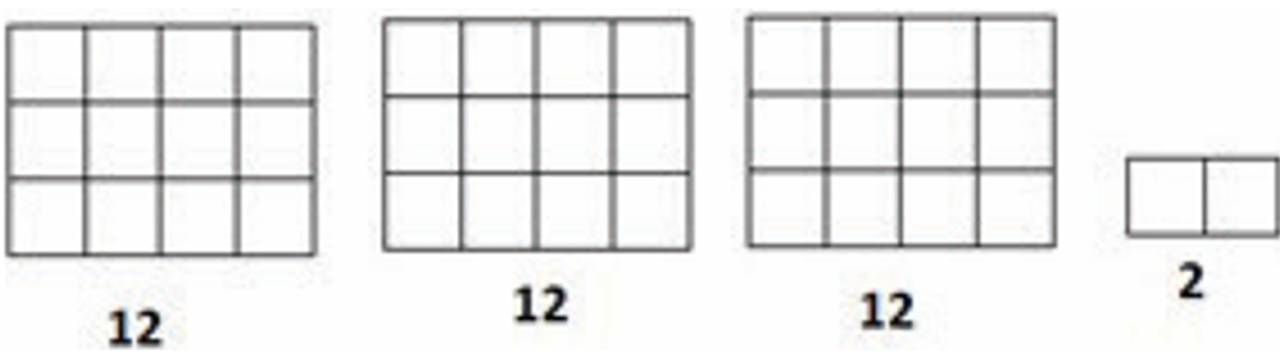
- And then evaluate the answer step wise:
3 x 12 = 36
36 + 2 = 38
Eventually, the teacher could get them to process the solution directly from the arithmetic expression without resorting to a visual representation.
Example 2: 3 out of 24 mangoes in the basket were rotten. Chandar and his two friends share the remaining mangoes. How many good mangoes does each of them get?
This in symbolic form is, (24 – 3) ÷ 3. 3 taken away from 24 gives us 21. Now, 21 mangoes to be shared among 3 is division. 21 ÷ 3 = 7
The teacher should discuss the role of the brackets in this problem. If the same expression was written without the brackets, then it would be 24 – 3 ÷ 3, which by the rules of BODMAS would be simplified as 24 – 1 which is 23. Such exercises will help students understand the importance of symbolic notations and the need for conventions.
- Writing a story for a given expression
Example: 5 × 2 + 4
Students could be given this expression and asked to make a story that uses this calculation. A sample: Meda’s teacher asked her to distribute story books to her class. There were 5 children seated at each bench.
Example: Meda distributed the books to 2 benches and had 4 books remaining. The story could be in words or sketches. This can also be done in pairs with one student making the expression and the other, the story.
- Understanding the rationale behind the rule and arriving at it through induction.
Example 1: 53 + 53 + 53 + 53 + 53 + 53 + 27
- The expression could be evaluated in any order.
- Let us condense it to make it simple and easier to calculate. Since 53 is added 6 times,
the expression could be written as:
6 × 53 +27 (getting them to read 6 times 53 added to 27 and hence order of operation being multiplication followed by addition) = 318 + 27 = 345 Multiplication first and then addition- this must be brought to the students’ notice, along with the answer if the problem was interpreted as addition first, then multiplication.
Example 2: 34 + 102 + 102 + 102
- The expression could be written as 34 + 3 × 10². Which means 34 is added to 3 times 102.
- The rule gives the order of operation, that 102 is multiplied by 3 and then added to 34. 34 + 306 = 340 Again, we see multiplication preceding addition
Note: Students may represent this problem as 34 + (3 × 10²) but they should be led to understand that the bracket is redundant in this problem. Such discussion helps them to see how precise and concise the language of mathematics is.
Example 3: 17 – 25 – 25 + 17 + 17 + 17 + 17 – 25 + 17
- The expression could be written as 17 × 6 – 25 × 3. It is simplified to 3 times 25 to be subtracted from 6 times 17.
- Now, the order of operation is multiplication followed by subtraction; 102 – 75 = 27
Note: The teacher should encourage students to see how the multiplication shortens the process of calculation. In turn, they can create expressions which are shortened by using more than one operation.
Example 4: 12 – 3 – 3 + 2 – 3
- The expression condenses to (12 + 2) – (3 × 3). We have 12 added to 2 from which we need to take away 3 times 3.
- So, we simplify the term in the brackets and then subtract. = 14 – 9 = 5
- Understanding the meaning of the expression
Here students will read the expression and state the order of operation.
Example 1: 3 + 4 × 5
- 3 added to 4 times 5
- So, we need to multiply 4 and 5 first and then add 3 to it. = 3 + 20 = 23
Example 2: 6 × 5 – 8 ÷ 2
- Here the convention rule follows reading from left to right we have multiplication followed by division and then subtraction. First we simplify 6 x 5 to get 30
- Then simplify 8 ÷ 2 to get 4
- The answer now becomes 30 – 4 which is 26.
Students should be able to state: So, as we read left to right we multiply, divide and then subtract.
In summary, BODMAS simply tells that brackets must be first opened to unfold the calculation, after which must be performed any of the two higher operations (Multiplication/ Division) before any of the two lower operations (Addition/subtraction). What is important is to ensure that operations of higher order are performed first.
- http://www.math.ucdenver.edu/~jloats/Student%20pdfs/4_Order%20of%20OperationsSass.pdf
- http://mathforum.org/library/drmath/view/52582.html
- https://www.scienceabc.com/eyeopeners/why-bodmas-or-pedmas-is-in-the-order-that-it-is.html
- https://www.thecalculatorsite.com/articles/math/bodmas-order-of operations.php
- https://en.wikipedia.org/wiki/Order_of_operations