
Visual Method for Fraction Multiplication
A generalised visual model for multiplication of fractions, based on the paper folding method, is presented.


A fraction is a ratio of two whole numbers. For the moment we consider only positive fractions; then they are formed as a ratio of two positive whole numbers and written in the form \(\frac{a}{b} , b \neq 0\).
Such a fraction is interpreted as follows:
Postulate 1: A collection of \(a\) equal-sized objects each of size \(\frac{1}{b}\) units has a combined magnitude or size of \(\frac{a}{b}\) units.
For example, a collection of 10 objects each of size \(\frac{1}{3}\) metres has a total size of \(\frac{10}{3}\) metres. A collection of 2 objects each of size \(\frac{1}{5}\) square centimetres has size \(\frac{2}{5}\) square centimetres. \(\frac{22}{7}\) is a collection of 22 parts, each of which is equal to \(\frac{1}{7}\) part of a defined object. If the defined object is a cord of length 1 metre, then we have 22 pieces of cord each of length \(\frac{1}{7}\) metres, giving us \(\frac{22}{7}\) metres in all.
What is \(\frac{3}{4}\) of an apple? Here the defined object is the apple and we are talking about cutting the apple into 4 equal parts and taking 3 of those 4 parts. What is \(\frac{5}{4}\) of an apple? Here, we start with 1 apple, divide it into 4 equal parts and add one more part equal to these 4 equal parts. Thus, in total we have 5 parts, each equal to \(\frac{1}{4}\) of the original apple. We now have \(\frac{5}{4}\) of an apple.
These concepts can be readily applied to extend fraction multiplication in the visual form by paper folding [1] to improper fractions. Consider a fraction multiplication of the form \(\frac{a}{b} \times \frac{c}{d}\). For uniformity of treatment we shall always start with the second multiplicand, i.e., \(\frac{c}{d}\). We shall depict \(\frac{c}{d}\) visually, then formulate a procedure for finding \(\frac{a\times c}{b\times d}\) visually and establish its equivalence with \(\frac{a\times c}{b\times d}\) using Postulate 1.
Case 1: a < b, c < d
This case is already demonstrated [1]. In this case \(\frac{a}{b}\) and \(\frac{c}{d}\) are both proper fractions. A unit square is drawn and divided into \(d\) horizontal sections, of which \(c\) are selected. This selection represents the fraction \(\frac{c}{d}\). The selected \(c\) horizontal sections are further divided into \(b\) vertical sections of which \(a\) are selected. The result of the cumulative selection process gives \(a\times c\) cells, and the \(b\times d\) partitions of the original unit square provide the size of each cell, viz. \(\frac{1}{b\times d}\) units. Thus, the resulting magnitude, according to Postulate 1, is \(\frac{a\times c}{b\times d}\) units = \(\frac{no. \ of \ selected \ cells}{no. \ of \ partitions \ of \ the \ unit \ square}\) and represents the result of multiplication (Figure 1(i)).
Case 1: \(\frac{a}{b} \times \frac{c}{d}, a\lt b, c\lt d \)
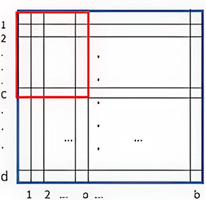
Illustration 1: Consider the multiplication \(\frac{1}{2} \times \frac{3}{4}\)
Illustration 1: \(\frac{1}{2} \times \frac{3}{4}\)
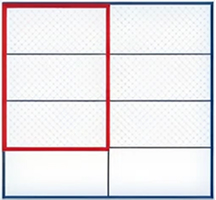
Take the unit square and divide it (or fold it) horizontally into 4 equal sections, thereafter select 3 adjacent sections. The selection is designated by the dotted portion in Figure 2(i). Next, divide the square vertically in two equal parts, and select one. The overlap of the selected areas is designated by the red outline Figure 1(ii). The original unit square is designated by the blue outline. The product is designated by the ratio of the red to the blue area. Each area is proportional to the number of sub-sections or tiles since they are equal-sized, and therefore the result is \(\frac{3}{8}\). Note that the reference object shrinks at each step of this multiplication.
Case 2: a < b, c > d
In this case, the unit square has to be extended by as many sections as are required to obtain a total of c sections of size \(\frac{1}{d}\) units each. That is to say, we divide the unit square into \(d\) equal horizontal sections, and then add \(c-d\) sections of the same dimensions to the square, as shown in Figure 2(i). This enlarged rectangle now represents the improper fraction \(\frac{c}{d} , c\gt d\). For taking \(\frac{a}{b} , a\lt b\) part of this enlarged rectangle, the same is divided into \(b\) equal vertical sections, of which a are selected.
Case 2: \(\frac{a}{b} \times \frac{c}{d}, a \lt b, c \gt d\)
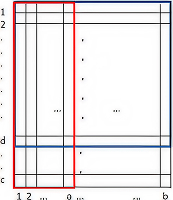
Now, we have a total of \(a\times c\) cells, all of which we have selected. The size of each cell is \(\frac{1}{b \times d}\) units, since the unit square itself is now split into exactly \(b\times d\) equal cells. The result of multiplication is, as before \(\frac{a\times c}{b\times d}\) units = \(\frac{no. \ of \ selected \ cells}{no. \ of \ partitions \ of \ the \ unit \ square}\)
Illustration 2: Consider the multiplication \(\frac{1}{2} \times \frac{4}{3}\)
Illustration 2: \(\frac{1}{2} \times \frac{4}{3}\)
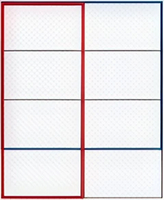
Take the unit square and divide it horizontally into 3 equal sections, thereafter append one more section to it as in Figure 2(ii). All 4 sections are selected at this stage (dotted portion in Figure 2(ii)). Next, divide the object vertically in two equal parts, and select one. The overlap of the selected areas is designated by the red outline Figure 2(ii). The original unit square is designated by the blue outline. The product is designated by the ratio of the red to the blue area and the result is \(\frac{4}{6}\), which may be simplified algebraically into \(\frac{2}{3}\). Note that the reference object enlarges in the first step and then contracts in the second step of this multiplication.
Case 3: a > b, c > d
Case 3 : \(\frac{a}{b} \times \frac{c}{d}, a\gt b, c\gt d\)
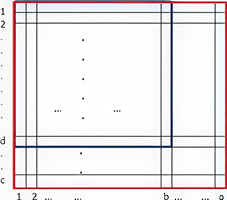
This is the case where two improper fractions are being multiplied. The unit square is partitioned into \(d\) horizontal sections, and as before, \(c-d\) sections of the same size are appended to it. This enlarged object is now sub-divided into \(b\) equal vertical sections, but they are inadequate for the purposes of selection, since we require \(a\) such vertical sections, \(a\gt b\), Therefore \(a-b\) additional vertical sections are appended to the object, as depicted in Figure 3(i). The object is further enlarged by this appendage, which is intuitively understandable, since the fractions are each larger than unity. All the cells resulting are required for the computation, viz. \(a\times c\) cells. However, for the size of the cell, we revert to an examination of the original unit square, which we now find to be divided into exactly \(b\times d\) parts. Therefore, the result of our computation is: \(a\times c\) parts, each of size \(\frac {1}{b\times d}\) units, or \(\frac{a\times c}{b\times d}\) units = \(\frac{no. \ of \ selected \ cells}{no. \ of \ partitions \ of \ the \ unit \ square}\)
Illustration 3: Consider the multiplication \(\frac{3}{2}\times \frac{4}{3}\)
Illustration 3: \(\frac{3}{2}\times \frac{4}{3}\)
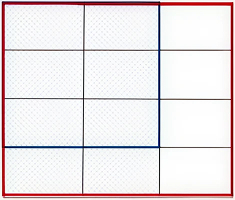
Take the unit square and divide it horizontally into 3 equal sections, thereafter append one more section to it as in Figure 3(ii). The entire 4 sections are selected at this stage (dotted portion in Figure 3(ii)). Next, divide the object vertically in two equal sections, and append another vertical section equal to each. The entire area is selected, designated by the red outline in Figure 3(ii). The original unit square is designated by the blue outline. The product is designated by the ratio of the red to the blue area and therefore the result is \(\frac{12}{6}\), which may be simplified algebraically into 2. The reference object doubles.
Case 4: b = 1 or d = 1
In the case that either of the multiplicands is a whole number, it can be treated as an improper fraction with unit denominator and the above procedure can be applied.
By commutativity of multiplication of rational numbers, the remaining possible cases are trivially covered.
Note that, geometrically speaking, in every case, the result of multiplication of the two fractions is the ratio of the area of the red figure to that of the blue figure. This result, when extended to say, 3-dimensions, suggests that the product of 3 fractions may be visualized as the ratio of the volumes of two cuboids. The result may be extended to \(n\) dimensions.
Conclusion
We have shown with rationale that the paper folding method for fraction multiplication can be extended to improper fractions. This expands the scope for using visual methods to demonstrate how fractions interact with one another and can be used for pedagogical as well as creative exercises. Further, the result may be extended to \(n\) fractional factors.
Acknowledgements
The author thanks Proteep Mallik (APU) for the inspiration to write up this note and Swati Sircar and Sneha Titus for many helpful comments.