
Making Sense of Adding Unlike Fractions


Here is an account of a class in which this problem was tackled by students who had understood the need/reason for fractions to be of the same size i.e., to have the same denominators so as to be able to add them easily. However, they had not yet arrived at any particular method to achieve this. This account is written by Rupesh Gesota, an engineer turned-school-maths teacher. Check the Teacher’s blog, where this was first published, to know more about his adventures in teaching math. Given below is the description of the class in Rupesh’s words.
Looking at the problem 4/3 + 5/2, one of the students said that each of the unit fractions above i.e., 1/3 and 1/2 should be split into quarters. Most probably, the reason for this could be that the pictorial representations of both the quantities (that were drawn on the board) looked bigger than a quarter. (Quarters and halves are fractions that students are extremely familiar with.) All the students agreed with this suggestion… So I simply went ahead without showing any hesitation. This is what the picture looked like:
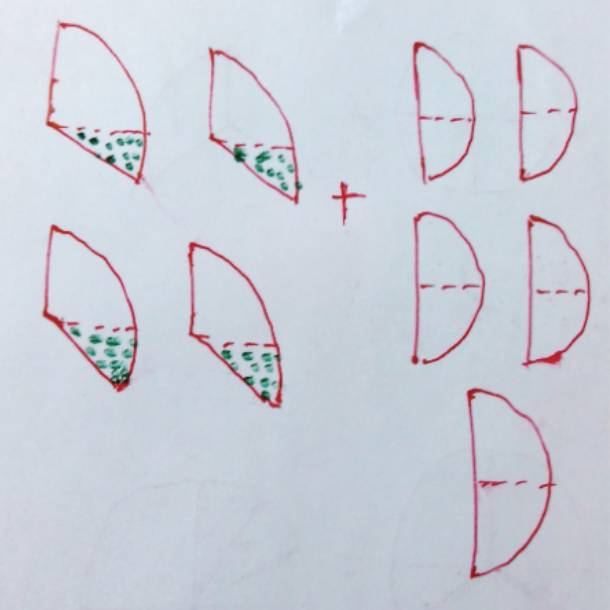
Seeing it, the students said that we have 14 quarters in all plus 4 smaller pieces. When I asked them how to add the smaller (green) pieces to these 14 quarters, one of them argued –
The green piece is half of a quarter. So, 2 green pieces would make up 1 quarter.
This is not the first time I have witnessed a student giving this specific argument, i.e., misinterpreting this left over piece as half of one-fourth (Do you see why so many students would be saying/seeing it this way?).
I chose to ask the class about this viewpoint. And, unsurprisingly, the whole class completely agreed with this, except for one student.
She said – If 2 smaller (green) pieces sum up to 1 quarter, then 2 pieces of one-third should sum up to 3 quarters! That isn’t true. So the green piece is not half of a quarter.
Isn’t this a beautiful argument?
I looked at the class. Not everyone understood this. So a picture was drawn where a whole was first divided into three thirds, and then one third was erased. This visual instantly enabled them to see the difference between two-thirds and three-quarters.
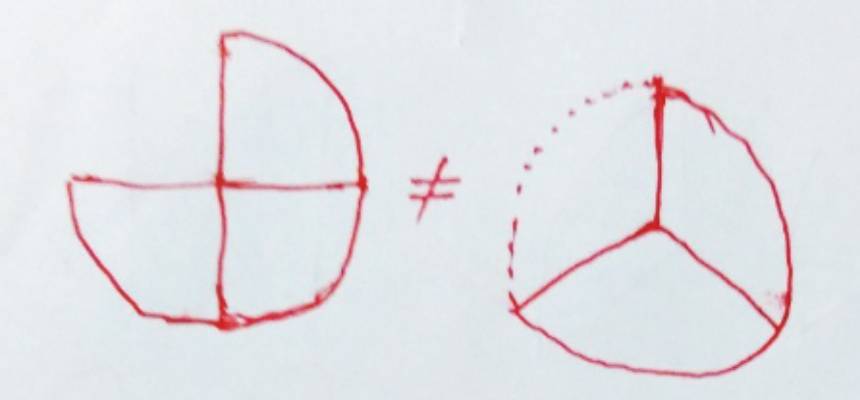
So, now the problem was – What is the size/ name of this smaller piece??
It did not take much time for one of them to shout – So then, THREE green pieces would make one quarter!
I must confess that when I heard this claim at first, I thought that it was just a random guess and hence would get eliminated through another line of argument. I did not pay attention to this and did not evaluate this new claim, probably because of the tone in which it was broadcasted and also probably because of its nature (since TWO didn’t work, it must be THREE)!
However, I am glad that a couple of them took it seriously and they not just agreed with this claim but even proved it correct with the help of this diagram.
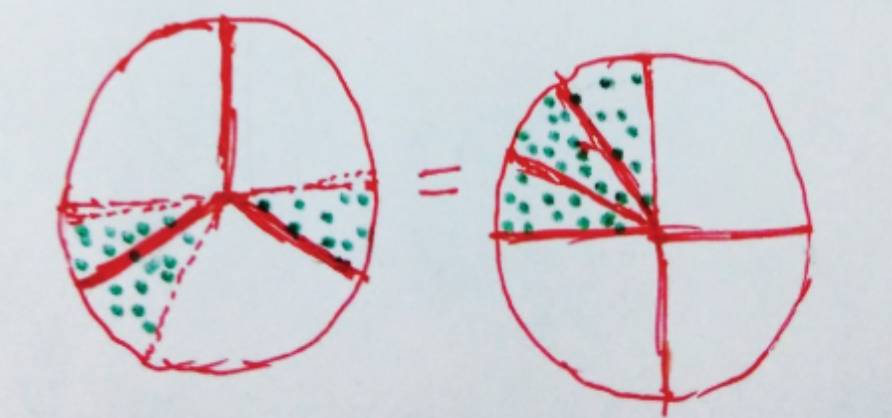
Now, isn’t this too beautiful? 🙂
Finally, when I probed, they could also give me the name of this green piece.
“Because 3 pieces make one quarter, 12 such pieces would make one whole, hence it’s 1/12”
So now, we knew that 3 thirds is same as 4 quarters and the remaining one-third also had one quarter. That left us with a single green piece.
To this, one of them proposed – So let’s represent each quarter in terms of this green piece now, because we know that 3 greens make one quarter.
I looked at the class again for their approval. Some required one more round of explanation but soon everyone was on the boat.
Finally, they transformed the original problem 4/3 + 5/2 i.e.,
4 thirds + 5 halves —> 16 twelfths + 30 twelfths = 46 twelfths.
You might have noted that they did not multiply the Numerator and Denominator by the same number to get a common denominator. Neither did they take the LCM, nor did they do any cross multiplication.
So what is your view about this approach?
PS: These students study in Marathi medium municipal schools and hail from disadvantaged backgrounds. To know more about and support this maths enrichment program, check the website.