
Low Floor High Ceiling Tasks Try-Angles!
How acute can you be?



In this issue’s task we work with right-angled triangles, isosceles as well as scalene. The activity has enormous scope for creativity, visualisation, investigation, pattern recognition, documentation and conjecture. Facilitators should encourage students to come up with proofs for conjectures that they make.
You need two sets of triangles to work with. Each set will need at least 20 triangles; they may be made of cardboard so that they do not fray too easily. The triangles need not be very big; in fact, our idea sprung from the waste paper that was being trimmed off the corner of some rectangular cards [Fig. 1].
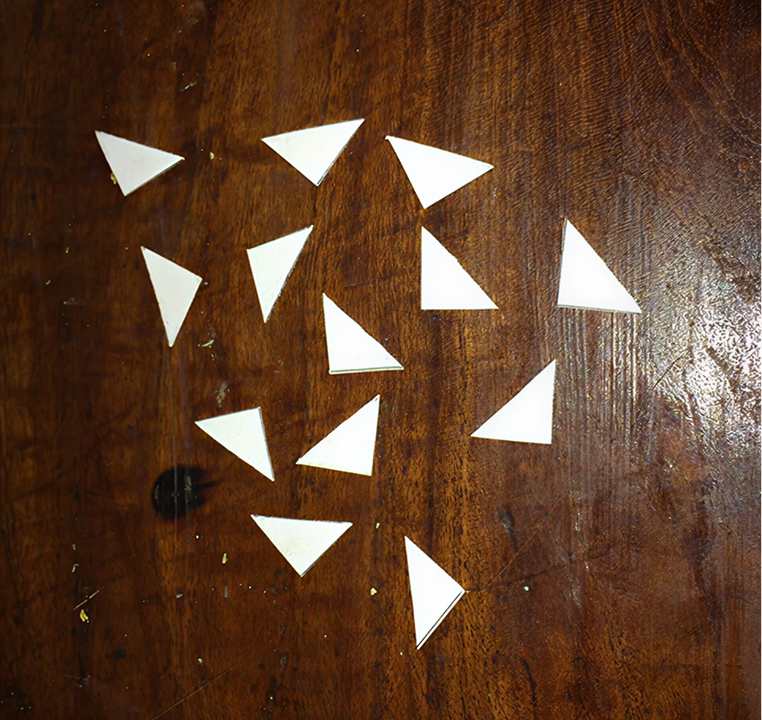
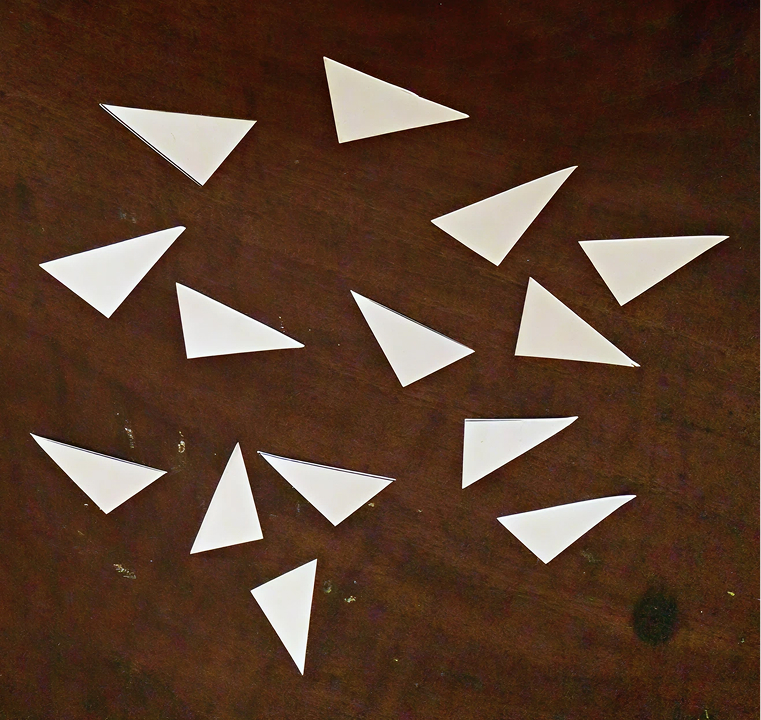
The first is a set of congruent right isosceles triangles (assume that the sides are \(1 – 1 – \sqrt{2}\)) [Fig. 2]. The second is a set of congruent scalene right-angled triangles (assume that the sides are \(a\), \(b\), \(c\) where \(a\lt b\lt c\)); see Fig. 3.

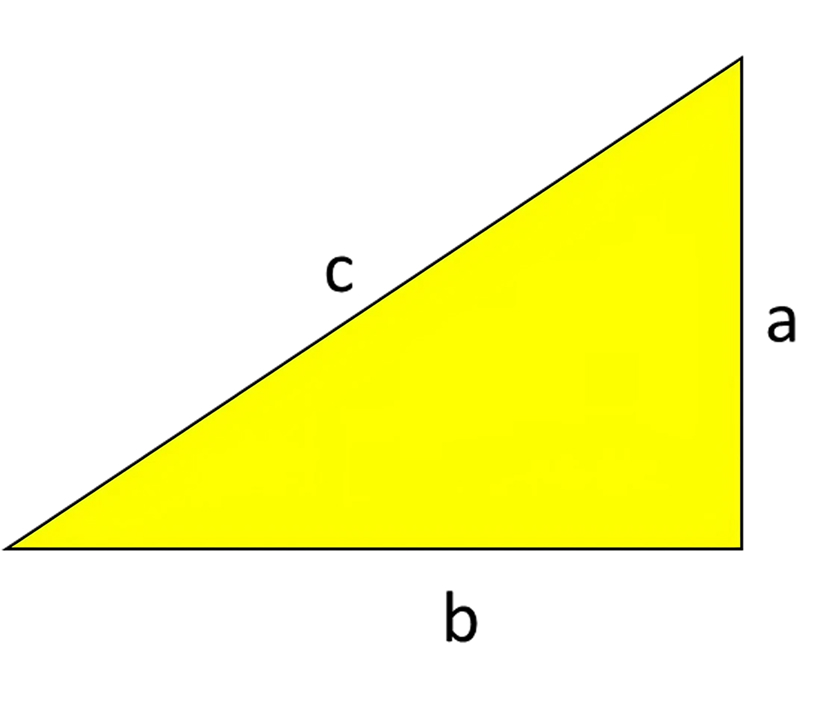
In all the described tasks, the aim is to use these triangles as building blocks to create specified geometric shapes. A necessary condition for tiling these triangles is that there are no gaps and no overlaps. These shapes can be created in a variety of ways and the aim is to encourage students to classify these ways and generalise from them.
This low floor high ceiling task would be appropriate for students of middle school. They need to know the properties of triangles, the sum of angles of a quadrilateral, the different types of quadrilaterals and their properties, and the Pythagoras theorem. An enterprising facilitator can push this activity to including crossed quadrilaterals too, but there is plenty of scope for mathematisation and skill development even within the ambit of triangles and convex quadrilaterals.
TASK 1: To make different Quadrilaterals from the given Triangles
- Try to make all possible quadrilaterals with the right isosceles set and identify the resulting shapes. You may use as many as you wish but there should be no gaps between the pieces. Fill in the following table:
| Name of quadrilateral | Number of right isosceles triangles used | Sketch/picture | Possibility of enlarging this quadrilateral using more triangles | |
|---|---|---|---|---|
| Sketch | Observation | |||
- Which shape is missing?
- Repeat the above with right scalene triangles. Document your results in a similar table.
- Did you get any new quadrilateral with the right scalene triangles?
- Is there any quadrilateral that cannot be made with the right scalene triangles?
Teacher’s Note:
This task is a great way to get students to apply their understanding of the properties and differences between various classes of quadrilaterals. A stab at the high ceiling would be to ask the students to make a general quadrilateral and investigate its special properties. The facilitator should note that the same quadrilateral may be made with different numbers of triangles. Or, the same quadrilateral can be made with the same number of triangles but in a different orientation. The quadrilateral could be an enlarged version of the original, with the triangles in the same or different orientation. Interestingly, the dimensions of the quadrilaterals may or may not change and this aspect would be worth recording and studying for pattern development. Striking number patterns may emerge here. The facilitator should encourage students to document their findings systematically and help them to generalise from these. When the right isosceles triangles are used, a general rhombus (excluding the specific case of a square) and a kite cannot be made, and when general scalene triangles are used, a square cannot be made.
TASK 2: To make different Triangles from the given Triangles
- Try to make as many triangles as possible with the right isosceles triangles. What kind(s) of triangles do you get? Tabulate your results as above.
- Which triangles are possible? Explain why.
- Repeat the above with right scalene triangles and tabulate your results.
- What kind(s) of triangles did you get? How is this different from the previous case?
Teacher’s Note:
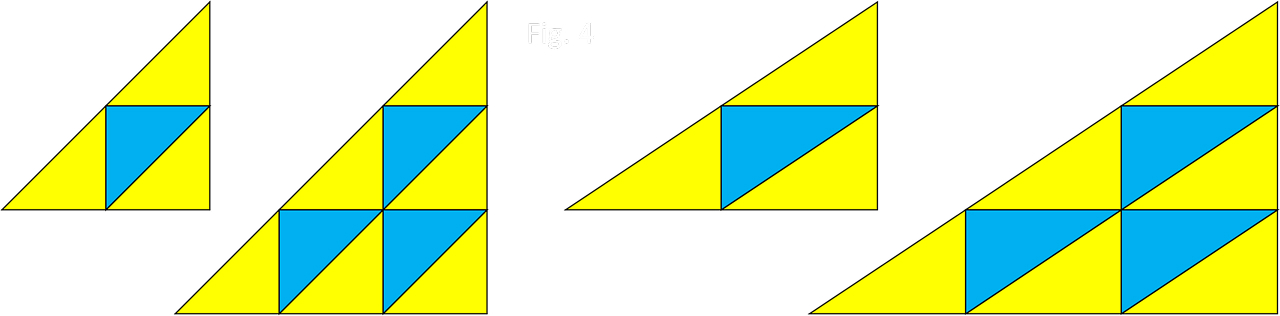
With the right isosceles triangles, it is only possible to make right isosceles triangles; for hints for a proof, the reader can refer to the Low Floor High Ceiling article in At Right Angles, November 2015, Volume 4, No. 3 (November 2015). With the scalene triangles, right scalene and acute and obtuse isosceles triangles are possible. Nice patterns emerge, such as the triangles made with 1, 4, 9, 16, … triangles and the connection between this and sums of consecutive odd numbers. The facilitator must encourage students to document their work systematically and explain their findings logically.
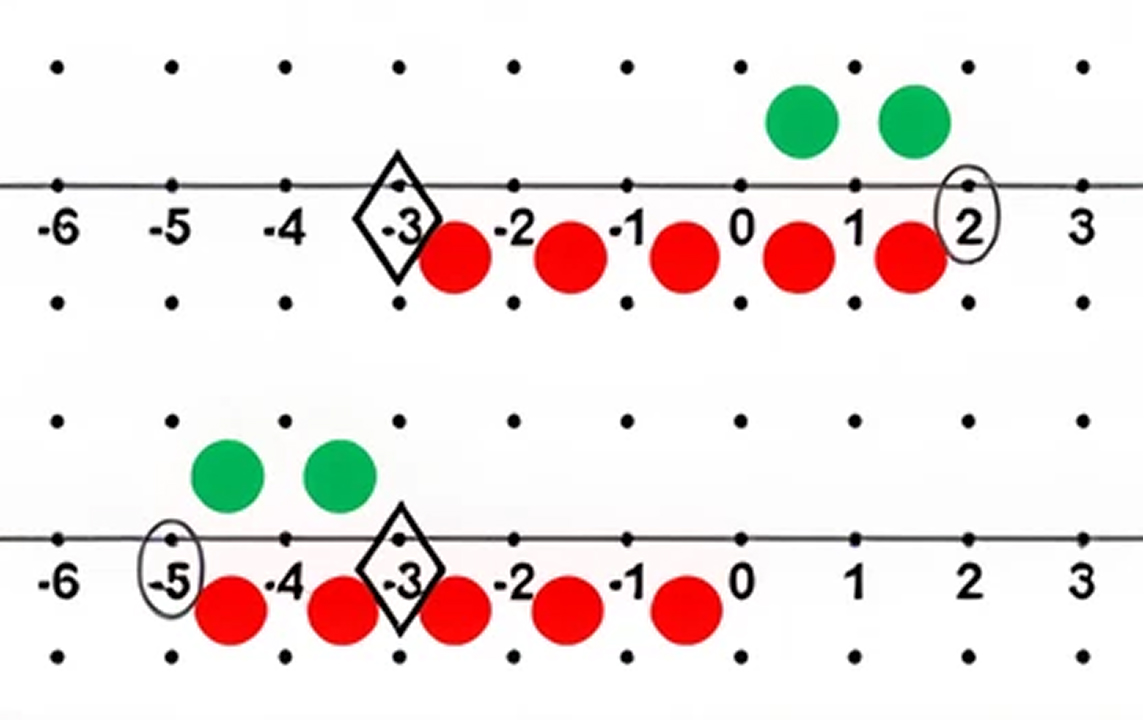
This task is especially exciting because theorems such as the mid-point theorem and Thales’ basic proportionality theorem are clearly demonstrated in some configurations of the triangles. (See Fig. 4.) This may be a good opportunity to distinguish between demonstration and proof.
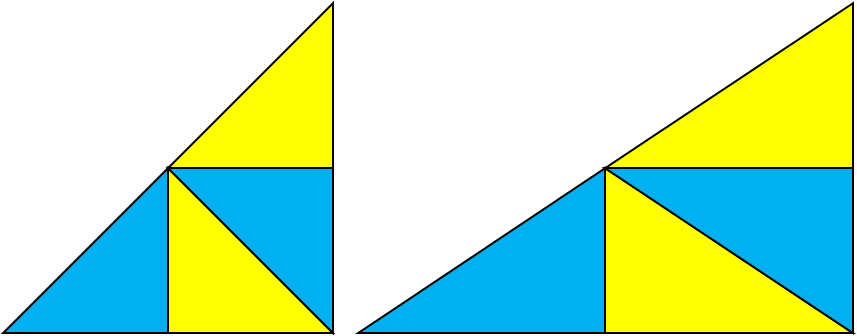
Note from Fig. 5 how this orientation of triangles clearly marks the circumcentre of the outer triangle for both right isosceles as well as for right scalene. More subtly, the figure demonstrates that in a right isosceles triangle, the perpendicular bisectors of all three sides are concurrent.
TASK 3: To extend the previous task to make Triangles from Acute/Obtuse-angled triangles
- Which of the above arrangements to form triangles can be made with acute-angled triangles?
- Which arrangements cannot be made?
- Which of the above arrangements can be made with obtuse-angled triangles?
- Which arrangements cannot be made?
Teacher’s Note:
Arrangements like those in Fig. 4 are possible with acute- and obtuse-angled triangles, whereas arrangements like those in Fig. 5 are not possible with acute- or obtuse-angled triangles; they are only possible with right-angled triangles. This task moves from working with concrete materials to a more abstract style. If the student finds this difficult, the facilitator could suggest the use of pencil and paper or dynamic geometry software such as GeoGebra.
TASK 4: Squares (and Triangles) with the right Isosceles Triangles – to generalise the number of Triangles used
- Make squares with the triangles and fill in the following table:
| Number of right Isosceles Triangles used |
Picture of Square (if it is possible to construct it) |
Side of the Square |
|---|---|---|
| 2 | ||
| 3 | ||
| 4 | ||
| 5 | ||
| 6 | ||
| 7 | ||
| 8 | ||
| 9 | ||
| 10 | ||
| 11 | ||
| 12 | ||
| 13 | ||
| 14 | ||
| 15 | ||
| 16 | ||
| 17 | ||
| 18 | ||
| 19 | ||
| 20 |
Continue until a pattern emerges. (You could go up to 100 triangles.)
- If we can make a square with \(m\) triangles, can we make a square with \(2m\) triangles?
- Give a general representation for the number of right isosceles triangles with which you can make a square?
- Give a general representation for the number of right isosceles triangles with which you can make a right isosceles triangle?
Teacher’s Note:
This task invokes visualisation and kinesthetic skills but students who are not very adept at these need not be daunted because soon a pattern emerges; once they realise that the sides of the possible squares can only be multiples of 1 or \(\sqrt{2}\), they are able to speed ahead with the configurations possible for squares corresponding to these sides. Skillful facilitation can also elicit recognition of arithmetic progressions as the squares are enlarged. Students should be able to generalise their finding, that squares can only be made with \((2n^{2})\) and \(2n^{2}\) triangles.
The last question provides an interesting variation and students may be guided to recognise that these triangles may be made with \(n^{2}\) or \(2n^{2}\) right isosceles triangles – challenge them to prove that this can be generalised as \(n^{2}\) triangles or \(2n^{2}\) triangles.
TASK 5: More generalisations with right Isosceles Triangles – findings for a combination of Squares and Triangles
- If we can make a square with \(m\) triangles, can we make a triangle with \(m\) triangles?
- If we can make a triangle with \(m\) triangles, can we make a square with \(m\) triangles?
Teacher’s Note:
Slicing the square along a diagonal and reorienting the triangles will always give a triangle, and this is a good activity to develop visualisation skills in students. So the answer to 5.1 is always ‘Yes’, but the same is true for 5.2 only when the number of triangles used is even.
Conclusion
Idle hands make for a math learning activity! The power of working with scrap material unfolded as we doodled with the triangles and we are quite sure that we haven’t plumbed the depths or soared to the heights that more play can reveal. These tasks are sure to keep students learning experientially and we hope that teachers will document and post their classroom discoveries on AtRiUM (our FaceBook page)!