
Turning the Hands of Time: A Classroom Journey with Half and Quarter Hours


During a workshop in Bengaluru, I first encountered a simple yet ingenious Teaching Learning Material (TLM)— a time clock. I was immediately captivated. The idea was so clever and straightforward that I thought, “Why didn’t we think of this?” I knew I wanted to bring it back to my classroom to help my Grade 3–5 students truly see time, not just read it.
Even though children may read off the time from a digital display, being able to read an analog clock remains very important. I’ve noticed instances where the child can read the time on a phone which has a digital display but gets completely confused by the analog clock in school. I realised that this affected their sense of time, planning, and daily routines. Analog clocks are valuable because they help children understand fractions, elapsed time, angles and number patterns in a hands-on and visual manner. And since schools, examination halls, and public places still use analog clocks, being confident about reading them is a practical life skill. That’s why I prefer reinforcing the skill of reading an analog clock.
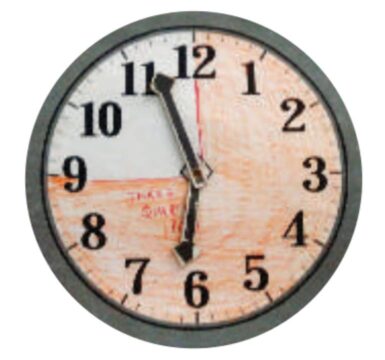
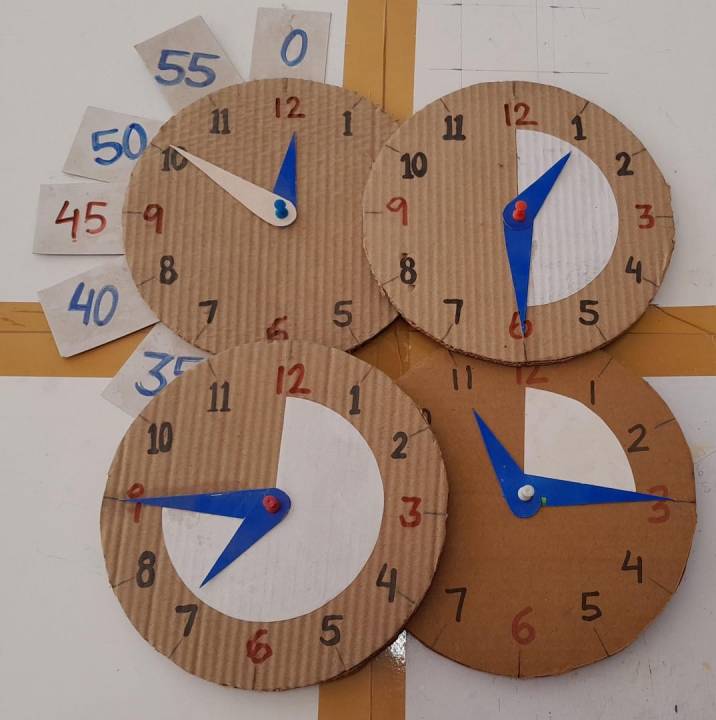
Inspired by the original clocks (shown in Figure 1), I designed my own version with a few innovations.
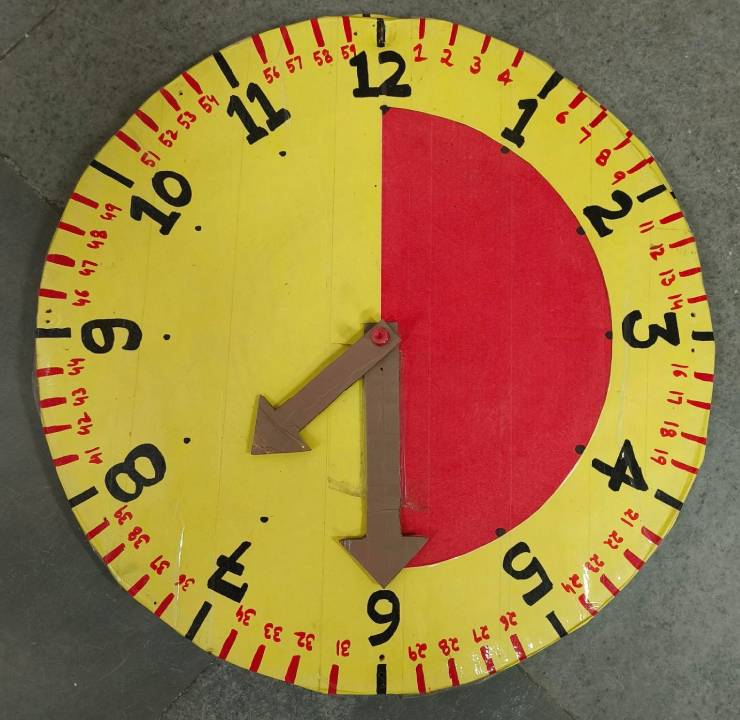
- I coloured it brightly to make it visually engaging — I chose green for the quarter past clocks and red for the half past clocks — and I marked all the minutes neatly around the clock to help students who struggled to remember how many minutes each number represents.
- I made three different clocks: one showing half past (Figure 2), one showing quarter past (Figure 3), and one showing quarter to (Figure 4) the hour, with the minute hand fixed but the hour hand fully movable. Concepts such as ‘half past’, ‘quarter past’ and ‘quarter to’ had always seemed abstract on paper, but this tool promised a way to make them tangible.
- To ensure durability, I laminated the clocks so they could be used repeatedly.

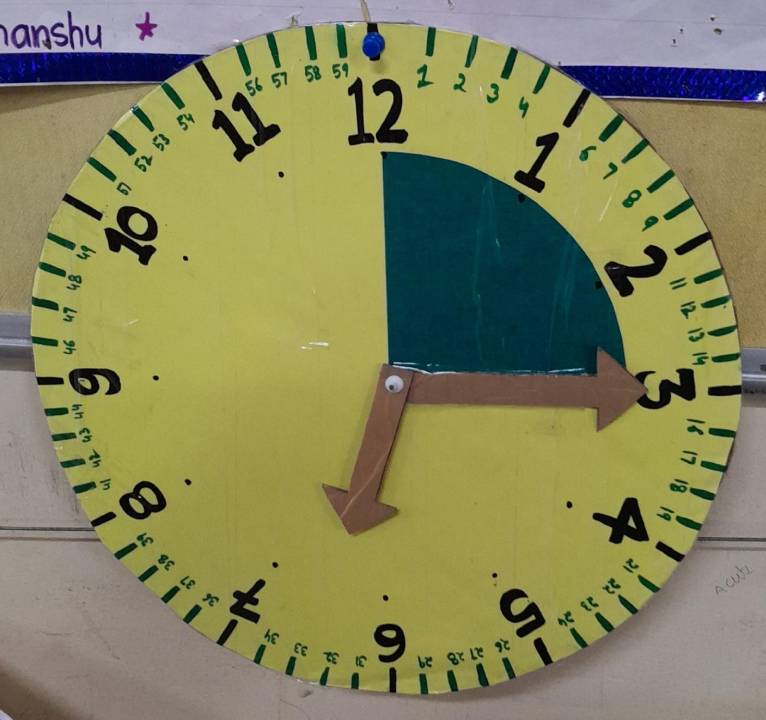
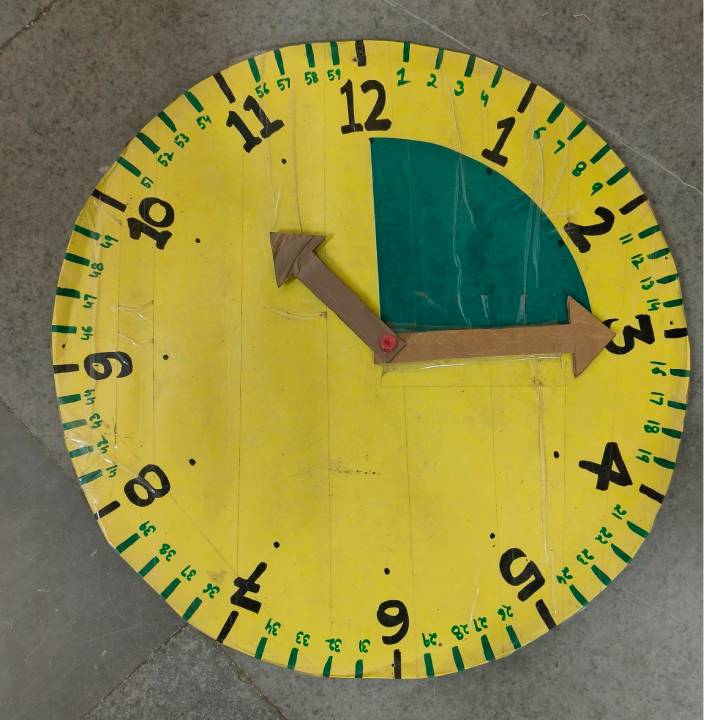
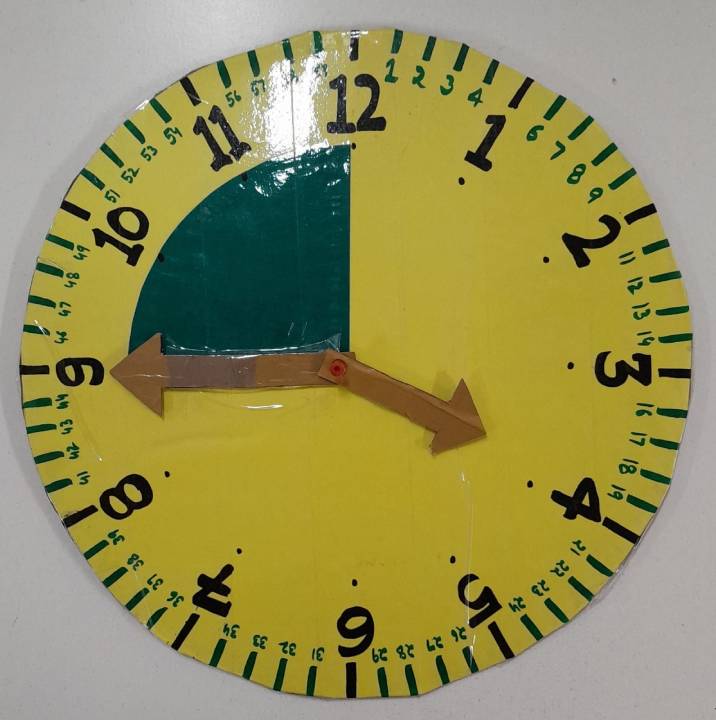

The class began by revisiting what they already knew. Students could identify the minute and hour hands of a clock and read simple times like 5:20 (20 minutes past 5) and 5:30. They had practised this using both oral and written exercises. During one such drill, a student shared the time in Hindi: “1:30 is dedh, 5:15 is sava panch — my mother says it like that at home.” I explained that in English, these correspond to ‘half past’ and ‘quarter past’, connecting prior knowledge to new learning. Since students were familiar with fractions, it was easy to explain that 15 minutes is a quarter of an hour, and 30 minutes is half an hour.
When I introduced the clocks in class, the students were immediately intrigued. Their first observation was that the big hand was glued in place. “Ma’am, why is the minute hand fixed?” they asked. Before I could answer, one student suggested, “So we can focus on the hour hand!” Another noticed, “Wow, that’s clever! Now we can see all half past hours clearly.” Suddenly, the language used became meaningful and concrete.
As they explored, one curious student asked, “Ma’am, does the hour hand go past the number a little bit, or does it have to stop exactly on it?” I explained that the hour hand doesn’t always sit exactly on a number — it depends on the time we are showing. For example:
- For half past 1 (1:30), the hour hand is exactly halfway between 1 and 2.
- For quarter past 2 (2:15), the hour hand is a little past 2, closer to 2 than 3.
- For quarter to 5 (4:45), the hour hand is a little before 5, closer to 5 than 4.
Then students started to place the hour hand exactly where it needs to be. This distinction helped students visualize the gradual passage of time and understand the subtle positioning of the hour hand for each case.
The following interaction took place in Class 4. There were 28 students, so I created groups of four students each. Each group received one of the three clocks — half past, quarter past, or quarter to — and explored how to position the hour hand correctly for any hour. I ensured that each group had the opportunity to work with all three clocks. They experimented with placing it exactly between two numbers for half past and closer to the relevant hour for quarter past or quarter to. Students rotated the hour hand repeatedly, comparing their observations with the Hindi terms they knew and discovering the logic of English time terminology for themselves. They excitedly predicted times, experimented with moving the hour hand to different positions, and discussed amongst themselves: “If the hour hand moves, it tells us exactly how far into the hour we are!” Some asked if they could try making other clocks showing times like 2:40 or 6:10 or 11o’ clock, by fixing the minute hand at 8, 2 and 12, respectively. They weren’t memorizing rules — they were reasoning, experimenting, and learning through discovery.
Reflecting on this experience, I realized that the TLM not only reinforced time-related terminology but also kept the concepts alive because I revisited it periodically, even after moving on to other topics. A short question here or a minute of play there reminded students of half past, quarter past and quarter to. They remembered because they had interacted with the tool joyfully and repeatedly. Even shy students participated enthusiastically, encouraged by the hands-on exploration.
This simple, colourful time pullout clock transformed abstract notions into visible, tangible experiences. It allowed students to take ownership of their learning, explore independently, and understand the subtle movement of the hour hand in relation to fractions of an hour. For me, it reinforced a vital lesson: thoughtfully designed TLMs can turn challenging concepts into joyful discoveries, making the classroom a place where students truly experience learning.
Editor's Note
- Teachers can build the fraction connected to (i) ‘saade’, (ii) ‘sava’, (iii) ‘poune’: These 3 words in Hindi and some other Indian languages refer to
- Half past, or half more than – e.g., saade char (four) = 4½ or half past 4, i.e., 4:30
- Quarter past, or quarter more than – e.g., sava sat (seven) = 7¼ or quarter past 7, i.e., 7:15
- Quarter to, or quarter less than – e.g., poune aat (eight) = 8 – ¼ = 7¾ or quarter to 8, i.e., 7:45
- Why do we say ‘half past’, ‘quarter past’, but ‘quarter to’? This was asked by a bunch of primary school children from Pokhrama, Bihar. Half past and quarter past indicate that we are adding more to what is already there. But ‘quarter to’ indicates that we are a quarter unit away from reaching the given number. For example, quarter to eight means quarter of hour, i.e., 15 minutes before 8, i.e., 7:45. The phrase ‘quarter to 8’ is equivalent to ‘three quarter past 7’ or 7:45. But that is a longer phrase. So, we have chosen to use the former. Similarly, ‘quarter past 6’ is equivalent to ‘three quarter to 7’ or 6:15.
- A question for the reader: Do you notice the difference between the quarter to clock in the Time pullout (Figure 5) vs Garima’s version in Figure 4? Which one do you prefer and why? Please let us know at AtRightAngles.editors@apu.edu.in