
Exploring Properties of Addition with Whole Numbers and Fractions


This is inspired by the Pullout on Multiplication in At Right Angles, Vol 3 Issue 1 where Padmapriya Shirali mentioned how the commutative, associative and distributive properties of multiplication can be verified visually. What appealed to us was that the methods were free from computation and could be used or imagined for any combination of whole numbers no matter how large. We got interested in exploring the properties of addition in a similar manner. The basic processes for the commutative and associative properties of addition remain the same across the first three number sets, i.e., whole numbers, fractions and integers. In this article, we will discuss whole numbers and fractions. Usually these are not discussed in textbooks or classrooms. Even if they are mentioned at upper primary level, rarely any justification is given. Moreover they are often assumed. We felt that it was necessary for students to make sense of these properties and that visualization would be the ideal tool for this.
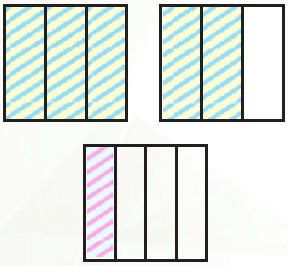
We will be using two models: counters for whole numbers and unit square as the whole for fractions. So six will be represented by six counters and zero by the absence of any. \(\frac{1}{4}\) will be represented by slicing a square into 4 equal vertical strips and shading 1 of them, and \(\frac{5}{3}\) by slicing two squares in 3 strips each and shading 5 strips (Figure 1). The sums will be the total number of counters (for whole numbers) or the total shaded area (for fractions). Also for any sum x + y, x is shown on the left and y on the right.
Commutative Property
The basic idea behind making sense of the commutative property is looking at a sum from two vantage points.
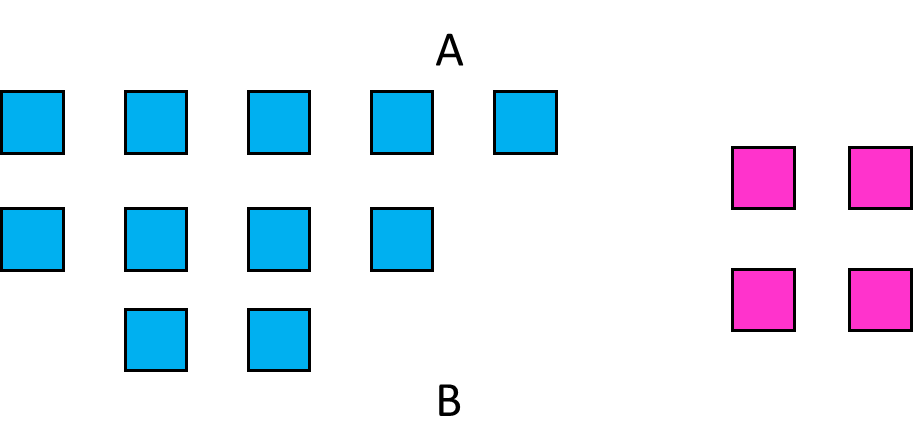
Figure 2. |
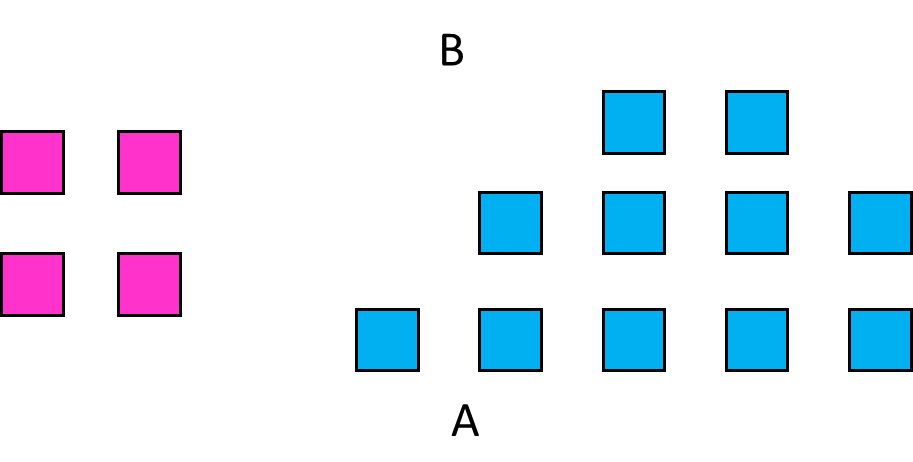
Figure 3. |
| So consider 11 + 4 as shown in Figure 2 (from point B) and observe how it looks from the point A. That is shown in Figure 3 and is nothing but a 180° rotated version of Figure 2. So from point B it is 11 + 4 and from point A it is 4 + 11. | |
With two groups of students situated at A and B recording their sums, it will make sense for them to conclude that 11 + 4 = 4 + 11, since view point does not change any of the concerned quantities. Note that this is true for any two whole numbers. It is easy to see that this holds even if one or both of the numbers are zero. For large numbers, say 100 or even 50, it may be cumbersome to arrange so many counters. So children should be encouraged to imagine the same for numbers as large as they can visualize.
When it comes to fractions, there are three possibilities:
- Proper + proper
- Improper + proper (and ∴ proper + improper)
- Improper + improper
We will show an example of 2 and the other possibilities can be visualized in a similar way. Let us consider the sum as shown in Figures 4 and 5.

Figure 4. |
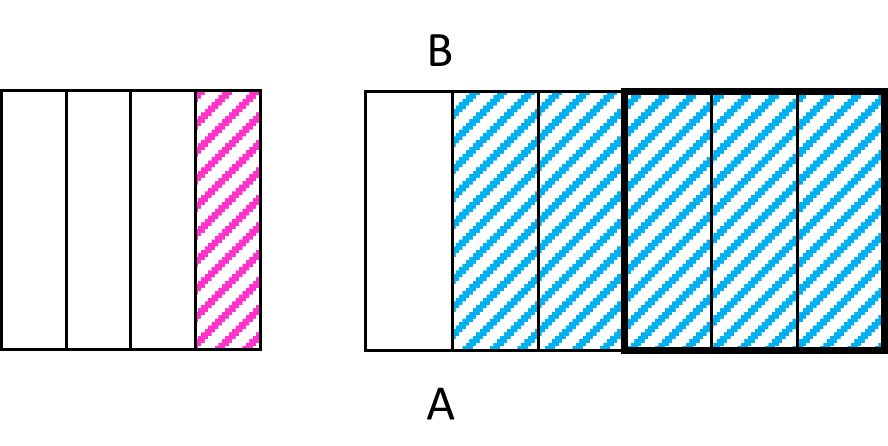
Figure 5. |
| Figure 4 is from B’s perspective and it shows \(\frac{5}{3}\) +\(\frac{1}{4}\) while Figure 5 shows the same sum from A’s view point and it is \(\frac{1}{4}\) +\(\frac{5}{3}\) . The whole (unit square) is highlighted within the improper fraction. Again, since only the perspective changes, students may observe that the sums remain unchanged, i.e., \(\frac{5}{3}\) +\(\frac{1}{4}\) =\(\frac{1}{4}\) + \(\frac{5}{3}\) . Note that this holds for any two fractions. In fact, since any whole number can be represented by as many unit squares, this can also be extended to any sum involving a whole number and a fraction. | |
Associative Property
For this one, the basic idea is that if we have to add x + y + z, then it doesn’t matter whether we combine first the x and y or y and z.

Figure 6. |
| For whole numbers, it may be best done as an activity. Pick any three whole numbers, say 7, 4 and 10 and represent them as piles of counters, i.e., the first pile with 7 counters, second pile with 4 counters, etc. Now the sum 7 + 4 + 10 will be all the three piles combined into one. If only two piles can be combined at each step, then step 1 can be combining the first and second pile, i.e., the addition 7 + 4 and step 2 can be combining the third pile with this, i.e., adding 10 to the sum 7 + 4 or (7 + 4) + 10. On the other hand, step 1 can also be combining the second and third pile or 4 + 10 with step 2 as combining the first pile with this, i.e., 7 + (4 + 10). Both lead to the combination of all three piles into one with no extra counter coming in or going out. So the two sums can be justified to be equal, i.e., (7 + 4) + 10 = 7 + (4 + 10). Observe that the three whole numbers were chosen arbitrarily. For large numbers like 100, 1000, etc., if physical piles of counters are cumbersome to deal with, the process can be imagined. So this can be generalized for any three whole numbers. |
For fractions, we can consider combining the shaded areas instead of piles of counters. There are eight possibilities:
- All 3 proper
- 2 proper and 1 improper
- Proper + proper + improper
- Proper + improper + proper
- Improper + proper + proper
- 1 proper and 2 improper
- Proper + improper + improper
- Improper + proper + improper
- Improper + improper + proper
- All 3 improper
We will show an example of 2c and leave the rest for the reader to explore.
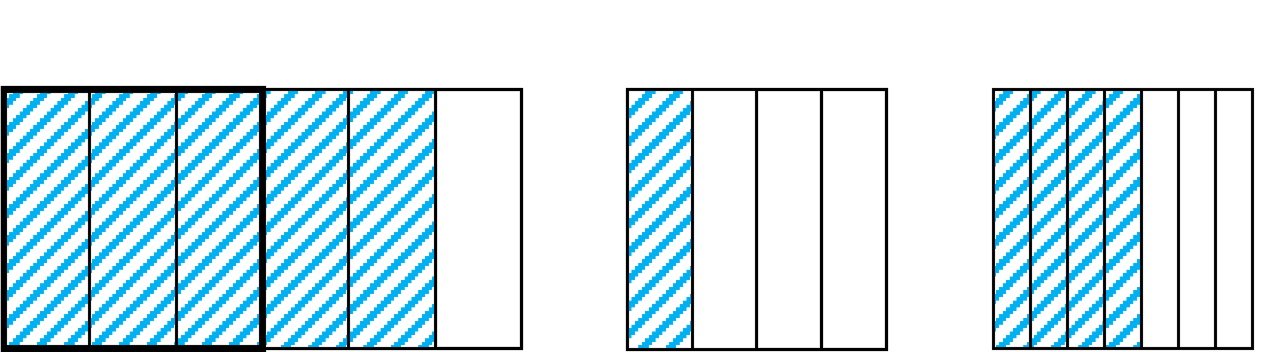
Figure 7. |
| Figure 7 represents the starting point of the example \(\frac{5}{3}\) +\(\frac{1}{4}\) + \(\frac{4}{7}\) . |
We show step by step how the areas can be combined to show \(\left(\frac{5}{3} + \frac{1}{4} \right) + \frac{4}{7}\) and \(\frac{5}{3} + \left(\frac{1}{4} + \frac{4}{7}\right)\) respectively and that the end result is the same for both. So, \(\left(\frac{5}{3} + \frac{1}{4} \right) + \frac{4}{7} = \frac{5}{3} + \left(\frac{1}{4} + \frac{4}{7}\right)\)
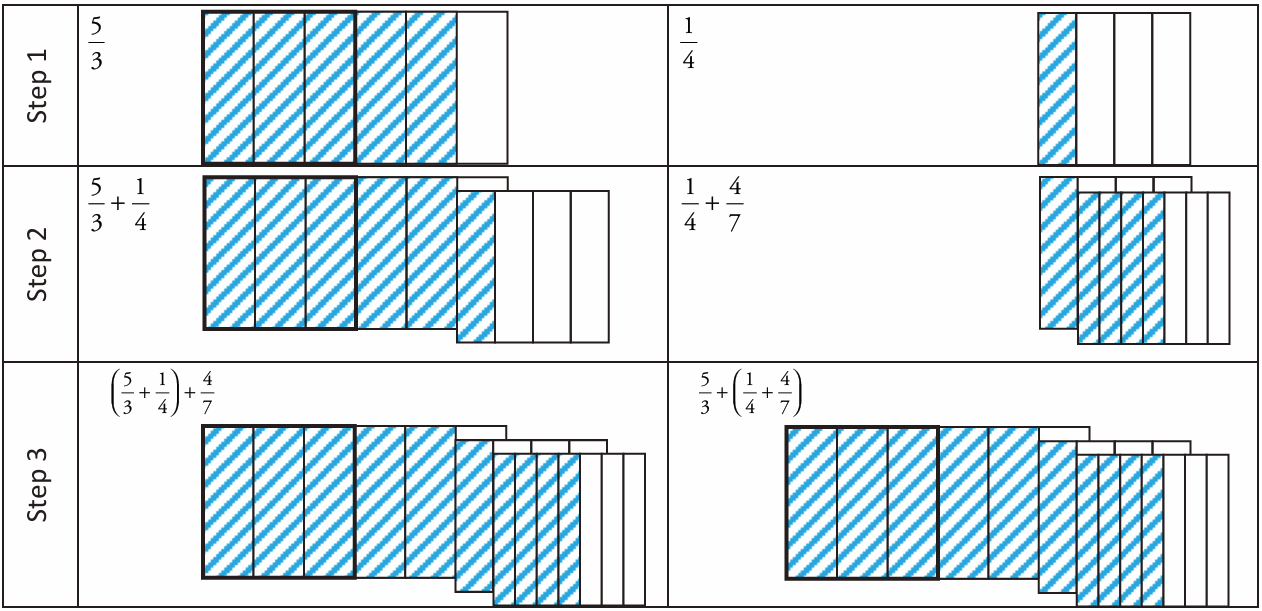
Note that this can be used for any three fractions and even a combination of fractions and whole numbers. Therefore this can be generalized for any combination of fractions and whole numbers. Also note that the total horizontal length of the shaded area is proportionate to the sum it represents. This can be used to show the sum on the number line. It is also a crucial step towards verifying these properties for rational and real numbers. These will be discussed in a later article.