
Manipulatives for Whole Numbers: What to use, When and Why?

At Right Angles has reviewed several manipulatives that can be used to teach place value and comparison of whole numbers as well as arithmetic operations on them. These manipulatives include (i) arrow cards, (ii) Ganitmala, (iii) counters, (iv) ten-frames, (v) flats-longs-units (FLU), (vi) Diene’s blocks and (vii) static beads (in the order of appearance in various issues of this magazine.) In addition, bundle-sticks are well-known and are widely used. There are a few other manipulatives which are used popularly – (a) abacus and (b) notes and coins. Several of these have entered the mathematics textbooks of Foundational (Class 1-2) and Preparatory stages (Class 3-5) of NCERT and a few states such as West Bengal and Sikkim.
Types of manipulatives for whole numbers
All of the manipulatives mentioned above, except for arrow cards, represent the quantity. The arrow card in contrast builds the numerical form using units, tens etc. The rest can be broadly classified in two groups:

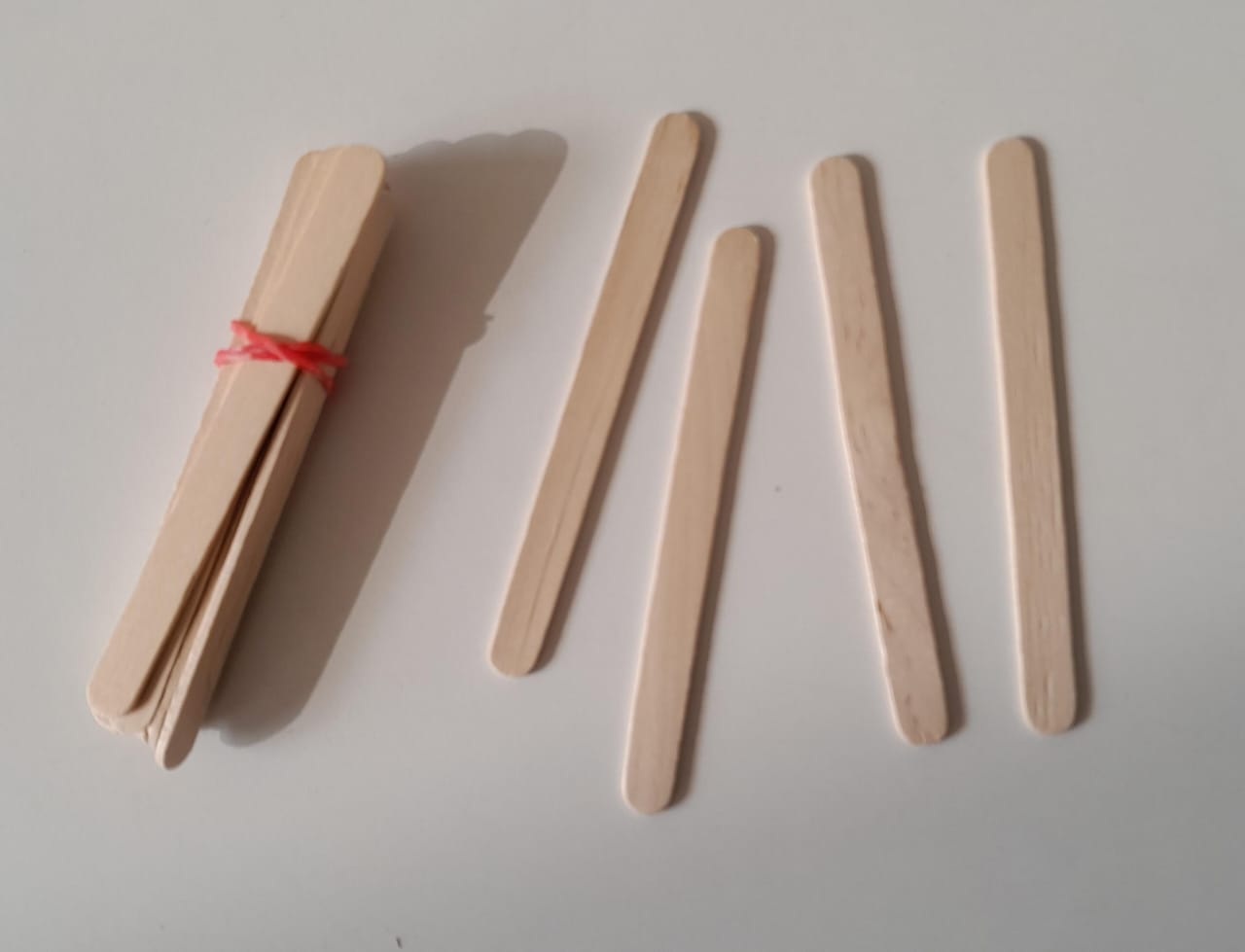
- Proportional: where the ten is clearly 10 times bigger than the one, or the hundred is 100 times the one or 10 times the ten – ganitmala, ten-frames, bundle-stick, FLU, Diene’s block, static beads fall in this category, so do counters.
- Non-proportional: where such proportionality is assumed but not observed – abacus and notes and coins fall in this category: a ₹100 note is not 10 times a ₹10 note by area/ volume or weight, the same holds for a ₹10 or a ₹1 coin.
Now within proportional manipulatives there are two subgroups:
- Groupable: where each unit can be part of a ten or hundred or can be on its own – bundle-sticks (and counters) fall in this category.
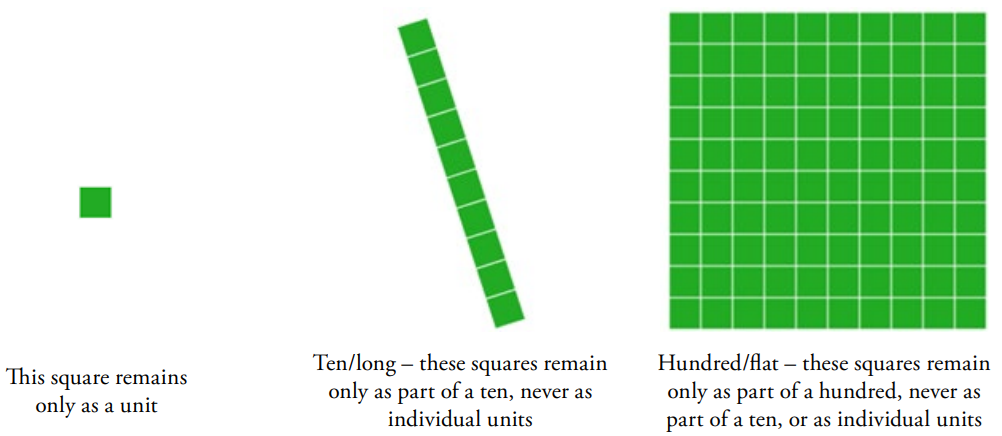
- Pre-grouped: Where each unit, ten, hundred remains an entity by itself. It cannot be broken down further or be part of the bigger entity.
Interestingly, Ganitmala and ten-frames have aspects of both:
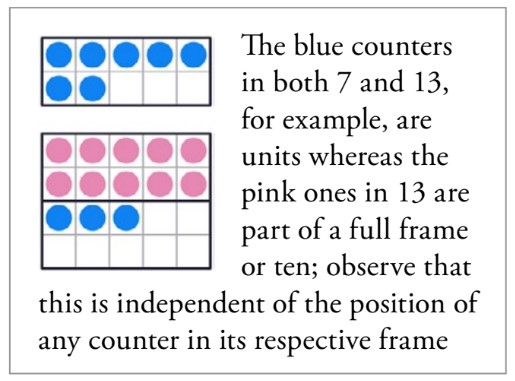
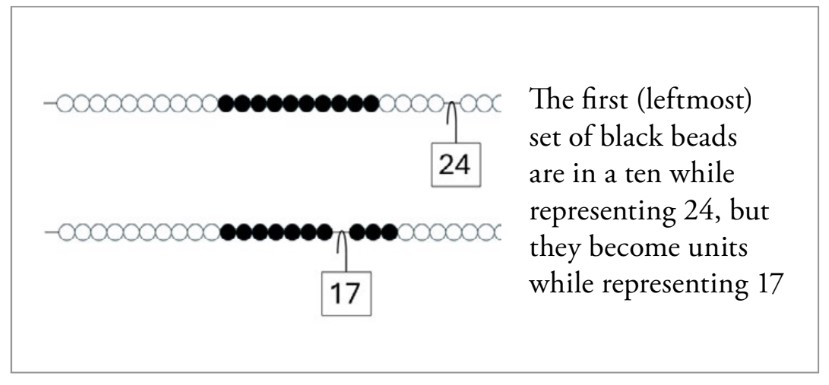
| Pre-grouped aspect | Groupable aspect | |
|---|---|---|
| Ganitmala | Beads are in groups of ten and colour-coded accordingly | Each bead can be part of a ten or be considered a unit depending on the number represented |
| Ten-frames | The 2 × 5 frame | Each counter placed can be part of a ten (if the frame is full) or be considered a unit |
This makes them super-useful!
Now, one must start with proportional material to build a strong foundation of understanding the base 10 structure, aka place-value. Also, since hands-on experience is very crucial for young learners, one should start with manipulatives having groupable aspects. The following table captures various aspects of these manipulatives:
| Mat(h)erials | Number range | Ease of making | Uses | Virtual version | Possible extension |
|---|---|---|---|---|---|
| Counters | 0-10 and more | Can be collected by the learners, these can be pebbles, buttons, seeds, etc. – good if they are identical, but not absolutely necessary | Counting, comparing, 4 operations, patterns and more | Yes | Coloured or signed ones for integers |
| Ten-frames | 0-20, 0-50 | Easy to make | Counting, automatization of single-digit addition facts, recognition of odd-even | Yes | Other frames for multiples and number patterns |
| Ganitmala | 0-100, 0-200 | Can be made by learners | Counting, order of digits, comparing, 4 operations and more | Not yet | 4-coloured version for integers |
| Bundle-sticks | 0-100, possibly 0-999 | Can be collected and bundled by learners | Counting, practice of grouping (in tens), comparing, addition-subtraction | Not yet | Long coloured ones for multiplication – becomes non-proportional |
| FLU | 0-999 | Can be made by the teachers possibly with the help of older students | Representation, comparing, 4 operations, crucial for area, squares and square roots | Yes | Decimal FLU, algebra tiles |
| Diene’s block | 0-1000 | Very difficult to make locally | Comparing, 4 operations, crucial for volume | Yes | Decimal version |
| Static beads | 0-1000 | Difficult to make locally | Representation, Comparing, 4 operations | ||
| Abacus | Beyond 3-digit numbers | Difficult to make locally | Representation, addition-subtraction | Not yet | Decimal version |
| Notes and coins | 0-999 | Can be made locally | Representation, addition-subtraction, word problems |
So, counters and bundle-sticks can be collected directly by the learners, while Ganitmala can be easily made by them. FLUs can also be made locally at any school but would require active supervision of a teacher and middle/high school students. Ten-frames and notes and coins can be prepared locally also. Static beads can be made locally – but it is both material intensive (about 2000 spherical beads) and labour intensive. Similarly, abacus can also be made locally with the help of a carpenter. But Diene’s block maybe difficult to make unless one has access to a skilled carpenter*.
(*Diene’s block: The unit should be a small cube, say 1cm × 1cm × 1cm, the rod (or ten) should be 10 times a unit, i.e., say 10cm × 1cm × 1cm, the plate (or hundred) should be 10 times a rod, i.e., say 10cm × 10cm × 1cm and finally the big cube, the thousand, which should be 10 times a plate, i.e., say 10cm × 10cm × 10cm. If the unit is a bigger cube, then the rest should be bigger proportionately.)
Also, note that, learners must have access to the mat(h)erials at the initial stage of learning. So, having just one set in the class may not suffice. Students do learn by observing. But to make it deep enough, they must engage with the mat(h)erials themselves. So, ideally there should be minimum 6-8 sets of materials in a class of 30 allowing 4-5 learners per set of mat(h)erials.
Therefore, it is difficult to have adequate Diene’s block and Static beads. The same maybe true for Abacus.
Stage-wise
Counters, bundle-sticks and Ganitmala are very important for Foundational stage to get started on counting, bundling in tens and playing with numbers. As a groupable material, bundle-sticks provide the much-needed concrete experience of bundling in tens, and then forming a bigger bundle whenever ten of a kind is there. [So, 10 tens make a bigger bundle, hundred.] Ganitmala shows that tens are on the left and ones on the right, and thus associating (in a 2-digit number) the left digit as ten’s and the right one for units/ones. A 200-bead Ganitmala in 4 colours (2 contrasting colours showing 0-100 and 2 more such colours showing 100-200) takes it forward to show that the hundred’s digit should be the leftmost. T hese malas are also manipulative versions of the number line with many related virtues (Figure 5). Ten frames may not be as crucial as these three but triggers some important mental images.

At the Preparatory stage, as we move beyond 2-digit numbers, FLUs become more useful than bundle sticks in terms of ease of use as pre-grouped material. Also, the arrays with FLUs in multiplication and division are pre-requisites for several concepts later on, including (but not limited to) perimeter and area.
As we move to 4-digit numbers, it becomes difficult to work with proportional mat(h)erials. A teacher can easily show a thousand made by joining 10 hundreds, to give a sense of how big 1000 is. But it is practically/logistically impossible to use it to compare any two 4-digit numbers or for operations etc. in a regular sized class. This is where non-proportional mat(h)erials can help. Unfortunately, ₹1000 note is no longer there. So, notes and coins can no longer help in this. Abacus can help, especially with respect to number-structure (place-value) and addition-subtraction.
One must also remember that, by the time a learner reaches 4-digit numbers, she should have developed adequate understanding of the base-10 structure (aka place-value) and should be able to deal with 4-digit numbers without manipulatives.
In short
Ganitmala = 1D base 10, FLU = 2D base 10, Diene’s blocks = 3D base 10
- Counters are crucial since one learns to count with them, are super easy to obtain, even make.
- Bundle-sticks are also crucial since they provide the experience of bundling in tens and are easy to collect/make.
- Ganitmala is very good since it connects to number line and provides the association for the order of the digits, and is easy to make.
- FLU is excellent as the 2D base-10 blocks – 2D makes it more useful and easier to make locally in enough quantities.
Therefore, the above 4 mat(h)erials are very highly recommended and in adequate quantity, i.e., one set for every 4 students.
- Ten-frames are easy to make and have the virtues mentioned earlier.
- Notes and coins can help by contextualizing use of numbers in real-life, especially w.r.t. buying (and selling) and can be made by students.
The above 2 matherials fall in the category of good to have.
- Static beads need a lot of effort and material (beads) to make. But they provide conceptual clarity.
- Diene’s block demands specific craft skills and precision in terms of making.
These two matherials may be used as demo sets. Abacus – non-proportional, therefore doesn’t help with conceptual clarity, might be useful for some learners who are struggling with some concepts in Class 5 or higher grades; and is not easy to make. So, not recommended…
Arrow cards help with unpacking the base-10 structure and are therefore, super-useful, but should be combined with some proportional mat(h)erials. They can be made locally and more easily than FLU. So, they should be used in adequate quantities.
Ganitmala, ten-frames, bundle-sticks, FLU and of course counters have entered NCERT math textbooks along with arrow cards. A few states such as Sikkim had introduced these in their textbooks previously. Abacus had entered West Bengal state textbooks. We encourage the reader to explore them – relevant links are included below.
- Arrow Cards: https://bit.ly/42ZuwRX
- Ganitmala: https://bit.ly/4hRl9rs
- Counters: https://bit.ly/3EzT7m2
- Ten-Frames: https://bit.ly/4hXAtCU
- Flats-Long-Units (FLU): https://bit.ly/430USCK
- Dienes Blocks and Static Beads: https://bit.ly/3Qjnb8a
- NCERT textbooks: https://bit.ly/4jSCn9H
- Sikkim textbooks: https://bit.ly/4aZQkPl
- West Bengal textbooks: https://bit.ly/410ikNU