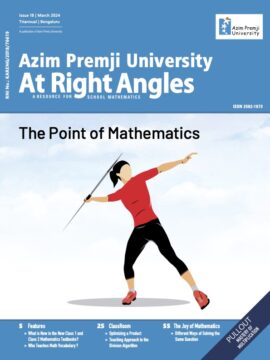



At Right Angles is part of the Azim Premji Foundation’s endeavour to provide goodquality learning resources to practising teachers and teacher educators. Our aim is to promote dialogue among schoolteachers, practitioners and educationists on current discourses and perspectives on education, pedagogy, and on-the-ground experiences. The intent is to help build teacher capacity and facilitate more experiential and meaningful teaching-learning processes. In order to celebrate teaching with purpose and passion, At Right Angles showcases experiential and practical understanding grounded in the reality of India and the societies we live in.
As the November 2023 editorial described in some detail, the March 2024 issue of At Right Angles is significantly different from previous issues. So, it is only fitting at this point, to thank Shailesh Shirali for his active lead and guidance as Chief Editor for all our past issues. Our thanks also to the editorial committee members, K Subramaniam, Prithwijit De, Shashidhar Jagadeeshan, A Ramachandran and Jonaki Ghosh for their significant contributions into making the magazine what it is today. We will continue to look to them for their suggestions and input whenever possible.
Our primary audience is the primary and upper primary school teachers in the public education system. Hence the content of this and subsequent issues will be aimed at being of direct relevance to them and for Resource Persons on-the-ground, who work with teachers to help them teach better so that their students can learn better. With this in mind, we have taken some cues from the Mathematics section in the NCF 2023 also.
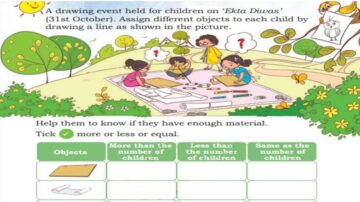
So, our Features section of this issue begins with Sandeep Diwakar describing What’s New in the New Mathematics Textbooks for Class 1 and Class 2. Hriday Kant Dewan discusses how to address pedagogical, material and process challenges in the local context of teacher & school environment in his article on Contextual Problems. Rima Kaur’s article Who Teaches Math Vocabulary probes the invisible separating lines between disciplines.
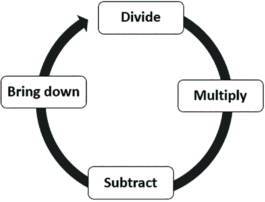
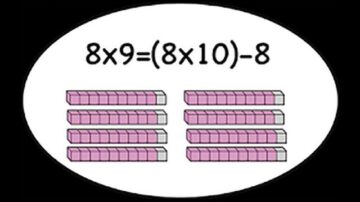
The ClassRoom section focuses on the concepts of multiplication and division. Arddhendu Dash shares his thoughts on the Teaching Approach to the Division Algorithm and Jitendra Verma describes and explains three ways to check the divisibility of a number by 7. Swati Sircar describes a game to optimize the product of two numbers and also explains the advantages of teaching division by multi-digit divisors. In all these articles, the process skills of visualisation, estimation, reasoning, and logic are emphasized.
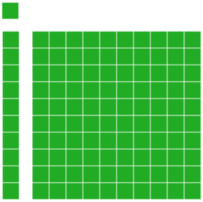
The Review section continues where ClassRoom stops with a review of FLU- Flats, Longs and Units or the basic Base 10 number blocks.
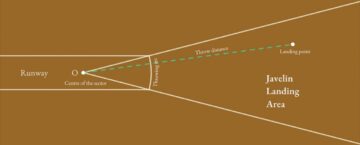
In our new section The Joy of Mathematics, we celebrate the subject with two articles by Mohan R – Javelin Throw and Guesstimation – the Fermi Estimation Problems. How does mathematics come into play in unseen ways? And in how many ways can a problem be solved – read the story about the hens and the rabbits to find out!
We close as usual with the PullOut– how do we check for Mastery of Multiplication? Padmapriya Shirali describes several ways- all of them providing drill and practice while developing higher-order thinking skills, none of them tedious or stressful.
As we settle into this new avatar, we hope to bring you more articles on Computational Thinking, some TearOuts with worksheets for your classes and of course, a complete Problem Corner. For now, enjoy the problems in the Fillers and don’t hesitate to send in your solutions to AtRightAngles.editor@apu.edu.in
Sneha Titus
Chief Editor, At Right Angles