
Division with Decimals



Fractions and decimals are two interconnected crucial concepts with which children face enormous difficulty in middle school (Class 6-8). First, these concepts are difficult to visualise, and second, arithmetic operations on them are usually taught with a lot of abstraction with emphasis given to the rule to be used. Here, we will discuss division with decimal numbers – understanding the operation conceptually– and observe with the help of manipulatives how the rule emerges.
Before we move to division with decimals, we need to understand the meaning of the division operation. It has two meanings, one is equal sharing, i.e., 12 ÷ 3 means 12 things distributed equally among 3 groups (i.e., how many does each of the 3 groups get), and another is equal grouping (measure), i.e., 12 things distributed in a way such that each gets 3 (i.e., how many groups get 3 things each).
Both 3D and 2D manipulatives made with cardboard/paper may be used for modelling decimals. Whichever we use, there is a need for consistency throughout the representations and the problem-solving.
| 3D model of decimals | The whole, the big cube or 1.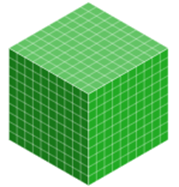 | The whole can be split into 10 equal plates, each being \(\frac{1}{10}\) or 0.1 of the whole. | Each plate can be further split into 10 equals rods, each being \(\frac{1}{100}\) or 0.01 of the whole.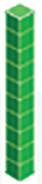 | Each plate can be further split into 10 equals small cubes, each being \(\frac{1}{1000}\) or 0.001 of the whole. |
| 2D model of decimals | The whole, the flat or 1. | The whole can be split into 10 equal longs, each being \(\frac{1}{10}\) or 0.1 of the whole. | Each long can be further split into 10 equal small squares, each being \(\frac{1}{100}\) or 0.01 of the whole. |
Representing decimals using these models
2.034 using the 3D model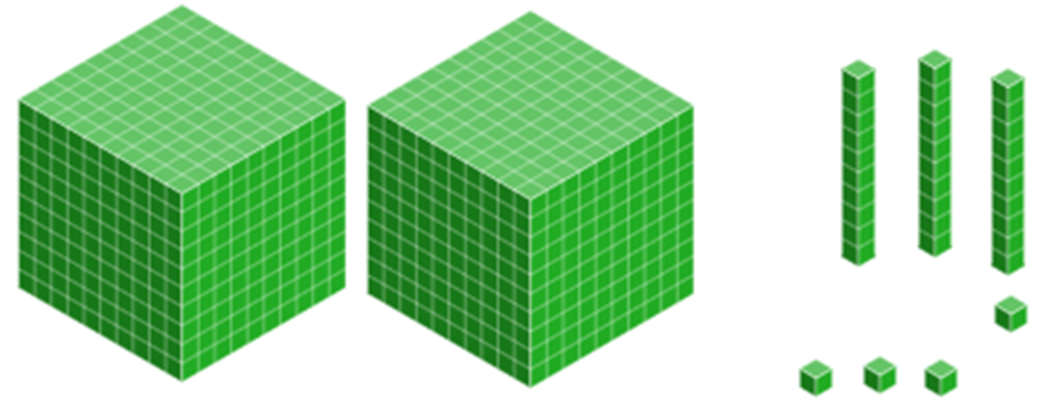 | 3.54 using 2D model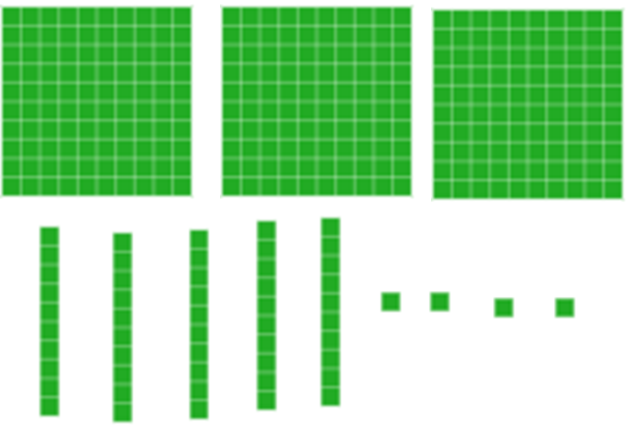 |
1.32 using 3D model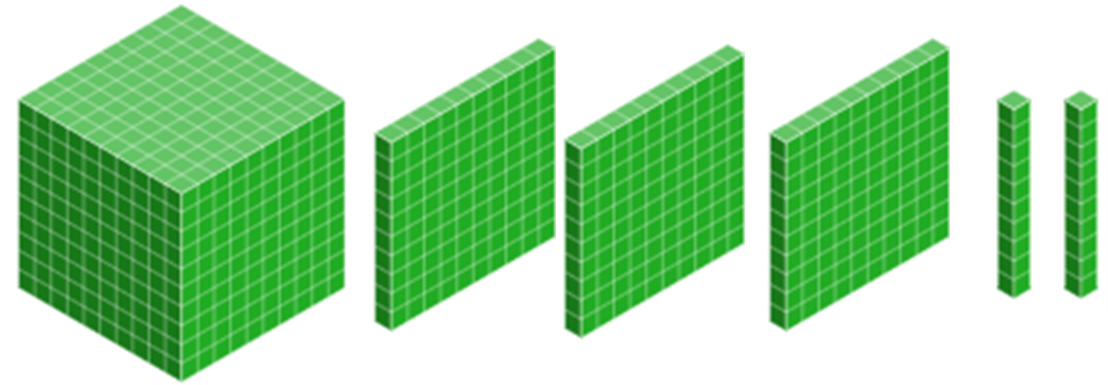 | 1.32 using 2D model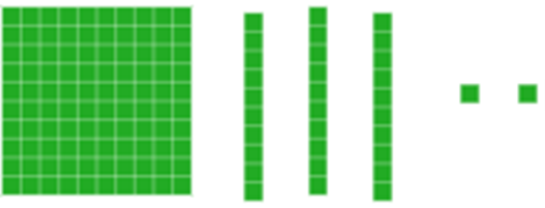 |
We will try to perform division with decimals using either the 3D or the 2D model, as needed. One can use Mathigon Polypad for virtual models while the physical ones can be made with cardboard/paper. 2D models can be extended to 4 places after the decimal point, i.e., 0.0001 using a centimeter graph paper with 10cm × 10cm square as a whole.
Prerequisites for division with decimals
- Understanding of decimals, especially expressing decimals as fractions
For example, \(0.25 = \frac{25}{100} = \frac{1}{4} \)
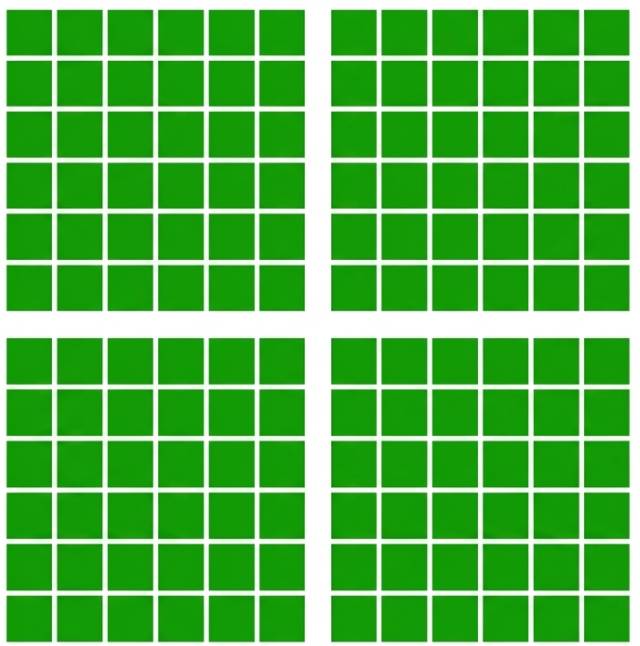
If one flat is a whole or 1 which consists of 100 small squares, each 0.01, (Figure 1).
0.25 is 25 such small squares, i.e., \(25 \times 0.01. 4\) such 0.25 make the whole as shown in Figure 2. So, 0.25 is \(\frac{1}{4}\) of a whole or flat.

- Multiplication with decimals, specifically products of decimals and powers of ten
For example, \(0.34\ \times\ 0.002 = \frac{34}{100}\ \times\ \frac{2}{1000} = \frac{34\ \times\ 2}{100 \times1000} = \frac{68}{100000} = 0.00068\) - Division with fractions, specifically, division by a fraction being the same as multiplication by the reciprocal of the fraction
For example, \(\frac{3}{4}\) ÷ \(\frac{2}{5} = \frac{3}{4} \times \frac{5}{2} \) (multiplied by the reciprocal of \(\frac{2}{5} \)) = \(\frac{15}{8} = 1\frac{7}{8} \)
Let us explore four possible division situations with decimals as given below.
Types/Situations
- Natural number ÷ Natural number = Decimal
- Decimal ÷ Natural number = Decimal
- Natural number ÷ Decimal
- = Natural number
- = Decimal
- Decimal ÷ Decimal
- = Natural number
- = Decimal
So, both dividends and divisors can be natural numbers or decimals. As we proceed further, we will realize that the nature of the dividend is less important than that of the divisor. (The same thing is observed in division with fractions.)
Natural Number ÷ Natural Number = Decimal
In this case both the dividend and divisor are whole numbers.
If the divisor is a natural number, then it can be considered as the number of groups among whom the dividend is to be divided equally, i.e., using the equal sharing meaning of division. For example, in 12 ÷ 40, 12 is divided equally among 40 groups. Let us see how this can be done through the 3D model.
Now 12 cubes cannot be directly divided by 40. So, we convert each cube to 10 plates (Figure 3).


∴ 12 ÷ 40 = 0.3 (Figure 4)
If we do the same division using the 2D model, 12 flats cannot be distributed among 40 groups. So, we convert each flat to 10 longs (Figure 5).
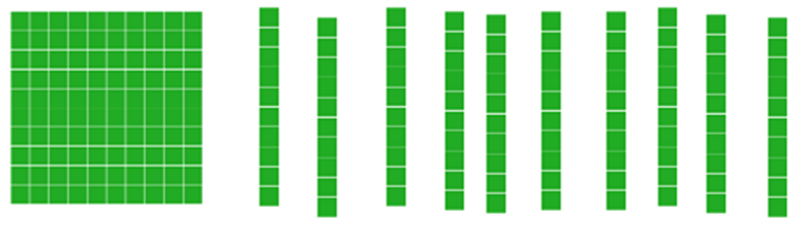

We get the same quotient using either model.
Decimal ÷ Natural Number = Decimal
Let us take the example 0.24 ÷ 5. Again, since the divisor is a natural number, we can use the equal sharing meaning of division. Therefore, in this case, 0.24 has to be divided equally among 5 groups.
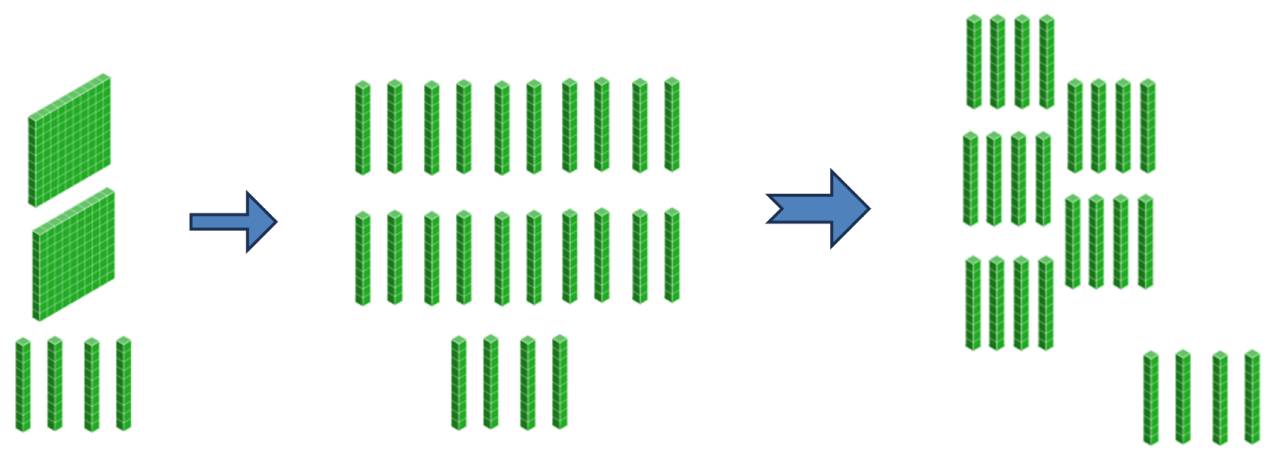
In the first round, 2 plates are converted into 20 rods, equally distributed among 5 groups, each group gets 4 rods (0.04), and 4 rods are left over since they can’t be distributed to 5 groups (Figure 7).
In the second round, 4 rods are converted into 40 small cubes, and equally distributed among 5 groups, each group gets 8 small cubes (0.008) (Figure 8).

So, combining both rounds of distribution, each group gets 0.04 + 0.008 = 0.048, i.e., 0.24 ÷ 5 = 0.048 (Figure 9).
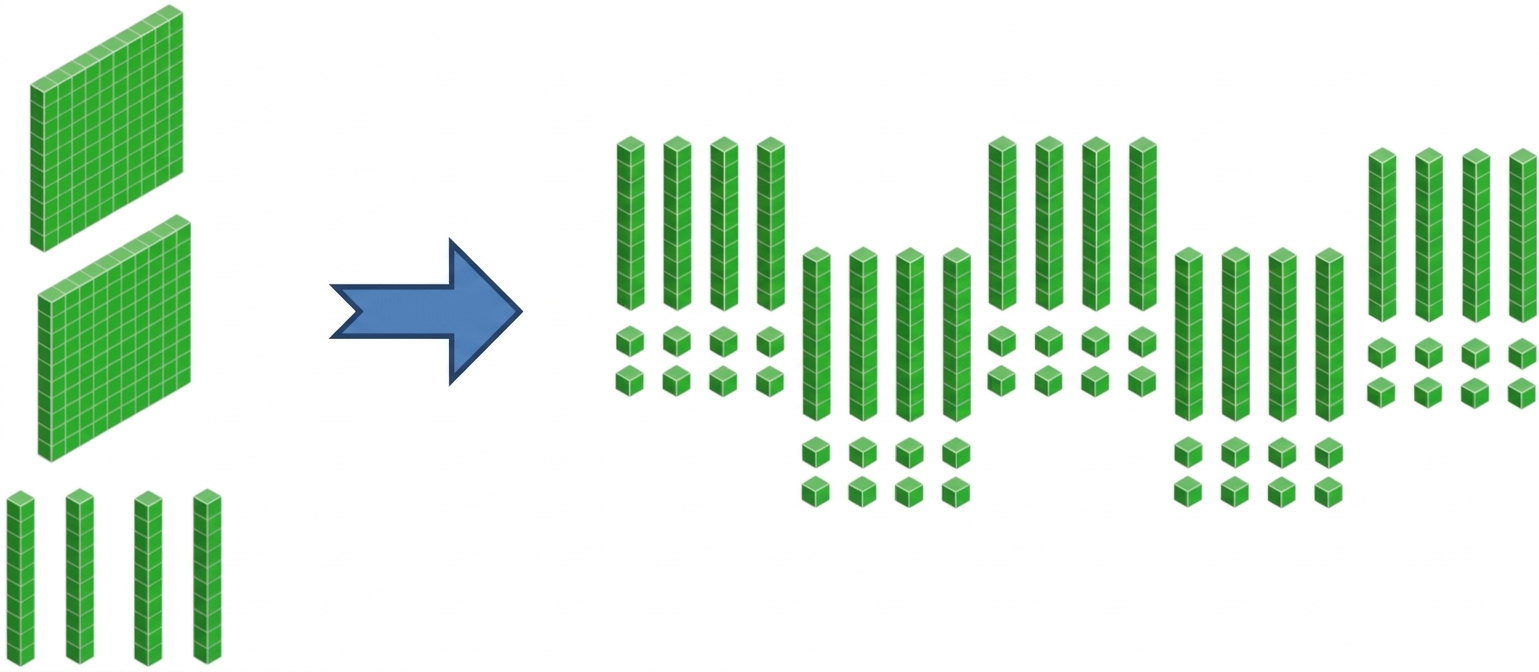
In an alternative way, we can convert 0.24, i.e., 2 plates and 4 rods into 240 small cubes (0.001) and distribute them among 5 groups, so that each group gets 48 small cubes, i.e., 0.048. So, 0.24 ÷ 5 = 0.048 in either way.
Natural Number ÷ Decimal = Whole number
However, if the divisor is not a natural number, then it can’t represent a quantity like the number of groups. So, if the divisor is a decimal number, we can’t use the equal sharing meaning. Therefore, it makes more sense to use the equal grouping (measure) meaning, i.e., the divisor amount is given to each group and the number of groups is the quotient.
So, for 12 ÷ 0.3, each group gets 0.3 or 3 plates (0.1). 12 cubes can be converted to 120 plates. Since each group gets 3 plates, 120 plates can be distributed among 120 ÷ 3 = 40 groups (Figure 10). This works fine if the quotient is a whole number.

Natural Number ÷ Decimal = Decimal
But when the quotient is not a whole number, then this meaning of division does not suffice. For example, it does not help with 11 ÷ 0.4.
11 cubes can be converted into 110 plates. If we divide 110 plates among certain groups where each group gets 4 plates, i.e., 110 ÷ 4 (Figure 11).

Then 108 (out of 110) plates can be equally distributed among 27 groups. But 2 plates, i.e., 0.2, is left and cannot be distributed further since it is too little (0.2 < 0.4). So, equal grouping fails to make sense in this case using manipulatives.
Decimal ÷ Decimal = Natural Number
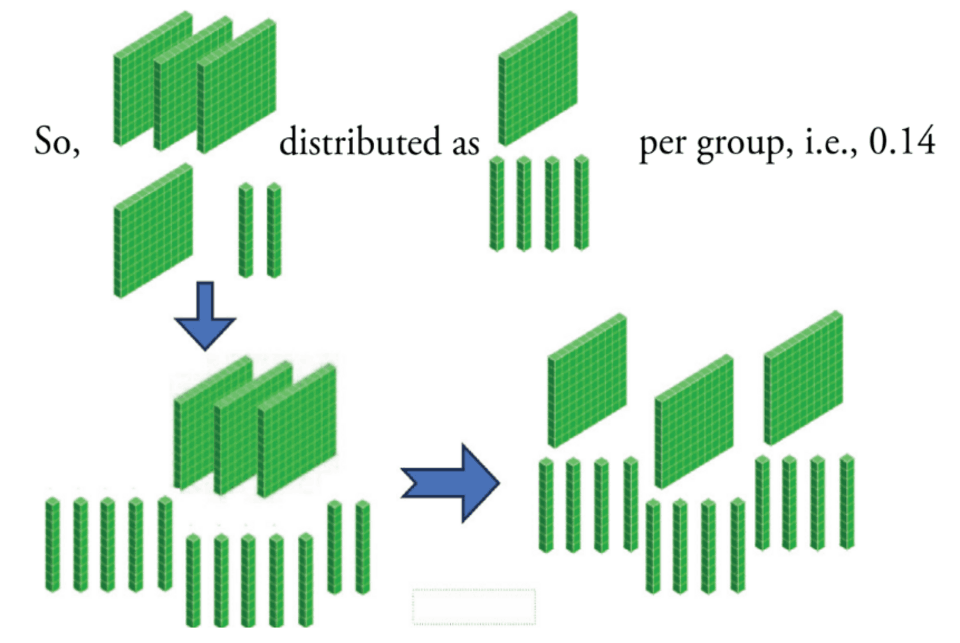
Let us consider 0.42 ÷ 0.14. So, 0.42 (4 plates and 2 rods) is divided into certain groups such that each group gets 0.14 (1 plate and 4 rods). Now, 4 plates and 2 rods can be converted into 3 plates and 12 rods. So, these can be distributed among 3 groups, each getting 1 plate and 4 rods, i.e., 0.14 (Figure 12).
∴ 0.42 ÷ 0.14 = 3
So, in this case, equal grouping makes sense since the quotient is a natural number.
Decimal ÷ Decimal = Decimal Number
Let us now consider 0.42 ÷ 1.4. If we try to solve this by using manipulatives, let us see what issues we may face. For this case let us use 2D modeling instead of 3D.
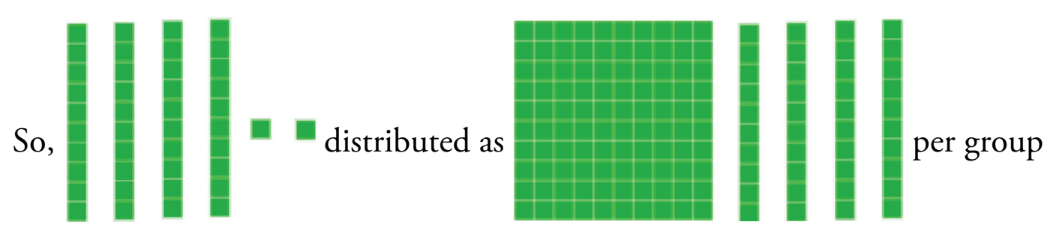
Clearly, the amount to be divided, i.e., the dividend 0.42, is less than how much each group must get, i.e., the divisor 1.4. Therefore, it is impossible to use the equal grouping meaning to make sense of this division using manipulatives.
Let us consider 2.03 ÷ 0.5, In this case, dividend 2.03 is larger than the divisor 0.5. But still, the division remains incomplete (Figure 14) because 0.03 cannot be distributed since it is too small (0.03 < 1.4). And so equal grouping fails again.

Note that this is not a limitation of manipulatives. For example, 0.000042 ÷ 0.000014 cannot be demonstrated with manipulatives but can be explained with equal grouping if we can imagine tiny pieces representing 0.00001 and 0.000001. We got this clarity only when we explored.
So, whenever the divisor is a natural number, equal sharing can be used to make sense of the division. Similarly, whenever the quotient is a natural number, equal grouping helps in understanding the corresponding division. But if neither the divisor nor the quotient is a natural number, then how can we make sense of such a division? In particular, that happens in the following two cases as illustrated above:
- natural number ÷ decimal = decimal
- decimal ÷ decimal = decimal
One possibility is to use division of fractions, since decimals can be converted to fractions and the chocolate plate model* adequately illustrates all possible situations for division with fractions (and natural numbers).
*Chocolate Plate model: For \( p\) ÷ \(q\), let \(p\) be the amount of chocolate to be distributed among \(q\) plate(s). The quotient is the amount of chocolate on one plate. Both \(p\) and \(q\) can be any natural number or any fraction, i.e., unit, proper or even improper.
Let us consider the cases where both meanings of division failed, i.e.,
- \(11\) ÷ \(0.4\),
- \(0.42\) ÷ \(1.4\) and
- \(2.03\) ÷ \(0.5\).
- \(11\) ÷ \(0.4 = 11\) ÷ \(\frac{4}{10} = 11 \times \frac{10}{4} = \frac{11 \times 10}{4} = 110\) ÷ \(4\)
Note that we had arrived at the same thing with equal grouping, but there the quotient represented the number of groups and so, it had to be a whole number. But we have no such restriction here since we are not using that meaning. Now we are free to use the equal sharing meaning for \(110\) ÷ \(4\).
Also note that \(110\) ÷ \(4 = (11 \times 10)\) ÷ \((0.4 \times 10)\), i.e., both the dividend and divisor are multiplied by 10 to shift the decimal points and make the divisor a natural number.
- \(0.42\) ÷ \(1.4 = \frac{42}{100}\) ÷ \(\frac{14}{10} = \frac{42}{100} \times \frac{10}{14} = \frac{42}{140} = 4.2\) ÷ \(14\)
Note that if we convert just the divisor to a fraction, then also we end up with the same thing since
\(0.42\) ÷\( \frac{14}{10} = 0.42 \times \frac{10}{14} = \frac{0.42 \times 10}{140} = 4.2\) ÷\(14 = (0.42 \times 10)\) ÷ \((1.4 \times 10)\)
In both cases, we have again effectively multiplied both dividend and divisor by the same power of 10. This was done to shift the corresponding decimal points. With such shifts, the divisor becomes a natural number.
- \(2.03\) ÷ \(0.5 = 2.03\) ÷\( \frac{5}{10} = 2.03 \times \frac{10}{5} = \frac{2.03 \times 10}{5} = 20.3\) ÷ \(5\) \(= (2.03 \times 10)\)÷\((0.5 \times 10),\)i.e., both the dividend and divisor are again multiplied by the same number, shifting the decimal points, and making the divisor a natural number.
This is exactly what is done as the usual procedure, but without any explanation.
So, for a general process that works for all types of division with decimal divisors, it makes more sense (i) to convert the divisor, to a fraction, whose denominator is a power of 10, and (ii) then use division by a fraction. As we convert this ‘division by a fraction’ to a ‘multiplication by the reciprocal of the fraction’, the dividend gets multiplied by a power of 10. This power of 10 is the denominator of the decimal divisor. And this product is the new dividend. The new divisor is the numerator of the original decimal divisor, a natural number.
Decimal divisor \((DD)\) = natural\ number/power\ of\ 10 = \(N/10^m\)
Original dividend \((OD) \div DD = OD \div N/10^m\) = \((OD × 10^m) \div N\)
For example: Let us consider \(3.006 \div 0.15\), here \(DD = 0.15 = \text{15/100}\), i.e. \(N = 15\) and \(m = 2\), while \(OD = 3.006.\) So, \(3.06 \div 0.15 = 3.006 \div\) \(15/10^2 = (3.006 × 10²) \div 15 = 300.6 \div 15.\)
Note that it is enough to make the divisor a natural number, and then we can use equal sharing. It does not matter if the dividend remains a decimal or not.
Throughout this discussion we have deliberately avoided recurring decimals since they do not appear till the secondary stage according to the current syllabus. Therefore, we felt that recurring decimals are not relevant enough. However, the process remains the same even when the quotient is a recurring decimal.