
Measuring Javelin Throws with a Broken Tape


Problem
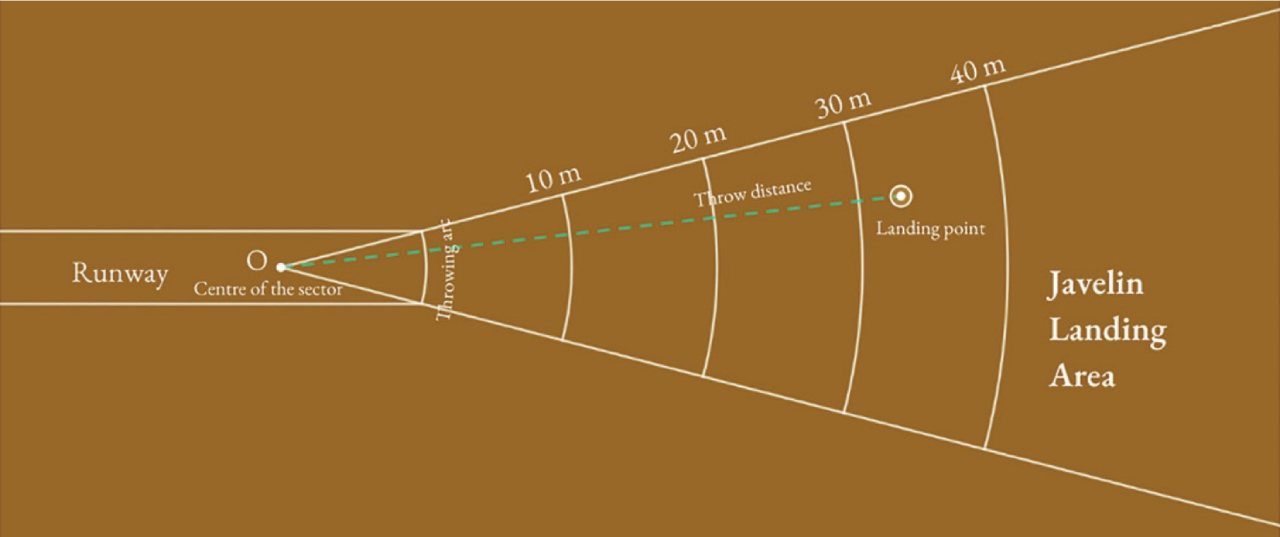
On the day of the school sports meet, the physical education teacher notices that the broken measuring tape hasn’t been replaced. The javelin throw event is about to begin in 30 minutes, and there’s no time to get a new tape. They need to measure the distance from the centre of the sector subtending the throwing arc to where the javelin lands (Figure 1). The issue is that the damaged tape can only measure up to 12 metres, while javelin throws typically cover distances of 10 to 60 metres

She changes the field layout by drawing circular arcs around point O using ropes, with a 10-metre difference in radii (Figure 2). This way, she thinks that she only has to measure from where the javelin lands to the nearest arc.
The event takes place with this adjusted layout. However, by the end of the day, the runner-up questions the fairness of the teacher’s method. He wonders how the point on the nearest arc is selected and questions the validity of the approach.
Question: If the method used by the physical education teacher is mathematically sound, can you, on her behalf, describe the method of choosing the point on the arc and justify that the method is fair and sound?
A Solution
Let \(A\) be the landing point, let \(\alpha\) be the circular arc closest to \(A\), and let \(O\) be the center of \(\alpha\). To ensure a valid measurement, the tape must align with the line connecting \(A\) and \(O\). Let \(C\) be the point of intersection of the line \(AO\) and the circular arc \(\alpha\). The physical education teacher, acting as the referee, needs to find the right spot, point \(C\), on \(\alpha\). If the referee doesn’t do this correctly, the measurement isn’t fair, and the runner-up’s point is valid. How can the referee make sure to find point \(C\) accurately?
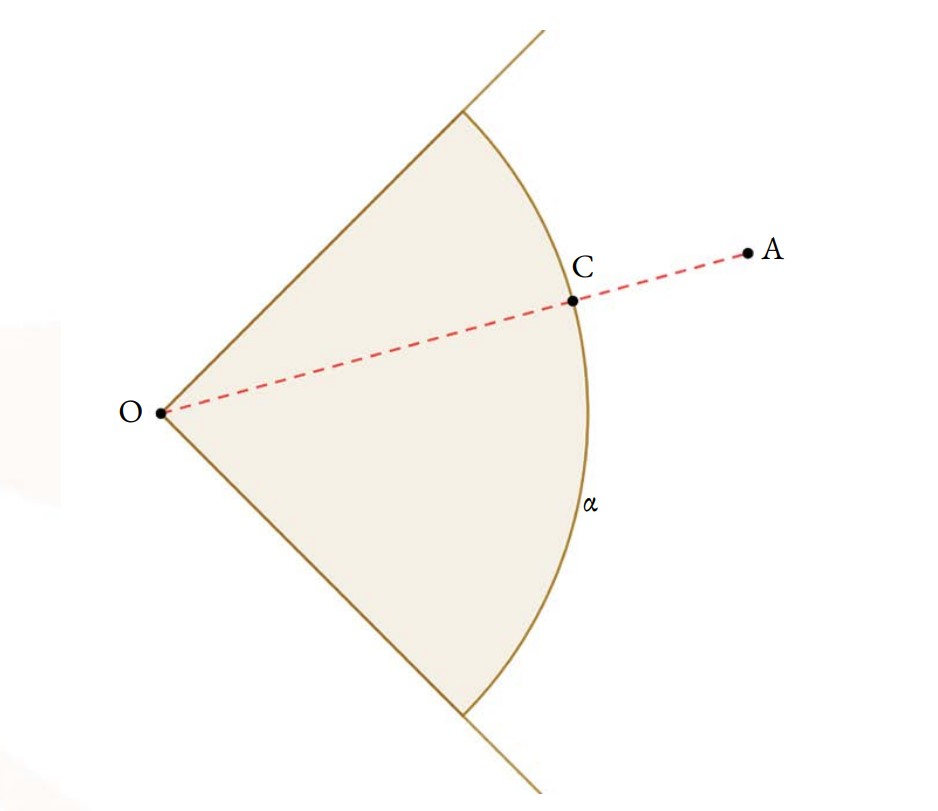
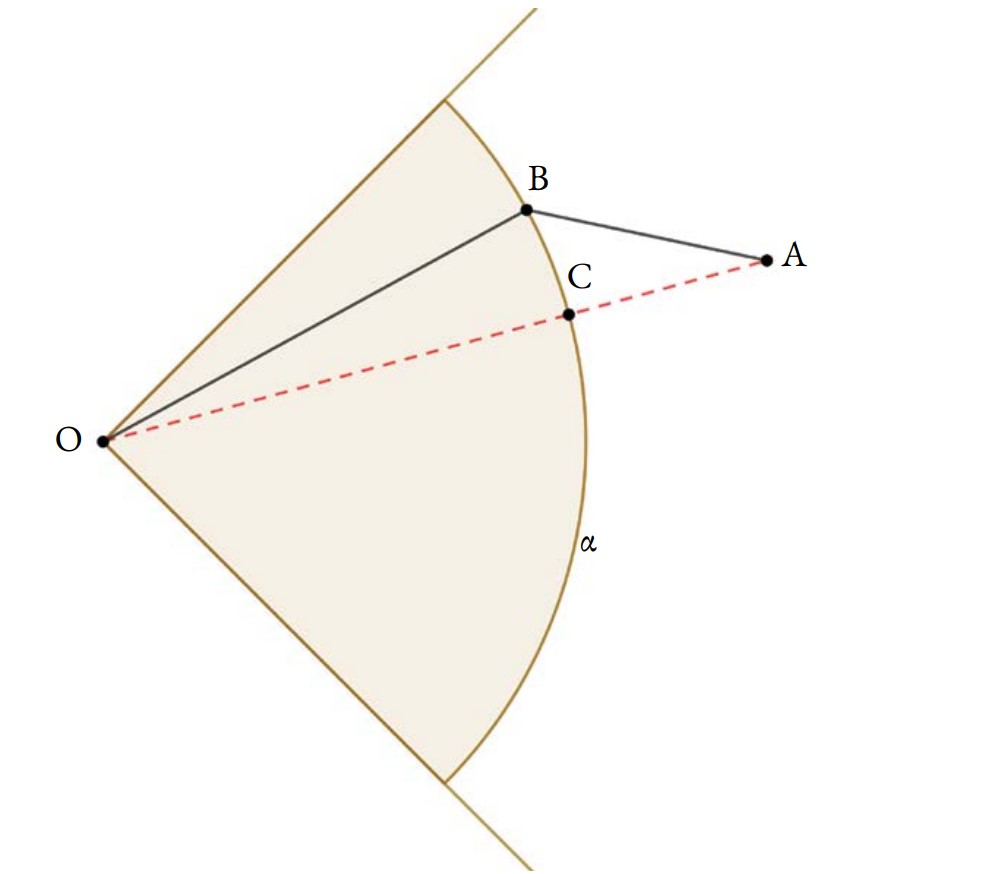
If we choose any other point \(B\) on \(\alpha\), by triangle inequality, we would have \(OB + BA > OC + CA = OA\).
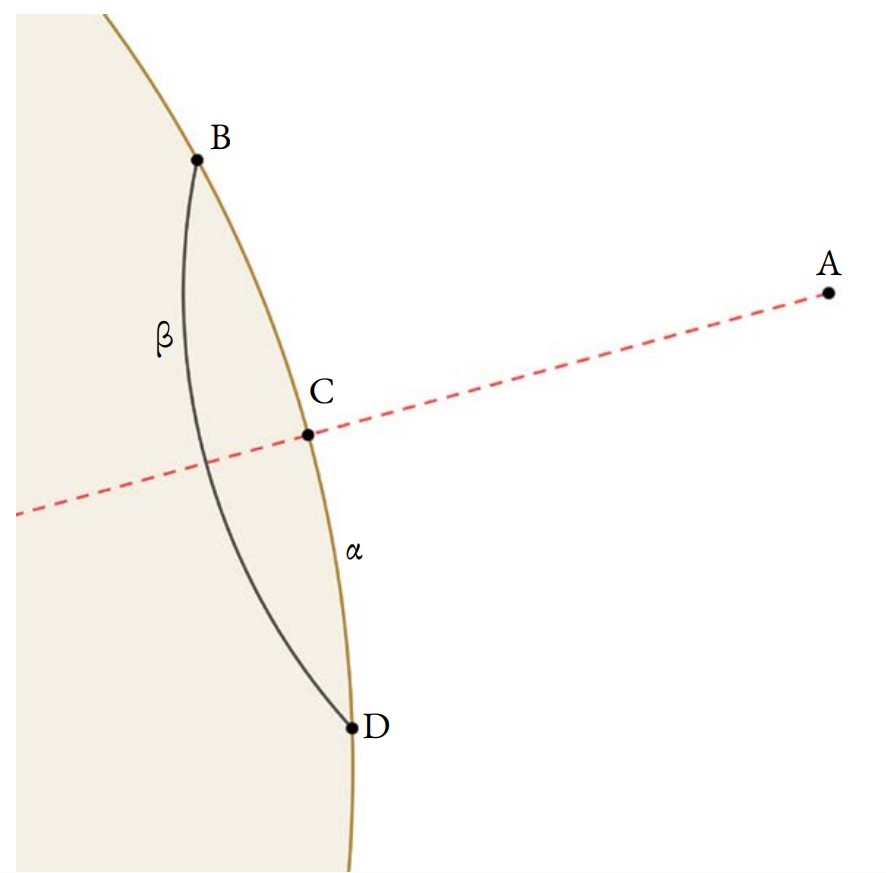
So, if \(B\) is a point on \(\alpha\) different from \(C\), we can draw another circular are \(\beta\) using \(A\) as the center and \(AB\) as the radius. Now \(\beta\) cuts \(\alpha\) at the original point \(B\) and at a different point \(D\) (Will this happen if \(B\) and \(C\) coincide?).
Let us look at the exaggerated figure given below. Let the line joining \(B\) and \(D\) intersect the line joining \(O\) and \(A\) at point \(M\). Then the triangles \(BOA\) and \(DOA\) are congruent (by SSS). It follows that \(\angle BOA\) = \(\angle DOA\), and hence the triangles \(BOM\) and \(DOM\) are congruent (by SAS). This implies \(\angle OMB\) = \(\angle OMD\), making them right angles. Thus, lines \(BD\) and \(OA\) are perpendicular.

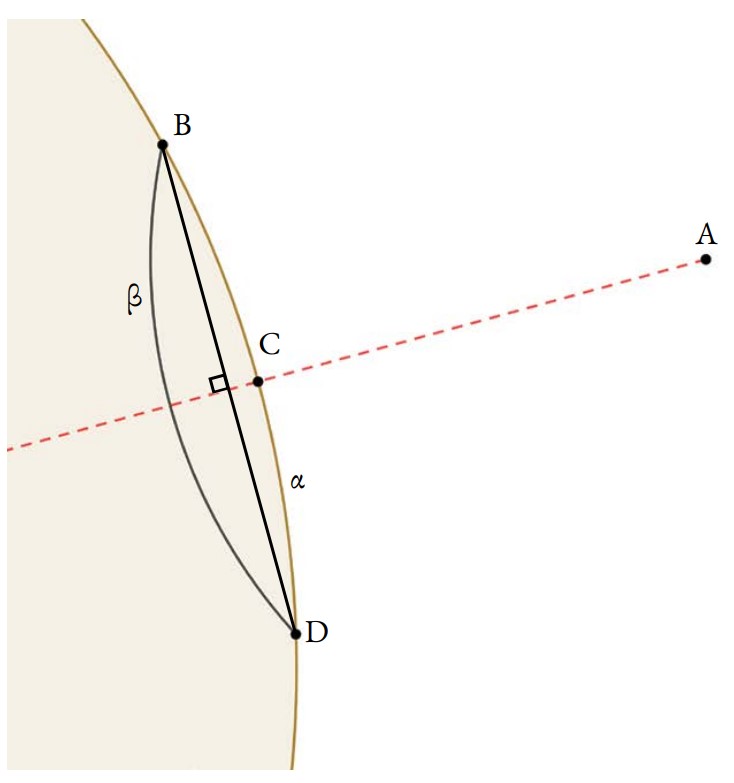
Hence, if the referee chooses any point \(B\) on the circular arc \(\alpha\), she can create a perpendicular bisector of \(BD\) (or angle bisector of \(\angle BAD\)) using basic geometric methods learned in middle school. The point where the bisector meets the arc \(\alpha\) is the desired point \(C\).
Acknowledgement
At Right Angles is grateful to Mr. Suyash Tiwari, mathematics teacher at Azim Premji School, Dhamtari. His write-up on measuring javelin throws seeded the idea for this article.
Editor's Note
Theorem: The tangent to a circle at any point is perpendicular to the radius of the circle that passes through the point of contact.
Geometry becomes more engaging when we connect it to real-world experiences. In sports like shot put, hammer throw, and discus throw, distance measurement follows the principles discussed here, particularly for reasoning, error analysis and justification.
Moreover, this discussion naturally leads to the concept of the tangent of a circle at a point on the circle. If the referee chooses point C instead of B, it’s evident that the new circular arc \(\beta\) does not intersect \(\alpha\) at any other point. Therefore, the line at C, perpendicular to AO, represents the tangent at C. This concept underpins the following theorem, typically introduced to students later: