
Thoughts on the Teaching Approach to the Division Algorithm


The National Policy on Education (NEP – 2020) highlights a severe learning crisis in basic mathematical skills, as evidenced by various governmental and non governmental surveys. Why is this severe? When students fall behind on basic mathematics skills, they tend to maintain flat learning curves for years, unable to catch up forever. For many students, this has become a major reason for not attending school, or for dropping out altogether.
Division is an important topic in mathematics, but unfortunately, the majority of primary school children struggle with it, often making mistakes. This article primarily focuses on the types of mistakes made by students while performing the division algorithm, possible reasons for these mistakes and the suggested pedagogy to address them. It also highlights the importance of estimating the quotient, verifying the result and understanding the concept of division in different contexts in solving word problems.
Let’s start with a question: if a child performs the division algorithm, can she check if the quotient is correct? The answer is yes, it is possible through estimation and verification of the quotient. However, in most of our classrooms, the teaching does not focus much on estimation and verification.
Estimation in mathematics is a process of rough calculation of an approximate answer in order to check for accuracy. This requires a high level of thinking skills. Estimating the quotient is an important part of teaching division, where students can use this skill to get the approximate answer to the division problem and can also check the correctness of any answer. One way of estimating the quotient is to round the dividend and the divisor. Let’s understand the estimation of quotient in the division problem 242 ÷ 22. Rounding the dividend 242 and the divisor 22 to the nearest tens, we get 240 and 20. So, the mental calculation would be 240 ÷ 20 which is 24 ÷ 2 = 12. So, the estimated quotient of dividing 242 by 22 would be \(12.^{1}\)
Note: The example used here is 242÷22. When 242 is rounded to 240 and 22 to 20, the answer is quite close to the actual answer. But this may note also be the case. For example, when dividing 242 by 16, 16 also rounds to 20, giving an approximate answer of 12, but 242÷16 is approximately 15. What is significant is that an approximate range in which the answer falls may be obtained. Please see the article on Multi-Digit Divisors in which estimation is discussed in greater detail.
To do this, the student must be adept in rounding, in dividing by powers of ten and in the tables.
Another important aspect of division is the verification of the result. While teaching division, we must ask students to find the relationship between Dividend, Divisor, Quotient and Reminder. This relationship can be found by observing the relationship in different division problems and based on the pattern, students can find the relationship as “Dividend = Divisor × Quotient + Remainder”. And they will be encouraged to verify the quotient using this relationship. Suppose that, while dividing 517 by 5, a student gets the quotient 13 and the remainder 2. The student can verify the quotient like this:-
Divisor × Quotient + Remainder
= \(5 \times 13 + 2\)
= \(65 + 2 = 67\)
Which is not equal to the quotient \(517\). So, the student is alerted that the quotient is not correct.
Importance of understanding the context of division: For students, the challenge in solving word problems is understanding which number operation is to be used. Most of the students try to take hints from cue words in the question and use the operation related to that word. But it is not always necessary that the word indicates the operation and also to point out which numbers are involved. Let’s understand from the following two examples.
Example 1: If 40 cakes are kept equally in 4 bags, then how many cakes will there be in each bag?
Example 2: Rajesh bakes 40 cakes and stores them in boxes of 10. How many boxes does he need?
In Example 1, the action verb “equally” indicates that division is needed to solve the problem, while in Example 2, the student needs to understand the question to solve the problem as there is no such cue word given in the question. So, it is required to understand the different contexts of the concept of division and as teachers, we need to discuss some of these contexts while teaching division.
Two contexts used to teach division in primary classes relate to “equal sharing” and “equal grouping”.
Equal Sharing: In this context, we need to find out how much each portion contains when a given quantity is shared out into a number of equal portions. For example, if there are 6 mangoes in a basket and these are distributed among 3 students. How many mangoes will each student get? The simplest way to build an understanding of this context is to distribute one mango at a time to each student until all the mangoes have been shared equally.
Equal Grouping: This is the context in which we need to find the number of portions of a given size which can be obtained from a given quantity. For example, if there are 6 mangoes in a basket and we are making packs of 2 mangoes, how many packs will we make? This question is all about finding groups of 2 mangoes from 6 mangoes. This can be done through repeated subtraction.
Mistakes in carrying out the division algorithm: I have noticed that students make mistakes while using the division algorithm due to a lack of understanding of the concepts of division, subtraction, multiplication and place value. As mentioned earlier, one can verify that the answer of the division of 416 ÷ 4 cannot be 14 as sometimes obtained due to leaving out the ‘zero’ in the quotient. This is checked by the fact that \(14 \times 4 = 56\) which is not equal to the dividend i.e., 416 (Refer Figure 2A). Or the student can estimate that 14 could not be the quotient as when we divide 400 ÷ 4 the quotient is 100, so the quotient in the question should be more than 100.
I had assigned a few questions on the division of whole numbers in class 4. I analyzed the students’ responses on two points – what children know and what they need to understand. Let us go through a few sample answers.
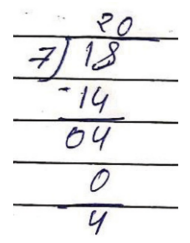
In the division question 18 ÷ 7, the first answer (Figure 1) indicates that the student knows the process of division but does not understand it completely. Here, the student does not know when all the places have been divided and whether to perform one more step or not. Also, the result in the quotient reflects that the student does not know the property of division – that for whole numbers, the quotient will be less than the dividend. Estimation can also be used to verify the answer.
In the question 416 ÷ 4, I present two responses. The first answer (Figure 2 A) indicates that the student has not divided one place at a time. When 4 hundred is divided by 4, the quotient has 1 in the hundreds place but then the tens and units place were combined to form 16 units, which was then divided by 4, to give 4 as the units digit in the quotient. Here the child could not write the quotient based on the place value system. Instead of 104, the child considered it to be 14. (In the case of the second response (Figure 2 B), we see that the child made a mistake in the multiplication of 4 by 0. This is an error commonly made by students and usually because, when teaching the tables, we start with multiplication by 1 instead of by 0. Later, this student ignored the 6 in the unit place of the dividend and assumed that the division was complete. In both these cases, estimation of the quotient would have helped the student.

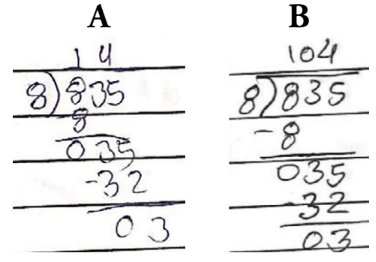
In the question 835 ÷ 8, we can find that in the first answer (Figure 3 A), the child made a mistake in not accounting for the fact that after 8 it would only be 3 tens that 8 has to divide which should have given 0 in the tens place of the quotient. Instead, the student has divided 35 units by 8. Whereas in the case of the second answer, (Figure 3 B), the child could write the quotient when dividing 35 units by 8.
The difference between the two responses shown in Figure 4, makes a strong case for verification of the quotient. Figure 4B shows the correct process and quotient and the child has followed step by step division of each place. The student whose response is shown in Figure 4A may be encouraged to do this:-
Divisor × Quotient + Remainder
= \( 5 \times 61 + 2\)
= \(305 + 2 = 307\)
Which is not equal to the quotient 3007. So, the student is alerted that the quotient is not correct.

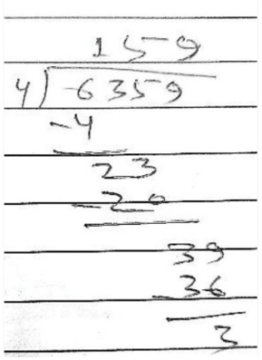
In the division of 6359 ÷ 4, the child made a mistake (Figure 5) perhaps because of not writing the digits in proper places i.e. units under units, tens under tens etc. Because of the displaced placement, the students may have missed the digit 5 of the tens place. These types of mistakes are generally seen in the case of the division of numbers having four or more digits. This suggests division involving larger numbers should be practiced with adequate emphasis on estimating the anticipated answer before starting the formal algorithmic process.
From the above answers, we can conclude that basic mistakes made by children are –
- Understanding of place value,
- Multiplication by zero. Some students assume that \(4\) × \(0\) = \(1\) or \(4\)
- Understanding whether all the places have already been divided or not. It is good to divide one place at a time in the division algorithm. After mastery, one can combine two places but needs to take care while writing the quotient.
- Not using the skill of estimation to check the answer to the division problem.
It is important to understand how to work with students while teaching the division algorithm so that students can conceptually understand the process and mistakes can be minimized.
In the teaching approach, we initially use concrete objects and connect them with the symbolic form of the division algorithm. Dienes block is one of the Teaching Learning Materials (TLM) which can be used to explain the concept and process behind the division algorithm. Students can easily visualize the process and can understand the algorithm so that they can perform the division algorithm for numbers with any number of digits. Here the teacher needs to provide exposure to the students to work with the TLM for various questions after a whole group discussion.
Consider the example ‘452 ÷ 4 =?’ that I used to demonstrate my teaching approach. During the initial discussion, students estimate that the answer is a little more than 100. The teacher asks the students to show 452, using Dienes blocks.
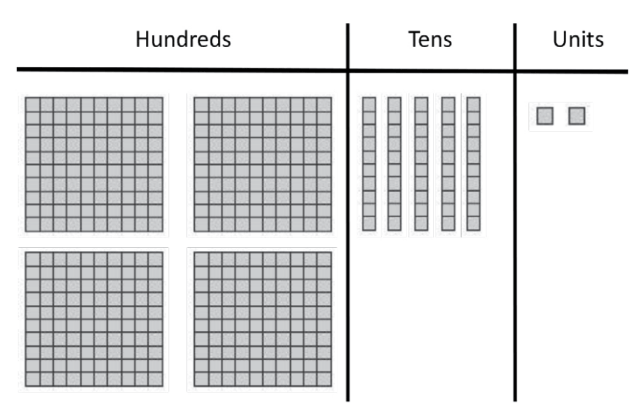
Subsequently, the place value chart is drawn on the floor, with blocks for Hundreds, Tens and Units in which the students place the appropriate Dienes blocks. Some questions to check conceptual understanding which are asked during the process are –
- How many hundreds, tens and units are there in 452,
- Can we write 12 = __ units?
- Can we write 52 = 4 tens + 12 units?
Then, the teacher uses the concept of equal sharing to discuss the concept of the division algorithm. The teacher draws four circles to show the process of equal sharing and will also write the symbolic form of the problem and connect these with the process.
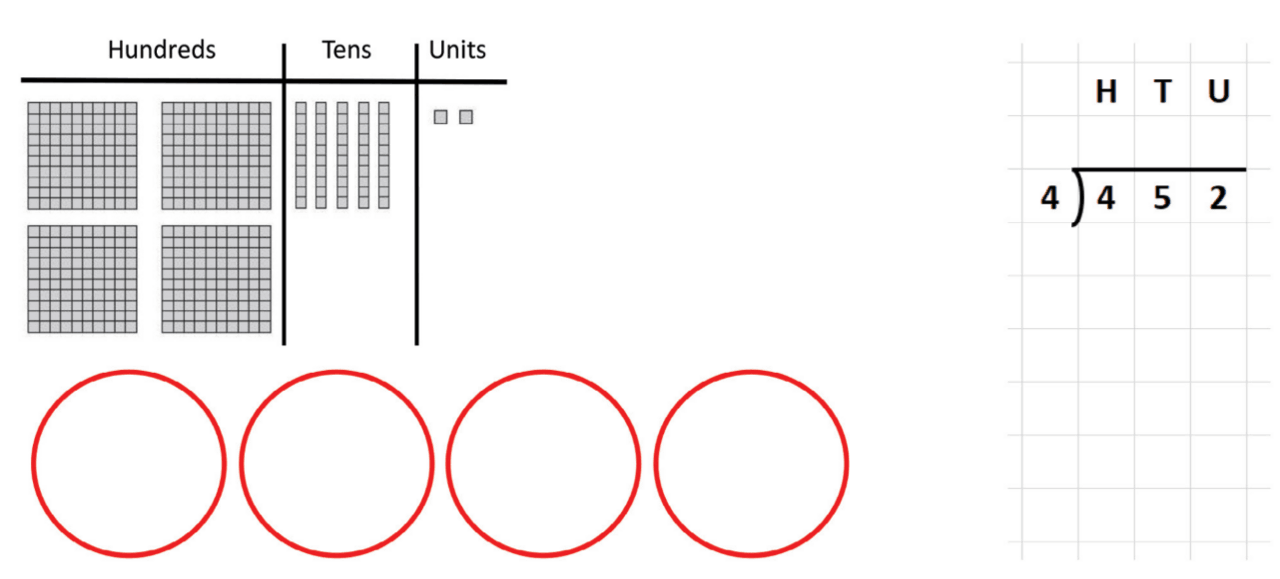
Step 1: First, divide the 4 hundred by 4. That is, divide 4 hundred into 4 groups. We get 1 hundred in each group, which means that1 is the quotient and the remainder is zero. While explaining the process, we write the symbolic form along.
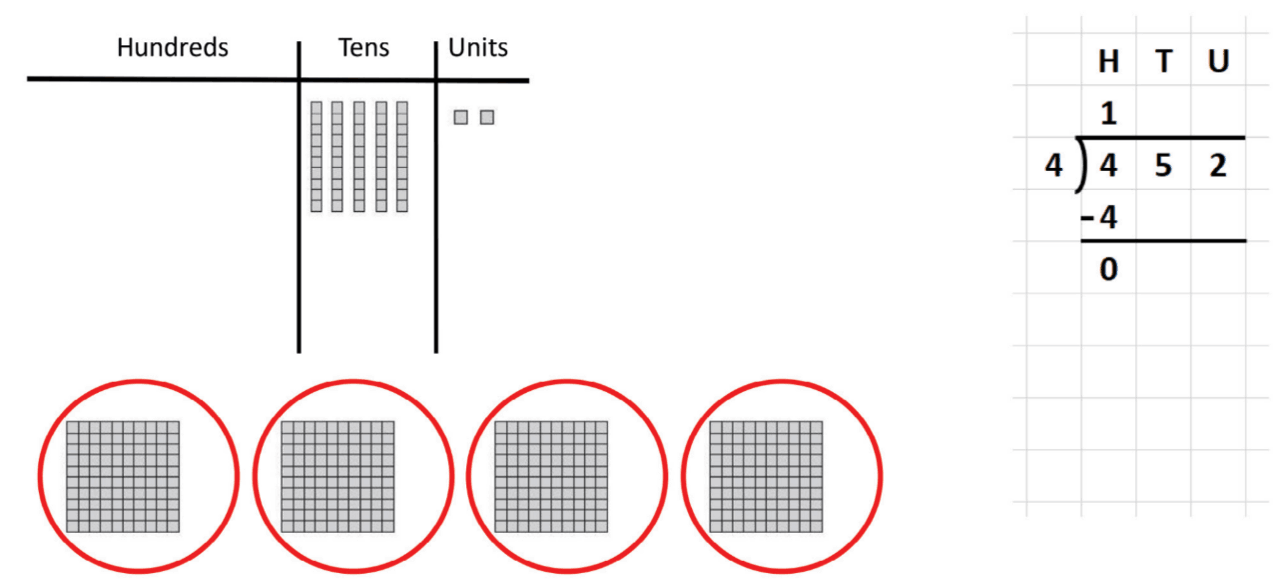
Step 2: Now move to the next place i.e., the tens place. There are 5 tens, and we have to divide by 4 (i.e., into 4 groups). Looking at the blocks, we conclude that we have 1 ten in each group. So we write 1 as the quotient in the Tens place and the reaminder is 1 ten.
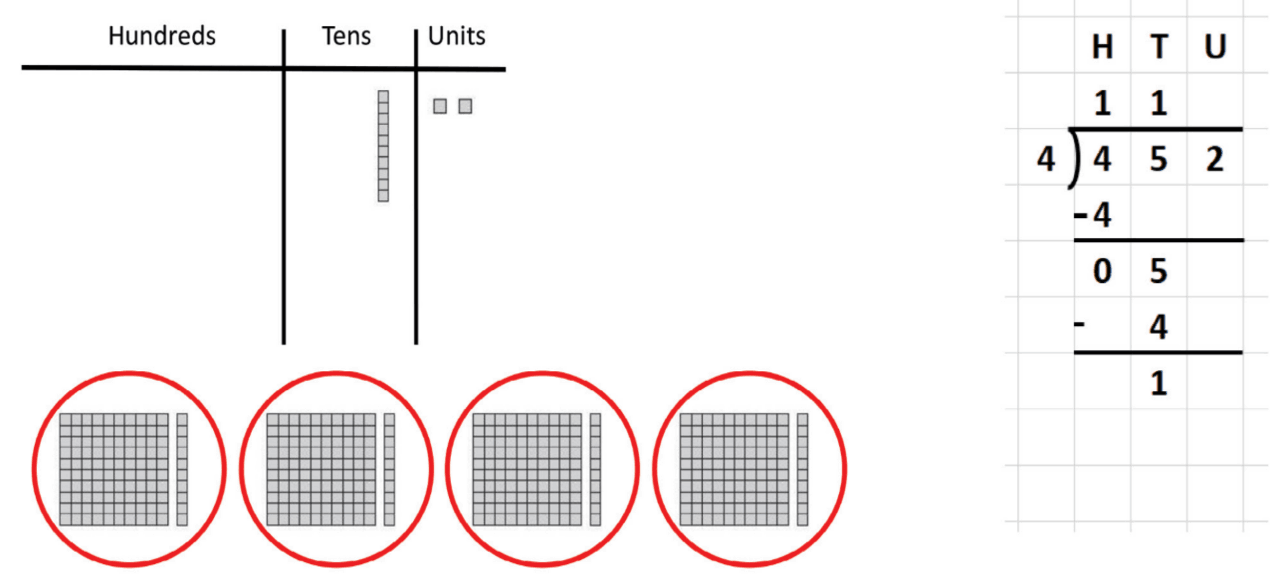
Step 3: Here the remaining ten cannot be divided among the 4 groups but conversion to units is possible. So, adding the 10 units to the 2 units already there, we get 12 units.
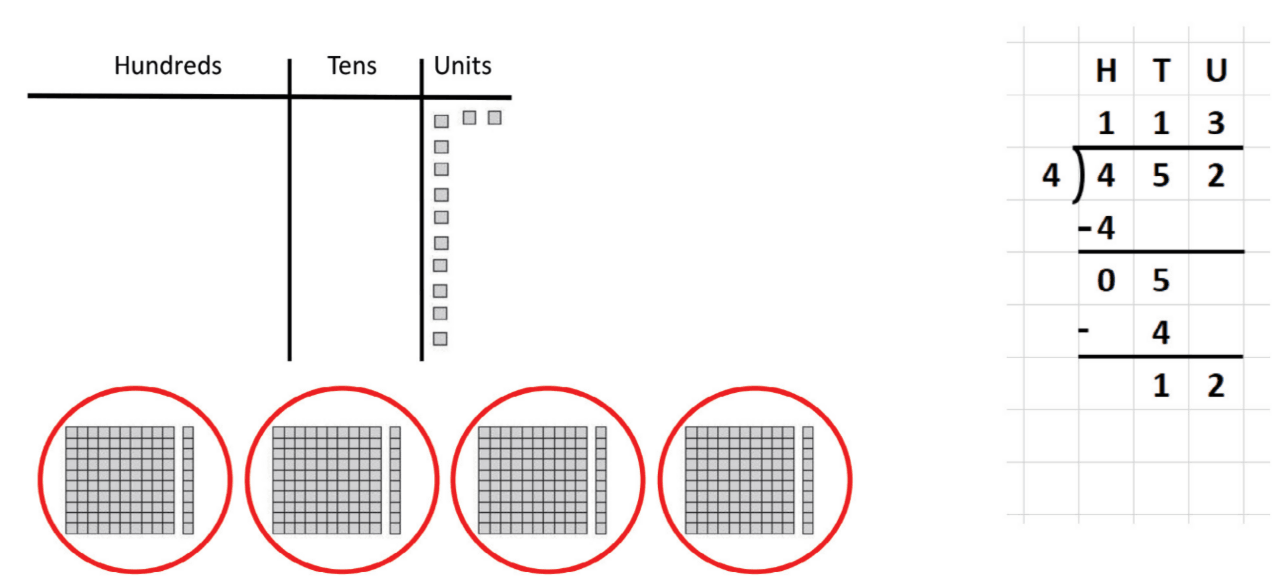
Step 4: Now, we will divide the 12 units among the 4 groups. We will get 3 units in each group i.e.; the quotient has 3 in the units place and there is no remainder.
So, when we divide 452 by 4, we get 1 hundred, 1 tens and 3 units. i.e., 452 ÷ 4 = 113
Highlight that in the division algorithm, we repeat the steps Divide, Multiply, Subtract and bring down the next place until all the places have been divided.

After discussion on the process of 452 ÷ 4 and its symbolic form, the teacher can assign a few questions such as 204 ÷ 2, 320 ÷ 4 etc. in groups of students working with the Dienes blocks\(.^2\)
Note: The FLU (Flats, Longs, Units) described in the Review section can be made at a very low cost and distributed among the students.
Check the process and facilitate support to groups who need help. Next, the teacher can assign questions having nonzero remainder and then three-digit by two-digit numbers. In the initial phase provide square grid papers so that the children can write the number as per place value and also can do the division algorithm properly.

In this process, I think we can get a good improvement in the learning of students. Most of the students could then divide whole numbers easily with both conceptual understanding and procedural fluency.