
Contextual Problems in Math: The NCF-SE Approach

Policy and action conversations and programs have been attempting to address the lack of learning and capability in mathematics. As a parallel process to this, what mathematics to teach and how it should be taught has been a matter of concern, ever since this started being emphasized in curricular frameworks. What is to be understood as important mathematics is evolving – particularly in the context of the teaching of mathematics. Given that easy-to-use calculators are accessible now, does foundational mathematics education need to focus exclusively on rote memorization of algorithms or calculation tricks?
According to the NCF-SE 2023, The ability to formulate problems, develop many alternative solutions, evaluate different solutions to choose the most optimal solution, and implement the solution is again indispensable in achieving all five Aims. Problems that require quantitative models require the mastery of various mathematical procedures, starting from simple arithmetic skills of addition and subtraction to more complex solving of algebraic equations. The use of computational models for solving problems would require computational skills. Skills for logical reasoning include constructing and evaluating arguments, both formally and informally.
It is with this perspective and much more that we look at the emphasis on the problems chosen for the student to develop these capacities. Contextually relevant problems are not simply word problems which are presented with attractive figures. They should, of course, be derived from children’s life experiences. At the same time, the child should be able to see the need to solve the problem and understand how these solutions can impact their daily routines and their decision-making.
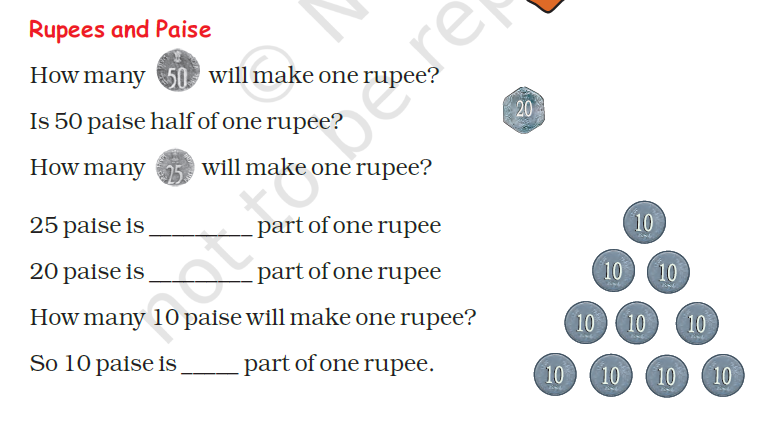
The usual mathematics class does not give the student such opportunities and in almost all schools, there is no time for children and teachers to savour mathematics and problem solving. Neither is time allotted for relaxed conversations about the concepts that are to be transacted nor are these concepts linked to the context of the children. For example, a question from the Math Magic series (Figure 1), (designed to make children work with mathematics from within their context, but often transacted mechanically), focuses on a currency that is no longer in use in India, making it difficult for children to relate to it unless it is part of a discussion on larger issues about conversations with grandparents and rising costs of living.
Secondly, no opportunity is given to students to unravel the nature of the problem and extract from it the information that is relevant to the problem. Only then can they comprehend the intention of the question and how to go from the information available to the one that is sought. T he effort is towards building the ability to follow algorithms stepwise and remember the steps like a mechanical drill. The message is ‘do not deviate from the steps, follow them precisely’. The advice is to not use your conceptual understanding and follow a different method of solution, as you may make a mistake. The classroom processes, and the so-called TLM (Teaching Learning Materials), are very often geared towards this. In a sense, they are expected to present to the learners the ‘concrete’ steps of the algorithm and help them remember them. They neither try to explain the process and the steps nor allow children to use alternative strategies at all. The problems are also designed so as to emphasise the practice of the algorithms mechanically. For example, this page (Figure 2) in the Class 5 NCERT Textbook (even though it is only focused on the breaking up of the algorithm of multiplication and its piecemeal practice) can have plenty of scope for the teacher to discuss the ‘why’ of the algorithm, but how often is this done?

Amit Kulshrestha is a mathematics teacher and researcher, both as his profession and for pleasure. Given below is a summary of his article in Pathashala Bithar Bahar [1] and a subsequent webinar [2] on the same.
Very often in a hurry to give students ways to solve word problems, teachers suggest that they look for keywords to help decide what operations to use. He argues that the whole focus in the classroom is actually on giving children practice in extracting the correct numbers, applying the correct algorithms and memorising the known standard rules for solving questions. The classroom is focused on giving the explanation and the steps to follow to reach the answer. There is no space for allowing children to think and develop their own strategies and approaches to problems given. However, the national curricular documents including the current NCF forcefully argue that children must not just be allowed to but encouraged to develop and find their own strategies to solve problems. They must learn to appreciate that there can be many strategies to solve them and sometimes, many answers too. The NCFSE (2023) also suggests that the classrooms encourage multiple methods so that students develop their own strategies to evolve. The NCERT textbooks for mathematics as well as the NCFSE emphasise the need for children to be able to create problems.
Here are some examples which illustrate that questions are often worded in a manner and comprise situations that are not natural for the context of the children.
- 114 birds were sitting in a tree. 21 more birds flew up to the tree. How many birds were there altogether in the tree?
It is unlikely for anyone to be able to count birds as they fly up to the tree. So, the context for the question seems more for form, than for any real pre-experience that the children can relate to.
- Jane has 63 m of ribbon. If she cuts 56 m 21 cm ribbon from it, what length of ribbon will be lefts?
Even if we change the name (as is often unfortunately the solution to bringing in local context,) the numbers in the question make no sense. A ribbon of 63 meters is not generally heard of and then cutting a length of 56 m and 21 cm also makes it unnatural.
- In a grocery shop, there was 2510 kg 350 g of wheat in the morning. During the day, 890 kg 600 g of wheat was sold out. How much wheat was left in the shop in the evening?
This is a surprising amount of wheat in stock and an equally surprising amount sold in the day! Normal shops would usually keep stock in number of bags, rather than in grams.
- Vishal wants to make a book tower of height 48 cm. If the thickness of each book is 12 mm, how many books will he need to make the desired height?
- A box of frozen vegetables weighing 144 kg 780 g was delivered at a grocery shop. If there were 15 bags of equal weight inside the box, what was the weight of each bag?
Both these problems are supposed to be contextual questions. But it is clear that the objective is for students to practice dividing one number by another. Surely a thoughtful student would wonder who would want to make a tower of a specific height? Even if that is required, why would someone have so many books all of the same height and need to find the number of books in the stack? Why would such an accurate weighing of the box of vegetables be needed?
- The length, breadth and height of a room are 24, 18, and 12 feet respectively. What is the longest tape that can be used to measure these?
The point about this is that the common experience of the child when they see a measuring tape being used is that a very long tape may be used to measure small distances. We need a long tape if we do not want to lift the tape and continue the measurement from the end point of the previous placement of the tape. Otherwise, we can use any tape and measure the length. So, we could use any tape above 24 feet in length, including the one that is 24 feet long. The intention of those who designed the question was to test if the child could find the Highest Common Factor of 24, 18 and 12 and use that as the longest tape so that there is no part measurement needed. The wording of the question does not match its objective. The language of the question may sometimes be ambiguous, but the answer expected does not allow for multiple options.
Clearly, the idea here is to get children to do some operations and that too with some specific kind of numbers and the context is just a false pretence that does not add any value to their deriving an understanding of the concept or the notion of numbers. It does not give them procedural clarity either, as they cannot make sense of the number they get as an answer and have no way of knowing if it is even approximately correct.
While all these may be called exercises for understanding the language of the question, they may not help in the aspects of relating mathematics to life and seeing connections. In fact, these problems are often even more contrived with complicated numbers and tedious use of algorithms. Very often it is not logically obvious how the solution has to be reached and it becomes necessary for the teacher to outline the solution steps. This is then memorized by the student. But they are not clear why the approach needs to follow the specific method suggested and why it leads to the answer.
Here are some suggested questions which may relate better to the child’s context.
- Suresh uses a bucket and mug for bathing every morning. He saw that he got 12 full mugs of water from the filled bucket. However, one day, he found that he got only 9 full mugs of water. He realised that the mug was new. What would be the difference in the new mug with respect to the old?
This can relate to filling water in different containers and may lead to interesting conversations bringing in other experiences and also linking capacity to ratios and fractions.
- Using square tiles how many tiles of different sizes can you use to fill a square floor of area 144 sqm?
- Could any rectangular tiles also tesselate the same floor area of 144 sq.m? What sizes of rectangles and how many are needed in each case?
- Given the area of a floor is \(a^2\) sq.m, where ‘a’ is a whole number, what are the possible sizes of square tiles that can fill the surface’?
Note that the questions are getting more complex (and more interesting) at every stage. If we attempt these problems ourselves, we can see that it leads to counting the combinations and that in itself has opportunities to explore. Or one could go beyond that and try to find a way to solve it in a manner that allows for a general formulation for the possible combinations of numbers or the sizes of the square tiles.
Questions which enable students to use mathematical objects and concepts with understanding and develop curiosity and a sense of adventure are the need of the hour. A good guiding question while such questions are being developed is: What is the objective of giving the exercises and how do we view the nature of mathematics and the learning of the same? What does the learner have to do to solve the question? The objectives for a task arise from our understanding of the foundations of mathematics and how we visualise the path of learning. And that has to show up in what the learner has to do in the task that you have given the learner.
The kind of problems around which contextual conversations can be facilitated are at the moment, rare if not entirely absent. Admittedly, these are not easy to formulate, also there is not enough time that can be allocated for discussing these. The concern about assessment and hence the entire process of mathematics teaching and learning being focused on memorisation, algorithm focus and lack of understanding and any real capability to explore and feel comfortable with mathematics persists. NCFSE 2023 points out that “Most of the assessment techniques and questions focus on facts, procedures, and memorisation of formulas.” However, assessment should focus on understanding, reasoning, and when and how a mathematical technique is to be used in different contexts. This is not a new thought and has been expressed since the beginning of the century and in some spaces of India even earlier, but this has been extremely difficult to find a way to start to put this in place. If this is done, then the aims of mathematics education as defined in NCF-SE will have a far greater chance of being met.
Editor's Note
All images from textbooks reproduced with permission from NCERT.
- https://cdn.azimpremjiuniversity.edu.in/apuc3/media/ publications/downloads/Pathshala-Bheetar-Aur-Bahar_17 Issue-Sept-2023.pdf
- https://www.youtube.com/watch?v=4tKptfJLPW4&list=P LVI4qkjTdM728SukvE9lLM7eBzg-8BKvM&index=1
- National Council for Educational Research and Training (NCERT). (2023). https://ncert.nic.in/textbook.php?aejm1=11-13