
2D Base-10 Blocks
(also known as Flats-Longs-Units)


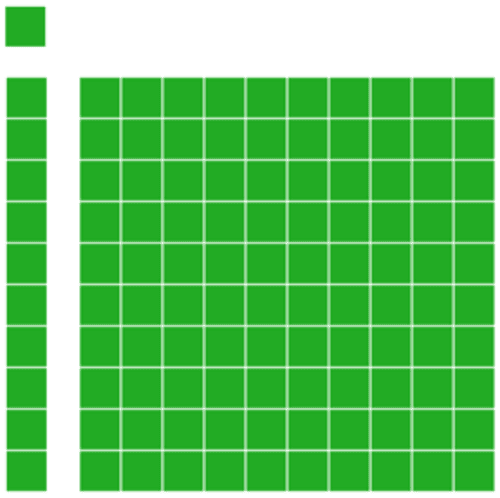
Many teachinglearning aids help one understand the base10 structure and how we conceptualise and use whole numbers. Several of these also aid in introducing and exploring the four operations. We found that the best of these is 2D base-10 blocks popularly known as Flats-Longs-Units (FLU). The unit is a small square or a 1. The long is ten times the unit and therefore a 10. Finally, the flat is a bigger square, a hundred times the unit and ten times the long, therefore a 100. Figure 1 illustrates these basic blocks. All three types of blocks should be of the same colour for the reason explained below.
Since this is a pre-grouped proportional material, the long cannot be unbundled into 10 units. So, it has to be exchanged for 10 units. Similarly, the flat has to be exchanged for 10 longs. Because of this pre-grouped nature, FLU cannot provide direct grouping and ungrouping experience, unlike a groupable material, for example, bundle sticks. Therefore, it is advisable to use FLU after exposure to some groupable material.
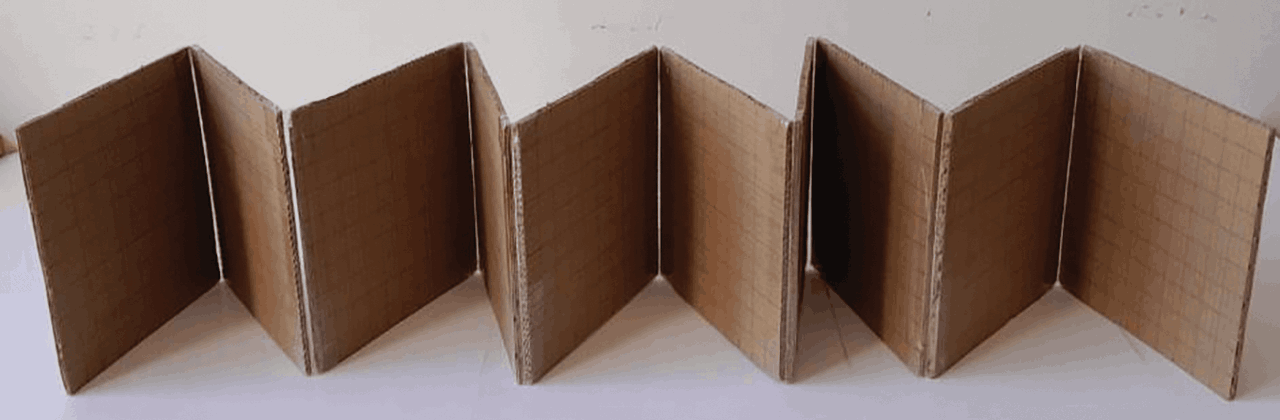
We recommend that for younger children, i.e., at the foundational level, preprimary and Class 1–2, a larger version made of corrugated cardboard (Figure 2) is provided. The sizes of the blocks can be:
- Unit: \(2\) cm × \(2\) cm
- Long: \(20\) cm × \(2\) cm
- Flat: \(20\) cm × \(20\) cm

If children at this stage are introduced to Thousand, then that can also be made by joining 10 flats using transparent cello-tape (Figure 3).
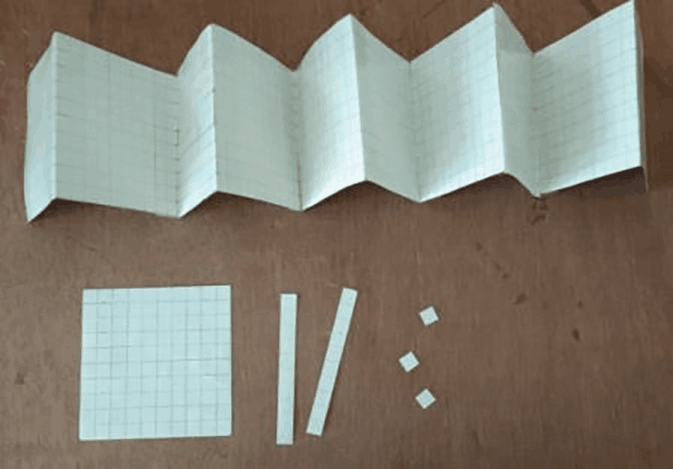
For older children, i.e., at the preparatory and middle stages, Class 3–5 and Class 6–8 respectively, smaller blocks made with square grid notebook pasted on thick chart paper or thick poster can be used (Figure 4).
FLU can be used for
- Comparing whole numbers.
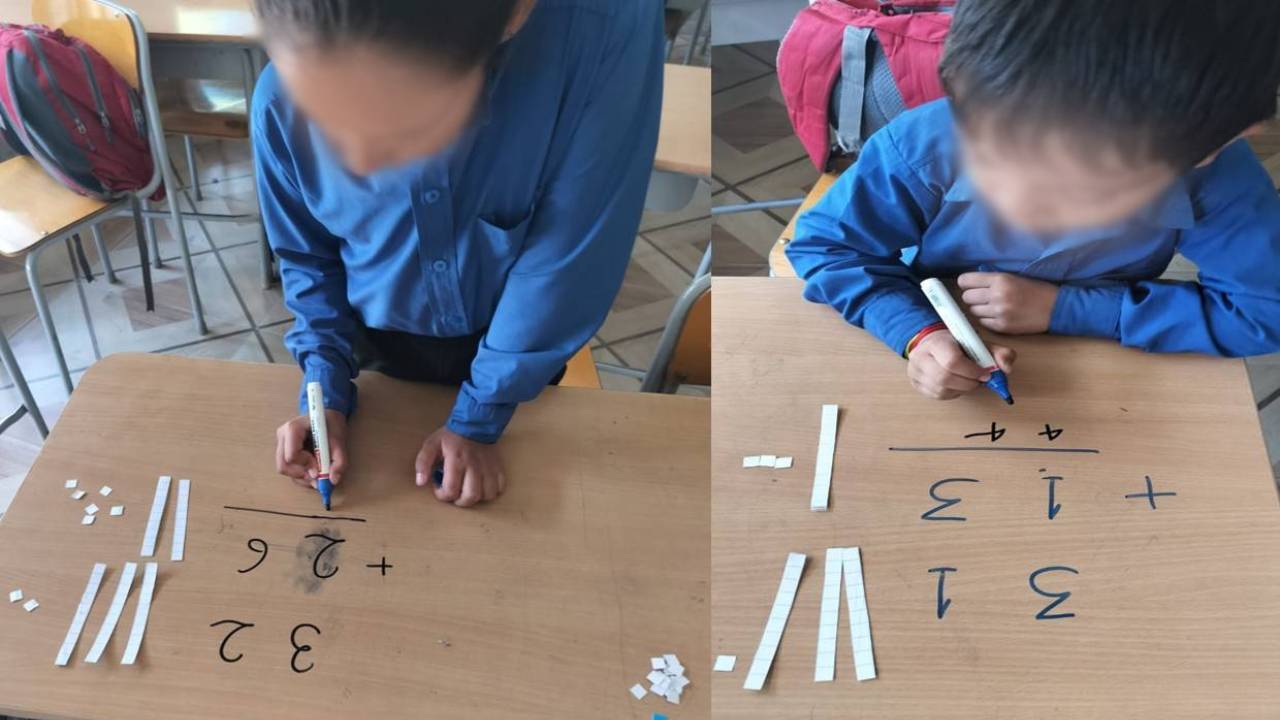
- Addition-subtraction, especially, constructing the standard algorithms.
- Multiplication and division, both using the notion of the array.
- Squares and square roots – introduction and constructing the algorithm for finding the square root by long division.
There should be an adequate amount of each block for each use:
- Addition-subtraction – at least 20 of each type
- Multiplication-division – at least 12–20 flats, 90 longs and 90 units
- Square and square root – similar to multiplication-division
When children start working with whole numbers (comparing them and using the four operations), their practice often reduces to symbolic manipulation without understanding the whys behind the rules and algorithms. FLU fills that gap very well by matching numbers to the respective quantities they represent.
While comparing two whole numbers, FLU helps a learner understand that a single long is more than 9 units and similarly a flat is more than 9 longs (or 90 units). Therefore, any 2-digit number is greater than a 1-digit number and likewise, any 3-digit number is more than any 2-digit number. These observations can be generalized to “the whole number with more digits is larger”, e.g., 10002 > 98. One can also conclude that if two 2-digit numbers have different leading digits, then they are represented with different quantities of longs. Naturally, the number with more longs is bigger, i.e., “if two numbers have the same number of digits, then the one with the bigger leading digit is larger”, e.g., 43 > 34. The same conclusion can also help them to reason that 403 > 289. And finally, if the leading digits are equal, then we should check the quantities of the next digits. For example, if two 3-digit numbers have the same leading digits, then we need to check the number of longs needed to represent each, i.e., the next digit on the right, e.g., 640 > 638. If they are also the same, then check the next digits, e.g., 756 > 753. Thus, arriving at the last rule, “if leading digits are also the same, check the next digit to the right, larger digit ⇒ bigger number” and “keep going till the digits differ”.
The column addition and ‘carry over’ or regrouping becomes automatic with a few simple ideas:
- Making each number (to be added) using FLU.
- Addition means to combine.
- Whenever, there are 10 of a kind, exchange with the next bigger block – i.e., if there are 10 or more units then exchange 10 units for a long, or if there are 10 or more longs then exchange 10 of those for a flat.
The teacher can just show how the algorithm is simply a way to record this. Figure 5 illustrates this for 487 + 376

A similar process for subtraction would be:
- Making the first number using FLU.
- Visualising the second number, especially the FLU needed to make it.
- Subtraction means ‘to take away’.
- Exchange longs and flats, if needed, so that there is enough of each kind to take away.
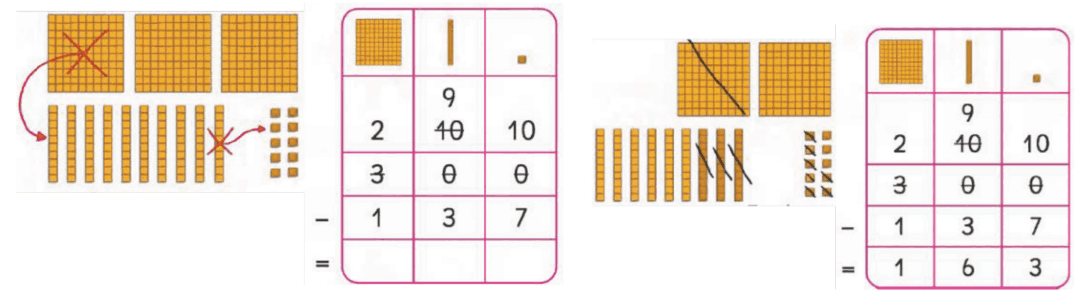
Again, the teacher can facilitate to show how the standard algorithm just writes this down. Figure 6 illustrates this for 300 − 137, a difficult subtraction demanding two rounds of exchange at the very beginning!
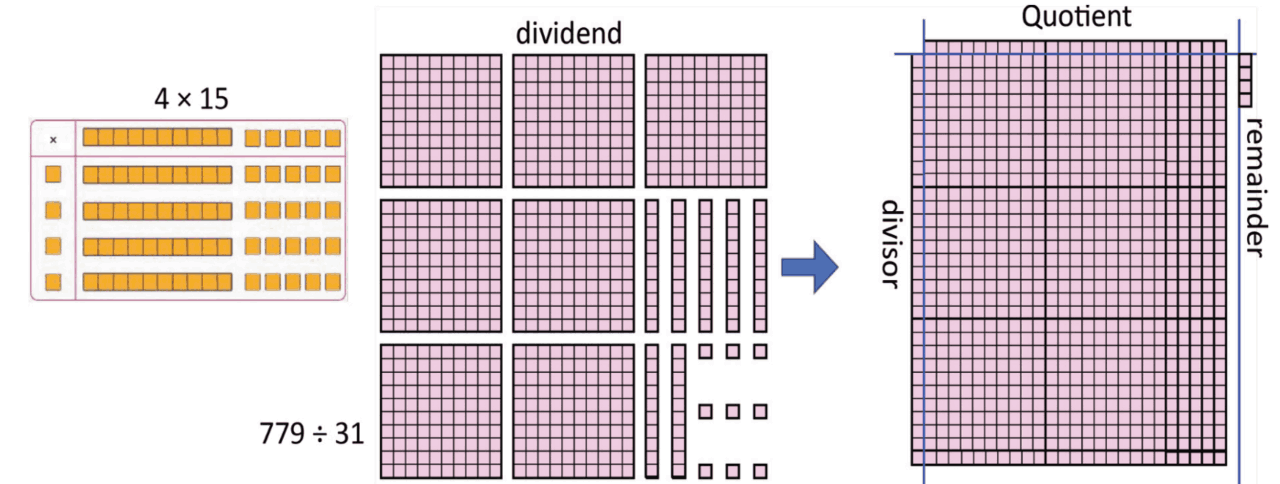
We have already illustrated division in the article on the Division of Whole Numbers. Figure 7 shows a multiplication example (4 × 15) and a second example for division (779 ÷ 31).
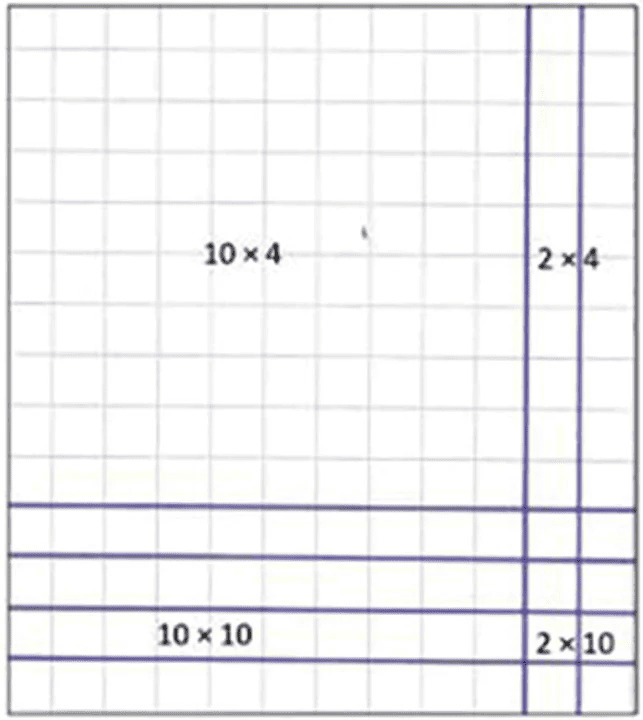
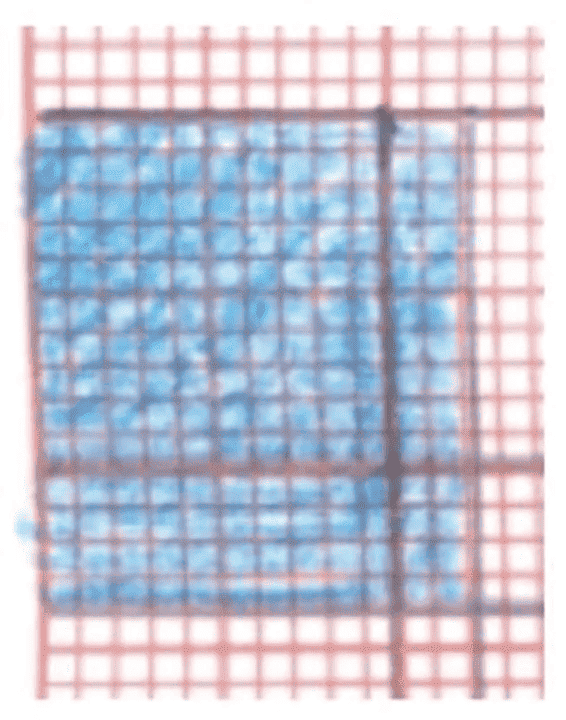
One usually encounters such arrays while making FLU – both larger and smaller versions. Figure 8 illustrates the material needed to illustrate \(14 \times 12\), i.e., 1 flat, \(4 + 2 = 6\) longs and \(2 \times 4 = 8\) units that can be made from one sheet of square grid.
Squares can be considered special cases of multiplication. Squares of 2-digit numbers, in particular, resemble the pattern of \((a + b) ^2 \). This very identity is used in the division algorithm to find square roots. And this can be initiated using FLU. However, since this is done much later, with much older learners, the need for physical manipulatives would be less. But one can use the idea to draw pictures and rough diagrams.
Many virtual manipulative sites, including Mathigon Polypad, provide virtual FLU, which is as good as physical manipulatives. However, these come in different colours. But fortunately, one can change the colours as well. Figure 1 was generated using polypad.
FLU can be extended to decimals easily since it is base-10. However, there are some crucial changes.
- The flat becomes 1, whole, and therefore, should not have any lines within.
- The longs are \(1/10^{th}\) of the flat, i.e., 0.1 and should not have any lines either.
- The units are \(1/10^{th}\) of the long, so, \(1/100^{th}\) of the flat, i.e., 0.01.
We recommend no lines so that learners see the big square in decimal FLU as one or whole. If it includes lines, then learners would be prone to count, and it will become 100 instead of 1. Since learners would be older when they start working with decimals, physical manipulatives would be needed less, and more focus should be on drawing on square grid notebook, and later centimetre graph paper with:
- 10 cm × 10 cm square as 1
- 10 cm × 1 cm rectangle as 0.1
- 1 cm × 1 cm square as well as 10 cm × 1 mm rectangle as 0.01 – the latter is very useful in decimal multiplications such as 0.34 × 0.27
- 1 cm × 1 mm rectangle as 0.001
- 1 mm × 1 mm square as 0.0001
Addition and subtraction are almost identical. Multiplication also resembles the corresponding whole number counterpart quite closely. Figure 9 illustrates 0.14 × 0.12 on graph paper, which is very similar to 14 × 12.
FLU also generalizes to algebra tiles as a base, i.e., 10 is replaced by the variable x. We will discuss algebra tiles in a later issue. But it is worth mentioning here that the processes, especially w.r.t. multiplication and division are eerily similar
Acknowledgement: Anupama S M of Azim Premji University extended the usual FLU to include a thousand.
- How to make FLU (including a thousand): https://sites.google.com/apu.edu.in/mathspace/matherials#h.r8y4lfrj399c
- Addition-subtraction with FLU (ppt): https://drive.google.com/file/d/1ALzKVaLe3cZfvZxsG38ObpHh55ChGLY7/view
- Multiplication with FLU (ppt): https://drive.google.com/file/d/1G1LY8Btc1lsF5zuYpnFTQPBpFtDKlASg/view
- Division with FLU (ppt): https://drive.google.com/file/d/17HS5ygXG-3aWrhmv3WZPskLZMHZ_sJri/view
- Sikkim math textbook, Class 3: https://www.scertsikkim.ac.in/_files/ugd/05f8ad_d72c9029dc8f438cbcfb0026ff982a62.pdf
- Chand, Amit: How the Square Root Algorithm Works, At Right Angles, Mar 2021 http://publications.azimpremjifoundation.org/2655/1/4_How%20the%20Square%20Root%20Algorithm%20works.pdf
- Mathigon Polypad: https://mathigon.org/polypad#numbers