
Who Teaches Math Vocabulary?


Let us look at the following vignette.
Vignette 1
Christina has just begun class 1. During the term-end parent teacher meeting, her class teacher (who is also her Math teacher) tells her parents – “Christina is just not able to understand simple word problems, no matter how many times I solve them on the board. Please talk to the English teacher to sort out this issue, otherwise this will create many more problems in future.” Slightly puzzled as Christina swiftly and correctly answers most addition and subtraction problems at home, be it 3+5 or 7−3, Christina’s mother closely examines her notebook and finds the following:
Jennifer skipped 8 times in the morning. She then skipped 3 times in the evening. How many times did she skip during the day?
Christina’s answer: 5
Lynpu goes to the river and catches 7 fish. His friend goes to the river and catches 3 fish. How many more fish does Lynpu catch?
Christina’s answer: 10
Prasida has 5 idlis on her plate. She eats 2 idlis. How many idlis does she have now in total?
Christina’s answer: 7
Christina commits errors which we commonly associate with the initial stages of learning addition and subtraction. While errors are always useful for learning, they also present us with an opportunity to examine if there are any underlying pedagogical reasons which are leading to misconceptions in the minds of learners. Both from Christina’s mother’s experience and from the worksheet responses, it seems clear that Christina knows addition and subtraction – she simply does not know which to use when. The inability to solve word problems possibly stems from common practices related to the teaching of mathematics (Shirali, 2016) (10), which Christina’s teacher may have followed too:
- Using confusing vocabulary while teaching a mathematical concept or encouraging rote memorization of cue words e.g., ‘more’ and ‘total’ mean addition.
- Not addressing conflicts between everyday words and mathematical concepts. For example, here Christina possibly mistakes the word ‘skip’ to mean ‘subtract’.
- Teaching addition and subtraction as mere procedures without developing important skills such as following instructions, visualization, and problem-solving.
- Seeing vocabulary development as a language problem and not as a mathematical concern.
- Designing poorly framed word problems, which are often not related to the children’s context.
- Not ‘thinking aloud’ or demonstrating/verbalizing the thought process of solving mathematical problems so that children not only understand the steps better but also develop conceptual clarity.
- Not creating opportunities for children to share their thought processes.
- Underestimating the ability of children to formulate and solve their own mathematical problems.
The relationship between vocabulary and comprehension is intricate. Children who have a rich vocabulary are not only able to engage deeper with rich language contexts such as participating in conversations, playing, cracking jokes, and telling and listening to stories, but are also able to derive meaning from mathematical problems. As in the case of Christina, many learners face no real issue with computation but struggle to interpret and use language. Explicit instruction of vocabulary is shown to improve comprehension among learners in all subjects, including for children with disabilities (Powell & Driver, 2014) (9).
While teachers in the Foundational and even Preparatory Stage (from preschool to class 5) are recruited with the clear expectation that they will teach all subjects, there are some ground-level realities such as:
- Teachers ill-prepared to teach all school subjects despite having the requisite pre-service qualifications.
- Teachers teaching only one/two subjects to multiple classes i.e., different teachers teaching different subjects. This scenario is similar to Vignette 1 where the mathematics teacher shifts/ transfers responsibility to the language teacher. This results in clear separation between subjects which is reflected in not only how time is organized (timetable) but also in how different subjects are taught – where no interconnections are built despite there being multiple, organic opportunities – especially in the Foundational and Preparatory Stage classrooms.
- Teachers having varying levels of interest in different subjects. In other words, teachers taking more interest in teaching certain subjects and not others.
- Fear of mathematics in teachers themselves, which transfers to the children.
What could Christina’s teacher do instead?
Christina’s teacher will certainly benefit if she derives her pedagogy from the Curricular Goals and Competencies listed in the National Curriculum Framework for Foundational Stage (NCF-FS) 2022 (6). The Curricular Goal associated with Mathematics (CG-8, within the domain of cognitive development) expects learners to develop mathematical understanding and abilities to recognize the world through quantities, shapes, and measures. Of the 13 Competencies corresponding to this Goal, the Competency associated with addition and subtraction (C-8.6) clearly states that children should be able to do so fluently and using flexible strategies. This Competency should be seen alongside another (C-8.13), which expects children to be able to formulate and solve simple mathematical problems. Moreover, there is a whole other Competency (C-8.12) on developing an adequate and appropriate vocabulary for comprehending and expressing concepts and procedures related to quantities, shapes, space, and measurements. However, CG-8 cannot be read in isolation. The previous Curricular Goal (CG-7) plays a critical role in helping children develop their understanding and abilities for mathematics, as it is about how children can observe the world around them and think logically to understand categories and their relationships.
The learning standards summarized above suggest a clear approach that the teacher needs to take while teaching Mathematics:
- Talking using everyday language to develop familiarity with quantities, shapes, and measures in the world.
- Identifying how real-life concrete experiences and exploration of the world can be integrated with the teaching of mathematical concepts to develop sound conceptual clarity.
- Integrating mathematics learning with other domains and not seeing it as separate concepts and skills to be developed in a separate time i.e., exploring opportunities for mathematics through stories, rhymes, games and sports, and art.
- Working closely with the language teacher (if different) to understand how all classrooms can support vocabulary development and comprehension in a comprehensive manner.
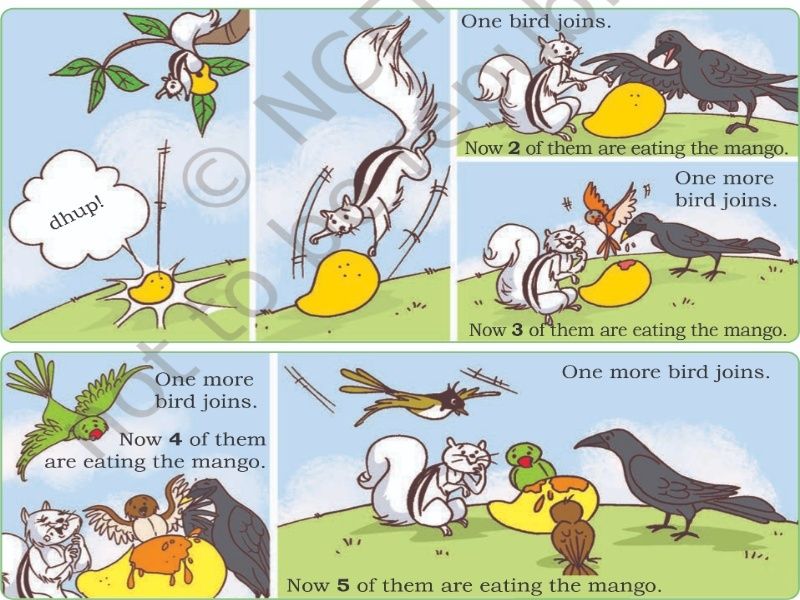
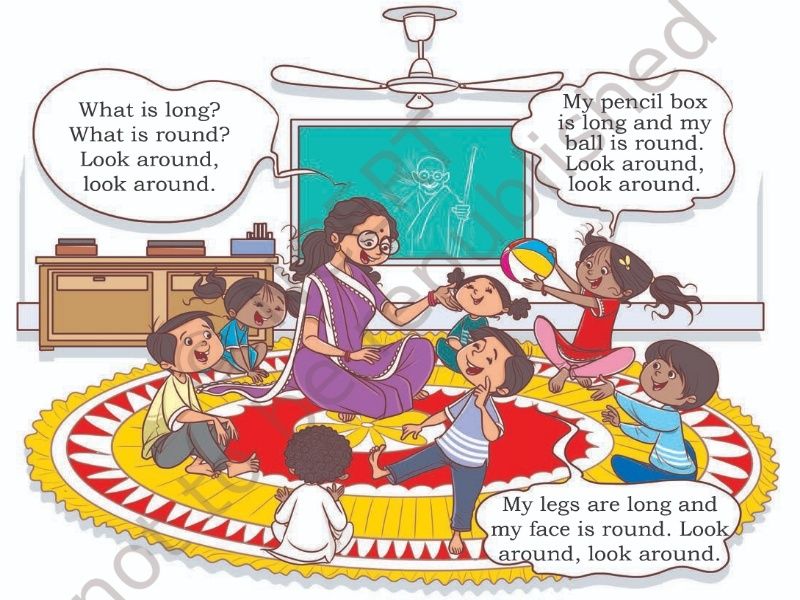
Given below are some samples from the new mathematics textbooks by NCERT for class 1 (8), where diverse contexts such as stories, rhymes, pictures, anecdotes, and comic strips are used to teach mathematics. Notice the use of language in the samples, and the richness of the contexts which are derived from children’s real-life experience. The textbooks, recently developed, are aligned with the Curricular Goals and Competencies defined in the NCF-FS 2022.

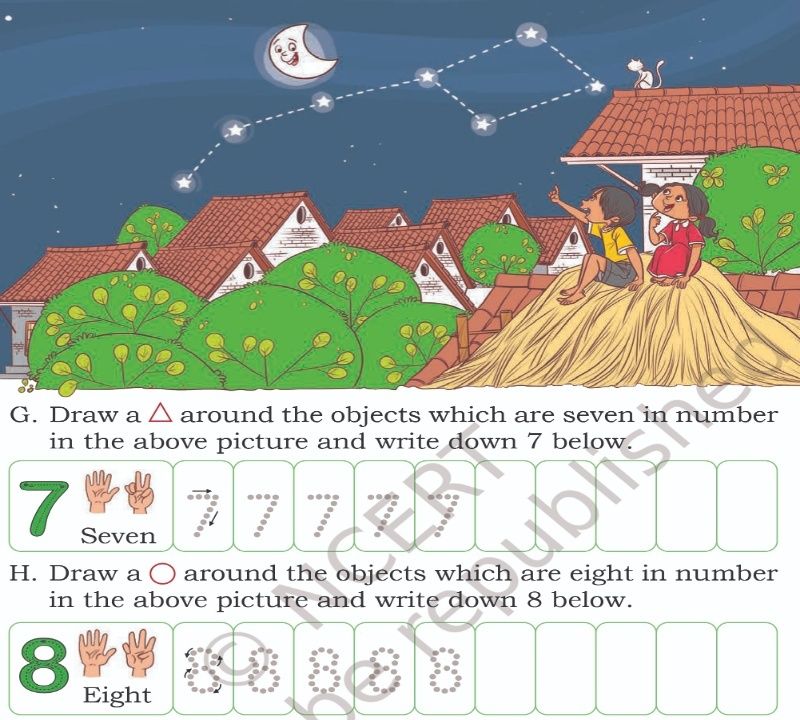

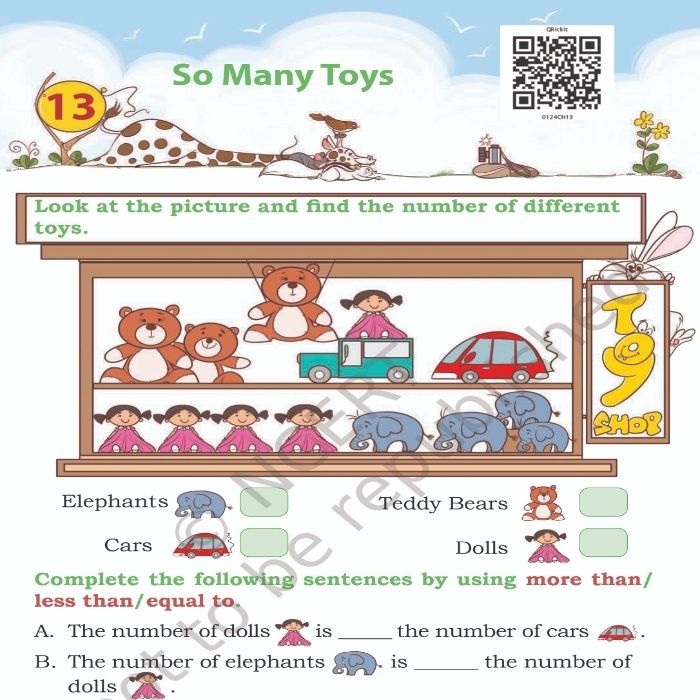
Strategies
Let us look at three specific strategies that are useful for strengthening mathematics related vocabulary in the Foundational Stage. These strategies are also reflected in the samples from the textbook shown above. As discussed earlier, these can be used by all teachers and in different periods/blocks in the timetable. Please note that these are in addition to the mathematical games of which you can find many examples.
Reading/ talking about pictures
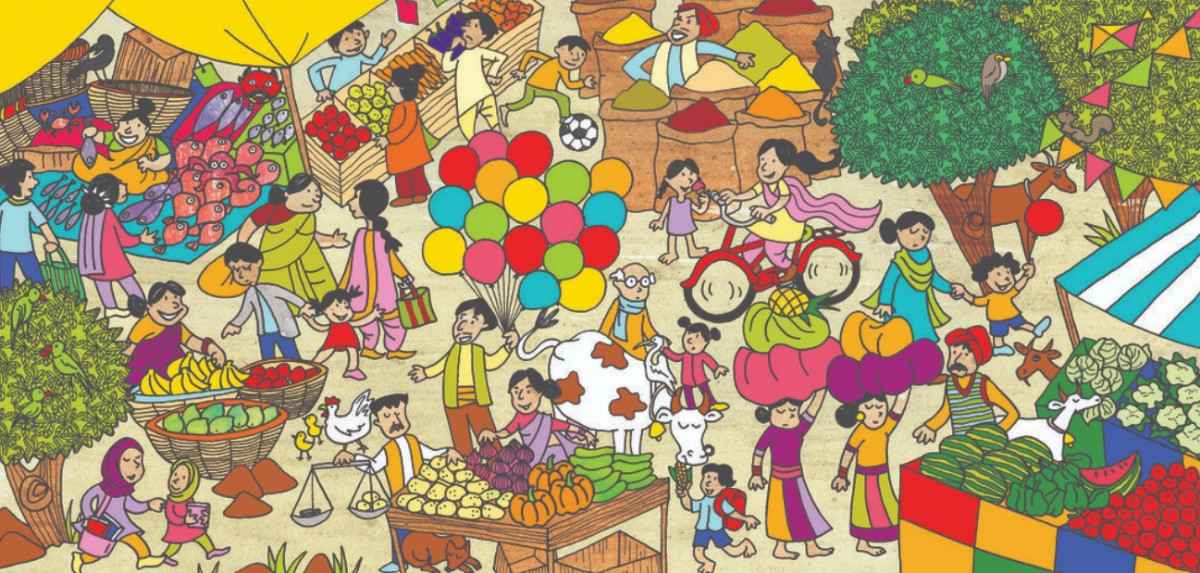
Discussing pictures can enhance mathematical thinking by encouraging students to visually analyze and interpret the depicted information, on which further problems can be built based on the creativity of the teacher. For example, the picture below from ‘Market Mayhem’ by Soumya Menon (4) provides a rich context for many mathematical concepts already discussed above. Can you think of how you would use this picture in your classroom?
Children’s literature
When selecting children’s literature for teaching mathematics, prioritize stories/anecdotes that naturally incorporate mathematical concepts. Look for opportunities to integrate words from children’s daily lives, making mathematics more relatable and enhancing comprehension through familiar contexts. For example, the Nepali story embedded in a learning experience ‘Kun Lamo, Kun Choto?’ (Which is Long, Which is Short?) in the Draft Sikkim Preschool Curriculum (SCERT, 2024) (11) is about a lone stick in the woods that hops around and meets more sticks of varying lengths, which become its arms and legs. The teacher tells the story and simultaneously builds a stick figure using real sticks collected by children from the outdoors. Follow-up activities involve children making their own stick figures and comparing the lengths of the sticks they have used for the body, arms, and legs. The teacher uses words in Nepali like ‘lamo’ and ‘choto’ but also introduces English words alongside.
Here is another example of a story called ‘Gulli’s Box of Things’ by Anupama Ajinkya Apte (1), where words such as ‘small’, ‘big’, ‘wide’, ‘top’ are used while describing the assortment of objects collected by Gulli in his little box.
“What is wrong, Mangal Chacha?” asked Gulli one Sunday.
“I have to pour oil from this pack, but the bottle’s neck is so small. I am sure I will make a complete mess in my kitchen,” said Mangal Chacha.
“Ah, don’t worry, let me find you something really fast,” said Gulli.
Clink, clonk, dadum-dum, let’s see what Gulli has found this time!
A funnel with a big, wide mouth! Pour anything from the top, and see how it comes down so neatly, drop by drop!
This third sample story ‘The Very Shocking Report Card ’ by Jane De Suza (5) is about a boy, Pattu, who dreads receiving his report card because he knows he will not score too well. The story integrates mathematical and socio-emotional and ethical development. It also presents the opportunity for making simple calculations such as addition and subtraction.
So this time, Papa went with Pattu to get his report card from the teacher himself. Papa looked at Pattu’s report card. His smile went from a slice of papaya to the thin wedge of a lime.
3 out of 10 for Reading. Papa’s eyebrows dashed together like colliding bulls.
4 out of 10 for Recitation. He shook his head from side to side, like a tree in a storm.
2 out of 10 for Spelling. He let out a long whoosh, which sounded like a train engine.
On their way home, Pattu encounters different people in his neighbourhood and through their conversations, Papa realizes that Pattu is a thoughtful child who looks out for everyone. Once home, Pattu is scared and embarrassed to share his marks with his mother. But Papa shares a different report card…
“9 out of 10 for sharing,” said Papa.
“10 out of 10 for kindness.
11 out of 10 for respect.”
Graphic organizers
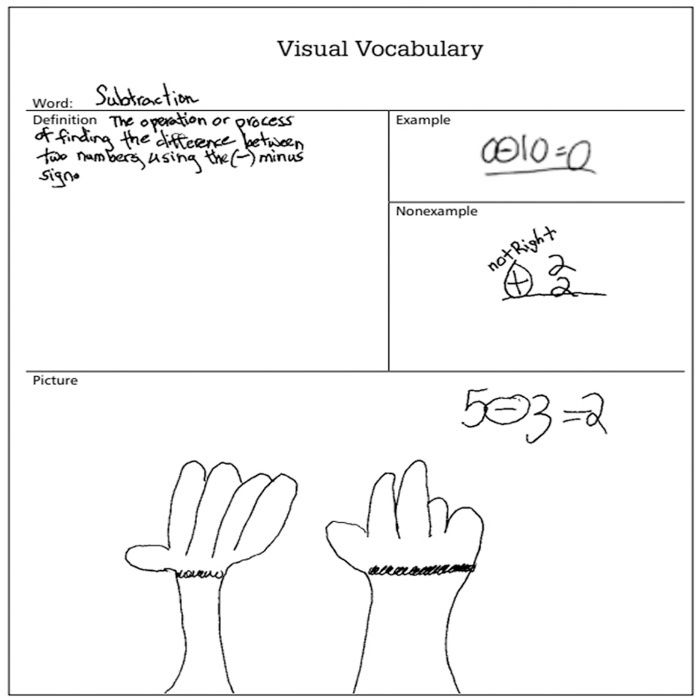
Graphic organizers are visual depictions of content in the form of diagrams, tables, maps, etc. They are a novel and appealing tool for children to develop and showcase deep conceptual understanding by using context-based vocabulary (Bay-Williams & Livers, 2009) (2). Graphic depictions, particularly by young children in the Foundational Stage, make vocabulary visible and contribute to comprehension in the same way as reading pictures. In a study conducted in 1997, learners who received vocabulary instruction through graphic organizers significantly outperformed learners who received vocabulary instruction through definitions (Monre & Pendergrass, 1997, as cited in Powell & Driver, 2014) (9).
In the given graphic organizer (Bruun et al., 2015) (3), the child works on the concept of subtraction by defining it, formulating their own mathematical problems with an example and non-example, and designing a picture showcasing subtraction.
The teacher can use this organizer to explore the child’s reasoning (Why does the child give ‘0 – 10 = 0’ as an example? Did the child intend to write ‘10 – 10 = 0’, or ’10 – 0 = 0’, or is there any other reason?); identify misconceptions (In the picture, the example ‘5 – 3 = 2’ is correct, but why does the picture show two folded fingers and three open fingers? What is the child’s process of arriving at the answer?); and obtain insights on the teaching plan (Should definitions be taught and expected to be reproduced? Can children arrive at their own definitions?)
Summary
In the Foundational Stage, basic pre-numeracy concepts related to counting, identifying numbers, and comparing quantities enable children to develop successful computational abilities such as adding and subtracting, developing a sense of basic shapes and measurement, and early mathematical thinking. Misconceptions arising from the use of language can impede mathematical comprehension. Explicit vocabulary instruction using content related to children’s real-life experiences and diverse strategies that provide multiple exposures (the key word being ‘multiple’, and not ‘repeated’!) need to be woven into the daily schedule and not exclusively left to a single teacher or period/class. Deriving an approach in alignment with the Curricular Goals and Competencies can help learners progress towards the key curricular aims of mathematics education given in the NCF for School Education (NCF-SE, 2023) (6) i.e., basic numeracy; mathematical thinking; problem solving; mathematical intuition; and joy, curiosity, and wonder!
Editor's Note
All images from textbooks reproduced with permission from NCERT.
- Apte, A. A. (2015, June 22). Gulli’s box of things. https://storyweaver.org.in/. https://storyweaver.org.in/en/stories/486-gullis- box-of-things
- Bay-Williams, J. M., & Livers, S. D. (2009). Supporting mathematics vocabulary acquisition. Teaching Children Mathematics, 16(4), 238–246. https://doi.org/10.5951/tcm.16.4.0238
- Bruun, F., Diaz, J., & Dykes, V. J. (2015). The language of mathematics. Teaching Children Mathematics, 21(9), 530–536. https://doi.org/10.5951/teacchilmath.21.9.0530
- Menon, S. (2016, November 21). Market mayhem. https://storyweaver.org.in/. https://storyweaver.org.in/en/stories/9740-marketmayhem
- De Suza, J. (2018, February 8). The very shocking report card. https://storyweaver.org.in/. https://storyweaver.org.in/en/ stories/26976-the-very-shocking-report-card
- National Council for Educational Research and Training (NCERT). (2022). Foundational Stage National Curriculum Framework. https://ncert.nic.in/pdf/NCF_for_Foundational_Stage_20_October_2022.pdf
- National Council for Educational Research and Training (NCERT). (2023). School Education National Curriculum Framework. https://ncert.nic.in/pdf/NCFSE-2023-August_2023.pdf
- National Council for Educational Research and Training (NCERT). (2023). Joyful mathematics (Class 1). https://ncert.nic.in/textbook.php?aejm1=11-13
- Powell, S. R., & Driver, M. K. (2014). The influence of mathematics vocabulary instruction embedded within addition tutoring for First-Grade students with mathematics difficulty. Learning Disability Quarterly, 38(4), 221–233. https://journals.sagepub.com/doi/10.1177/0731948714564574
- Shirali, P. (2016). Teaching word problems: A practical approach. At Right Angles, 5(1). http://publications.azimpremjiuniversity. edu.in/id/eprint/3124 11. State Council for Educational Research & Training (SCERT). (2024). Draft Sikkim Preschool Curriculum.
- State Council for Educational Research & Training (SCERT). (2024). Draft Sikkim Preschool Curriculum.