
Explorations on Symmetric Polygons


Polygons are defined as simple closed figures formed by straight line segments (that do not meet at 180 degrees). We typically name the polygon based on the number of sides it has. A polygon with three sides is called a 3-gon or a triangle, and one with four sides is called a 4-gon or a quadrilateral. In general, a polygon with n edges and n vertices is called an n-gon. The line segments or sides of a polygon are called edges and the points at which the edges meet are called vertices.
In the following, we discuss how different cuts in folded paper can lead to polygonal shapes. Students can gain a deeper insight into the relationship between symmetry and polygons by experimenting with various sequences of cuts and observing the resulting shapes.

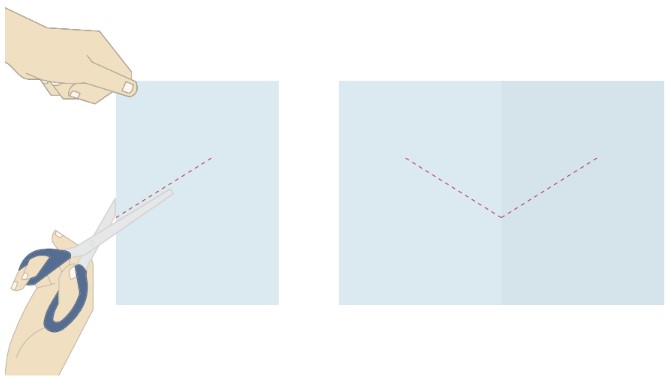
Let us understand a ‘cut’, a ‘sequence of cuts’ and a ‘cutout’, for the purpose of this article, as follows. A ‘cut’ is a single stroke of cutting the paper along a straight line (as shown in Figure 2). A second cut in a ‘sequence of two cuts’ would begin from the endpoint of the first cut, along a straight line that does not align with the first cut. That is, there is some angle (other than 180 degrees) between the two cuts at the common point they share. Figure 3 below shows a sequence of 3 cuts. By a ‘cutout’, we mean the piece of folded paper that comes out on completing a sequence of cuts that start at a point along the fold line and end at another point along the fold line. We call this a multiple cut. The picture on the right of Figure 3 shows the cutout obtained using the sequence of 3 cuts (as shown in the adjacent figure there).
Some General Observations
- To obtain a polygon as a cutout, one has to start at a point on the fold line, make cuts along straight lines (as the cutout should be made of only line segments), and end at another point on the fold line. This constraint ensures that the cutout will be a simple, closed polygonal shape.
- As illustrated in Figure 2, a single cut will not produce a polygon due to the need for more vertices and edges that mirror themselves along the fold line. Instead, multiple cuts (as described above) are necessary.

- If a point on the fold line is on a cut that is not at right angles (90 degrees) to the fold, then the point is a vertex of the polygonal cutout (see Figure 3).
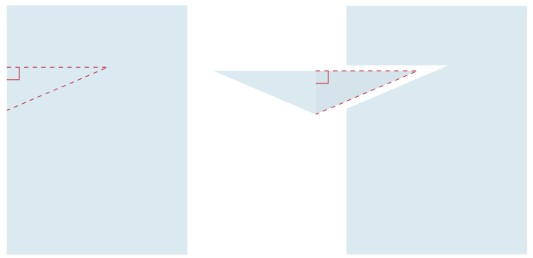
- If a point on the fold line is on a cut that is at right angles to the fold, then the point is not a vertex of the polygonal cutout (see Figure 4). Furthermore, such a point will be the midpoint of an edge of the polygonal cutout.

- Any two cuts meeting at a point (this point cannot lie on the fold line)results in two vertices of the polygonal cutout (See Figure 5).
Exploration 1: Creating Symmetric Triangles (3-gons)
Let us begin by investigating how to create a triangle that is symmetric along the line of the fold.
Question: What are the possible ways to make the cuts to obtain a symmetric triangular cutout from a folded paper?
Let us fold a piece of paper in half as shown in the figures above. Observe that we cannot use three (or more) cuts as they result in two (or more) distinct points formed by two cuts meeting and hence by Observation 5, the cut-out will have four vertices as a result. So, to obtain a triangle we should have exactly two cuts.
If neither of the two cuts are at right angles to the fold line, then by Observation 3, the two points on the fold line result in two vertices of the polygonal cut-out. The point where these two cuts meet, by Observation 5, results in two more vertices of the polygonal cut-out. Thus, in such a case the polygon has four sides and hence cannot produce a triangle.
So, the only way we can strategically make two cuts to obtain a triangle is by having exactly one of these cuts at right angles to the fold line. The below figures demonstrate the kind of strategic cuts leading to a triangle. Clearly, the fold line is a line of symmetry for the triangle obtained.

Moreover, observe that on folding these triangular cutouts along this line of symmetry, the edges on either side of it coincide, meaning these two edges are of the same length. So, we can conclude that if a triangle has a line of symmetry then the two edges on either side of the line are of equal length. Such a triangle is called an isosceles triangle. Furthermore, we see that the two vertices on either side coincide indicating that the edge joining them is bisected by the fold line.
Further exploration: How do we obtain a triangle with all three sides equal (called an equilateral triangle) by strategically making two cuts?
Exploration 2: Creating Symmetric Quadrilaterals (4-gons)
Next, we turn our attention to creating a 4-sided polygon, quadrilateral, that is symmetric along the fold.
Question: What are the possible ways to make the cuts to obtain a symmetric quadrilateral cutout from a folded paper?
First, let us fold a piece of paper in half. Observe that we cannot use four (or more) cuts as they result in three (or more) points where two cuts meet and hence by Observation 5, the cut-out will have six (or more) vertices as a result. So, to obtain a quadrilateral we should have either two cuts or three cuts.
Case 1 – With two cuts: First, let us use just two cuts to obtain a quadrilateral cut-out. As described in Observation 3, when we make two cuts neither of which is at right angles to the fold line, we obtain a quadrilateral.

In the quadrilateral \(ABCD\) (see Figure 7), observe that the fold line is a line of symmetry. Clearly, \(B\) and \(D\) are vertices of the quadrilateral that are symmetric to each other about the fold line, while \(A\) and \(C\) are vertices that lie on the line of symmetry. Let us connect \(B\) and \(D\) through a line segment, and let it cut the line of symmetry at \(O\) as shown in Figure 8.

Observe that when we fold \(ABCD\) along the line of symmetry, \(OB\) and \(OD\) coincide. Also, the angles \(AOB\) & \(AOD\), and \(COB\) & \(COD\) coincide with each other respectively.
Thus, \(OB\) and \(OD\) are of the same length. Furthermore, each of the angles \(AOB\), \(AOD\), \(COB\) & \(COD\) is a right angle.
Hence, we can conclude that in such a symmetrical quadrilateral obtained using exactly two cuts, two vertices lie on the line of symmetry and the diagonal joining them is the perpendicular bisector of the other diagonal. There are two kinds of quadrilaterals with this property: Kite and Dart. (Note that there could be a special case when a Rhombus is obtained.)
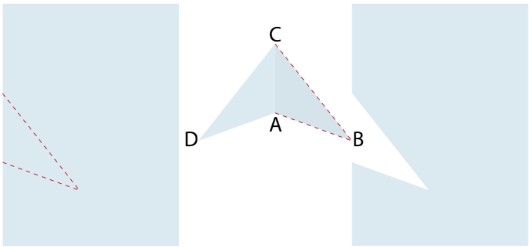
The one in Figure 7 and Figure 8 is called a Kite, and the one in Figure 9 is called a Dart. The difference between the two is that in the case of the former, the diagonal \(BD\) lies inside the quadrilateral, while, in the case of the latter, the diagonal \(BD\) lies outside the quadrilateral.
Case 2 – With three cuts: If none of the three cuts is at right angles to the fold line, then by Observation 3, the two points on the fold line result in two vertices of the polygonal cut-out. The two points where two pairs of these cuts meet, by Observation 5, result in four more vertices of the polygonal cut-out. Thus, in such a case the polygon has six sides and hence cannot be a quadrilateral.
Also, we see that if exactly one of the three cuts is at right angles to the fold line, then by Observation 4, the point on such a cut will not form a vertex of the polygonal cutout. However, the other point on the fold line that is on one of the other two cuts, forms a vertex. Also, the two points where two pairs of these cuts meet, by Observation 5, result in four more vertices of the polygonal cut-out. Thus, in such a case the polygon has five sides and therefore cannot be a quadrilateral.
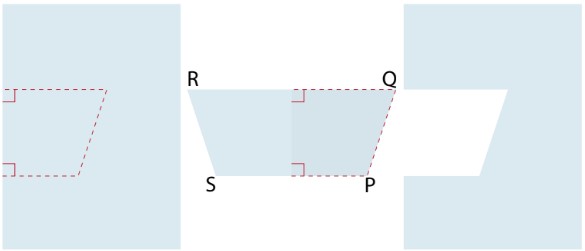
Hence, the only way we can use three cuts to obtain a quadrilateral is by making two of the cuts that are at right angles to the fold line. In that case, the two points where two pairs of these cuts meet, by Observation 5, result in four vertices of the polygonal cut-out, and there are no other vertices. The figures below (Figure 10) show a couple of such scenarios.
In the quadrilateral \(PQRS\) (Figure 10), the fold line is a line of symmetry. Clearly, \(P\) and \(S\), and \(Q\) and \(R\) are pairs of vertices of this quadrilateral that are correspondingly symmetric about the fold line. Furthermore, \(PS\) and \(QR\) are parallel to each other as they are both perpendicular to the line of symmetry. Also, on folding \(PQRS\) along the line of symmetry we observe that \(PQ\) and \(RS\) coincide meaning they are of the same length.
Hence, we can conclude that in a symmetrical quadrilateral obtained using exactly three cuts, no vertex lies on the line of symmetry, and there is a pair of opposite sides that are parallel while the other pair of opposite sides have the same length. We call a quadrilateral with such a property an Isosceles Trapezium.
Further Exploration: Under what conditions, can we guarantee that the symmetric quadrilaterals obtained through the above processes have at least one more line of symmetry?
Generalising our observations: What are the possible ways to make the cuts to obtain a symmetric n-gonal cutout from a folded paper?
- National Council of Educational Research and Training (NCERT). (2024). Ganit Prakash, Class 6 (1st ed.). NCERT. https://ncert.nic.in/textbook.php?fegp1=0-10