
Unveiling the Magic of Patterns



Mathematics is often described as the language of patterns. Observing and extending patterns is a valuable skill at any level of mathematics education. It is, therefore, not surprising that the National Council of Educational Research and Training (NCERT) emphasises the importance of observing and extending both geometrical and numerical patterns as a key learning outcome. (NCERT, 2017)
To meet these learning outcomes, the NCERT textbook for Grade 3 has a chapter “Play with Patterns”. The chapter starts with repetitive patterns that are based on colour, a sequence, and rotation by a fixed angle. Then, it introduces some growing patterns. This is followed by introducing repetitive number patterns and growing number patterns which are based on adding small numbers or adding 10.
This article is based on teaching this chapter to thirty Grade 3 students in a school in a town in Uttarakhand, India. The children were largely from the middle-class or lower income families of the town.
Session 1
The students were expected to draw patterns in their notebooks that would be similar to or inspired by the textbook patterns.

To make the session interesting and hands-on, the teacher divided the students into six groups of 5 students each and distributed Rangometry sets to them. They were asked to make their own patterns with these sets.
Exploring patterns using Rangometry
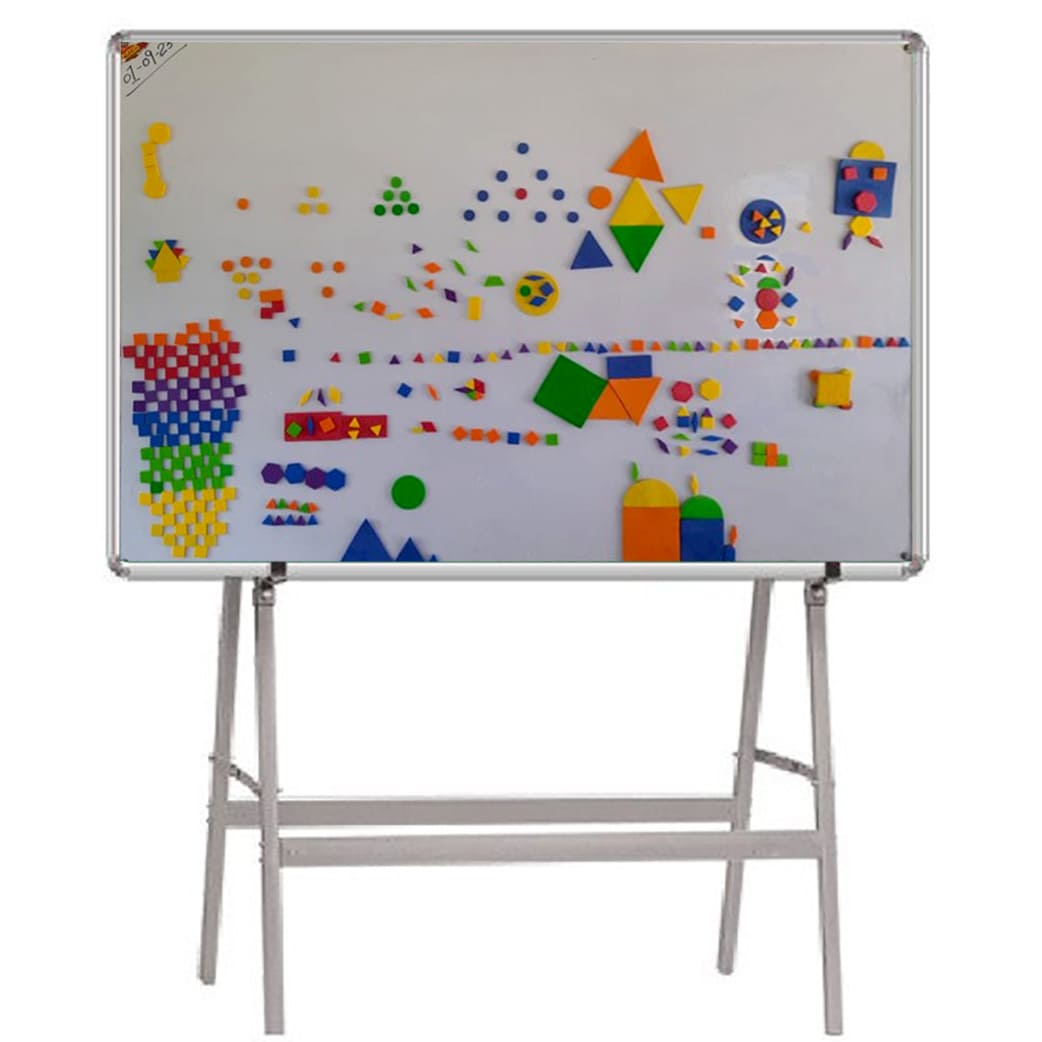
Students created various patterns using the Rangometry shapes. Some focused on the colours being in a pattern while some others focused on the shapes. Watching them work together, sharing the sets and being completely engaged was a treat to the eyes!

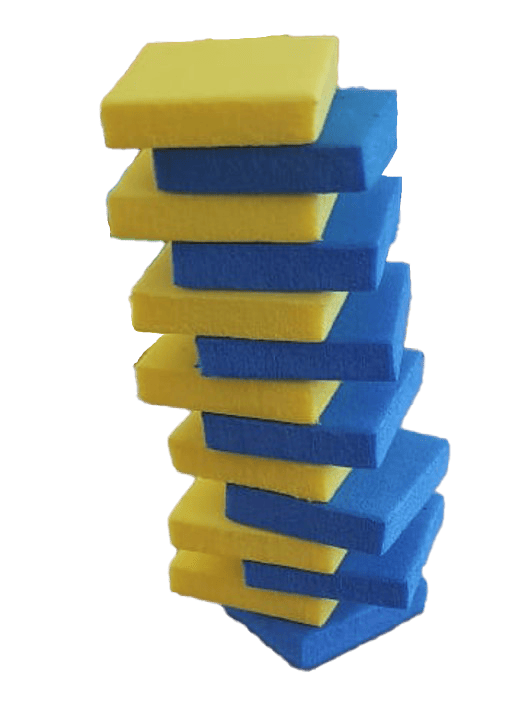
Note: The student has decided to ignore the colour of the shapes to make this pattern.
The textbook and the crayon drawn patterns in notebooks both focused on two-dimensional (2D) patterns. Thus, the teacher had expected similar 2D patterns from Rangometry as well. However, to the teacher’s surprise, students started stacking the shapes to make three dimensional (3D) patterns.
Session 2
In this session, the teacher planned to introduce increasing and decreasing patterns to students. Due to a shortage of Rangometry sets, the teacher decided to mix Aakar Parivar sets with Rangometry. Unlike Rangometry, Aakar Parivar sets have shapes in different sizes, leading to students making increasing and decreasing patterns on their own.
Exploring patterns using Aakar Parivar
Here are some such patterns:


Note: Here, students most likely didn’t focus on the number of rectangles that were being added in each subsequent stack.
Initially, the student increased the number of squares by 1, that is, 1, 2, 3, 4 but then there was no stack with 5 squares and thus, it seems like the focus was just on increasing the height and not on the numbers.


A concern and strategies to address it
Students quickly noticed that these TLMs can be used to make images such as faces, peacocks, etc. and many students started making them!
In such situations, it is not advisable to reprimand the student for not following instructions. Lecturing them on the meaning of patterns and the use of the materials may turn out to be futile. However, this can be seen as an opportunity to develop an intuitive understanding of what a pattern is. Creating the first few shapes of the pattern and asking the student to continue it may help. Picking a shape and asking why one can or cannot place it next in the sequence can help build curiosity. Giving examples of peer’s work to develop an intuitive understanding can also be helpful, although a point to keep in mind for the teacher is to ensure that this does not lead to any comparison. Thus the stray instances of wrong usage of TLMs may be mined for learning opportunities.
To keep the students engaged throughout the session it is important that the teacher has rich conversations with the students, and have relevant follow-up questions. Conversations around the patterns each student made, how two patterns are similar or different, and questions such as: “Keeping the first three shapes the same can a different pattern be made?”, “What exactly is increasing or decreasing here?”, “What can you do to change this pattern into a growing pattern?”, can engage students more with patterns.
The use of TLMs led to a lot of Aha! Moments during the sessions. The below-mentioned patterns provide evidence of learning resulting from the doing stage.


Here, a student has made this pattern in which each quadrilateral is rotated anticlockwise to get the next quadrilateral.
Also, the student has used two criteria simultaneously, that is, colour and rotation. Similarly, in the below-mentioned pattern, multiple criteria have been used simultaneously.
This is beyond what a teacher would have expected from a pattern made by a third-grade student. In fact, the teacher’s educational judgement of letting students explore the material on their own led students to be creative and unveil the potential of the materials. This gave them the freedom to choose to explore their environment as Montessori’s theory of learning suggests. (Faryadi, 2007)
Conclusion
To conclude, this classroom sets a good example of how a suitable choice of activity plan and Teaching Learning Materials can create a learning environment where students learn by using their creativity and exploring their potential. At the same time, it’s important to note here that there should be adequate material available for every student. For example, in this classroom, we tried to give at least one set of Rangometry and one set of Aakaar Parivar to each group of 5 students. This allowed them enough scope to play with colours, shapes, and sizes. However, in case of shortage, students helped each other by sharing the required colour and shape pieces. Thus, this activity helped to improve teamwork and classroom dynamics as well. These sessions highlighted children’s sensitivity towards the factors of colour and shapes, and incorporating these in any TLM can enhance the learning experience.
Acknowledgement:
The authors would like to thank Kshama Chakravarthy for her help in editing this article.
- National Council of Educational Research and Training. (2007). Play with patterns. In Maths Magic: Textbook for Class III (pp. 144-152). NCERT.
- National Council of Educational and Research Training. (NCERT). (2017). Learning Outcomes at the Elementary Stage. NCERT https://ncert.nic.in/pdf/publication/otherpublications/tilops101.pdf
- Jodo Gyan. Rangometry 2. Jodo Gyan. https://www.jodogyan.org/product/rangometry-2/
- Jodo Gyan. Aakar Parivar. Jodo Gyan. https://www.jodogyan.org/product/aakar-parivar/
- Faryadi Q. (2007). The Montessori paradigm of learning: So what? (ERIC Document No. ED496081). ERIC. https://files.eric. ed.gov/fulltext/ED496081.pdf