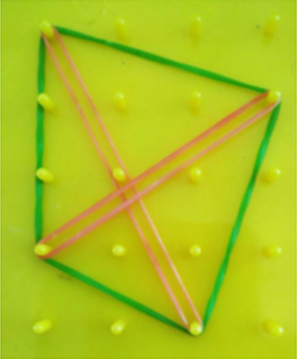

Constructing a Square with the Area \(1/n\) of a Given Square


In the following figure let \(ABCD\) be a given square (of unknown side length). Let \(PB\) = \(BS\) = \(1\) unit, and \(BQ\) = \(2\) units. Let \(PRQ\) be a semicircle passing through points \(P\) and \( Q\). Then the area of the square \(XYZB\) must be half of that of \(ABCD\).

This question and this picture were submitted by one of our authors and it made us think. Do spend some time observing this picture – Is the area of square \(XYZB\) half the area of the given square \(ABCD\)? If so, why? We explain below.
If we apply computational thinking to solve this problem, this is the first step:
Statement of the Problem: Is the area of square \(XYZB\) half the area of the given square \(ABCD\)? If so, why?
Let us try to decompose the steps: We are given that \(QB\) = \(2\) units, and \( PB \) = \(BS\) = \(1\) unit.
Given a square whose area is \(x\) square units, we want to draw a square whose area is \(\frac{x}{2}\) square units. A quick observation reveals that this is the same as given a line segment of \(\sqrt{x}\) units, we want to construct a line segment of \(\sqrt{\frac{x}{2}}\) units.
Step 1. Mark three points P, B and Q on a line l, such that B lies in between P and Q. QB = 2 units and PB = 1 unit.
Step 2. We draw a semicircle \(\alpha\) with PQ as the diameter.
Step 3. Let the line m perpendicular to l and passing through B intersect \(\alpha\) at R. (See Figure 2)
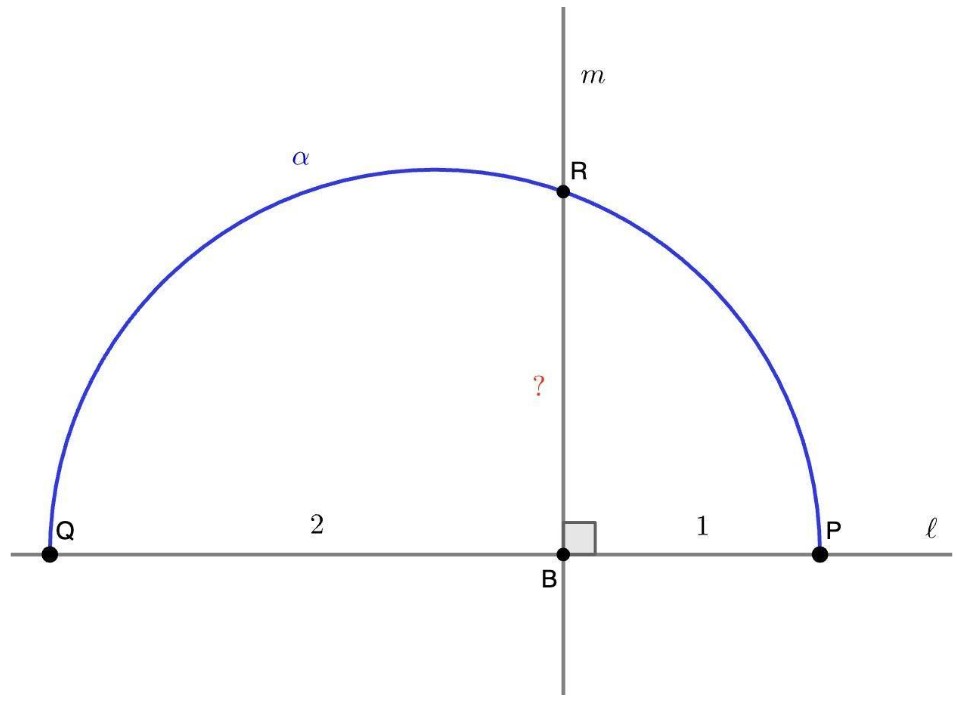
What will BR be?
From the right-angled \(\triangle PBR, PR^{2} = PB^{2} + RB^{2}.\)
From the right-angled \(\triangle RBQ, QR^{2} = RB^{2} +BQ^{2}.\)
From the right-angled \(\triangle PRQ, PQ^{2} = PR^{2} + RQ^{2}.\)
(note that \( \angle PRQ\) is a right angle in the semicircle). By using these three equations, we arrive at the fact that \(BR = \sqrt{2}\).
Step 4. Mark the point \(S\) on the line m at the other side of l such that \(BS\) = \(1\) unit (see Figure 3)
Step 5. Draw the line \(\alpha\) parallel to l passing through \(R\), and the line \(b\) parallel to l passing through \(S\).
Step 6. Choose any point \(A\) on the line \(\alpha\) and join the points \(B\) and \(A\) via the line \(c\). Let \(c\) intersect \(b\) at \(X\).
Now \(\triangle ARB\) and \(\triangle XBS\) are similar. So, if \(AB\) = \(\sqrt{x}\) units, then \(BX\) = \(\sqrt{\frac{x}{2}}\) units.
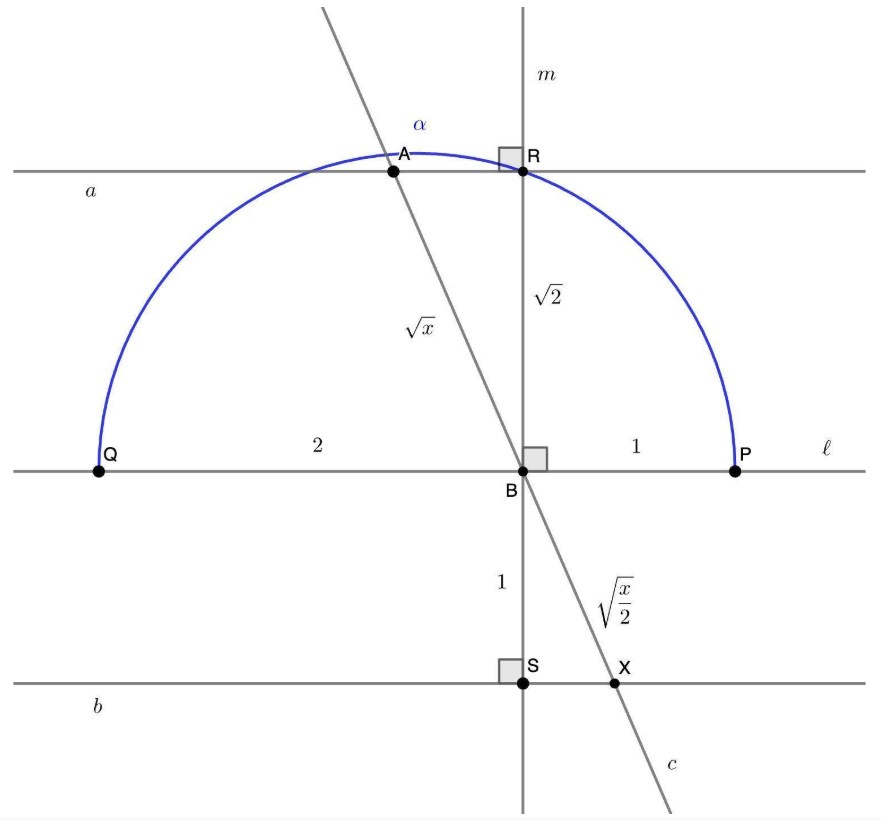
Thus, if we construct a square with \(AB\) and \(XB\) as respective side lengths, then necessarily we should have that the square with \(AB\) as a side, must be two times the area of the square with \(XB\) as a side. Thus, by decomposing the solution steps, we conclude that the area of square \(XYZB\) is indeed half the area of the given square \(ABCD\).
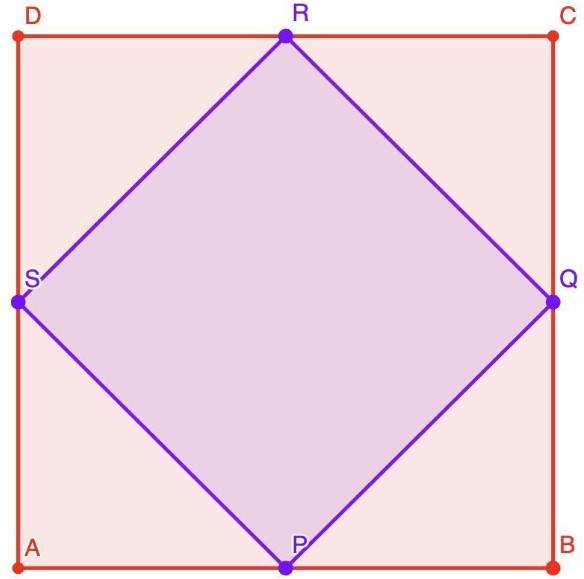
The reader might have already observed that there are simpler constructions of squares that can halve the area of a given square, such as in Figure 4. Here ABCD is a given square, and P , Q, R and S are midpoints of sides AB , BC , CD and DA respectively. However, the above construction can be extended to construct a square with area \(\frac{1}{n}\) of a given square, by taking BQ = n instead of 2 (See Problem 1 below).
Why stop at halving the area of a square? We claim that this construction can do more! We provide a set of problems for the reader to try their hands on.
Problems
- If we assume that BQ = n units, what would be the length of BR? What would be the length of BX? What is the ratio between the areas of ABCD and XYZB?
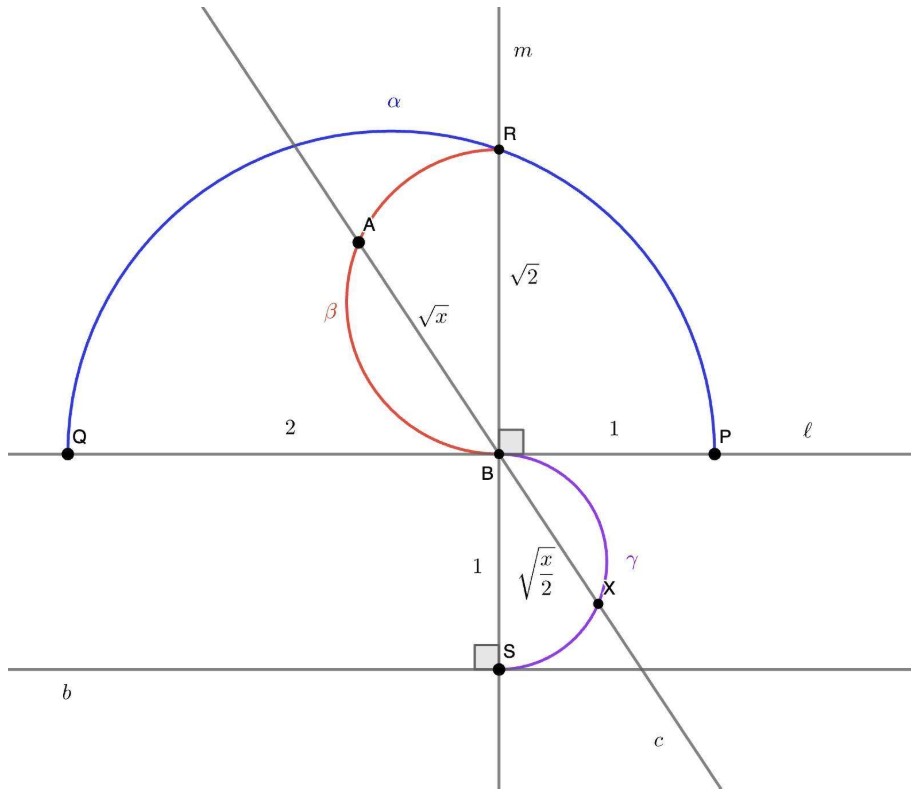
- The above construction works only if the side AB is more than or equal to BR. What if AB < BR? The above construction can be slightly modified to accommodate this possibility (Figure 5). Argue why the following construction would work. Here \(\beta\) is a semicircle joining the points B and R, and \(\gamma\) is the semicircle joining the points B and S.
- Do the above constructions work if we want to halve the area of an equilateral triangle? A regular hexagon? A regular 13-gon? A circle?
- Given a two dimensional shape, can you argue if the above constructions give a shape which is similar to the given shape and has area 1/n of that of the given shape?