
Fun with Fractions


Let us define “Fun Fractions” using the following simple rules:
- Rule 1: \(\frac{1}{2}\) is a fun fraction.
- Rule 2: If \(\frac{p}{q}\) is a fun fraction, then \(\frac{p}{q + p}\) is also a fun fraction.
- Rule 3: If \(\frac{p}{q}\) is a fun fraction, then \(\frac{q}{q + p}\) is also a fun fraction.
This means we can start with the fun fraction \(\frac{1}{2}\), and generate all other fun fractions by repeatedly applying Rule 2 and Rule 3. We can represent the processes of applying rules 2 and 3 visually by drawing a red arrow whenever Rule 2 is applied and by drawing a blue arrow whenever Rule 3 is applied.
Assume that \( \frac{p }{q} \) is a fun fraction. By applying Rule 2 and Rule \(3\) on \(\frac{p}{q}\), we get the following

For example, applying Rule 2 and Rule 3 to \(\frac{1}{2}\) can be represented as

Extending this branching one more level looks as follows.

This shows that each fun fraction branches out to create two new fun fractions.
Activity: Extend the branching to the next two levels. What are your observations?
Next, let us explore some natural questions that are also mentioned on the NRICH webpage. The reader is urged to try them before checking the solutions.
- What is the biggest/smallest fun fraction?
- What is the biggest/smallest numerator?
- Is it true that numerators are not in decreasing order?
- It seems that the numerator and denominator of a fun fraction share no common divisors except 1. Is this always true?
- Is it possible to create a closed loop of fractions, where a sequence of transformations brings you back to the starting point?
Now, I would like to take the reader through my journey of solving the above problems. First let us introduce a notation: Since there are only two possibilities at each step, we can represent every fun fraction using the notation described below.
- The fun fraction generated by Rule 1 is represented by the symbol \(A\).
- A fun fraction generated by Rule 2 is represented by the symbol \(B\), and
- A fun fraction generated by Rule 3 is represented by the symbol \(C\).
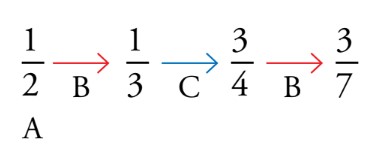
This means \(\frac{1}{2}\) is represented as \(A\), and any other fun fraction can be represented as a string starting with \(A\) and followed by a binary combination of \(Bs\) and/or \(Cs\).
For example, \(ABCB\) represents the fun fraction \(\frac{3}{7}\) , because
Solutions
- Since \(\frac{1}{2}\) is positive, every other fun fraction has to be positive. Also, since the denominator of each fun fraction is more than the numerator, each fun fraction has to be smaller than \(1\). Now let us look at the fun fractions of the form \(A\), \(AB\), \(ABB\),\(ABBB\), \(ABBBB\), and so on. This means we are applying Rule 2 repeatedly on \(\frac{1}{2}\) . Visually this mean the left most branch:

Given any natural number \(n\), its reciprocal \(\frac{1}{n}\) should be there in this branch. Thus, the entries in this branch keep getting smaller and they never end. This means that there is no smallest fun fraction possible.
Now let us look at the fun fractions of the form \(AC\), \(ABC\), \(ABBC\), \(ABBBC\), \(ABBBBC\) and so on. This means repeatedly applying Rule 2 on \(\frac{1}{2}\) , and then applying Rule 3 once at the end. Visually, this means the ‘second’ left most branch:
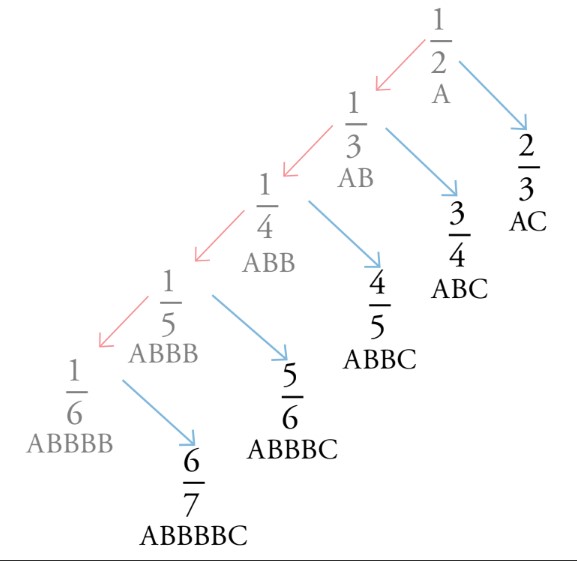
This branch consists of fun fractions of the form \(\frac{n }{n + 1}\) for every natural number \(n > 1\). So this is an increasing sequence of fun fractions that never ends. This means that there is no biggest fun fraction possible.
- The smallest numerator is clearly \(1\), which is the numerator of \(\frac{1 }{2}\). However, as we observed in Solution \(1\), \(\frac{n}{n + 1}\) is a fun fraction for every natural number \(n\). So there cannot be any biggest numerator possible.
- Yes. Since Rule 2 retains numerators and Rule 3 increases numerators, the numerators can never decrease. But what if we can cancel out a common factor between numerator and denominator at some stage? The next solution says that is not possible.
- Let \(\frac{p}{q}\) be a fun fraction. By applying Rule \(2\) or Rule \(3\), we get fractions \(\frac{p}{q}\) or \(\frac{p}{p + q}\) respectively. Let us try to compare the common factors of numerators and denominators among these three fractions.
Suppose that \(d\) is a common factor of both \(p\) and \(q\). Then clearly \(d\) should divide \(p + q\). Similarly, suppose d is a common factor of both p and \(p + q\), then d should also divide \(q = (p + q) – p\). This means that the list of common factors of \(p\), \(q\), and \(p + q\) are exactly the same.
Clearly, for the first fun fraction \(\frac{1}{2} \), there is only one common factor between the numerator and the denominator, namely \(1\). So for every other fun fraction \( \frac{p}{q}\), 1 is the only common factor of numerator \(p\) and the denominator \(q\).
- Both Rules 2 and 3 increase the denominators. So the only way in which we can obtain a closed loop is by cancelling out common factors in a fun fraction to get smaller numerators and denominators. However, by Solution \(4\), this is not possible. So there is no loop.
I also observed something interesting. Let us look at the right most branch, whose entries are in the form \(A\), \(AC\), \(ACC\), \(ACCC\), \(ACCCC\) and so on.
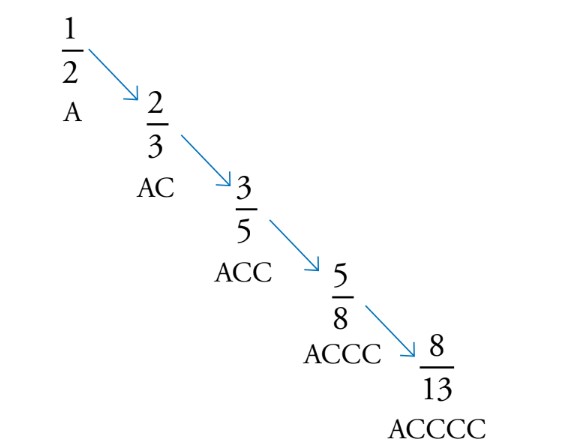
Notice that these fractions may be defined recursively as follows, and should remind us about the
Fibonacci numbers. Let for every natural number \(m\).
\(F_1 = 1\)
\(F_2 = 2\)
\(F_{m + 2} = F_{m + 1} + F_{m}\)
Clearly, any fun fraction of the form \(ACCC\)…\(CCC\) is nothing but \(\frac{F_{m + 1}} {F_{m + 2}}\), where m is the number of \(C’s\) appearing at the end. As we have already shown, this means that there are no common factors between consecutive Fibonacci numbers other than \(1\).
I also noticed that if we divide the denominator \(F_{m + 2}\) by the numerator \(F_{m + 1}\), we always get the remainder \(F_{m}\). This is simply because \(F_{m + 2} = F_{m + 1} + F_{m}\). Then I noticed something more intriguing. This is also true for fun fractions of the form \(ACCC\)…\(CCCBBB\)…\(BBB\), where \(C\) appears in the middle m times and \(B\) appears at the end k times.
For illustration, here is how fun fractions of the form \(AB\), \(ACB\), \(ACCB\), \(ACCCB\), \(ACCCCB\) and so on look like.

Let us see why this is true. Let \( \frac{p}{q}\) be a fraction of the form \(ACCC\)…\(CCCBBB\)…\(BBB\), where \(C\) in the middle appears m times and \(B\) at the end appears \(k\) times. In other words, \( \frac{p}{q} \) is obtained from \( \frac{p }{q} \) by applying Rule 3 repeatedly \(m\) times first, and then applying Rule 2 repeatedly next. So \(\frac{p}{q}\) would been obtained from \(\frac{F_{m + 1}}{F_{m + 2}} \) by applying Rule 2 repeatedly \(k\) times. So we should have
\(\frac{p}{q}= \frac{F_{m + 1}}{F_{m + 2} + k(F_{m + 1})}\)
So if we divide the denominator \(q\) by numerator \(p\), we should get \(k + 1\) as quotient and \(F_m\) as the remainder. So what we have proved is the following theorem.
Theorem: Let \(\frac{p }{q}\) be a fun fraction obtained from \(\frac{1}{2}\) by repeatedly applying Rule 3 \(m\) times, and then repeatedly applying Rule 2 \(k\) times, then if we divide \(q\) by \(p\), the remainder is always the \(F_m\) defined as
\(F_1 = 1\)
\(F_2 = 2\)
\(F_{m + 2} = F_{m} + F_{m+1}\)
Editor's Note
The problems presented in this article naturally lead to numerous variations and interesting new questions. For example, what if the initial fun fraction were different from \( \frac{1}{2} \) ? Does every fraction in its reduced form appear in the above tree? These problems can be adapted for students aged 9 to 16, offering opportunities to practise fraction operations, identify patterns, and justify their findings. Sivaraman (2021) explored a related variation in the July 2021 issue of At Right Angles, which we encourage readers to explore.
- Sivaraman, R. (2021, July). Tremendous tree. At Right Angles, (10), 17-22. http://publications.azimpremjifoundation.org/2786/1/02_Sivaraman_TremendousTree.pdf