
Investigating Perimeter and Area with Square Tiles


Materials required
- 5 cm × 5 cm square tiles cut from a thick chart paper
- Pencil and paper for notes
- Grid paper/graph paper for drawing and rough work.
Activity 1: Starting Small – Classes 3-5
In the new NCERT textbooks, the notion of measuring area by counting unit squares is introduced in Class 3, and measuring length is introduced in Class 4.
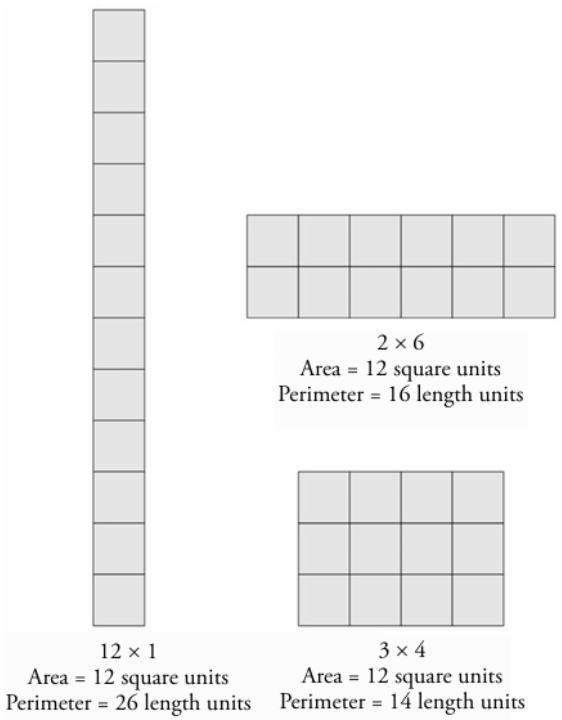
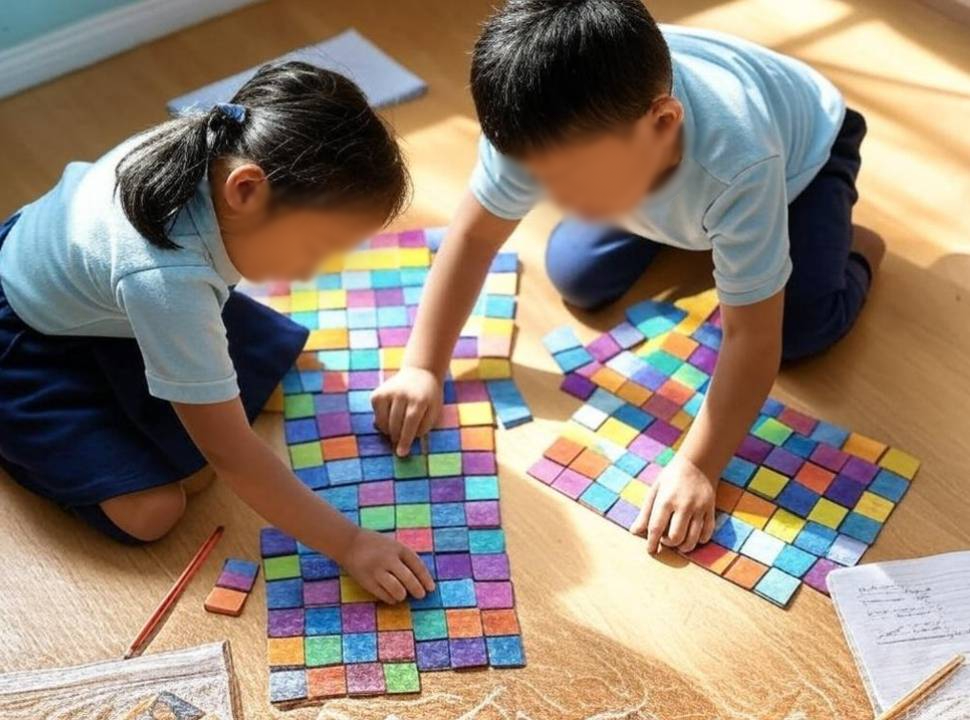
The teacher could begin with a short introduction/revision of the notions of area and perimeter, and how to measure them using square tiles. (See Figure 1.) The class is divided into groups of two, and each student is asked to create rectangles with exactly 12 tiles (orientation does not matter). The pairs discuss and find different ways to arrange these tiles and then carefully record each arrangement on grid paper. Students are then asked to count and record the perimeter (which changes), and the area (which is always 12 square units).
Activity 2: Fencing the floor – Classes 4-6
Once students are comfortable creating rectangles using a given (small) number of square tiles, the teacher can extend the investigation by inviting students to create shapes that aren’t necessarily rectangles. For clarity, we can refer to these new shapes as “floor plans.” The only requirement for these floor plans is that they must be connected, which means it is possible to start at any tile and reach every other tile by moving only across shared edges (Figures 3 and 4).
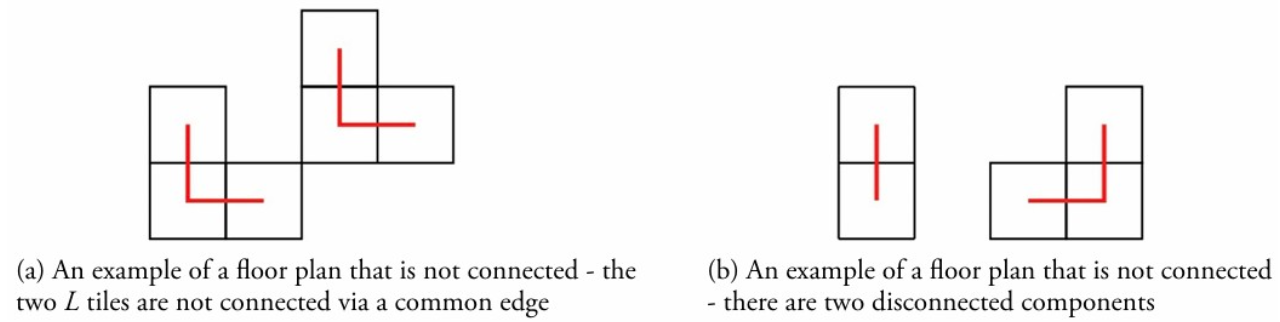
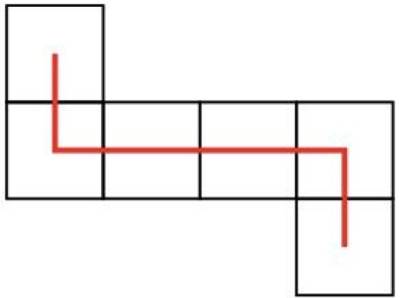
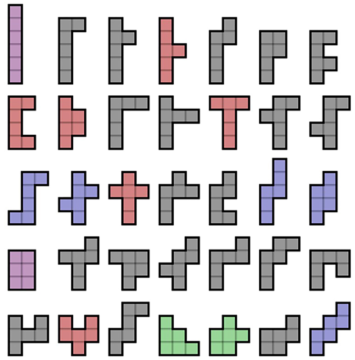
The objective of this activity is to identify the floor plan with the smallest possible perimeter. In practical terms, this means finding the arrangement of tiles that would minimize the amount (and therefore the cost) of fencing needed around the boundary. To start, the teacher provides each student with exactly six square tiles. Students are then tasked with creating and recording all possible connected floor plans on grid paper, noting that orientation does not matter (rotations or reflections are considered the same) (Figure 5). After drawing all possible floor plans, students calculate and record the perimeter of each shape.
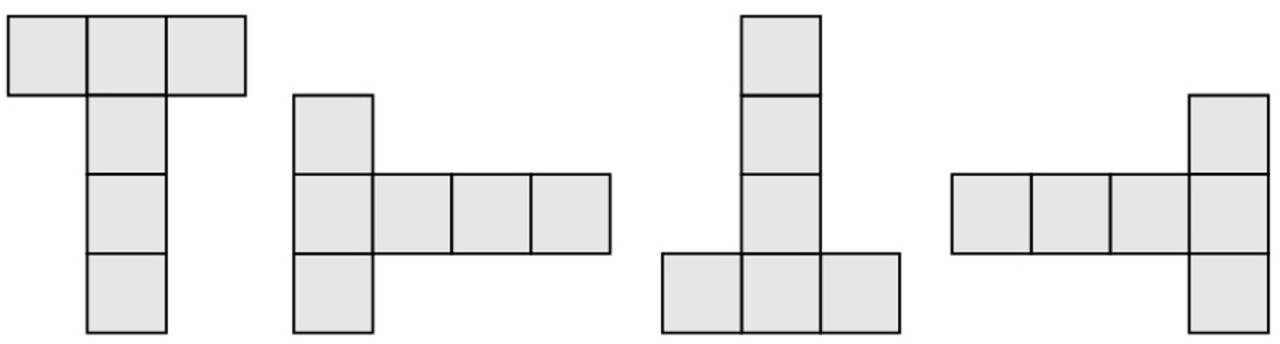
Note: It is possible to have a floor plan with a blank interior as in Figure 7. In such cases, the perimeter is the sum of the interior boundary and the exterior boundary.
The teacher discusses the following questions, and the students reason and argue why their answers are correct.
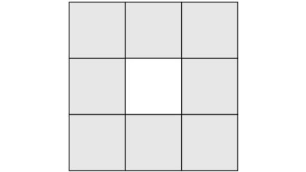
Figure 7. A floor plan with 8 square tiles
- Which arrangement had the greatest perimeter? Which arrangement had the smallest?
- Why do you think changing the arrangement affects the perimeter but not the area?
- Do you see any relationship between the rectangles and the factors of 12?
- What do you think happens if we take 13 tiles instead of 12?
- What do you think happens if we take 24 tiles instead of 12?
- Will the perimeter always be even?
- (For advanced learners) What do you think happens if we take n tiles instead of 12?
Activity 3: Conquer the land – Classes 5-7
The final activity in this series explores a related but converse question: Given a fixed perimeter, what rectangle maximizes the enclosed area? This problem could be presented as a real-world scenario: Imagine conquering land represented by square tiles, and you have only enough fencing material of a specific length (the perimeter). How can you arrange your boundary so that the land you’ve conquered covers the greatest possible area?
To begin, the teacher sets the perimeter at 24 units. Students then generate all possible rectangles with this fixed perimeter, carefully calculating the area for each configuration to identify the one with the largest area. At this stage, teachers can gently introduce the language of algebra, tables and systematic reasoning to help students organise their findings and guide their thinking. After practising with several small perimeter values, students who are comfortable with rectangles can then be challenged further: explore non-rectangular floor plans to find which shapes offer the greatest area given a fixed perimeter.
Conclusion
Through these interactive and exploratory activities, students intuitively grasp key mathematical ideas related to area and perimeter. They discover important patterns, engage in systematic reasoning, and experience how mathematical concepts connect to practical scenarios. Using simple square tiles, these activities build foundational skills and a deeper appreciation for mathematics as being both creative and practical.
For more ideas on this topic
- Some previous articles of At Right Angles have discussed similar ideas. For example the tearout https://bit.ly/3L0uH8u – this includes similar explorations on a square grid.
- One can start with smaller floor plans with n = 3 and find pairs with a) same area and same perimeter b) same area, different perimeter c) same perimeter, different area.
- There is a notion of L-ing (cutting an L from the corner of a rectangle) preserving perimeter but decreasing area and U-ing (cutting a U from a side of a rectangle) reducing area while increasing perimeter discussed in the link above. This can be explored with polyominoes. See tasks 4 and 5 in https://bit.ly/47i5jCt
- There is another Tearout on hexominoes https://bit.ly/49fKkmu