
Review: 3 Little Firefighters
By Stuart J. Murphy, Reviewed by Kshama Chakravarthy


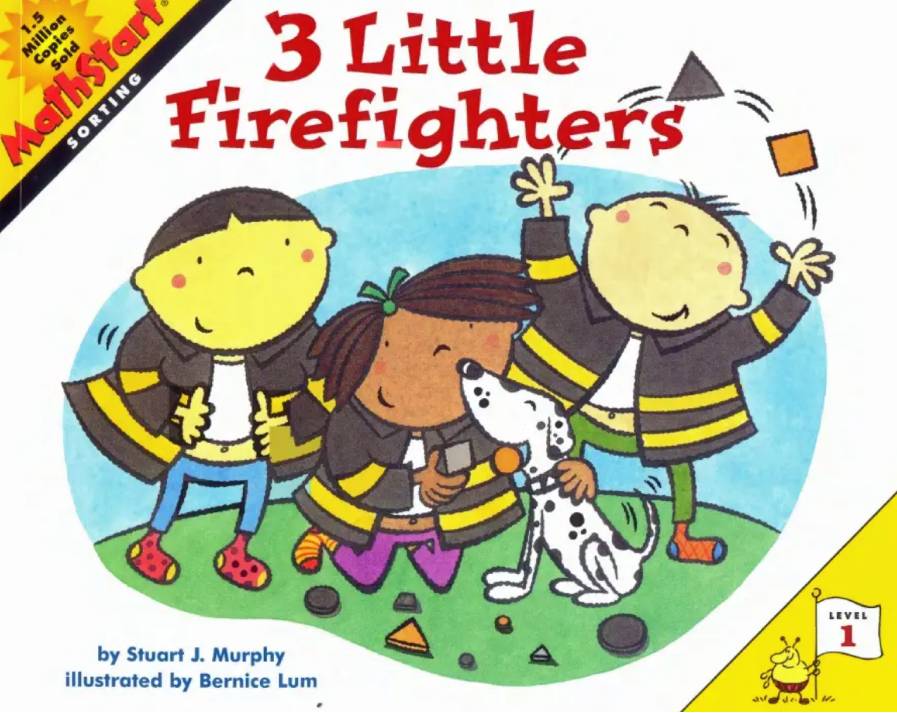
“3 little firefighters” is one of the books in the “MathStart” series and is a Level 1 book. In total there are three levels of books.
Level 1: Pre-K and Kindergarten
Level 2: Grades 1 and 2
Level 3: Grades 3 and 4
The first two levels are in line with the foundational stage as envisioned in the NEP 2020.
The topics covered in the series range from matching and sorting to bar graphs, integers, and finding unknowns. Level 3 books can be used in Grades 5 and 6 too, depending on how one holds discussions with students. For instance, the chapters on Fraction can begin or end with a read aloud of the story “Jump, Kangaroo, Jump” that covers dividing a discrete number of objects into equal groups. This can be a discussion that supplements what is covered in the textbooks. The list of topics in each of the 3 levels is shown in Figure 2. The details of all the books in each of the 3 levels can be accessed at https://www.mathstart.net/books.html.
| Level 1 | Level 2 | Level 3 |
|---|---|---|
| Patterns | Adding | Estimating |
| Comparing Sizes | Collecting Data | Classifying |
| Recognizing Shapes | Subtracting | Dividing |
| Counting | Regrouping | Time |
| Opposites | Time Lines | Fractions |
| Ordinals | Understanding Halves | Bar Graphs |
| Comparing Amounts | Symmetry | Counting Coins |
| Odd and Even Numbers | Calendars | Building Equations |
| Subtracting One | Probability | Capacity |
| Matching | Counting by 2s, 3s and 4s | Subtracting 2-digit Numbers |
| Sequencing | Measuring | Multiplying |
The book “3 Little Firefighters” deals with the concept of sorting and can be read out to children between the ages of 3½ and 6 years. I used it for a storytelling session with children in this age group and found the book to be quite engaging! The objective of this particular session was to allow kids to explore the topic of sorting in a real-life context. The assumption was that they were already introduced to sorting, and through the story and a follow-up activity they could move to more challenging situations involving sorting, based on various criteria that are either pre-defined or left for them to figure out on their own.
The book introduces the mathematical concept of sorting by attributes through an engaging story about three young firefighters preparing for a parade. The story follows three firefighters who discover, just before a big parade, that their coats have missing buttons. To solve this problem, they must find three sets of matching buttons, sorting them by attributes such as shape (circle, triangle, square), size (big, medium, small) and colour (grey, black, yellow).
The narrative unfolds with a sense of urgency and fun, as the firefighters scramble to organize their buttons in time. The vibrant illustrations by Bernice Lum complement the text, making the sorting process visually clear and appealing to young readers.
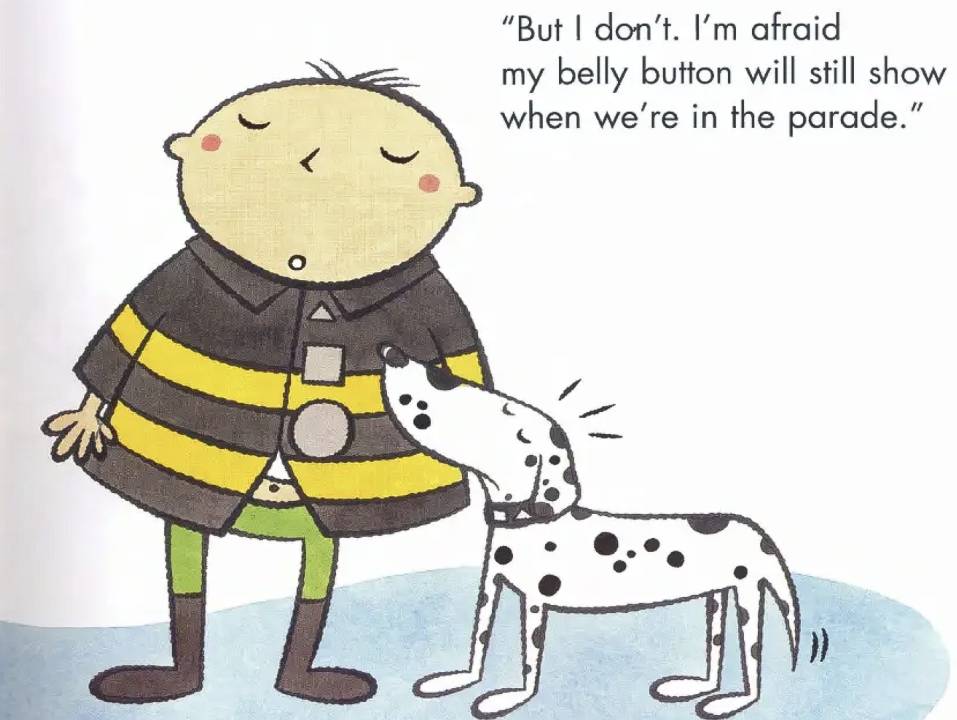
3 little firefighters are getting ready for a parade. They each need to wear a coat and find that the buttons are missing. They need 4 buttons each, so as to cover their belly buttons! (Through the entire session each reference to the belly button tickled the children pink!) They find a bunch of buttons and try to sort it by various parameters, to ensure they each have 4 buttons to wear. They first try to sort by shape. One boy gets 4 circles, but the other two only find 3 sets each of triangles and squares, and their belly buttons are seen! They cannot have that, and so they decide to sort again, this time by colour. Two of them are able to find a set of 4 each in black and orange, but the grey set has only 3! (Figure 3) Again, this sorting does not work.
Next, they try to sort by size- small, medium and large. And now, quite magically, each of them gets 4 buttons! See Figure 4. This is a good point to pause and ask children what exactly happened. They eventually realise that there are 12 buttons in all, and in the first two cases there were a few “extra” buttons that did not fit the criteria.
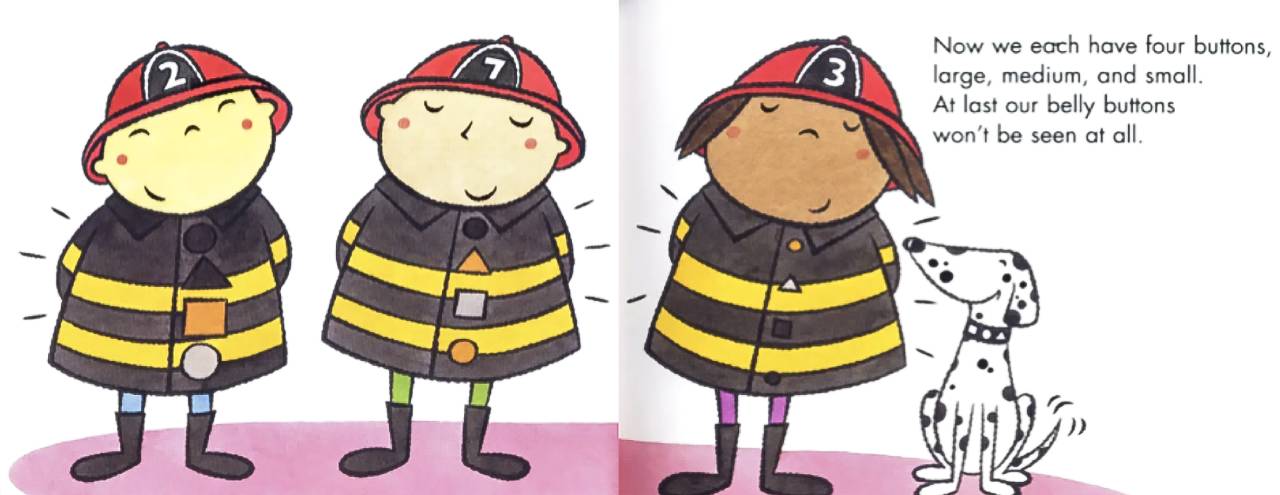
Satisfied about having done their job well, they proceed to the parade.
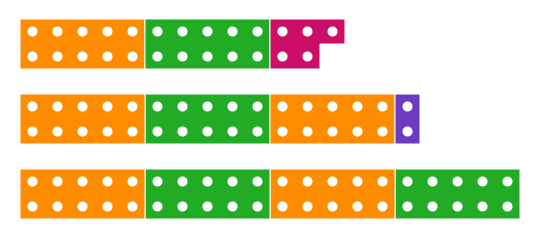
The book suggests a few activities that can be done while reading out the book. One of them is to make the various buttons- replicating the size, shape, colour and getting children to sort each time based on the criteria mentioned, to check for themselves if 4 sets each are formed. Figure 5a shows all the buttons arranged by shape (horizontally). Figure 5b shows the buttons arranged by size (vertically).
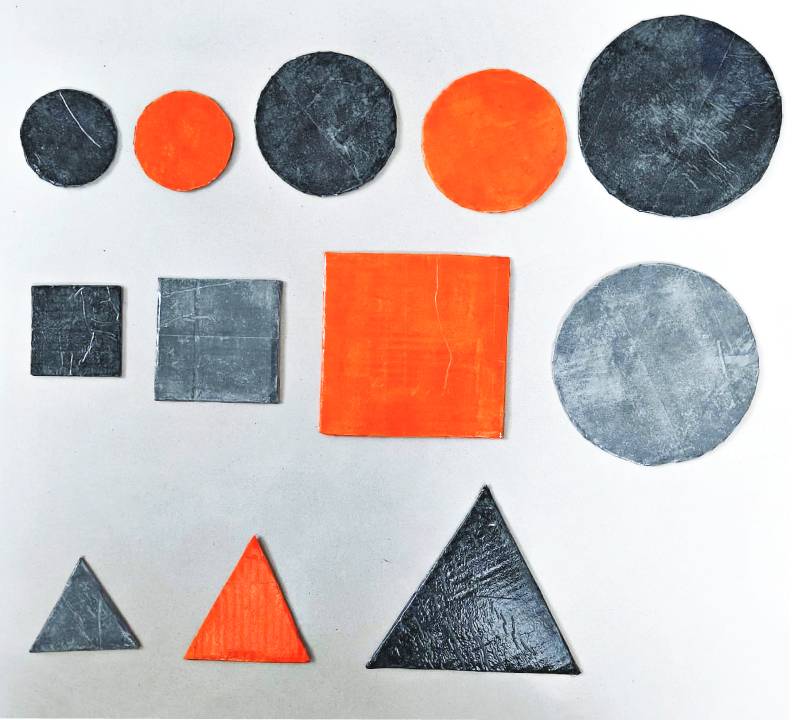
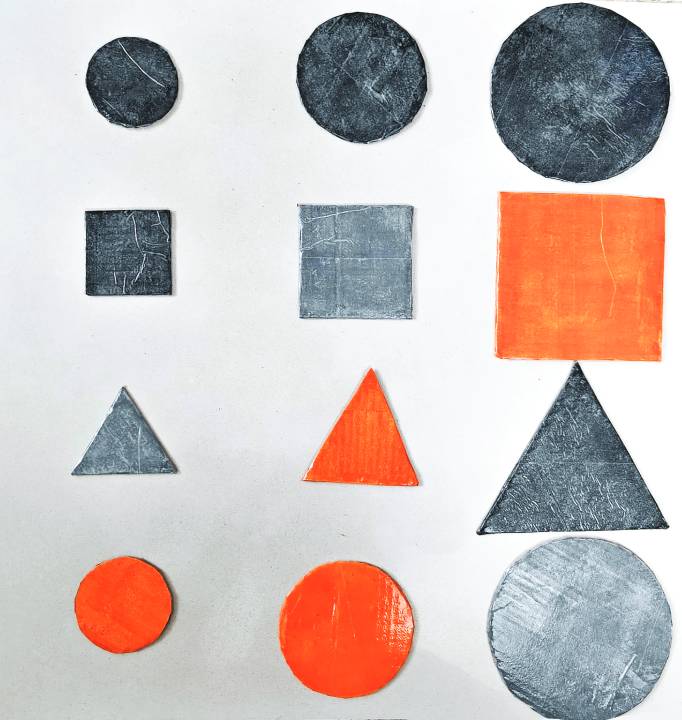
I found this really useful and engaging during the session, as children could work with these large-sized buttons, trying to replicate what was given in the book. They enjoyed trying to sort and see who was able to make a set of 4 and who could not. Moving the buttons around and exchanging the pieces every time the criteria changed, helped them pay attention to the changes based on the criteria. It possibly helped them in the follow-up activity where real buttons of various sizes, shapes, colours and patterns were distributed, and they were asked to sort them based on the criteria mentioned (by colour, shape, size and so on). Next, I placed a few buttons in three different groups and asked them to identify the “rule”. Based on their response I would place more buttons in the groups to contradict their reasoning, till they arrived at the logic I had used to sort the buttons. In the final round, each child took turns to sort, based on a certain criterion in their mind, and the rest of them guessed it.
The book excels in its ability to weave a mathematical concept into a relatable and entertaining story which presents sorting in a way that feels natural and engaging. The firefighters’ predicament is a practical problem that children can understand, and the repetitive structure of sorting by different attributes reinforces the concept without feeling didactic. The inclusion of activities at the end of the book is a significant strength. These activities encourage parents and educators to extend the math lesson into real-life scenarios, such as sorting objects at home or in the classroom.
- National Council of Educational Research and Training. (2022). National curriculum framework for foundational stage. NCERT. https://ncert.nic.in/pdf/NCF_for_Foundational_Stage_20_October_2022.pdf
- MathStart. (n.d.). Books. https://www.mathstart.net/books.html