
Little Childhood Mathematical Discoveries about Divisibility


NCERT (2017) [1] recommends observing patterns that lead to divisibility by 2, 3, 4, 5, 6, 9, 10 and 11 in the suggested pedagogical processes (p. 67) for Class 6. As rightly pointed out in the article mentioned above, the tests for divisibility by such numbers are popular among school students. Care must be taken to ensure that students discover and appreciate these interesting number patterns instead of practising them as prescribed rules. Chika’s test for divisibility by 7 was to multiply the units digit of a given number by 5 and add it to the remaining (truncated) part of the number. The original number will be a multiple of 7 if and only if the resulting number is a multiple of 7. However, in this article, we will learn about an investigation which will allow us to create several simpler tests for divisibility by 7 and other divisors, for example 13, 17, 19, 23 and so on. These tests are not widely known.
Encouraging students to notice these divisibility tests will enrich students’ perceptions about numbers and develop their number sense. This will allow students to explore and later reason out interesting patterns with numbers which can further contribute to students’ mathematical thinking. Another common aspect between this article and Chika’s story is the role of mathematical intuition in discovering interesting patterns while seeing relations between numbers and operations.
We begin with the story of a young girl called Maya, whose favourite pastime was to discover new divisibility tests for any number. Once we understand her set of simple tricks, we will be able to create our own general rules to check for the divisibility by any number without going into any complex mathematics or memorizing any rule. Wouldn’t that be fun? But to know this trick, you need to know Maya’s modus operandi. For our convenience, we will define and use some pre-defined symbols. We will denote the units digit of the given number by U and the truncated number after removing the units digits by T. For example, if the number is 5382, then U will be 2 and T will be 538, and if the number is 394, then U will be 4 and T will be 39, and so on.
To begin with, to find the divisibility test for 7, Maya would first write down the multiples of 7, i.e., 7, 14, 21, 28 and so on. She would then think of an operation between the digits of the multiples of 7 to get the outcome as 0 or 7. Thus, taking a cue from the second and fourth multiples of 7 (i.e., 14, 28), her trick would be to multiply the tens digit by 4, and find the difference between this product and the units digit to get the resulting value as 0 or 7 (Table 1).
Table 1. Trick-1: (T × 4) – U. (U = units digit, T = truncated number).
| The multiples 14 and 28 helped Maya make this rule. | ||
|---|---|---|
| Repeat until the result is 0 or 7. | ||
| Verifying the trick for a 2-digit number 84 (U = 4, T = 8) | Verifying the trick for a 3-digit number 959 (U = 9, T = 95) | Verifying the trick for a 4-digit number 9261 (U = 1, T = 926) |
| 8 × 4 – 4 = 28 Repeat for 28 U = 8, T = 2 2 × 4 – 8 = 0 | 95 × 4 – 9 = 371 Repeat for 371 (U = 1, T = 37) 37 × 4 – 1 = 147 Repeat for 147 (U = 7, T =14) 14 × 4 – 7 = 49 Repeat for 49 (U = 9, T = 4) 4 × 4 – 9 = 7 |
926 × 4 − 1 = 3703 For 3703 (U = 3, T = 370) 370 × 4 − 3 = 1477 For 1477 (U = 7, T = 147) 147 × 4 − 7 = 581 For 581 (U = 1, T = 58) 58 × 4 − 1 = 231 For 231 (U = 1, T = 23) 23 × 4 − 1 = 91 For 91 (U = 1, T = 9) 9 × 4 − 1 = 35 For 35 (U = 5, T = 3) 3 × 4 − 5 = 7 |
The most wonderful part about this trick is that it can be used as a test of divisibility by 7 for any multiple of 7. This trick can be proved using algebra or modulo arithmetic. However, as this is beyond the scope of elementary school mathematics, the proof is not discussed in this article.
Though the operations have been repeated until the result is 0 or 7, the process may be stopped and a conclusion reached when the result is a recognisable multiple of 7. For example, in columns 2 and 3 of Table 1, the process can be stopped on arriving at 147 and 1477, respectively.
What if there is a more efficient trick, which can reduce the number of digits in a number with each succeeding step? Maya thought of a new trick, sparked by the digits of the specific multiple of 7, i.e., 21.
Trick-2 was to multiply the units digit with 2 and find the difference between this product and the tens digit, i.e., T – (2 × U), to get the resulting number as 0 or 7 (as shown in Table 2). As before, this trick can be proved to be true for all multiples of 7.
Table 2. Trick-2: T – (2 × U). (U = units digit, T = truncated number).
| The multiples 21 and 42 helped Maya make this rule. | ||
|---|---|---|
| Repeat until the result is 0 or 7 or a known multiple of 7. | ||
| Verifying the trick for a 2-digit number 84 (U = 4, T = 8) | Verifying the trick for a 3-digit number 959 (U = 9, T = 95) | Verifying the trick for a 4-digit number 9261 (U = 1, T = 926) |
| 8 – (2 × 4) = 0 | 95 – (2 x 9) = 77 | 926 – (2 x 1) = 924 For 924 (U = 4, T = 92) 92 – (2 x 4) = 84 For 84 (U = 4, T = 8) 8 – (2 x 4) = 0 |
It is interesting to notice that Trick-2 is more efficient than Trick-1 as Trick-2 is directly reducing a 4-digit number to a 3-digit and then a 3-digit to a 2-digit number to quickly decide if the given number is divisible by 7 or not.
The clue for deriving these tricks is to get 0 or a multiple of 7, with some operations between the units digit and the tens digit observed in two-digit multiples of 7. Chika’s test can also be stated as T + (5 × U) using multiples of 7 such as 42 or 35. Further, it would be interesting to check if the above tricks will be more efficient than Chika’s test, but this task I leave for the reader. A word of caution, in case students have not encountered negative numbers, the teacher can encourage them to just find the difference between numbers (finding the magnitude and ignoring the sign) while using the trick.
Now, let us explore the divisibility trick for 13. Here again, we will start with writing down the multiples of 13, i.e., 13, 26, 39, 52 and so on. And in this case as well, the approach is to look for some operations between the digits that will lead to 0. In case of multiples of 13, it will be obvious that multiplying the tens digit with 3 and finding the difference between this and the units digit will give 0.
Table 3. Trick-3: T × 3 – U. (U = units digit, T = truncated number)
| The multiples 13 and 26 sparked this rule. | |
|---|---|
| Repeat until the result is 0 or 13 or a recognisable multiple of 13. | |
| Verifying the tricks for a 3-digit number e.g. 741 (U = 1, T = 74) | Verifying the tricks for a 4-digit number e.g. 3003 (U=3, T =300) |
| 74 × 3 – 1 = 221 For 221 (U = 1, T = 22) 22 × 3 – 1 = 65 For 65 (U = 5, T = 6) 6 × 3 – 5 = 13 | 300 × 3 – 3 = 897 For 897 (U = 7, T = 89) 89 × 3 – 7 = 260 |
Here is a task: Does T + 4 × U (sparked by 13, 91 and 52) work to identify multiples of 13? Which of these two tricks do you think works more efficiently, giving you smaller numbers at each step?
Similarly, the test for divisibility by 17 can also be figured out by first writing down its multiples, i.e., 17, 34, and 51 and examining their digits to figure out some pattern. For example, (7 × T) – U (sparked by 17) and T – (5 × U) (sparked by 51) are divisibility tricks that help to identify multiples of 17.
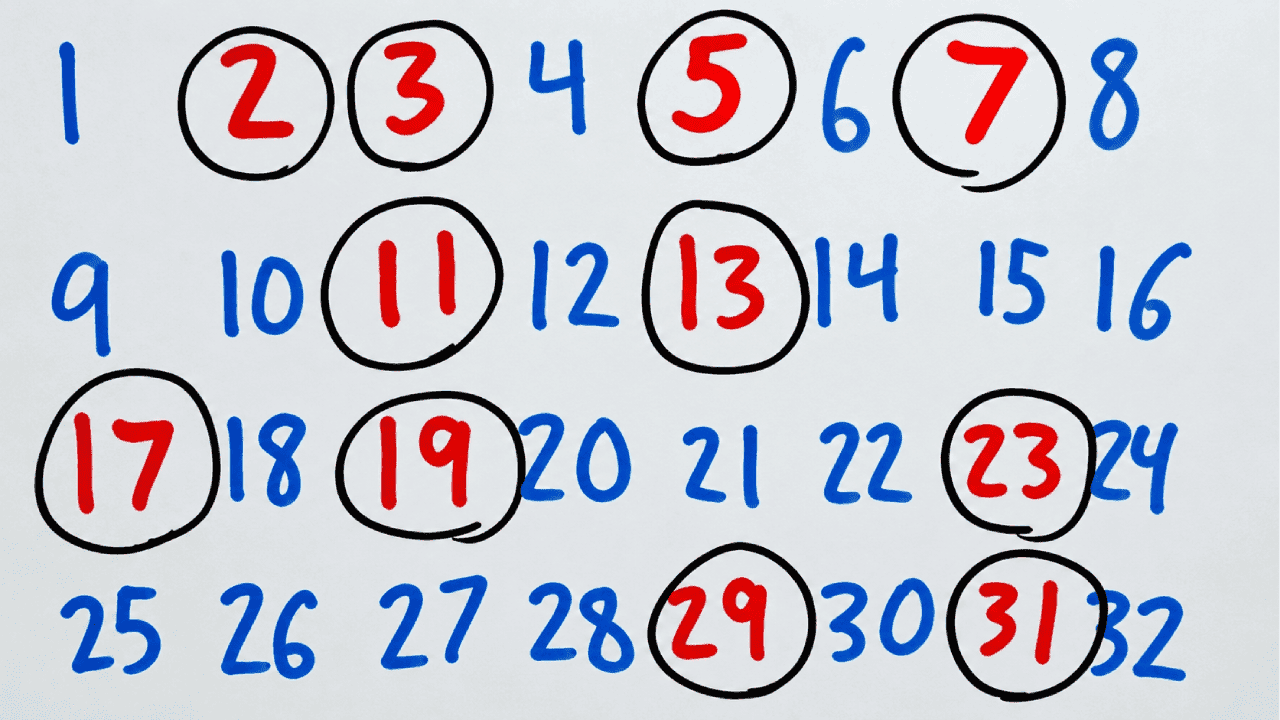
This indicates there is no single divisibility test for a number and that these tests can be derived following these simple rules. In this article, the examples were tried mostly with prime divisors, i.e., the divisors were numbers which have no factor other than 1 and themselves. The reader is encouraged to find more tricks for other prime numbers from the list of primes: 2, 3, 5, 7, 11, 13, 17, 19, 23, 29, 31, 37, 41, 43, 47, 53, 59, 61, 67, 71, 73, 79, 83, 89, 97 and so on.
Further, one can create these rules even for composite numbers. And I encourage you to try finding out the divisibility test(s) for any other two-digit number of your choice.
It is interesting to notice from this article that the digits of the multiples of a certain number are related by different patterns that lead to divisibility rules. And that all these patterns work for all multiples of the numbers, as seen in the examples discussed in the article.
While the examples used have all been multiples of the divisor under consideration, it would be useful for students to verify that these rules are not satisfied for non-multiples of this number. Such investigations are a subtle opportunity for making practice with number operations interesting. Students feel like investigators and explorers when the mathematics class offers them such avenues. I hope this article revives such intuitive discoveries among learners interested in mathematics.
Acknowledgement: The author is grateful to Aaloka Kanhere and Rossi D’Souza for reviewing the initial draft.
- National Council of Educational Research and Training. (2017). Mathematics learning outcomes for Class VI. In Learning outcomes at the elementary stage (p. 67). NCERT. https://bit.ly/4o2okAb