
Teaching Mathematics Through Problem-Solving: A Pedagogical Approach from Japan
By Akihiko Takahashi Reviewed by Anusha T


The book is a significant addition to mathematics education literature as it brings together decades of Japanese classroom practices and research, and explains them in a way that both teachers and researchers can understand. Adding to its strength, the book gives a detailed explanation of the pedagogical approach called Teaching Through Problem-Solving (TTP). I am deeply impressed by the way the book connects theory with what actually happens in classrooms. Often, educational ideas stay stuck in research papers and do not reach teachers, but this book makes those ideas practical and usable in classrooms. The author bridges this gap by providing real lesson examples, classroom stories, and practical teaching strategies. His writing does not only speak to researchers but also gives teachers and content developers ample concrete ideas that they can try.

For many years, Japanese students have consistently performed very well in mathematics in international tests like TIMSS and PISA1, but what is often overlooked is how they are taught.
In many Indian classrooms, problem-solving is often seen as something to follow up after the main lessons, i.e., once the concepts are taught and the formulae are explained. In Japan, however, the process is reversed: the problem itself is the lesson. Students are introduced to a well-chosen problem, and by working on it, they discover new concepts and methods. This book gives us a clear picture of this teaching method. The book explains how Japanese teachers structure such lessons, what kinds of classroom discussions (called Neriage) happen, and how students’ thinking develops step by step. This is important for all the stakeholders of mathematics education because it offers an alternative to the lecture-and-practice model that dominates in many countries. It shows us how mathematics can be taught in a way that is both challenging and joyful for students.

Finally, the book highlights the role of teacher collaboration. Teaching through problem-solving cannot succeed if teachers work in isolation. The Japanese system of Jyugyou Kenkyuu (lesson study) shows how teachers can work together to design, observe, and improve lessons. This makes the book important not just for teaching mathematics, but also for thinking about how teachers can develop professionally.
Overview of the Book
In the first chapter, “Development and Major Concepts of Japanese ‘Teaching Through Problem Solving’ (TTP),” the author traces how Japanese teachers and schools collaborated to develop and spread TTP as a powerful pedagogical approach. He clearly outlines the three kinds of TTP lessons and the four types of Neriage, that structure these lessons. This chapter provides the conceptual foundation for understanding how TTP can be thoughtfully designed and effectively taught.
Chapter 2, “TTP Lessons You Can Use,” is particularly engaging as it provides a wide range of classroom-ready TTP lessons, with multiple examples for each lesson type. What makes this chapter stand out is the way it balances theory with practicality that teachers can immediately see how abstract ideas of TTP take shape in real classroom contexts.
Chapter 3, “Designing Your Own TTP Lessons,” serves as a practical guide for teachers ready to take the next step. One of the most interesting ideas here is the introduction of Neriage Maps, simple yet powerful sketches that help visualize the flow of whole-class discussions. These maps not only make lesson planning more structured but also give teachers a concrete tool for facilitating meaningful mathematical dialogue.
Chapter 4, “How TTP and Collaborative Lesson Research (CLR) Can Change Your School,” really stood out to me because it goes beyond just what happens in one classroom; it talks about how an entire school can grow when teachers work together and learn from each other. The author situates TTP within the Japanese practice of Lesson Study, showing how teachers in Japan collaboratively refine their lessons through systematic observation and discussion. What I found particularly valuable is his introduction of Collaborative Lesson Research (CLR), an adaptation designed for teachers outside Japan. By presenting CLR as a practical model, the chapter highlights how schools worldwide can build a culture of collective inquiry, making TTP not just a teaching strategy but a driver of school-wide improvement.
What I Like About the Book
I really like the content discussed in Chapter 2 because it establishes problem solving as an integral part of every lesson for every grade, with a handful of well-chosen examples rather than just theory. What I appreciate the most is that the TTP lessons in the book are not generic—they are drawn from actual Japanese classrooms and show how TTP can be used to introduce new concepts, expand understanding, and promote mathematical thinking through open-ended problems with multiple correct answers. The chapter also gives scope for teachers to adjust the lessons based on students’ prior learning and classroom needs, which makes it very usable in diverse Indian contexts. Lessons from across the sections give students the space to struggle, explore, and articulate their thinking, which can lead to much deeper learning.
The Japanese school system includes six years of elementary education (ages 6–12) and three years of lower secondary education (ages 12–15), followed by three years of upper secondary education (ages 15–18). The author presents various examples of TTP lessons across schooling stages. The author divides Chapter 2 into three sections; in section 2.1 he gives five TTP lessons where each unit includes 3-4 progressive lessons. In sections 2.2 and 2.3, the author gives spotlight lessons. The three sections are discussed below with a few examples.
Section 2.1: Lessons to develop conceptual and procedural understanding
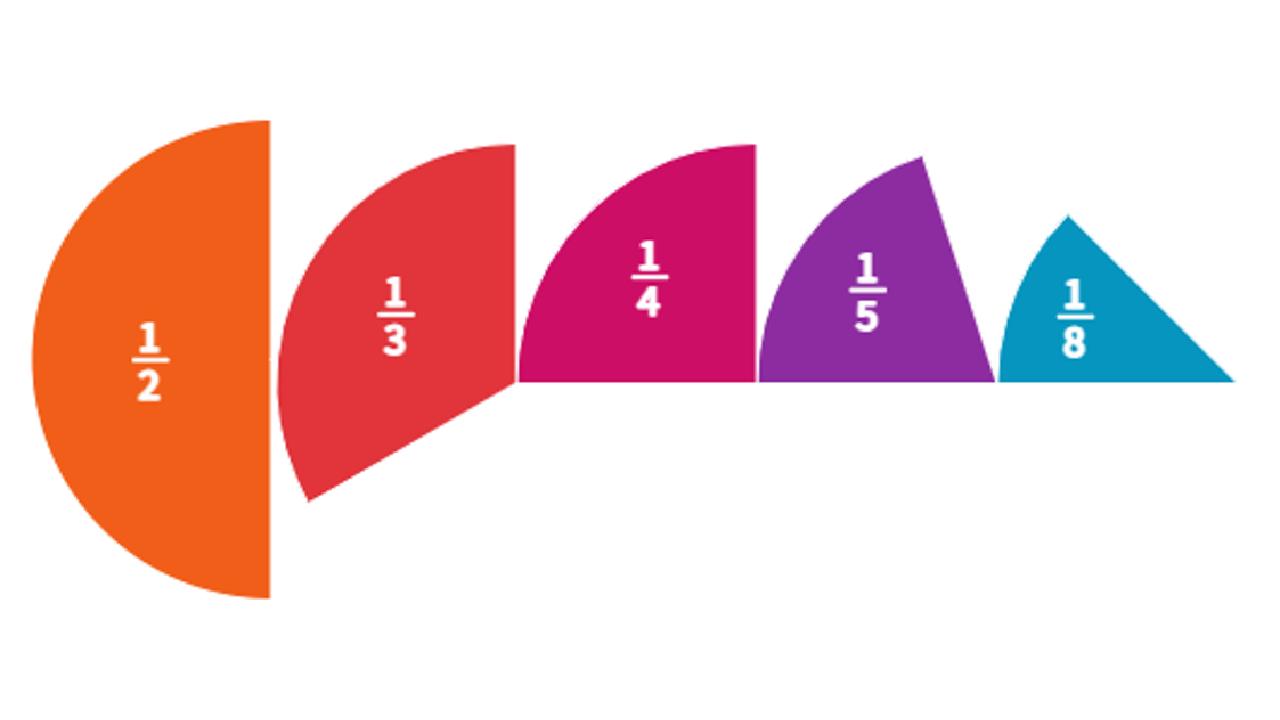
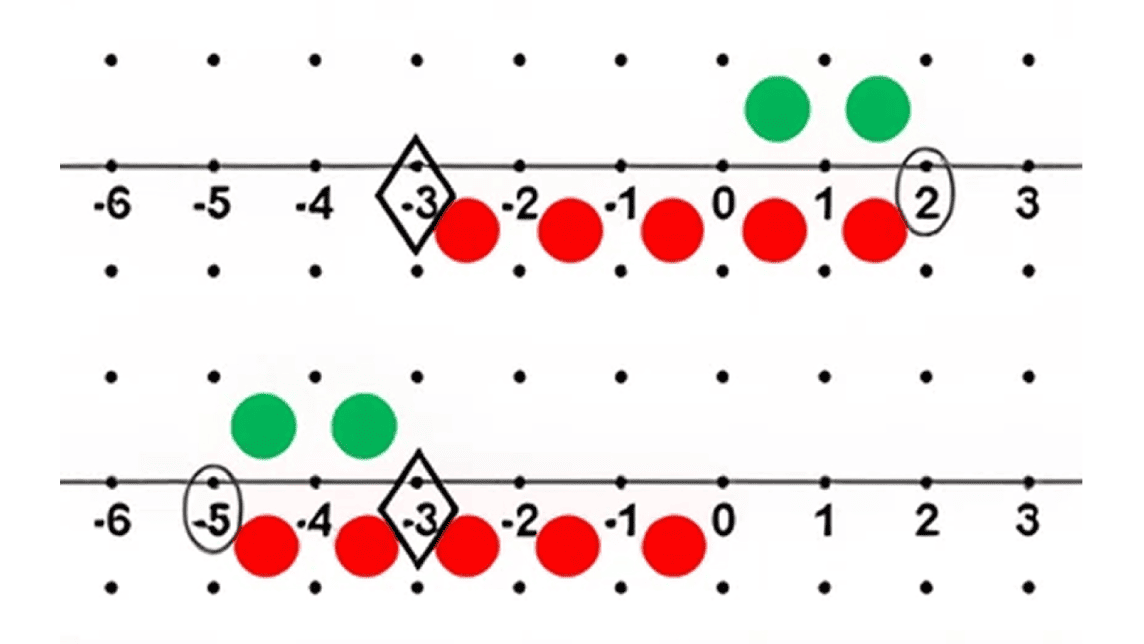
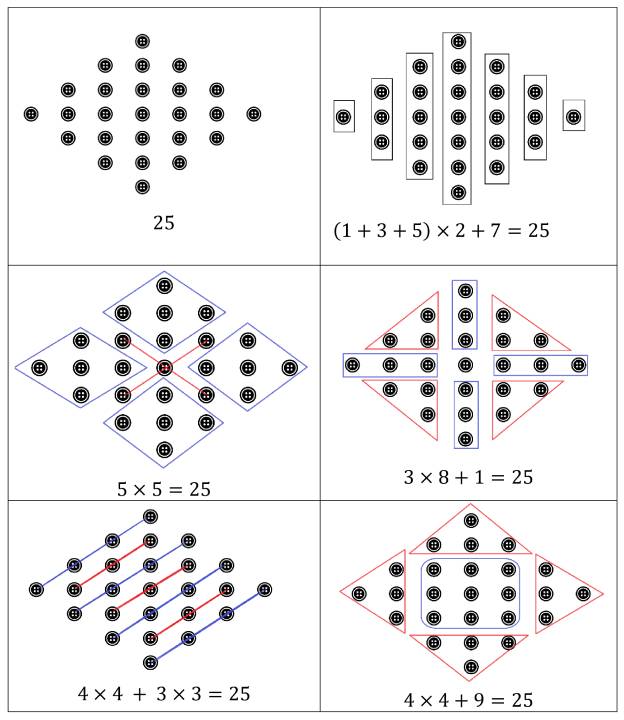
In this section, the author discusses units “Can you add these numbers without counting one by one”, “Ideas of quantifying crowdedness and speed”, “Deriving the Area Formula of Parallelogram”, “Introducing fractions” and “Building a bridge from Arithmetic to Algebra”. All the units are interesting, but I would like to discuss the unit “Building a bridge from Arithmetic to Algebra”. In the lessons the author establishes the crucial foundation of learning algebra. The TTP lessons are well-structured and build progressively, encouraging students to think deeply rather than rely on rote methods. Through problems like organising the dots and the stick arrangement task, students learn to generalize patterns, create and test mathematical expressions, and reason without direct counting. They also explore algebraic thinking through quasi-variable concepts and discuss arithmetic rules like parentheses and order of operations. The focus on reasoning, expression, and verification helps students develop strong foundational skills in mathematical thinking, making this section a valuable resource for teachers.
For example, the TTP lesson ‘Let’s think about ways to count the number of dots‘ discusses different ways of counting dots and representing them using mathematical expressions. This lesson is designed to help students explore the generalizability of mathematical expressions and connect symbolic expressions with concrete representations. Figure 3 illustrates the various strategies students used to count the dots and the mathematical expressions that emerged, as discussed by the author in the book.
Section 2.2: Lessons to expand understanding
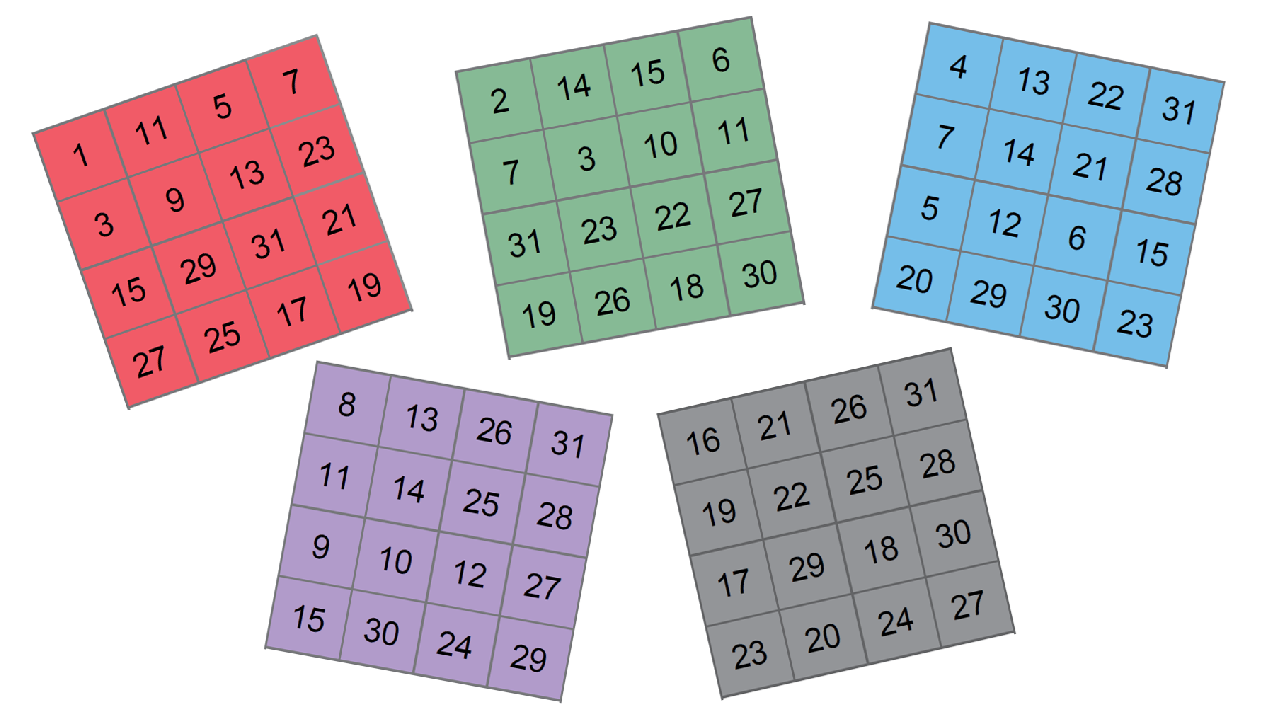
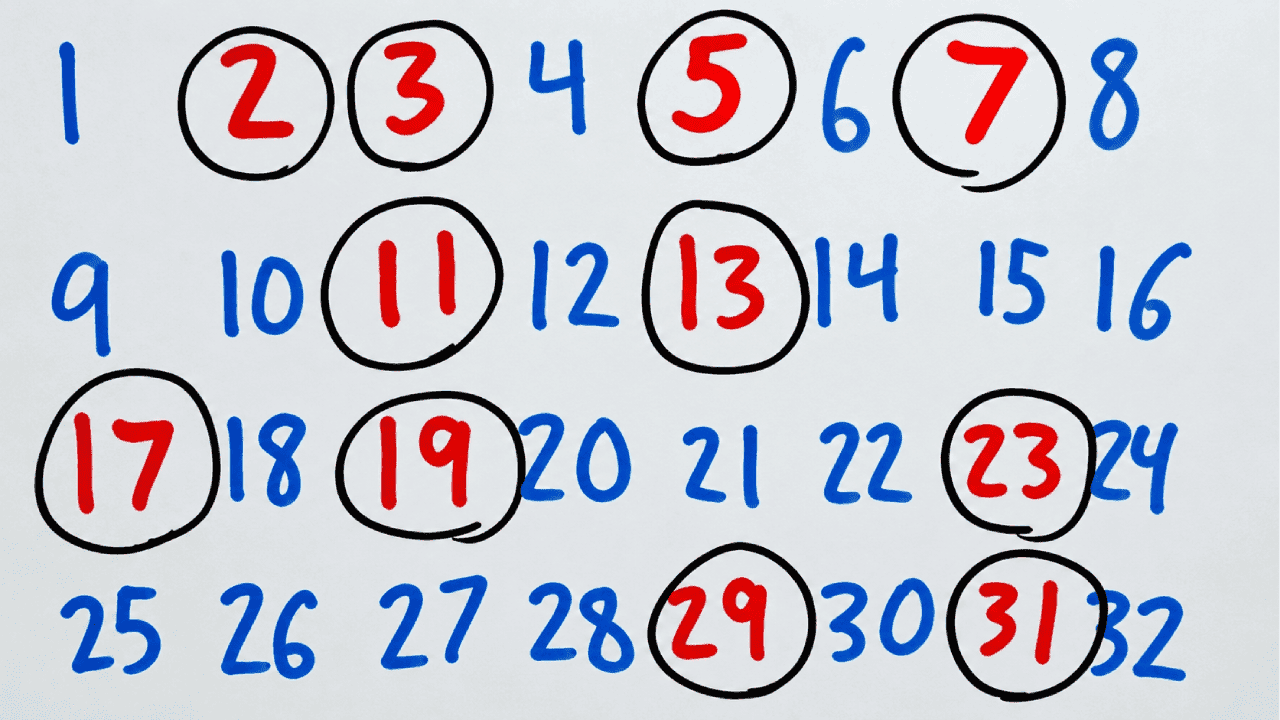
In this section, the author gives stand-alone lessons to challenge students’ mathematical thinking and ability to solve problems. The author calls these as “spotlight lessons” to highlight that these can be added to the existing curriculum. Spotlight lessons are “Curious Subtraction”, “Comparing areas using pattern blocks”, “Let’s Make a calendar”, “Finding the area of triangles inside parallelogram”, “Devising ways to construct a congruent triangle”. All the lessons are interesting; to understand the nature of the lesson in this section I will discuss “Let’s Make a Calendar”. In this lesson children are expected to use their understanding of place value and properties of operations to perform multi-digit arithmetic. The pedagogical process undertaken here to find the least number of cards needed to make numbers from 1-31, and the productive Neriage that results in development of logical progression in the process are both very impressive. This lesson gives scope to deepen understanding of base ten place value notation as well as geometry.
Section 2.3: Lessons with Problems having multiple correct answers
In this section, the author discusses several spotlight lessons: “Opening a Cube,” “How Many Different Squares Can You Make on a Geoboard?”, “Find All the Isosceles Triangles on a Geoboard,” and “Let’s Create a New Math Problem! (A Lesson from the Book Mondai kara Mondai e)” All these lessons present open-ended problems with multiple correct solutions, encouraging students to develop higher-order thinking skills (Becker & Shimada, 1997). The lesson “Let’s Create a New Math Problem!” is designed for all grade levels and was developed by Japanese researchers and educators. It is taken from the popular Japanese book Mondai kara Mondai e (Takeuchi & Sawada, 1984). This lesson provides an opportunity to extend the “stick problem” discussed in previous sections by creating new problems. For example, a minor modification to the original problem leads to new questions such as: “If we make 50 adjacent squares using sticks of the same length, how many sticks do we need?” or extending to making adjacent cubes. The Neriage map of Let’s Create a New Math Problem! can be seen in Figure 4.
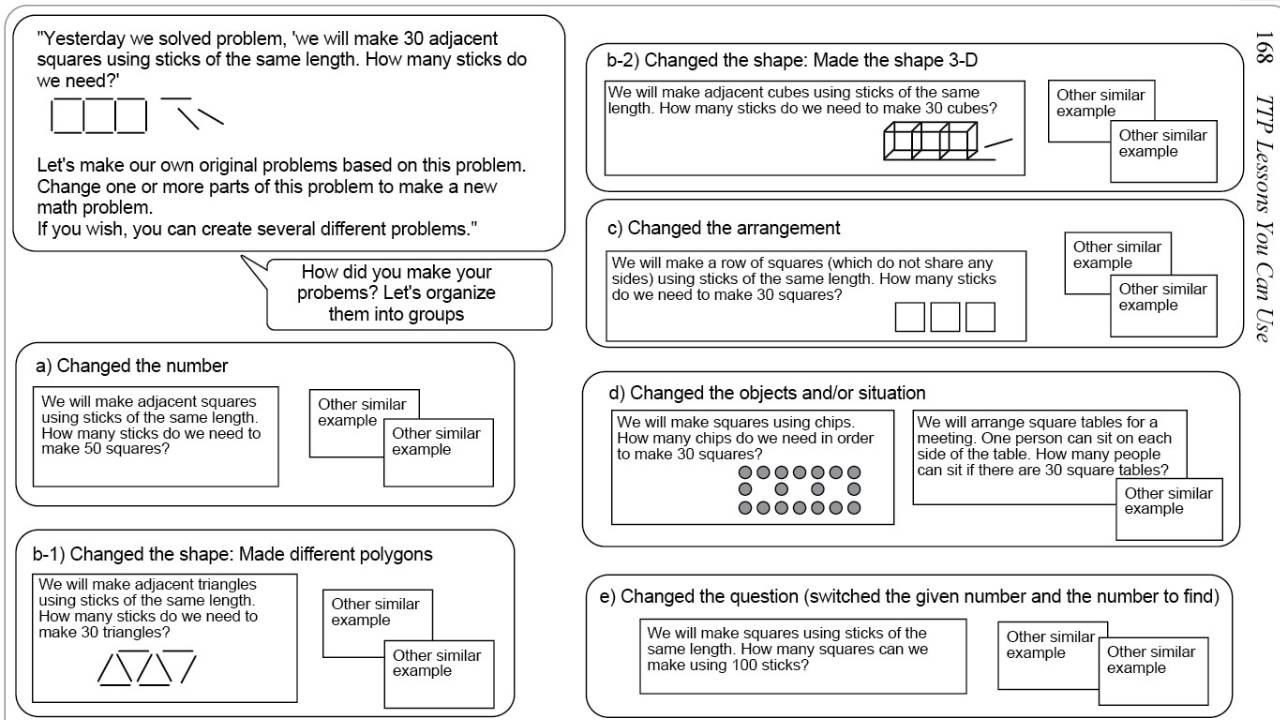
Figure 4: Neriage Map of “Let’s Create a New Math Problem! A lesson from Mondai kara Mondaie”. This page is reproduced with permission from the publishers, who have licensed the use of a complete scanned page from the book.
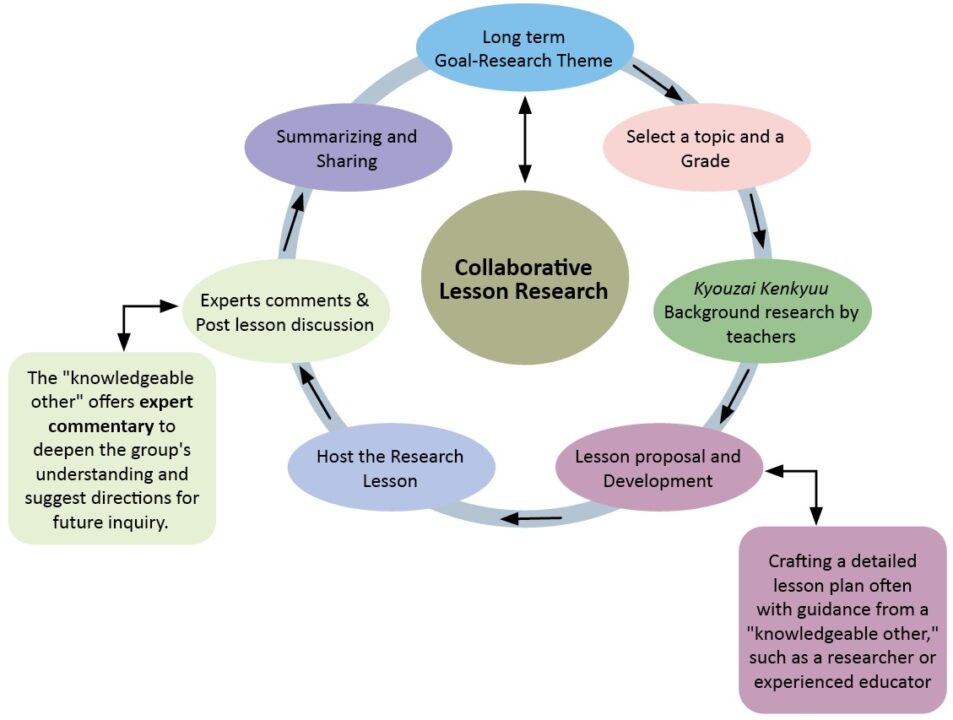
In Chapter 4 of the book, the author connects research to practice by showcasing how CLR can transform school wide teaching practices. The process of CLR represented using Figure 5 exemplifies how research becomes practice. Teachers use instructional strategies such as anticipating student thinking, promoting student centred mathematical conversations, and designing cognitively demanding tasks not as abstract ideas but as tools for lesson design and reflection. CLR shifts professional development from isolated workshops to embedded, collaborative inquiry. Teachers learn from each other, from students, and from experts, creating a dynamic feedback loop that continuously improves teaching quality. Through CLR, schools can build a sustainable model where teachers are empowered as co-researchers, and student learning is at the centre of instructional design.
Relevance to the Indian context and curriculum reforms
Teaching mathematics through problem-solving aligns closely with the principles of competency based learning outlined in the National Curriculum Framework for School Education (NCF-SE) 2023. The book emphasizes student-led exploration, where learners engage with unfamiliar problems before receiving formal instruction. This fosters critical thinking, creativity, deep understanding and skills, which mirrors NCF-SE’s focus on developing competencies rather than on rote memorization. Furthermore, the emphasis on reasoning, representation, and reflective discussion in the TTP framework supports NCF’s vision of formative, feedback-driven assessment. Both ideologies advocate for empowering students to take ownership of their learning, promoting flexible pathways and holistic development. Together, they offer a powerful model for transforming mathematics education in Indian classrooms to be more engaging, equitable, and effective.
In the Indian context, the implementation of TTP faces several limitations, including large class sizes, limited opportunities for teacher collaboration, and exam-driven systems that restrict sustained professional dialogue. The implementation of CLR may also be challenging; however, the framework presents significant potential. If adapted thoughtfully, CLR can foster professional learning communities in which teachers progressively integrate problem-solving approaches into their classrooms while supporting one another.
Conclusion
This book brings together years of research, classroom experience, and thoughtful reflection. What makes the book truly special for me, is how it presents deep and meaningful ideas in a clear and practical way. It shows how problem-solving can help students think for themselves, work together, and understand math more deeply. Even though the themes are rich and complex, the author makes them easy to follow and apply. This book is a valuable guide for anyone looking to make math teaching more engaging, student-centred, and effective.
I also found the following resources useful for CLR and TTP, which interested readers may refer to:
- The Lesson Study Group at Mills College https://bit.ly/4hlbRVP
- The Lesson Study Group at Mills College and Teaching through problem solving https://bit.ly/47eF5Ru
- Lesson Study Alliance. (2020). Lesson Study Resources. Retrieved from https://www.lsalliance.org/
- Takahashi, A., & Yoshida, M. (2004). How Can We Start Lesson Study? Ideas for Establishing Lesson Study Communities. Teaching Children Mathematics, 10(9), 436-443.
- Takahashi, A. (2008). Beyond Show and Tell: Neriage for Teaching Through Problem-solving – Ideas from Japanese Problem-solving Approaches for Teaching Mathematics. Paper presented at the 11th International Congress on Mathematics Education in Mexico.
Acknowledgement: The author gratefully acknowledges Routledge, Taylor & Francis Group for granting permission to reproduce a scanned page from the book in this article.
1Ikeda Y, Kita Y, Takagi R, Suzuki K, Mammarella IC, Caviola S, Lanfranchi S, Pulina F, Giofrè D. The Abbreviated Math Anxiety Scale (AMAS): Applicability and Utility in a Sample of Japanese Elementary School Children. Int J Psychol. 2025 Apr;60(2):e70015. doi: https://doi.org/10.1002/ijop.70015PMID: 39933572; PMCID: PMC11813552.