
Concrete to Concept: Teaching Mathematics that Sticks


Let us begin with a simple yet significant question: Can we, as educators, create a meaningful path? How can children move from counting objects to understanding written algorithms?
Often, the word “algorithm” evokes images of rote memorisation and mechanical steps. But imagine a child who not only understands the concept behind an algorithm but also enjoys discovering it, eventually developing the ability to use it independently and efficiently because of true conceptual understanding.
I have realised that this path isn’t always straightforward. What truly supports this journey? Is working with Teaching Learning Materials (TLMs) enough, or do we need more? In this article, I share the trajectory that I adopted, which was based on the following principles:
- Beginning with children’s familiar contexts before introducing formal notation;
- Using concrete materials not merely as aids, but as representations of place value;
- Allowing children’s informal strategies to surface before introducing the standard algorithm;
- Moving gradually from concrete materials to representational tools and then to symbolic notation;
- Treating “carrying over” not as a rule to be memorised, but as the result of regrouping ten ones as one ten.
These principles guided my planning and helped me to incorporate thoughtfully designed materials and real-world examples into the lesson. By facilitating engaging conversations, I hoped to nurture deeper learning and empower children to connect ideas meaningfully rather than mechanically.
Let me take you through the journey of my students as they transitioned from foundational number sense in Class 1 to applying the algorithm of adding 2-digit numbers with carry-over in Class 2.
By the end of Class 1, my students had already developed a strong sense of number, using bundles (of ten) and units to count up to 99. They were also adept at counting-on strategies, such as solving problems like 16 + 3 by keeping the larger number in mind and counting forward. At that stage, their learning objective was to add numbers only up to 20, and they practised addition using pairs of appropriately selected numbers.
As they began Class 2, I knew we had to deepen their conceptual understanding of the algorithms of addition, of numbers between 10 and 99 (chosen such that the sum was always less than 100), but we had to do this in a way that remained meaningful and rooted in the child’s lived experiences. So I designed a sequence of real-life situations, woven into their context.
Relating to Familiar Contexts: A Morning at the Shop
During our morning circle, I shared a story:
“Yesterday I broke my piggy bank because I wanted to buy things such as Maggi noodles, butter, etc. I went to Chauhan ji’s shop to buy butter. There were three others at the shop, and he kept ignoring me!”
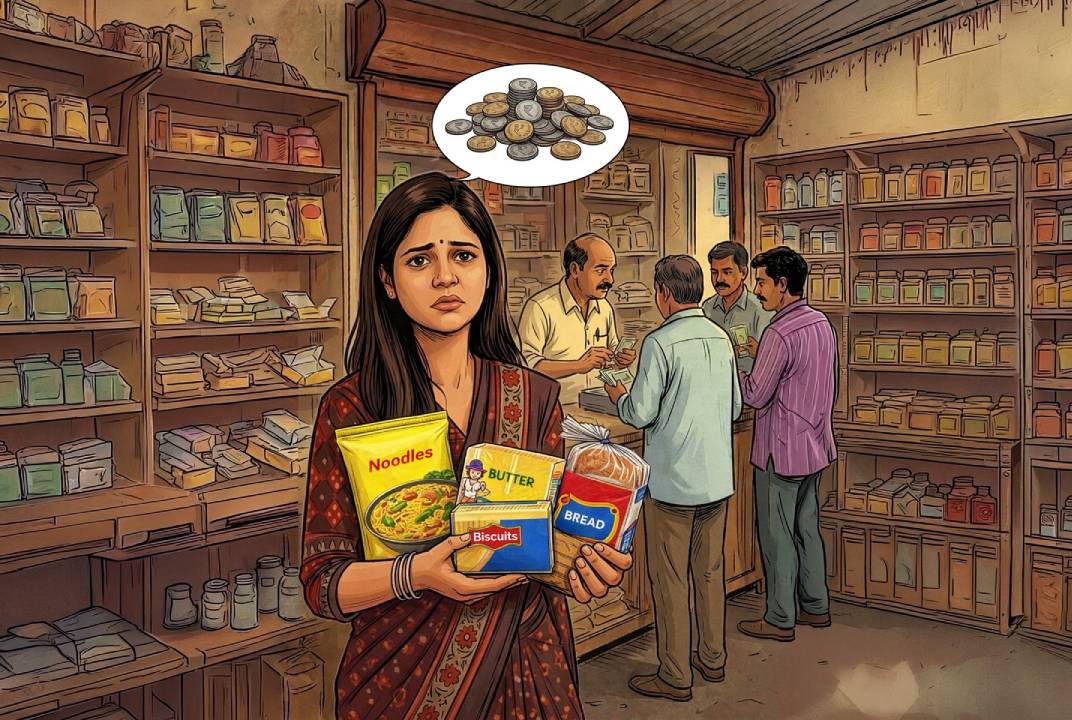
I then asked my students, “Why do you think he was ignoring me?”
Their responses were full of insight and humour:
- “Maybe he wanted you to be late to school.”
- “Maybe the other people were his relatives.”
- “Maybe you didn’t have money.”
- “Maybe you had too many coins!”
At this point, I revealed: “Yes! I had only one-rupee coins.”
This led to a spontaneous conversation about their own experiences with coins, delays, and shopkeepers.
Roleplay and simulation with the use of concrete materials
To bring the idea to life, I created a roleplay. I brought empty packets of butter, biscuits, and Maggi into the classroom and distributed them among small groups. Each of these items had been chosen because they were familiar to the students and their costs were between ₹10 and ₹99. Each packet had a price tag (Maggi ₹10, butter ₹57, biscuit ₹5).
I had also brought in about 75 one-rupee coins (as specimens), and asked five of the students to perform a scene in which they had to find the total of the bill. The children threw themselves into the roleplay, adding their own stories, which added empathy and humour to the storyline, and showcased their deepening understanding of money and counting strategies.
After dividing them into groups I asked them to find the total. (I kept the coins with myself, wanting to see how they grappled with the mental mathematics.) I observed animated discussions and the adoption of different strategies. Some groups used direct addition with the counting on strategy, starting from the price of the butter. A few groups split the calculations – one child adding tens, another adding ones, while others rounded up, thinking of 57 as 60 and then adding only 2 more instead of 5 for the price of the biscuit (they added 5 to 57 in 2 steps: 57 + 3 + 2). A few compared answers between peers, leading to small debates like, “No, you forgot the Maggi,” or “Let’s add again slowly.” This peer interaction helped them self-correct without immediate teacher intervention.
Towards Efficient Strategies
The roleplay led us to a critical thinking moment. I asked, “What can I do next time to save time at the shop?” They said, “Bring notes instead of coins.”
I asked, “If I only have 10-rupee notes, how many notes and how many coins should I take instead of the 75 one-rupee coins?” Most answers were accurate “7 ten-rupee notes and 5 one-rupee coins.” One child said: “Or 50 + 20 + 5!” (taking 50 as 5 tens and 20 as 2 tens) I encouraged them to think further as I observed their flexible thinking and decomposition of numbers. The transition from counting and adding units to regrouping the numbers into tens and units, was planned not through direct instruction, but through exploration and shared reflection. As students worked with real-life prices, they naturally began regrouping numbers by separating each cost into tens and ones, collecting tens together, and then adding them separately from the ones. This hands-on process helped them understand place value in a meaningful way and paved the way for column addition of larger numbers.
Starting with physical currency helped children move from concrete understanding to abstract reasoning. The classroom discussion allowed them to articulate and revise their thinking. And most importantly, the learning continued after the class ended, showing how joyful and meaningful learning can stick.
The following day, I wanted to deepen the students’ understanding of place value by using structured representational materials. I introduced the 2D-Base 10 blocks popularly known as Flats, Longs, Units or FLU where a long strip of ten squares stood for ten units, and each small square represented one unit. I began by simply handing them the long strip and asking them to observe it. “What do you notice?” I asked. Several children immediately pointed out, “There are ten of the small squares in one strip!” This was the perfect bridge.
To make the connection more hands-on, I gave each student a random number of unit squares and asked them to count these. Instinctively, they began grouping the small squares into sets of ten, and as they completed each group, I handed them a long strip to replace it. This natural transition, moving from many small units to fewer tens, helped the idea of one ten instead of ten ones to surface naturally.
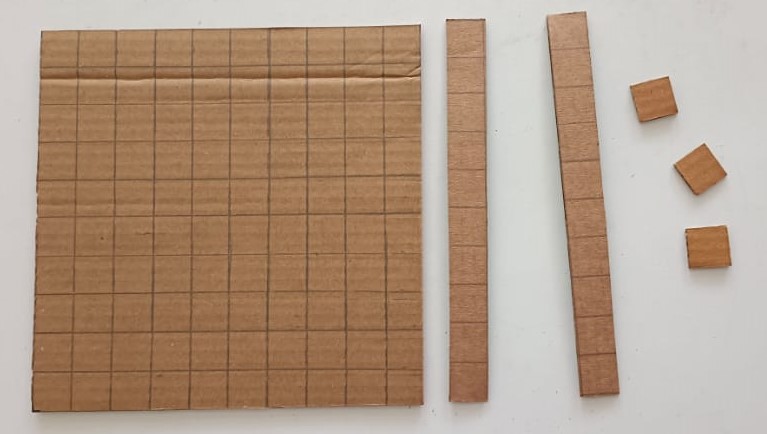
One Long = ten Units; one Unit square = one
The visual arrangement helped many students see the structure of tens and ones. By seeing the quantity laid out clearly in front of them, they could make sense of the structure of numbers and the logic of regrouping. I asked them to represent each of the prices using this material, which helped them to shift from concrete (coins and shopping) to representational (blocks). I was preparing them for more abstract work ahead and allowing them to engage with place value through their own discovery. Initially, the activity was only on counting and regrouping into tens and ones. There was no expectation to find totals using the material that day.
Why FLU? I used FLU materials instead of Dienes Blocks because I wanted students to work with resources that were easily available, accessible, and practical in our classroom context. While Dienes Blocks are effective for teaching place value, I had limited sets for the whole class. The hand-made FLU materials ensured that every child could actively participate and manipulate the materials independently. They were also cost-effective, easy to prepare, and could be made by any teacher using simple classroom resources.
The next day, we used the FLU kits for addition of 2-digit numbers. I intentionally selected numbers where the addition of ones did not exceed nine (like 31 + 13; 47 + 21). This allowed students to attend to relationships between ones and tens without the added complexity of carrying over. When they recorded their answers, students themselves noticed patterns: ones were added with ones, tens with tens, and column addition evolved! The algorithm was not introduced by me; it evolved through their own observations.
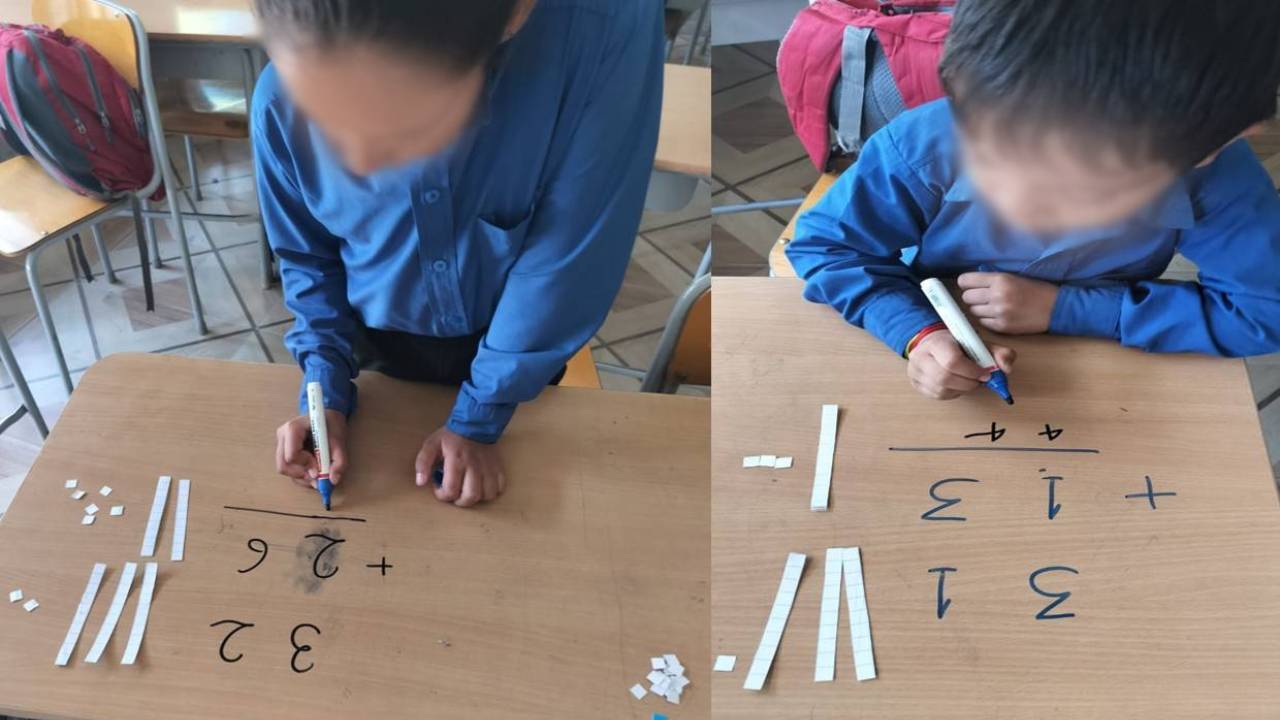
(They wrote with whiteboard markers, which could be erased and did not deface the table.)
Only after this understanding was secure did we move to situations where regrouping of ones went beyond nine. While adding 32 and 29, the students arrived at 11 units. At that point, a child referred to a familiar story of Bhola connecting the idea of regrouping to making groups of ten objects. There was a brief pause. Then, with visible excitement, one child stood up and said, “Yes, you’re right, we can keep one ten in place of these ten ones, as we did earlier while arranging and counting the strips and units.”
In that moment, the idea of “carrying” a ten transformed from a mechanical rule into an efficient algorithm that made sense to the entire class. The FLU representations of 32 and 29 sharpened their attention to a key realization: when ones accumulate beyond nine, they don’t just increase, they reorganise, forming a new ten. What the traditional algorithm calls “carry” was no longer mysterious; it became a visible, logical consequence of grouping.
Students recognised that whenever the sum of ones exceeds nine, regrouping naturally creates a ten and shifts its value to the tens place. The written algorithm, therefore, stopped being an imposed procedure to follow and instead became a meaningful record of their own reasoning. They had been making groups since UKG, but this experience allowed them to connect that familiar action to symbolic notation. In doing so, they did not simply learn how addition works, they understood why it works, and that shift turned a step-based method into genuine mathematical sense-making.
Conclusion
As described in the article, the lesson moved from the students’ lived experience with money and shopping, to representing numbers as tens and ones. Adequate time was spent in replacing ten ones with one ten, using structured materials -in this case the Flats, Longs, Units. At the end of the unit, we moved to understanding the written addition algorithm as a record of this regrouping process.
My teaching trajectory which began with the child’s familiar contexts, mindful use of concrete materials, listening to and building on the child’s informal strategies, and then graduating to representational tools and symbolic notation made me resolve to use this method for the algorithm of subtraction too!