


Dear Readers,
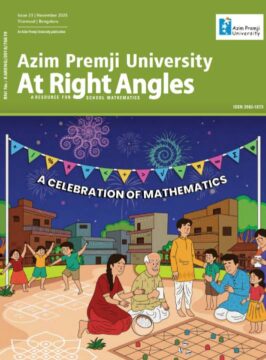
And just like that, 2025 has sped by and we are on the last issue of the year! At Right Angles has had a year of learning- not just of mathematics, but of the gaps and needs in the pedagogy of primary school mathematics. We examined the interweaving of craft, of art, of technology, of our environment and the occupations and preoccupations of our day-to-day lives with mathematics. And in the November 2025 issue, we focus on the celebration of mathematics! We are very conscious that there is a large population of students and adults who scoff at this idea- a famous quote goes, ‘I have a love-hate relationship with mathematics- I hate to love it, but I love to hate it.’ A celebration seems completely contrary to such an attitude; so we wanted to examine how we could have a meaningful celebration that was inclusive, catered to different abilities and, most importantly, changed this mindset about mathematics.
Festivals promote diversity, they bring different stakeholders into dialogue, they increase creativity, they offer opportunities for ‘owning the subject’. In short, they transform the classroom- at least for the day! How can we seize such opportunities to bring lasting change? Can we carry the festivities of the National Mathematics Day on December 22nd of every year into the academic year ahead? Then they are truly worth celebrating. The two Features articles and the Pullout of the November 2025 issue give you different aspects of, and ideas for, such celebrations.
This issue’s Classroom section begins with Smruti Smarak Panda’s thought-provoking article What we Steal when we Teach. How do we teach without detracting from learning? Jeenath Rahaman’s story about young Maya’s explorations with numbers and how she made Little Childhood Discoveries about Divisibility emphasizes the importance of student-led learning. And Karan Singh continues – Teaching Area and Perimeter through Experience describes a teacher training session in which teachers learnt how not to dictate formulas but to explore these concepts through contextual examples.
Kshama Chakravarthy’s article How do I Know They Got It? builds in some good debugging of teaching practices. How can we detect and address the errors which creep into the process of concept building in a student’s mind? Do take her up on her generous offer to build on this article with actual intervention initiatives in the classroom.
We end this section with Swati Sircar’s report and follow up on Aakefa Basri’s lesson on Fact Families – how can addition and subtraction facts build connections among numbers? Which gives us a great start to the Joy of Mathematics section- a Cross Number Puzzle after a very long time, this one based on Addition Fact Families. R Mohan describes interesting explorations with Square Tiles, and we conclude with a first for us- a mathematics play script and Padmapriya Shirali’s reasons (based on her experience) why such plays draw even the most reluctant of mathematics students on to the centre stage of the mathematics classroom.
We thank the readers of At Right Angles for the different responses to Carelin Christopher’s puzzle, Art in Numerals. Some of these are featured in this issue; both contributors sent several suggestions and we had to pick from these for want of space.
The Pullout and the cover of the At Right Angles, July 2025 issue focused on how weaving patterns could connect to school mathematics. We are delighted that the new NCERT Class 5 textbook also carries ideas for the same and we hope that teachers will enjoy weaving mathematics into the life of the class.
John von Neumann famously said, ‘In mathematics, you don’t understand things. You just get used to them’. We want to use that to urge you to make the celebration of mathematics with not just a one-day affair, but a way of life.
Sneha Titus
Chief Editor, At Right Angles