
Exploring Area and Perimeter Through Experience: A Classroom and Cluster-based Journey

Measuring pieces of land having different shapes
It began with a discussion during a primary school teachers’ cluster meeting in Rudraprayag district. We were discussing Chapter 11 Area and its Boundary in the Grade 5 NCERT Textbook. I made some rectangular shapes each with a fixed perimeter of 44 metres, on the board, as shown in Figure 1.
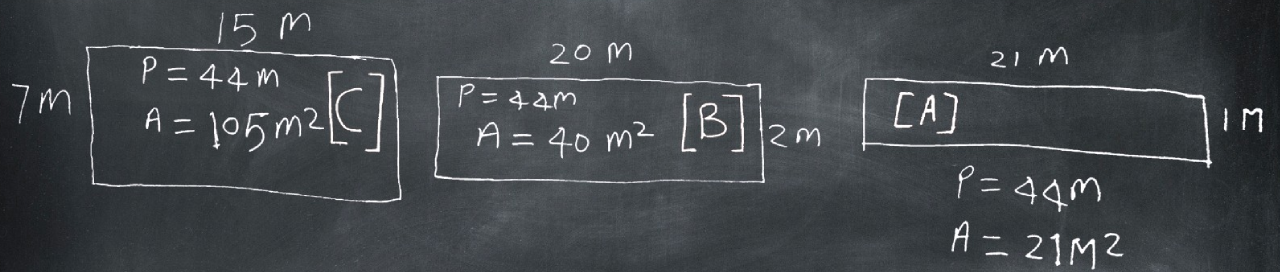
These rectangles immediately caught everyone’s attention. Teachers began drawing rectangles with various side lengths — 11 by 11, 12 by 10, 14 by 8, and so on. The calculations followed:
- 11m × 11m (square) → Area = 121 m2
- 12m × 10m → Area = 120 m2
- 14m × 8m → Area = 112 m2
The rectangles had the same perimeter = 2 × (length + breadth) = 44 m, but their areas varied.
Then we discussed what happens when the breadth of the rectangle is reduced by x metres and the length is correspondingly increased by x metres (to keep the perimeter constant).
Our observation: The maximum area occurred when the land was in the shape of a square!
Adding a Circle: The Biggest Surprise
In the next cluster meeting, a teacher asked:
“If the square gives maximum area among rectangles, what if we use a rope with the same length as the perimeter (44 m) to make a circle?”
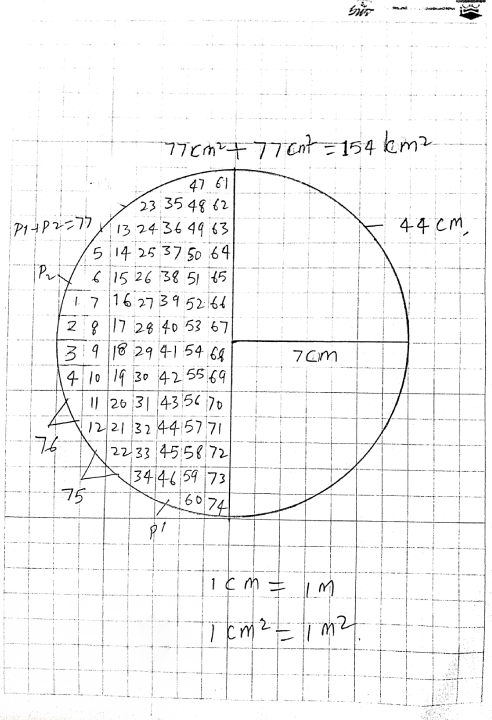
This became the next question:
If a circle has a circumference (perimeter) of 44 metres, what is its radius and area?
The estimation shown in Figure 2 was made using a graph paper (replacing m with cm). Using the formula, we arrived at:
\(C = 2\pi r\)
\(44 = 2 \times \pi \times r\)
\(r = \frac{44}{2 \times 3.14} = 7 meters\)
Using the value of r to calculate the area:
\(A = \pi r^{2} = 3.14 \times \left(\frac{44}{2 \times 3.14} \right)^{2} = 3.14 \times 49 = 153.86 m^{2}\)
So, the area of the circle is approximately 154 m2, which is larger than that of the square (121 m2).
This was an eye-opener. The circle, with the same perimeter as the rectangles, gave the largest area.
Teachers Reflect: Is the circle the most efficient shape?
We now had a new insight to explore. Among all shapes that can be formed with the same boundary, the circle encloses the largest area. Teachers reflected on this:
- “Is this why tanks, plates, and pots are often round – because they hold more with less material when the height is the same in 3D shapes?”
- “Does Nature use this property of circles – look at nests, fruits, planets? Maybe it’s because it’s more efficient.”
Table 1. Summary
| Shape | Dimensions (m) | Area (m²) |
|---|---|---|
| Rectangle | 21 × 1 | 21 |
| Rectangle | 20 × 2 | 40 |
| Rectangle | 15 × 7 | 105 |
| Rectangle | 14 × 8 | 112 |
| Rectangle | 11 × 11 (square) | 121 |
| Circle (r = 7m) | C = 44 | 154 |
Here are visual diagrams of different shapes—all with the same perimeter of 44 metres—that were discussed in the article. These diagrams can be used in teacher training sessions or classroom demonstrations:
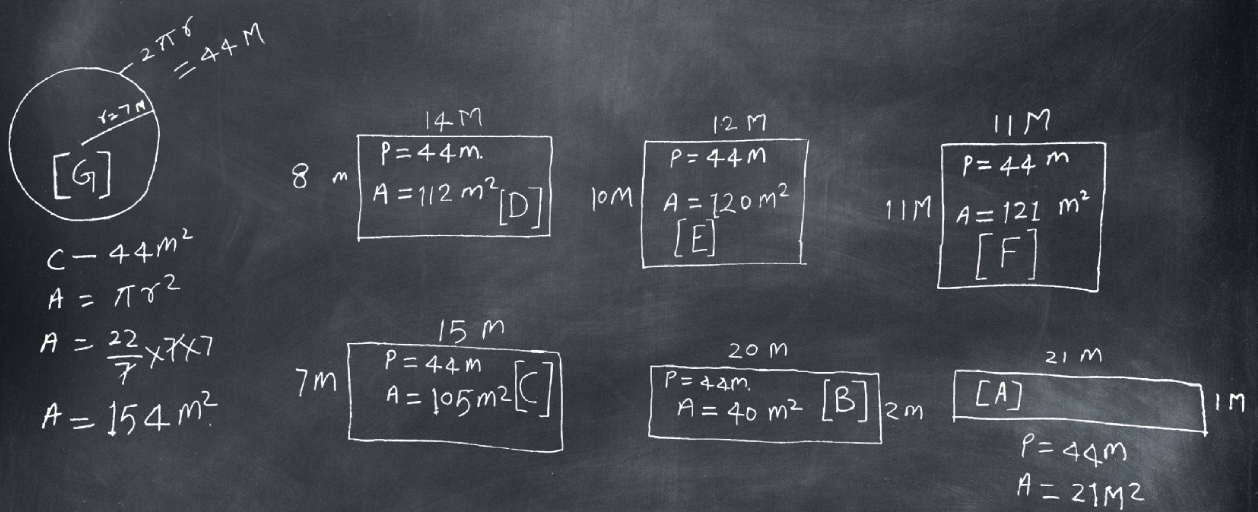
This led to beautiful discussions about protecting agricultural areas, fencing in the garden, making the house, and real-life applications in design and architecture.
Taking the Idea to the Classroom
Inspired by the discussion, we designed a classroom activity for Grade 5 students. We gave students ropes of 44 cm (using thread or string) and asked them to make different rectangular shapes using graph paper.
Children were excited — it felt like solving a puzzle. The results were similar to what the teachers had come up with.
One group made an 11 by 11 square. Another made 14 by 8 rectangle. Some tried extreme shapes such as 20 by 2 or 21 by 1.
They calculated the area for each. To their surprise, the square had the biggest area, even though all shapes had the same perimeter. One child said:
“Sir, jab chaaron taraf barabar ho to zameen zyada milti hai!” (Sir, when all sides are equal, we get more land!)
That one sentence captured a mathematical truth.
In another class, a boy said, “Sir, agar perimeter fix hai to sabse zyada area gol shape deta hai!” (If the perimeter is fixed, the round shape gives the maximum area!)
From Rote to Reasoning: Shifting Teaching Practices
This activity challenged the traditional way area and perimeter are taught. Usually, children memorize formulas:
- Area = length × breadth
- Perimeter = 2 × (length + breadth)
By working with a fixed perimeter and changing area, including the circle, students were forced to think, test, and observe patterns.
Teachers noted that students who struggled with formula-based teaching were actively participating when allowed to reason and explore using materials.
How to Integrate this in Regular Teaching
This concept can be integrated into Grade 4 Math Magic Chapter 13, Field and Fences, and Grade 5 Math Magic Chapter 3, How Many Squares, and Chapter 11, Area and its Boundary in practical and creative ways.
- Story context: “A farmer has 44 metres of fencing material. What shapes can he make for his field to get maximum land?”
- Use materials: Rope, string, paper strips, matchsticks.
- Draw and measure: Let students calculate and compare.
- Discuss: Ask open-ended questions like:
- “What changes when the rectangle changes?”
- “What stays the same?”
- “Which shape gives the biggest area?”
- Extension: Include the circle in the conversation. Draw it with a string compass in the graph paper.
Conclusion
Mathematics is not just about speed and accuracy — it’s about sense-making. The experience of exploring the topic of area and perimeter with teachers and students showed us that when learning is rooted in exploration, guided by curiosity, and connected to real life, deep understanding can emerge.
The journey from rectangles to squares, and then to the circle, showed a powerful idea:
For a given perimeter, the circle gives the maximum area.
This is not just a mathematical fact — it’s a gateway to critical thinking and appreciation of the natural world. The same thing can be done with other shapes as well and students can note and discuss their observations.