
Fact Families


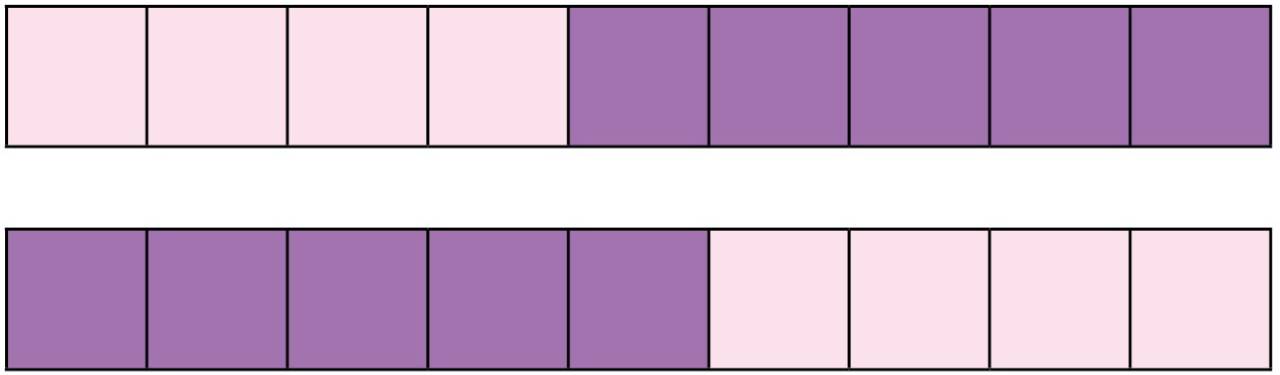
In the first class, the teacher initiated the topic with a discussion on the notion of a family – father, mother, child and then introduced the family of three numbers 4, 5 and 9. She asked if they could see how these numbers are related using addition and subtraction. The addition facts generated were 4 + 5 = 9 and 5 + 4 = 9. When some students wanted to include 2 + 7 = 9, the teacher reminded them that the members of this family were only 4, 5 and 9. She also demonstrated this with counters as shown in Figure 1. Then she asked for subtraction facts with the members of the same family, and got 9 – 5 = 4 and 9 – 4 = 5.
Now the teacher asked them to make a fact family with families which they themselves created. The initial choice of {6, 3, 10} became {6, 3, 9} after some verification with blocks. When the teacher specified that no members of the family were to be repeated, {4, 4, 8} was changed to {3, 5, 8}. Group work generated the families {12, 8, 20}, {54, 31, 23} and {20, 4, 16}.
For the second class, Aakefa took them to the playground and asked them to collect as many pebbles as they could in one minute. They then counted the pebbles collected. Each had a different number. The teacher asked them to split each collection into two parts and thus generate a corresponding fact family. One student had 43 pebbles and split them into 42 and 1. Her fact family was {1, 42, 43} and she noted down that 1 + 42 = 43, 42 + 1 = 43, 43 – 1 = 42, 43 – 42 = 1.
When one student got the family {20, 30, 50}, the discussion then went on to other fact families of which 50 was the largest member, such as {10, 40, 50} and {50, 0, 50}. They saw that the collection of 50 pebbles could have been split in many ways. They started exploring subtraction facts for 50 instead of addition facts.
Some children went further and came up with fact families involving 50 but not as the highest number, e.g., 60 – 10 = 50. A classic case of how math starts from concrete but becomes more abstract. Students were able to make fact families with single digit numbers as well as double digit ones. However, it was interesting to see children avoiding addition or subtraction facts involving regrouping, such as 37 + 25 = 62 or 51 – 24 = 27. They clearly preferred facts involving only digit-by-digit addition/subtraction, e.g., 23 + 14 = 37 or 45 – 13 = 32.
So, any fact family, especially with three distinct numbers, generates two addition facts, e.g., 2 + 3 = 5 and 3 + 2 = 5 illustrating the commutative property of addition. Similarly, there are two subtraction facts, e.g., 5 – 2 = 3 and 5 – 3 = 2 illustrating that the addition fact can be expressed as two subtraction facts.
Connecting addition and subtraction facts this way is crucial for deciphering word problems in the long run.
Moreover, it provides the opportunity to discuss that the biggest number is the sum of the remaining two, i.e., a collection of objects representing the biggest number can be split in two portions, each representing one of the remaining numbers. The second day’s activity of collecting pebbles was geared towards this.
Observations
- The pedagogic shift from concrete to abstract is preferable to the reverse shift observed, and children could have been asked to take a handful from a bag of pebbles brought into class and construct the fact families. It is important though, that they pick- rather than being handed – pebbles. There is greater involvement of the learner and each gets a random number of objects – a number that is not preselected by anyone.
- Since this was done with Class 2, 2-digit numbers were involved. But this activity can and should be initiated with Class 1 after they learn numbers up to 20 and with just single digit addition/subtraction. This can facilitate automatization (see [1]) of single-digit addition and corresponding subtraction facts – both critical for fluency in any addition subtraction. This can therefore provide a lot of opportunities to sharpen mental math. And such an activity will get them to start playing with numbers which is essential to befriend (and fall in love with) math!
- Variations that can be explored by teachers:
- Find all possible Fact Families such that the biggest number is (say) 20. How many fact families are possible with 20 as the biggest number?
- Find all possible Fact Families such that the smallest number is (say) 3. How many fact families are possible with 3 as the smallest number?
- Create a fact family such that two of the numbers are from the same multiplication table, e.g., 15 and 35. What can you say about the third number? Can you explain why this happens?
- Multiplication Fact Families such as {2, 3, 6} can be generated with multiplication-division, and can help students master multiplication facts at random. Further explorations can include:
- Find all possible multiplication fact families such that the biggest number is (say) 20. How many fact families are possible with 20 as the biggest number?
- What happens if 1 is in a Fact Family? What about 0?
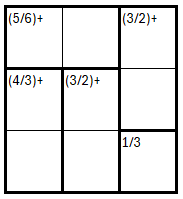
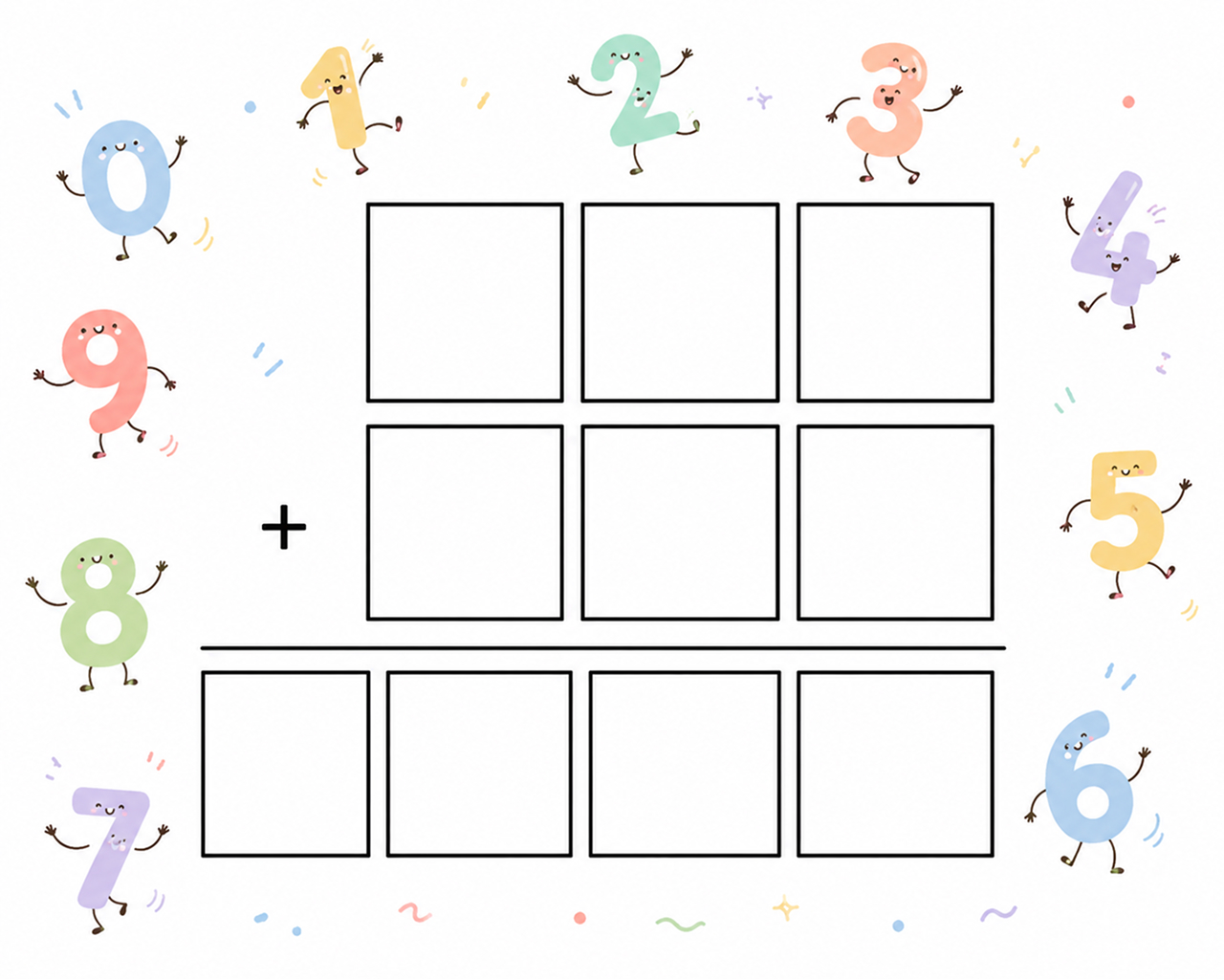
- A cross-number puzzle based on addition fact families is provided here.
A) can pave the way to finding all possible factors which is an important skill with applications such as middle term factorization- later used for solving quadratic equations. B) on the other hand, drives home the uniqueness these two special numbers have with respect to multiplication-division.
Based on these ideas, the following worksheet on Addition Fact Families was created.
- Addition pullout: https://bit.ly/4o5Q5YC
- Subtraction pullout: https://bit.ly/48BAHON
- Commutative property of addition: https://bit.ly/4nXcTcZ
- Word problems: https://bit.ly/4odUfxq
- Word problem Worksheet: https://bit.ly/49lXhuW