
Interpreting Fractions


Fraction is a rich mathematical concept introduced at an early school stage. Their two-storied number representation, which is more complex than whole numbers, demands a meaningful introduction with a proper context. When teachers introduce fractions without doing this, the topic becomes a burden for students who do not have a deeper understanding of the concept. Teaching fractions through rote learning creates more problems for the successive grades.
A typical introduction to the topic of fractions goes like this in the classroom: Fractions are expressed in the form \(\frac{a}{b}\), here a and b are natural numbers. a is called the numerator of the fraction and b is called the denominator of the fraction. The numerator represents the number of identical pieces selected from a whole whereas the denominator indicates the number of identical pieces the whole is divided into. For example, \(\frac{1}{4}\) of a cake indicates 1 piece when the whole cake is divided into 4 identical pieces. \(\frac{1}{4}\) is also the size of each piece. Similarly, \(\frac{3}{4}\) is nothing but 3 pieces taken from the same cake. \(\frac{3}{4}\) also indicates 3 pieces each of size \(\frac{1}{4}\). When the numerator is equal to 1 (or one part is picked), we call it a unit fraction, and when numerator is more than 1, we call it a non-unit fraction.
Among fractions, we have 3 main cases:
- Numerator < Denominator (E.g. \(\frac{1}{4}\), \(\frac{3}{8}\), \(\frac{2}{7}\), etc.) It is clear from the definition of numerator and denominator that such fractions are less than a whole or 1. They are called Proper fractions.
- Numerator > Denominator (E.g. \(\frac{5}{4}\), \(\frac{9}{2}\), \(\frac{7}{3}\), etc.)
The value of these fractions is greater than 1. The meaning of \(\frac{5}{4}\) for instance, is that a whole is divided into fourths (or 4 equal parts), and 5 such parts are selected. It is clear that selecting 4 such parts make a whole or 1, and we pick another \(\frac{1}{4}\) . Such fractions, that are greater than a whole, are called improper fractions. - Numerator = Denominator (E.g. \(\frac{5}{5}\), \(\frac{7}{7}\), etc.) The value of this fraction is equal to one.
BEWILDERING! Small wonder that students face ….
Conceptual difficulties with fractions as compared to whole numbers
- Fraction Notation
Fraction is always written by using two whole numbers (except zero as denominator). But the quantitative sense of the fraction is very different from the quantity the two whole numbers represent. For example, the fraction \(\frac{2}{5}\) does not mean either 2 or 5 or a number between 2 and 5. \(\frac{5}{2}\) is also different from \(\frac{2}{5}\).
Adequate time has to be spent to help learners understand fraction notation with proper introduction in meaningful contexts. - New Vocabulary
New terminologies such as numerator, denominator, unit fraction, non-unit fraction, proper fraction and improper fraction are stressed upon too early, focusing on the vocabulary rather than the meaning in both transaction as well as assessment. This diverts students from the real significance of the meaning of the fraction. - The comparison and ordering of fractions
The comparison and ordering of fractions are more complex and difficult than whole numbers. 8 is greater than 2. But \(\frac{1}{2}\) is greater than \(\frac{1}{8}\). This brings real confusion to children. There are no whole numbers in between two consecutive whole numbers, but there are many fractions in between two non-equal fraction numbers. That’s why ordering them is difficult. Comparison of non-unit fractions is even more complex and difficult. - Operations on fractions
In case of addition and subtraction of whole numbers, units are added to or subtracted from units, tens are added to or subtracted from tens, and so on. But in fractions, numerators are not added to / subtracted from, numerators and likewise for the denominators.
For example- 35 + 54 = 89 (5 units are added to 4 units and 3 tens are added to 5 tens) But \(\frac{1}{3}\) + \(\frac{3}{5}\) ≠ \(\frac{4}{8}\) (Numerator cannot be added with numerator, neither can denominator).
But interestingly, in the case of multiplication, the numerators are multiplied together as are the denominators.
In division, even though it is more complex, the reciprocal of the divisor is multiplied with the dividend. The focus on these rules leads students through a maze of algorithms, the learning of which becomes an end in itself.
In this article, I will discuss different meanings and interpretations of fractions. Being familiar with this will help a teacher to direct her pedagogy towards understanding and reasoning rather than recall and execution.
Different meanings of fraction with examples and illustrations
Behr, Harel, Post, Lesh [1], Kieren [3], and Lamon [4] mention that fractions have multiple meanings and interpretations, identifying five different meanings and interpretations of fractions [2]. They are given below.
- Fraction as part of a whole or part of a set
- Fraction as measure
- Fraction as the result of division
- Fraction as ratio
- Fraction as operator
It is quite amazing to think that the same fraction \(\frac{a}{b}\) could mean any one of these things. When a fraction is presented to students in symbolic form without any context, it is difficult to make sense of what its intended meaning is. When students are guided to look at fractions through these different lenses, they make sense of different situations and problems, and their understanding of and operations with fractions becomes logical and reasoned.
Before introducing fractions, a teacher should equip herself with the different meanings of fractions and how each of them unfolds at different stages of elementary school. We will discuss the five meanings of fractions one by one.
- Fraction as Part of a Whole or Part of a Set
The familiar and usual meaning and interpretation of fraction is the part-whole model. This meaning is generally experienced by students even before they come to school. Children share cake, chocolates, etc., equally among their siblings or friends. The relationship between the part and the whole represents the part-whole model of a fraction. There are two types of wholes:
- Whole being continuous
An example of a continuous whole is a cake. This is a simple and the most basic understanding of fraction which is introduced at the early stage of teaching fractions. For example, if a cake is shared among four people equally, each person will get one-fourth of the cake. This represents a part whole relationship. Since each person receives 1 out of 4 equal parts of the cake, they get (\(\frac{1}{4}\)) of the cake. This is a unit fraction. This interpretation means we are selecting 1 part out of ‘n‘ equal parts of a cake. This is denoted by \(\frac{1}{n}\) part of the whole (read as the \(n^{th}\) part of the whole).
Part-whole relationship does not mean each piece is identical or congruent to another piece. We may compare some other aspects of the parts, such as the area or volume of the pieces. The pieces may not be congruent shapes but have the same area or volume [2].
The illustrations are given below.
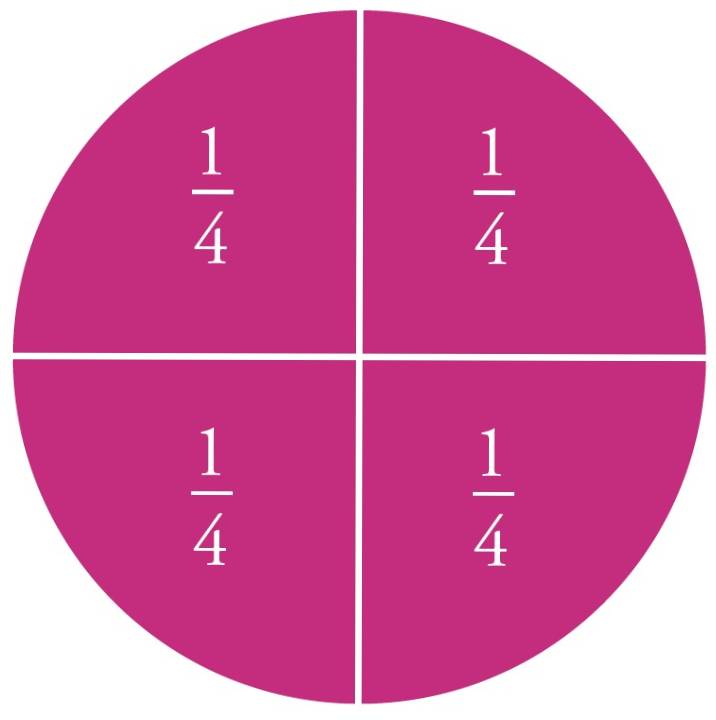
In Figure 1, each unit piece, \(\frac{1}{4}\) , is identical to other units (congruent)
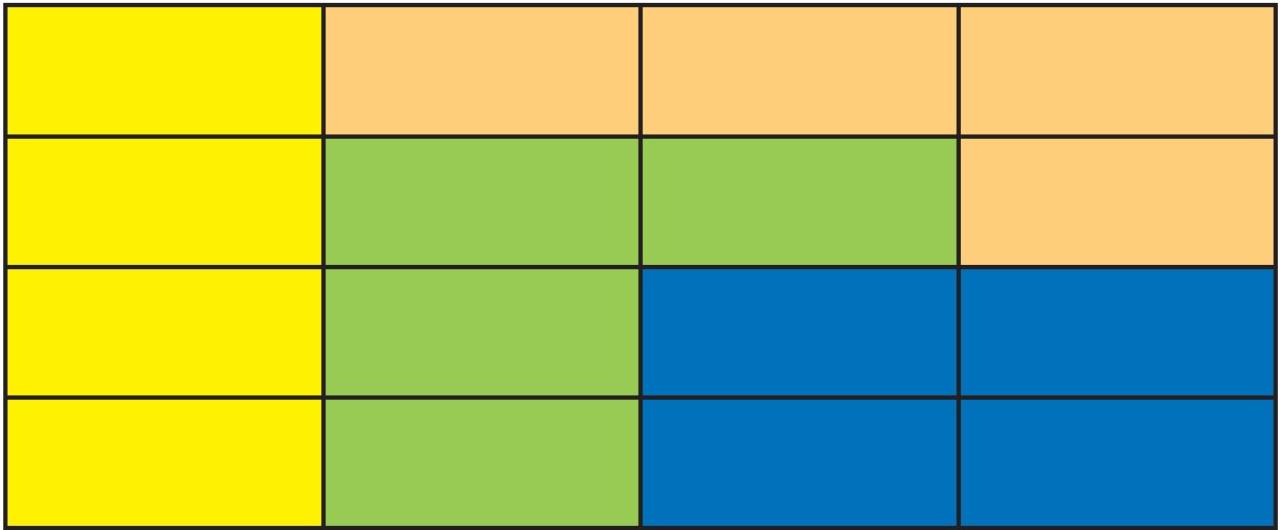
In Figure 2, the big rectangle is divided into 4 equal parts, shaded in four different colours. Each unit piece (yellow, for instance) is not identical with, but is equal in area to the other unit pieces (green, peach and blue colour)-each of them are \(\frac{1}{4}^{th}\) of the big rectangle.
In Figure 3, Beaker A is full of water and represents the whole. Beakers B, C, D show \(\frac{1}{4}\) , \(\frac{2}{4}\) and \(\frac{3}{4}\) respectively of the volume of the water that Beaker A has.

- Whole being discrete
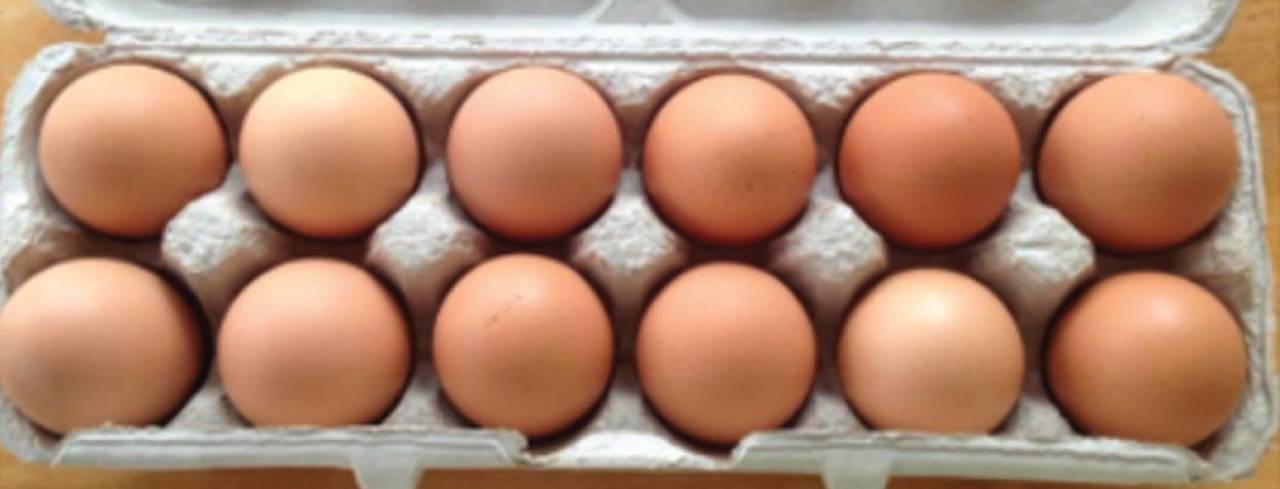
The second type of whole is something we use in our day-to-day life very often – we make half, one-third or one-fourth of many things such as collections of eggs, fruits, groups of students, etc. The collection is a set, and we take a part of that set. The part of a set interpretation of the fraction ensures an equal number of objects or people in each unit. I would like you to recollect one of the famous scenes in the Hindi movie Sholay. Asrani, the police inspector while marching, asked half of the guards to move to the right and half to the left and the rest to follow him (Adha bayen, adha dayen aur baki sab mere piche). This fraction meaning is a part of a set. On a lighter note, it is important to discuss whether Asrani knew fractions or not, but he has some sense of part of a set meaning of fraction.
The set can either be organized in the form of a single line or array or left unorganized. The following illustration is an example of a set organized in an array.
In Figure 4, there are 12 eggs. \(\frac{1}{2}\) of the eggs are in one row. But \(\frac{1}{6}\) of the eggs are in one column.
- Fraction as Measure
This meaning of the fraction is related to measurement. For example, a rope of 124 metres length is cut into 5 equal parts. While 120 m can be easily divided into 5 equal parts, each of length 24 m, there will be a remainder of 4 metres. These 4 metres can be converted to 400 cm and equally divided into 5 parts, each part getting another 80 cm. So finally, each part would be 24 metres and 80 cm. This is the way we divide length, weight and volume, till we reach the final quantity. This can be written as the fraction \(\frac{124}{5}\) m. This also represents the division meaning of fraction. Similarly, \(\frac{14}{10}\) can be contextualized as 14 litres of oil divided among 10 people. To measure quantity which is less than 1 whole or in between wholes, we use fractional units to measure, basically partitioning the unit in equal sub-units. For example- if 1 metre is cut into 3 equal parts, the length of each would be \(\frac{1}{3}\) metre. Similarly, if 3 litres of juice is shared among 9 people, each of them will get \(\frac{3}{9}\) or \(\frac{1}{3}\) litre of juice.
This is not limited only to length and volume measurement but is equally applicable to weight, area and time measurement, such as 200 ml = \(\frac{1}{5}\) litre, 250 g = \(\frac{1}{4}\) kg. This can be explored further as given below.
52 g = \(\frac{52}{1000}\) kg = 52 kg divided into 1000 parts = it means 52 times \(\frac{1}{1000}\) kg.
27 ml = \(\frac{27}{1000}\) litres = 27 litres divided into 1000 parts i.e., it means 27 times \(\frac{1}{1000}\) litre
- Fraction as the Result of Division
A fraction can be the result of the division of any two numbers. Here the whole can be either continuous or discrete in nature. It is explained below in detail.
Discrete objects
- A-Part of a set- If 12 mangoes are shared equally among 4 students, each student gets 3 or (\(\frac{12}{4}\)) mangoes. Since 12 is divisible by 4, the quotient is a whole number.
- B-Part of a set- If 12 apples are shared equally among 5 students, each student gets \(2\frac{2}{5}\) (mixed fraction) apples.
Continuous objects
- C-Part of a whole- Let’s say 1 litre of apple juice is shared equally among 3 people. Each of them gets \(\frac{1}{3}\) litre of juice.
- D-Part of a whole- Let’s say 1 watermelon is equally shared with 9 people. Each of them gets \(\frac{1}{9}\) of the watermelon.
Even though all the scenarios A, B, C and D mean equal sharing. Scenarios A and B overlap with the part of a set, and scenarios C and D overlap with the part of a whole construct. In addition, scenario C also overlaps with the measure meaning of fraction.
- Fraction as Ratio
A ratio is a quantitative relationship representing the relative size of one quantity to another. For example, if the length and breadth of a rectangle are 12 cm and 3 cm respectively, then the ratio of the length to its breadth is 4:1 which can be written as the fraction \(\frac{4}{1}\) . It means that the length is 4 times the breadth. It shows the multiplicative/ proportional relationship between length and breadth rather than the additive relationship – the length is 9 cm more than the breadth.
The part-whole relationship can easily convert into a ratio. Let’s say there are 30 balls, out of which 20 balls are blue, and the rest are red. Blue balls are \(\frac{2}{3}\) of the total number of balls. We can write this as a ratio. The ratio of blue balls to total number of balls is 2:3. Here the fraction can be written as a ratio, so \(\frac{2}{3}\) = 2:3. It works when they are in the same units.
It seems very odd, conceptually, when two quantities involved in ratios are in different measures/units. For example, a car uses 10 litres of petrol to travel 150 km. The ratio of distance covered to the amount of petrol used is 15:1. It means that to travel 15 km, 1 litre of petrol is required. If we convert this ratio to a fraction, it becomes \(\frac{15}{1}\) , which is meaningless if we only consider the part-whole meaning of a fraction. Rather we can think of the division meaning of fraction, which is that the car can travel 15 km for each litre (unit) of petrol.
- Fraction as Operator
As an operator, a fraction shrinks/reduces or enlarges, contracts or expands and multiplies or divides a number [4].
Operators are transformers which
- Increase or decrease the length of a line segment
- Increase or decrease the area of a figure or volume
- Increase or decrease the number of items in a set of discrete objects
When the operator is:
- A proper fraction, it shrinks, contracts, reduces
A shopkeeper sells 2 chocolates for ₹3. How many chocolates will a buyer have after spending ₹x ? It means the number of chocolates is always less than the money spent, as shown in Table 1. The number of chocolates that can be purchased is \(\frac{2}{3}\) of the amount spent. Here the number of chocolates is less than the amount of rupees spent.
| Input (Rupees) | Operator | Output (No. of chocolates) |
|---|---|---|
| 9 | \(\frac{2}{3}\) | 6 |
| 12 | \(\frac{2}{3}\) | 8 |
| 15 | \(\frac{2}{3}\) | 10 |
| 18 | \(\frac{2}{3}\) | 12 |
- An Improper or Mixed fraction, it enlarges or expands
Let us modify the previous example. If a shopkeeper sells 3 chocolates for ₹2, how many chocolates will a buyer have after spending ₹x ? Here the number of chocolates that can be purchased is \(\frac{3}{2}\) of the amount spent. It means the number of chocolates is always more than the money spent, as illustrated in Table 2.
| Input (Rupees) | Operator | Output (No. of chocolates) |
|---|---|---|
| 8 | \(\frac{3}{2}\) | 12 |
| 10 | \(\frac{3}{2}\) | 15 |
| 12 | \(\frac{3}{2}\) | 18 |
| 6 | \(\frac{3}{2}\) | 9 |
We have just seen that the part-whole meaning is insufficient to give a clear picture of different scenarios. \(\frac{2}{5}\) metre of cloth, \(\frac{2}{3}\) of the books of the store are in English, \(\frac{9}{7}\) of the apples, etc. have other meanings like measure, ratios and equal shares respectively. By being acquainted with the part-whole meaning of fraction only, students’ understanding of situations similar to those given above remains incomplete. When students are familiar with different meanings and interpretations of fractions, they make sense of different situations and problems, and their understanding of fractions get enriched.
We have discussed different meanings and interpretations of fractions. Researchers support that part-whole and part of a set meaning of fractions should be introduced at the early stage of learning fractions (Grades 3 and 4). The other meanings of fractions will be explored in a deeper way in Middle School. It does not mean that they should not be touched upon in primary grades. It is important that teachers are aware of the different meanings and interpretations of the fraction so that they bear these in mind as they plan their teaching, choose examples and do formative assessment and remedial teaching.However, care should be taken not to overload students with definitions. For example, the task given below is strictly for teachers and not intended to tax students in elementary school.
Based on the discussion given above, here is a task for teachers (Table 3). Go through each word problem, analyze the meanings and interpretations they carry and put tick marks on the relevant cell of the table given below. Remember that they are not always in water-tight compartments. These meanings and interpretations can even overlap with each other.
| Sl No | Word Problems/Contexts | Part of a whole/Set | Measure | Equal Sharing | Operator | Ratio | ||||
|---|---|---|---|---|---|---|---|---|---|---|
| Whole as continuous | Whole as discrete | |||||||||
| 1 | Vamshi and Dhruva have gardens that are of exactly the same size. Vamshi used \(\frac{1}{6}\) of his garden space to plant tomatoes. Dhruva used \(\frac{1}{7}\) of his garden to plant potatoes. Who has more garden space left? Why do you think so? | |||||||||
| 2 | Sriram runs a library which has 420 books. \(\frac{1}{3}\) of the books are on Science and \(\frac{1}{4}\) of the books are on Mathematics. How many books are on Mathematics and Science? What fraction of the books is in the other categories? | |||||||||
| 3 | A pumpkin weighs \(2\frac{3}{4}\) kg and a watermelon weighs 2340 grams. Which one is heavier- pumpkin or watermelon? | |||||||||
| 4 | Rabina mixed 3 cups of juice with 4 cups of water to make a special drink. What fraction of the drink is juice? | |||||||||
| 5 | Muthulakshmi spent \(\frac{2}{5}\) of her monthly salary on her household expenses. What fraction did she save? | |||||||||
| 6 | Three equal sized cakes were shared equally among 11 students. How much of the cake did each of them get? | |||||||||
- Behr, M. J., Harel, G., Post, T. R., & Lesh, R. (1992). Rational number, ratio, and proportion. In D. A. Grouws (Ed.), Handbook of research on mathematics teaching and learning: A project of the National Council of Teachers of Mathematics (pp. 296–333). Macmillan.
- Chapin,S., & Johnson, A. (2006). Fractions. In Math matters: Understanding the math you teach (Grades K-6) (pp.99-112). Math Solutions Publications.
- Kieren, T. E. (1988). Personal knowledge of rational numbers: Its intuitive and formal development. In J. A. Hiebert & M. J. Behr (Eds.), Number concepts and operations in the middle grades (pp. 162–181). Lawrence Erlbaum.
- Lamon, S. J. (2020). Teaching fractions and ratios for understanding: Essential content knowledge and instructional strategies for teachers. Routledge.