
The Hidden Logic of Shortcuts-Unlocking Mathematical Patterns



Converting Subtraction into Addition
Subtraction, especially when involving regrouping or “borrowing” is known to be a challenge for primary school students. Addition on the other hand is relatively easier. What if we could convert a subtraction problem into an addition problem?

Suppose we had to calculate 101 – 87. Let us now convert this into an addition problem (Figure 1). As the first step we consider the smaller number (87 here). We first subtract the units digit (7 here) from 10 and each of the remaining digit(s) from 9. This gives us 13. We need to add this number to 101: Adding 13 to 101, we get 114. We then drop the 1 at the hundreds place to get the answer 14.
Here is what we did, step by step.
Step 1: Subtract the units digit of the number to be subtracted (referred to as the smaller number henceforth) from 10 and the digits in the other places from 9.
Step 2: Add the number obtained in Step 1 to the number from which the subtraction is to be done (referred to as the larger number henceforth).
Step 3: In the answer that you get in Step 2, count as many digits as there are in the smaller number from the right and subtract 1 from the immediately next digit to the left.
This will provide the answer to the subtraction problem. Let us look at a few examples.
Example 1:

In Example 1, we need to compute 312 – 123. First, we find what number is to be added to 312 to find the answer. This we do by subtracting the units digit of 123 from 10 and all other digits from 9 to get 877. We then add 877 to 312 to get 1189. Since 123 is a three-digit number, we subtract 1 from the 4th digit from the right (the thousands digit highlighted in the figure) to get 189. That is, the required answer is 189.
Note that the digit from which 1 is to be subtracted depends on the number of digits in the smaller number as the following example shows.
Example 2:

In Example 2, since 89 is a two-digit number, in Step 3, 1 is to be subtracted from the 3rd digit from the right or the hundreds digit as shown. This means, for instance, if we were subtracting a single digit number using this process, in Step 3, we would subtract 1 from the tens digit – the second digit from the right.
As we have noted, Step 1 says subtract the units digit from 10 and all others from 9. What if the units digit is 0? This gives us 10 as the units digit in the number to be added. Example 3 shows us how to handle this.
Example 3:
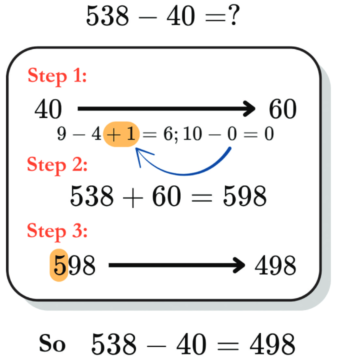
In Example 3, in Step 1, we retain the 0 of the units digit and add 1 to the preceding digit. Subtracting 4 from 9, we should have written 5 as the tens digit of the number to be added. We absorb the additional 1 from the units digit and change the number to 60. The remaining steps follow through.
Why does this process work? What exactly are we doing in this algorithm? Look carefully at Step 1. When we “subtract the units digit from 10 and all other digits from 9″ we are essentially subtracting the number from the a power of 10, aren’t we?
To subtract 87, we added 13, which is 100 – 87.
To subtract 123, we added 877, which is 1000 – 123.
To subtract 89, we added 11, which is 100 – 89.
To subtract 40, we added 60, which is 100 – 40.
So instead of subtracting a number N, the process described above suggests that we add 100 – N, or 1000 – N or 10n – N depending on the number of digits in the smaller number. (Here, the value of n is the same as the number of digits in N. For example, if N is a 2-digit number, then n = 2.) To get the correct result, we then subtract the 10n that was effectively added. This is precisely what Step 3 does by subtracting 1 from the appropriate digit.
In short,

In Step 1 we compute 10n – N. In Step 2 we add this to M and in Step 3, we subtract 10n to arrive at the final answer.
This shortcut is rooted in the decimal number system and the number relations within that system. In the primary classes, we highlight number bonds: 1 & 9; 2 & 8; 3 & 7; 6 & 4 and 5 & 5. These number bonds are related to pairs of numbers that add up to 10. We could extend the notion of number bonds to numbers that add up to other powers of 10 as well. This shortcut capitalises on number bonds between pairs of numbers that add up to 100, 1000 and other powers of 10.
This shortcut may come in handy when multiplying numbers by 9, 99, 999, etc. These numbers are one less than 10, 100, 1000, etc. So multiplying by these numbers can be done easily by multiplying by 10, 100 or 1000 and subtracting the multiplicand from the result obtained. We may use the shortcut for subtraction to do this.
Example 4:

Then we follow the above algorithm to get
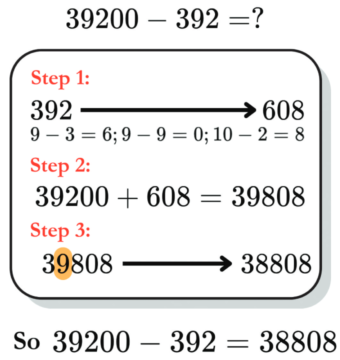
We could also use other number relations to find 39200 – 392 such as

The basic idea is to use number relations flexibly in order to find easy ways of calculation. When these are presented as a series of “how-to” steps for finding an answer, they can obscure the number relationships that form the basis of the shortcut. This is true of many calculation techniques commonly grouped under “Vedic mathematics.” Stated purely as procedural rules, they risk making mathematics seem like a collection of clever tricks.
On the other hand, if we begin with a method of calculation that relies on underlying number relationships and invite students to formulate the “how-to” steps themselves, the focus shifts from memorising procedures to understanding the structure beneath them. With some exploration and reflection, the seemingly magical elements dissolve, and what appeared to be a trick begins to feel like the most natural way to think about the problem.
Engaging with such number-based strategies is a powerful way to nurture number sense. For instance, the following methods draw on properties of operations involving powers of 10. Ask students to express these as step-by-step procedures:

Figuring out why a particular shortcut works can also be a good exercise for unravelling these number relations. We now share another shortcut for you to figure out the logic.
Multiplying by 98: Can you figure out the logic?
If the multiplicand is less than 50:
Step 1: Write down the number that is 1 less than the multiplicand.
Step 2: Subtract the multiplicand from 50 and multiply the result by 2. Append this to the number in Step 1.
Example 5:

If the multiplicand is greater than 50:
Step 1a: Write down the number that is 2 less than the multiplicand.
Step 2a: Subtract the number from 100 and multiply the result by 2. Append this to the number in Step 1a.
Example 6:

Further questions for the reader to ponder: Why does this algorithm work? How would you extend it to three-digit numbers? How does this shortcut relate to multiplication by 102? What might a similar shortcut look like for multiplication by 998? For what kind of numbers would a similar shortcut work?
The last words
As teachers, we may have had occasions when our students came up with such shortcuts or alternate methods of doing calculations (as Nikhil’s teacher Ms. Rosly surely did!). Rather than being treated as the “most natural things in the world”, such occasions call for small celebrations of these discoveries (as Nikhil would vouch), and probing if they would always work and why/when they would work.
Acknowledgement: Nikhil is grateful to Mr. Praveen. R, Trainer, Block Resource Coordinator, Palakkad for his support and to Ms. Rosly, his Mathematics Teacher at school who sparked his interest in mathematics through her encouragement.