
Anno’s Magic Seeds: A Review of the Story from the Perspective of Use in the Mathematics Classroom



This book is part of a series of children’s books by Mr. Anno on diverse mathematical themes (Anno’s Counting Book, Anno’s Hat Tricks, Anno’s Counting House are some other titles in this series). Originally written in Japanese, Anno’s Magic Seeds has been published in multiple languages over the years. The English and Hindi bilingual version of this book was published by Bharat Gyan Vigyan Samiti in 2005.
The story of Anno’s Magic Seeds deals with the idea of generation of plants from seeds to illustrate exponential growth. This book, written long before the beginning of the trend for STEM (Science, Technology, Engineering and Maths based books) books, has mathematical ideas driving the central plot, something we see in very few books even today. In Mr. Anno’s words, the story was written not to merely teach mathematics, but to delight in the arithmetic puzzles woven in both the text and the illustrations. (From author’s note in the story book Anno’s Magic Seeds.)
The story begins with a chance meeting between a young boy named Jack and an old magician who gifts him two magic seeds. The magician asks Jack to bake and eat one seed which would keep him full for a year. He also tells him to sow the other seed to get 2 more seeds the next year. Jack not only does as he is told but continues to do so for many subsequent years, until one day, he decides to manage without eating any seed and grows both the seeds together. This is the turning point in the story. Those 2 seeds turn into 4 seeds the next year. He eats 1 of them and sows the remaining 3 seeds. Next year, he gets 6 seeds, eats 1 and sows the remaining 5 seeds. And so, the story continues. In the later years, the mathematical complexity increases as he gets married, has a kid, starts storing seeds and selling them, etc. until one day, a storm appears and destroys everything, leaving Jack with just 10 seeds to start with again.
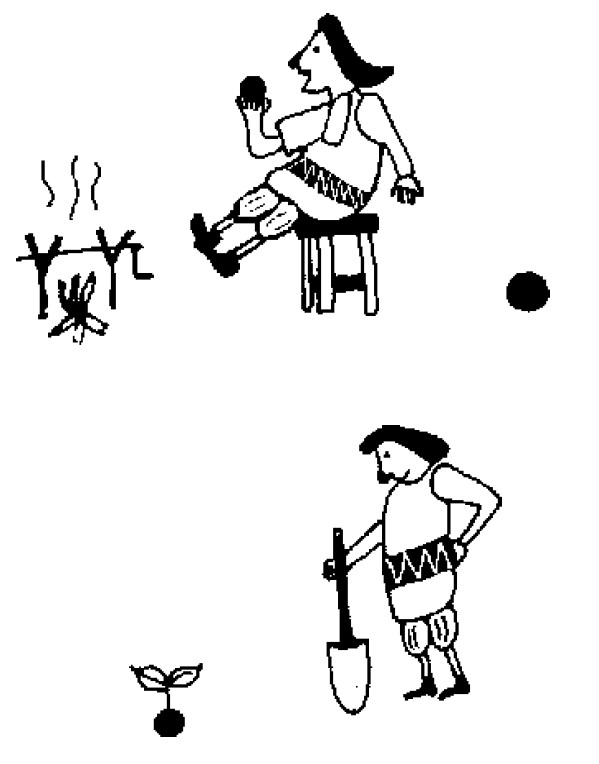
The story is interspersed with two recurring questions for the readers.
- How many seeds will he bury?
- How many seeds will grow in Jack’s garden the next fall?
This kind of story structure lends itself well to planning an interactive session for classroom teaching as there are already questions built within the story. I have used this story with both the primary and middle school children. With smaller children (grade 2-3), I simply used it to experience the joy of listening to a mathematical story. I noticed that children could enjoy the story even with the basic understanding of addition, subtraction and doubling, though I needed to skip over the more complex portions of the story.
With my class 6 students, I used this story for exploring exponential growth patterns. I planned to read the story aloud while stopping in between to let the students work out the answers to the questions. When presented with the first few questions, most children were able to solve them with ease. (e.g. 2 seeds doubling to 4 in the first year, 3 seeds (after subtracting the 1 seed eaten by Jack) doubling to 6 in the 2nd year.) After the first few years, we felt the need for some way to keep track of the number of seeds as it grows over the years. For this, we created a table as shown below. The table helped students to notice the emerging pattern and speeded up the process of calculating the number of seeds grown and sown in the subsequent years.
(To find the number of seeds grown in a year, we need to double the number of seeds sown. But seeds sown the next year are one less than the seeds grown the previous year, as Jack eats one seed every year. So, we need to double the number of seeds sown in a particular year and then subtract one to find the number of seeds sown the next year. This is the base pattern used in the story.)
| Year | Number of Seeds Sown | Number of Seeds Grown | Pattern |
|---|---|---|---|
| 1 | 2 | 4 | 2 × 2 = 4 |
| 2 | 3 | 6 | 4 – 1 = 3, 3 × 2 = 6 |
| 3 | 5 | 10 | 6 – 1 = 5, 5 × 2 = 10 |
| 4 | 9 | 18 | 10 – 1 = 9, 9 × 2 = 18 |
| 5 | 17 | 34 | 18 – 1 = 17, 17 × 2 = 34 |
| 6 | 33 | 66 | 34 – 1 = 33, 33 × 2 = 66 |
From the 7th year onwards, when there are slight changes to the story (i.e., Jack gets married and entertains, it requires subtracting a different number of seeds to find the seeds to be sown for the next year. At this point, some students also needed paper and pencil to calculate the answers to the problems posed in the story. But the table helped them to see that the base pattern of doubling was still the same. After the story ended, we held a brief discussion on the pattern used in the story and the strategies used by children to solve the problems. This led to the addition of the last column we see in the above table. This kind of pattern and rule recognition activity is excellent pre-algebra preparation. (See the March 2025 pullout for more ideas.)
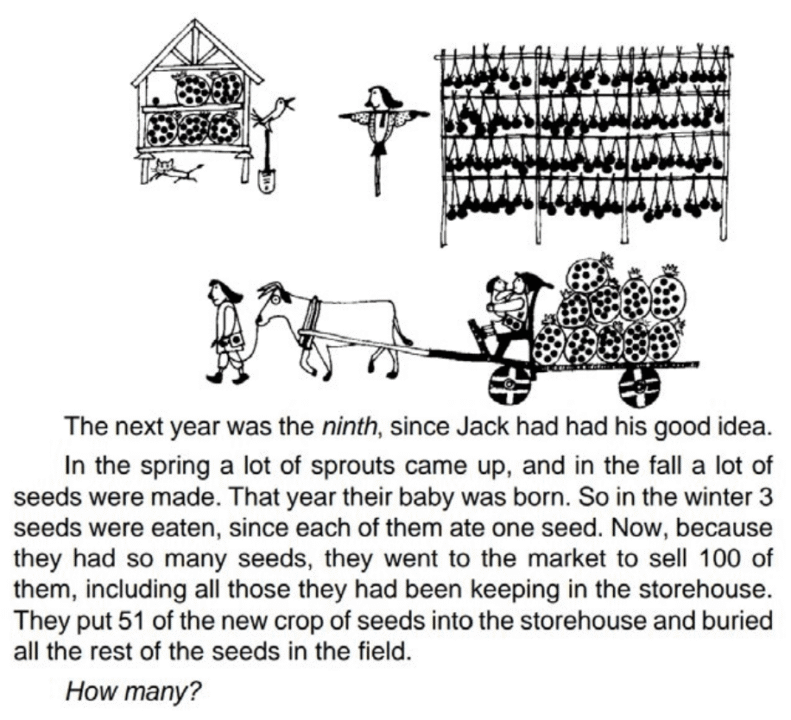
Along with the table, the mathematically accurate illustrations with easily recognizable patterns which accompany the text of the story, also helped students when the numbers grew bigger. We see the use of multiplication arrays and groups of tens in illustrations to make it easy to discern patterns and find the number of seeds.
For example, in this portion of the story, we can see exactly 100 seeds on the cart in neat bags of 10 seeds each, 51 seeds stacked in groups of 10 in the seed store, and 120 seeds arranged in the rows of 30 seeds each, each row further divided into 3 sections with 5 pairs of seeds each. This helps children in solving the mathematical problems that arise in the story by recognizing the patterns.
As a follow-up task, students were asked to work in groups and find out what would happen if the seeds could triple instead of doubling every year. Students created tables for the same in their respective groups. This helped them further explore the multiplicative patterns.
During the session, I noticed much higher class participation as compared to other days. I also observed peer group discussion on strategies for solving problems. They could also correct each other easily, in case of a mistake, without much outside help during these discussions. These are also important aspects which we need to focus on in the mathematics classroom. The use of stories like this in teaching mathematics helped me in achieving this purpose. We can also try using the same story in different ways and with different age groups to see what works the best for our students. For example, in future, while using this text, I would like to give additional challenges to the students, such as:
- What if the pattern of doubling and subtracting 1 continues for 10 years? Or 20 years?
- How many years would it take for Anno to get 1,000 or 1,00,000 seeds?
Some suggestions that were received for the foundational and preparatory stage are as follows
Foundational Stage
Children can be encouraged to connect the numbers to the pictures which show grouping in twos, fives, tens, etc. There can be worksheets on how numbers can be represented in that way. This paves the way for a deeper understanding of numbers especially with respect to divisibility. The visuals used in the story show clear links to ten frames (both as odd-even and as groups of fives).
Preparatory Stage
The discussion on the strategies for finding the number of seeds grown and sown each year can lead children to work on pattern recognition (2, 3, 5, 9, 17…) and describing the rule (one less than double the previous number or 2n – 1) with worksheets on creating similar patterns involving 2 operations. [This can also be connected (in Secondary stage) to the teaching of Algebra.] For this, it is advisable to create a table to capture the number of seeds that are obtained, eaten, planted against the year with justification. Here, the pictures in the book can be of great help.
After this, a line graph depicting the story could also be created. Students could be encouraged to note the sharp rises and then the fall again… This also provides opportunity to may be talk about life throwing curveballs and how it can be rebuilt provided some seeds are there. What can such seeds be? Such discussions can strengthen the literature and mathematics connections.
I would also like to explore the possibility where students can design their own story books using different patterns.
This story is a great resource to be used in the mathematics classroom with children of different age and grade levels. We know that the use of children’s literature helps in providing meaningful contexts for engaging with mathematical concepts. Anno’s Magic seeds is a good example of such literature. Learning to observe, discuss, document, recognise and predict mathematical patterns is a key skill.
The main character Jack encounters many situations- challenges, successes and setbacks) in the story which students can easily relate to and connect with their real world. Children also begin to appreciate Jack’s planning and foresight for the future as well as absorb the ideas of responsibility and caring as life circumstances change. The use of this book along with other resources can definitely enrich the teaching of different concepts and the development of good life skills and positive attitudes in the classroom.
Acknowledgement: The author is deeply appreciative of the suggestions made by Ms. Swati Sircar, Azim Premji University.
- Anno,M. (1992). Anno’s Magic Seeds/Jadui Beej https://arvindguptatoys.com/arvindgupta/anno.pdf