
My Pedagogical Experience with Arrow Cards


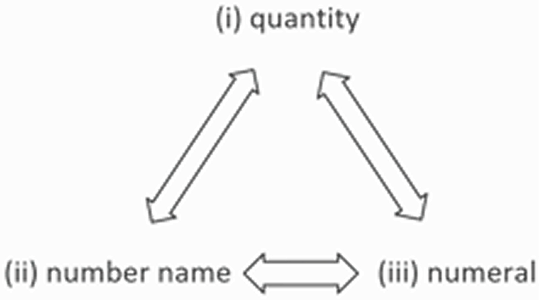
Mathematical concepts, such as numbers and their operations, or patterns and shapes, can be hard to grasp because they’re not always something you can see or touch. As Jean Piaget’s research suggests, children learn concepts through three levels of knowledge – concrete, pictorial, and abstract (Wadsworth, 1976). That’s why it’s important for children to begin their learning with hands-on activities. They should start with real objects that they can interact with, then move on to pictorial representations and finally arrive at abstract representations of these concepts on paper. The National Curriculum Framework for Foundational Stage (NCERT, 2022, pp 118-119) also suggests using the ELPS approach in education. ELPS stands for E for experience, L for spoken language, P for pictures and S for symbols.
Procedures or skills may be introduced to children by explorations with concrete materials. In division, for example, this might be done by sharing 12 sticks amongst 6 children. As students handle objects, they take the necessary first steps toward building understanding and internalizing mathematical processes and procedures. Working with physical objects allows students to explore concepts at first, which is the concrete level of understanding. Strategies and algorithms can be developed over time.
We, the teachers of Azim Premji School at Dhamtari, were engaged in the process of creating various Teaching and Learning Materials (TLMs) specifically for mathematics. As part of this activity, we made arrow cards. Arrow cards are TLMs used to teach concepts such as place value visually and interactively. Arrow cards also help children understand Partitioning and Recombining. Partitioning involves splitting numbers into smaller manageable parts and Recombining refers to the process of regrouping numbers in different place values.
Challenges faced in teaching place values
Moving from counting objects to understanding place value can be challenging for children because it involves shifting from something they can see and touch (concrete) to something more abstract that exists in their minds.
There are limited practical examples of place value that relate to students’ everyday experiences. Understanding the role of zero as a placeholder can be confusing for students.
Complex vocabulary, for example, terms such as “units,” “tens,” “hundreds,” and “thousands” are very difficult to understand and communicate about.
Working with Arrow Cards
Initially, I wasn’t familiar with using arrow cards effectively in the classroom. To learn more, I consulted a mentor who explained how they help students intuitively grasp place value. With this insight, I felt confident to implement them. Previously, I used bundles of straws for teaching place value, but as my students progressed to larger numbers, I found the arrow card method to be more helpful. I’ll narrate my experience of using the arrow cards in the classroom below.
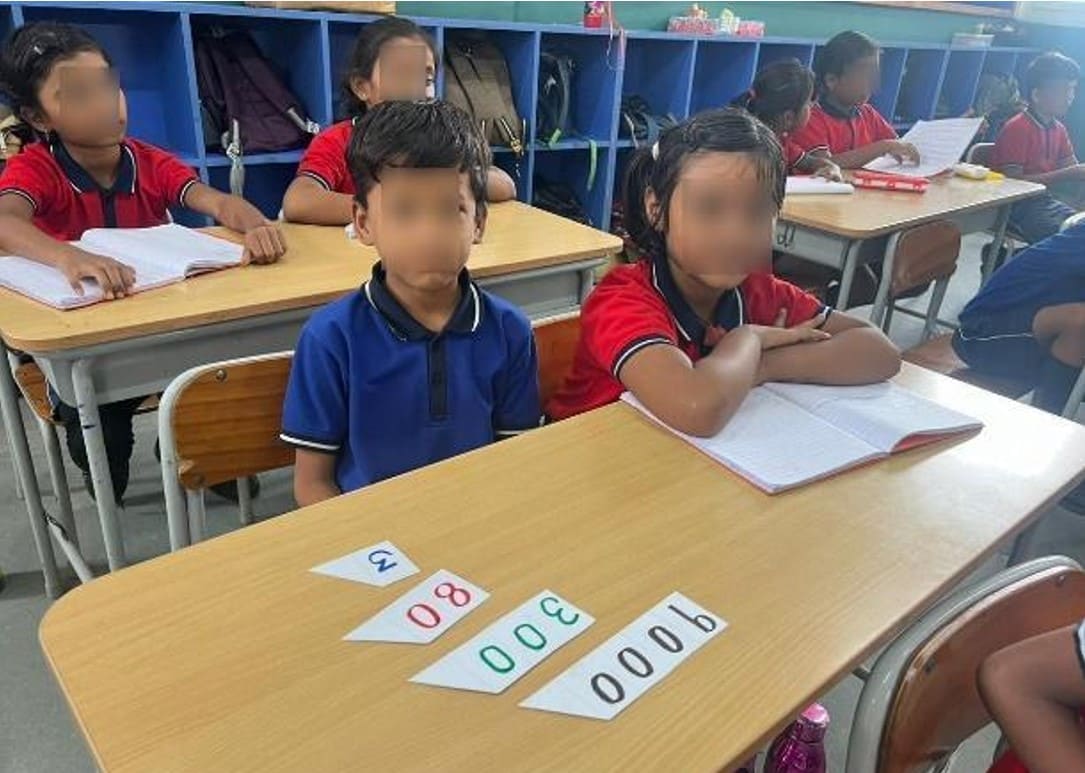
As soon as I entered the Grade 3 classroom, I took out the box of arrow cards. The children looked at the box with great curiosity, and when colorful cards emerged from inside, they were delighted to see them. Each arrow card shows hundreds, tens or ones of a number. For example: \(500, 100, 50, 20, 5, 2\). They can be placed on top of one another to make 2-digit, 3-digit numbers and so on. I gave a set of arrow cards to each bench, and the children quickly opened them and started arranging them on their benches. They eagerly awaited further instructions, curious about what would happen next.
First, I called out various single-digit numbers from \(0\)–\(9\) and asked the children to pick up the corresponding arrow cards. Next, I explained the concept of tens and hundreds and called out several numbers for them to pick up the correct arrow cards. For example, to make \(25\), they will need to select the arrow card for ‘ \(20\) ‘ and ‘ \(5\) ‘ and then put them together so that the slanted lines align. This teaches students that two-digit numbers are made of tens and ones.
Again, when I asked for the number \(234\), many children picked up the number \(200\) card, but instead of picking up the number \(30\) card, they picked up the number \(3\) and for the one’s place picked up the card 4.
Then I intentionally formed incorrect numbers with the arrow cards and asked the students to identify and correct the mistakes.
I placed the cards for 345 as 3, 40, and 5 instead of 300, 40, and 5 and asked them to hold the corners of the arrow cards. As soon as they did this, the middle card, which was the number 3 card, fell out. This provided a perfect opportunity to explain the concept of tens and ones, and how to correctly form the number 345 using the arrow cards. By using arrow card expansion of a multi-digit number for e.g., 234 = 200 + 30 + 4 becomes automatic and effortless.

I asked again by using an arrow card to make a number \(9,383\) whose expansion is \( 9383 = 9000 + 300 + 80 + 3\).
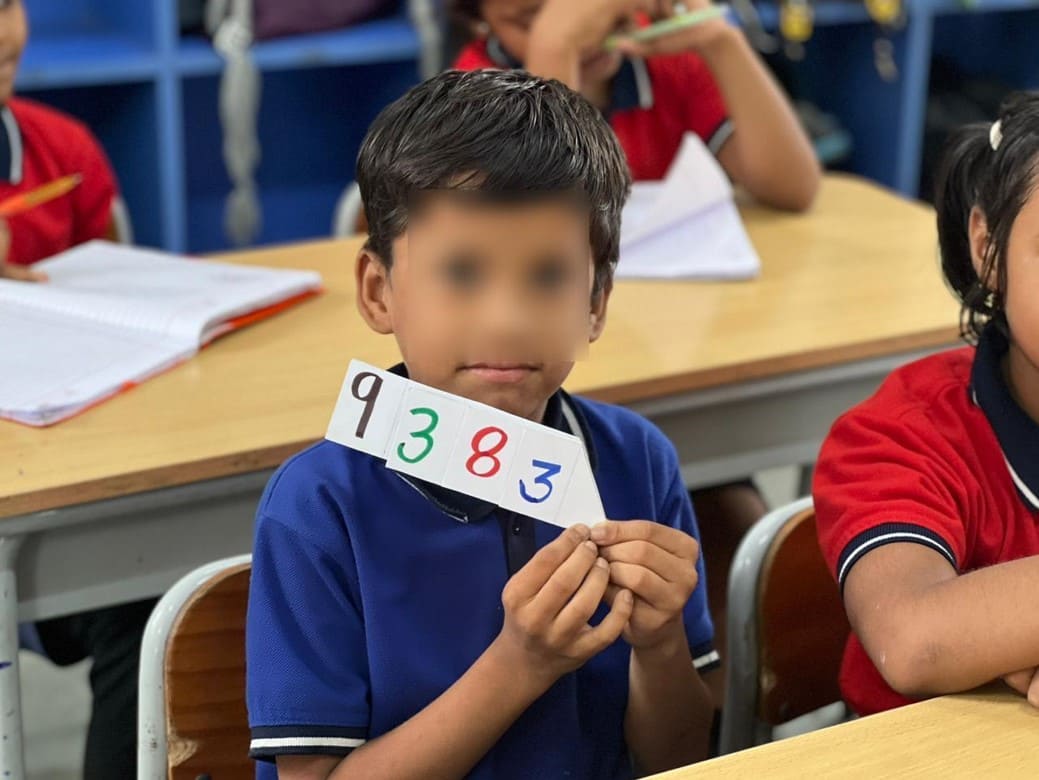
I turned the activity into an interactive quiz game. I called out numbers randomly, and the f irst student to correctly form the number with the arrow cards got a point. This game made the activity more exciting and motivated the students to think quickly and accurately about place values.
Using arrow cards in addition and subtraction
Arrow cards can be used to break down the addition process into smaller, manageable steps. For example, to add 23 + 15, use cards to represent 2 tens and 3 units as well as 1 ten and 5 units separately, then combine them to show how we get 8 units and 5 tens which gives us 58 as the total.
We can also visualize subtraction with arrow cards by arranging the cards in descending order to represent the process of subtraction. For example, to subtract 5 from 15, you might show the number 15 and then visually represent decreasing it by 1 each step until reaching 10.
Overall, arrow cards have significantly enhanced my teaching of place value. They make learning more interactive and enjoyable. Students were highly engaged, and I have observed a noticeable improvement in my students’ comprehension and retention of numerical concepts as it provides a hands-on, visual approach to understanding place value. I highly recommend arrow cards to other educators looking for effective ways to teach place value and related mathematical concepts. and a great learning experience. In the coming days, I will make further progress in creating more TLMs for mathematics.
Acknowledgements
- Swati Sircar, Assistant Professor at the School of Continuing Education and University Resource Centre of Azim Premji University, India.
- Arddhendu Shekhar Dash, Principal of Azim Premji School, Dhamtari (Chhattisgarh).
- National Council of Educational Research and Training (NCERT). (2022, October). National Curriculum Framework for Foundational Stage. NCERT. https://ncert.nic.in/pdf/NCF_for_Foundational_Stage_20_October_2022.pdf
- Wadsworth, B. J. (1971). Piaget’s theory of cognitive development: an introduction for students of psychology and education. McKay.