
Nifty, Thrifty, and Crafty: Math Space Turns 10


Walking into Azim Premji University’s Math Space for the first time, I immediately felt like a kid in a toy store. Before me were shelves, tables and drawers overflowing with seemingly handmade contraptions; colourful stationery was scattered around virtually every available surface; discarded tea boxes and laptop packaging were stacked up across the floor space. The room was a great example of organised chaos, I thought, the kind that gets your fingers fidgety, eager to settle into a spot and create something. Needless to say, I was only too happy to allow Swati Sircar, the custodian of this space, to finish up a meeting while I browsed.
A mathematician by qualification, Swati worked as a teacher for a few years before she joined the university’s School of Continuing Education and University Resource Centre in 2013. Passionate about maths education, Swati and her colleague and “partner-in crime” Sneha Titus (now the Chief Editor of At Right Angles) envisioned and brought to life Math Space.
Confined at first to a tiny room in the PES University campus (where Azim Premji University was functioning before the permanent campus was completed), Math Space first shifted to a larger shared room in the same campus, and then to the sunny room in the Sarjapura campus where I now stood. By the end of next year, Math Space is due to move to its final home.
The journey of Math Space, Swati told me, began with a small cupboard in a room that was designated as a science laboratory for the upcoming undergraduate programmes. “The cupboard was full of some material from Jodogyan, a maths resource group based in Delhi. The key to the room used to be with the security staff, so every time we wanted to access the material, we spent 20 minutes retrieving the key and another 20 minutes to hand it over after we were done. This was not going to work out.”
At this point, Swati and team recognised that these resources had a lot of potential in mathematics education. But before this potential could be realised, they would need to effectively document how teachers could use them and disseminate this through workshops and publications. Where would they do all this?
“At the time, the campus had a pottery studio. So I thought why can’t we have a similar space for maths?” Swati said. The duo began to explore possibilities by which they could share the room with the science team. This was not approved, however, they were assigned a small room from which they could start a maths lab. “It was one of the tiniest rooms, smaller than even that pottery studio! And that was our very, very humble beginning,” she reminisced.
It didn’t take long for Math Space to get its first taste of success. Back in 2014, the university had only two programmes – MA Education and MA Development. As part of their curriculum, the Education students had weekly engagements at nearby government and low fee private schools. Apart from this, the foundation also used to run a couple of centres for children of migrant labourers. “We had these schools with whom we have an existing relationship. So we thought: why not do some workshops with them,” said Swati. And so the duo began lugging their stash of resources into a larger room, where they conducted day-long workshops for teachers of these schools.
These took place on a monthly basis and while they tried repeatedly to cap participants at 30, it was common for the workshop strength to cross 40. Other subjects began their own similar workshops the following year, and these took place across primary and middle school levels. Kannada versions of the workshops were also organised for the benefit of municipality schools. “The workshops were a big hit. It was much, much beyond our imagination,” said Swati.
In a couple of years, it was universally agreed upon that they needed more space. As it turned out, they were re-assigned to a larger room, the same one they had initially been denied. The room began to function as a combined maths and science laboratory, with teachers participating in workshops and students performing science experiments. “Everyone was happy about this as the space was finally being fully utilised,” said Swati.
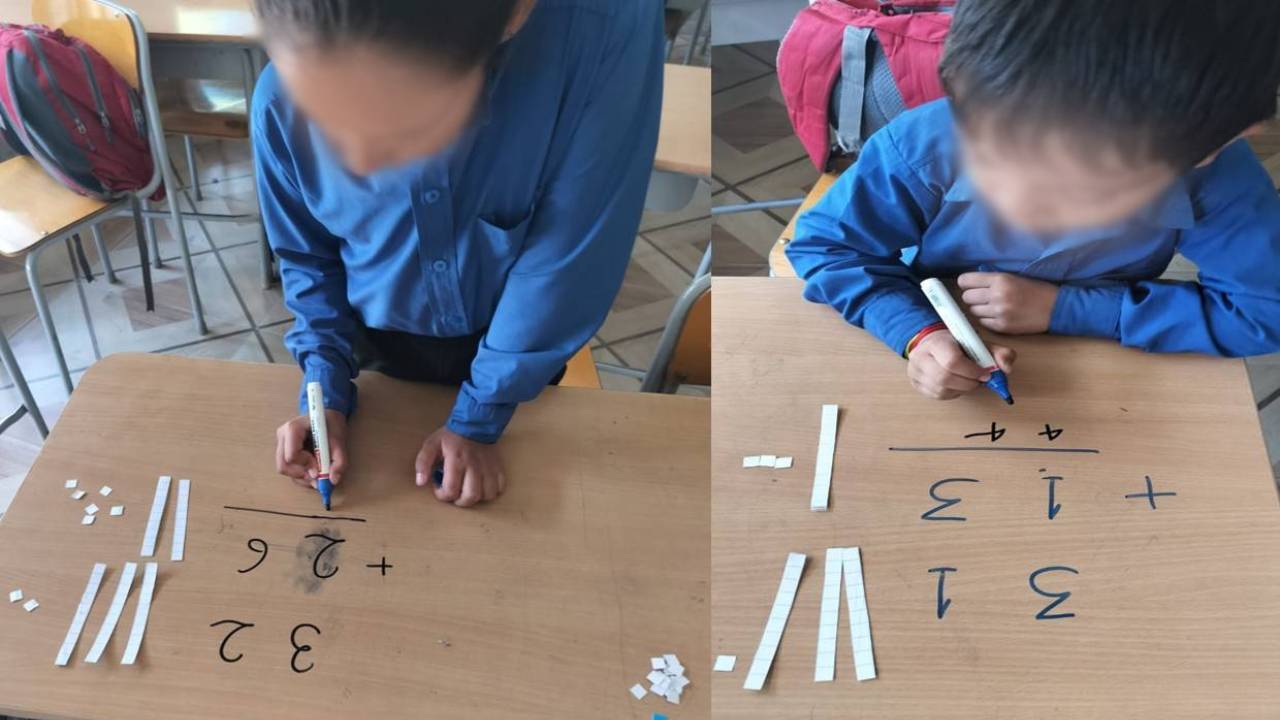
In addition to managing Math Space, Sneha and Swati were also teaching an elective called Curricular Material Development in Mathematics to MA Education students. During the course, they would encourage their students to create games, worksheets and other material. “We reminded them that this would not only get them grades and experience, but whatever they produce – their babies – would become part of the lab,” she recalled. This motivation worked. Students created various maths teaching resources such as a game to learn fractions, a model to visualise trigonometric functions, etc. “Sometimes one batch would make something, and the next batch would get inspired to build on the same thing,” she said, while proudly showing me a shelf full of resources that had been built by her former students.
Along the way Math Space also established a valuable partnership with the organisation Mantra4Change, which ended up hiring numerous alumni from the university. Alumni, now employed by various organisations, would return to Math Space to brainstorm new ideas with Swati. People from various NGOs working in education, too, would visit them, using their space to tinker and create.
Math Space further evolved with the initiation of the Student Assistantship programme which permitted students to have part-time jobs at the university. “We took advantage of this, and started employing a few students during semester breaks,” said Swati. The employed students, representing various disciplines, busied themselves with tasks related to the production of math teaching resources. Depending on their skills, some would draw, some would cut, others would manage, and so on. This streamlining allowed Math Space to bulk produce this mat(h)erial that would eventually go to schools across the country.
Job openings at Math Space became so much in demand among students that last summer, 16 of them signed up! It was gratifying for Swati to see students so engaged in the pursuit of accessible and high quality maths education, and even more so to see them come up with newer ideas and improvements for existing kits. “People were wondering what on earth was going on here,” Swati laughed. After a round of auditing, the authorities were reassured that all was in order.
“Now we have very strict limits. We can employ only up to 10 students, and we have a huge waiting list.”
Meanwhile, another exciting partnership was developing, with the university’s Infrastructure Management Function (IMF) team. The IMF is responsible for a range of activities fundamental to the functioning of the university, including land acquisition, construction, furnishing of offices, administration and facility management and purchases.
“We have a good tie up with the IMF, through which we were able to source waste materials such as tea bag boxes, discarded posters, etc.” said Swati. After a point, she observed with amusement that Math Space was turning into an unofficial archive of sorts. “Nothing is thrown away here. So sometimes IMF people come in here looking for old posters they need for documentation. It’s really funny!” More recently, when the university finished its landmark 40-storey student residence building, the IMF enlisted Math Space to create 40 key boxes for them to keep the keys organised in a floor-wise fashion. “With the IMF as one of our clients, so to speak, sourcing material has become much easier. They are a huge partner in all this.”
The impact of Math Space is getting increasingly evident. The maths resources they produced were taken to various schools in the northeast by university educators working in the area. Some of them even found their way to state board textbooks.
In this age of 3D printing and mass manufacturing, I asked Swati if she has been tempted by the allure of shifting to toolkits made of plastic and other synthetic materials. Wouldn’t these be quicker to produce, last longer and relieve her of the trouble of having to source waste and recycle? “Our resources last long enough,” she affirmed. Besides, she pointed out, the whole point was empowering teachers and students to know they can recreate these materials. “You break it, you fix it. It’s as simple as that. It’s not like if they break it, they have to stand in the corner as punishment. That’s why we make it with low-cost or no-cost materials available around us.
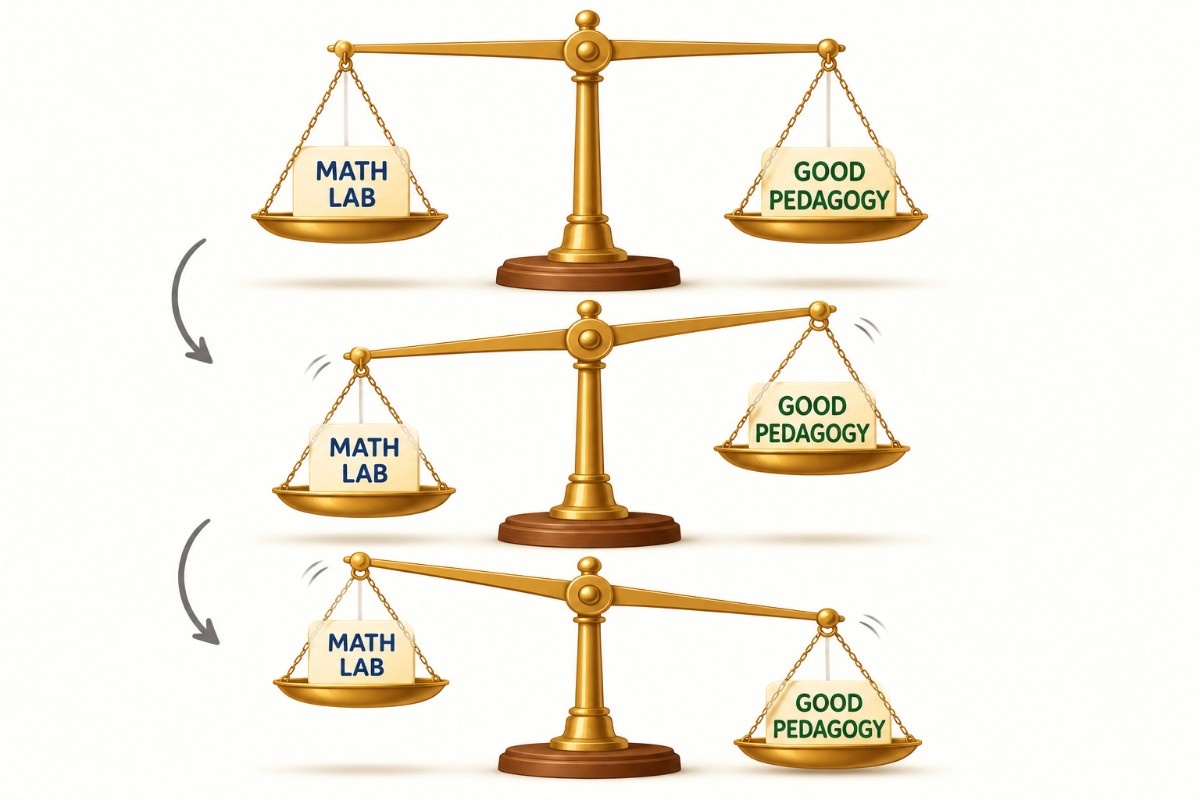
The matter of cost is particularly relevant here. “For our material to be effective, a class of 30 needs to have at least 6 sets. Which government school has the budget to buy six sets of every material?” she asked. Swati illustrated this with the case of one of her former BSc-BEd maths students, who shared with her the scenario at the “maths lab” in his school. “I call it a ‘maths temple’! Because the students were taken there in a line, not allowed to touch anything, they just do one round of darshan and then go back to class.” Such stories are a thorn in the side of educators like Swati. “What is the point of such a math’s lab? Students should be playing with the material, moving things around, putting them together, and saying ‘Oh! This happened!’ or ‘See what I made!’.”
Ten years since it came into being, Math Space has become an integral part of the fabric of the vibrant university ecosystem. And there is more to come. “We are working on explanations, explorations, posters, videos, worksheets, and animated presentations for introducing various concepts and constructions. We also hope to include games in the future,” Swati elaborated. There is also a website now, where many of these resources are being documented https://sites. google.com/apu.edu.in/mathspace/home. Clearly, this is only the beginning. “Oh and this is not going to be our last location,” Swati reminded me. “The upcoming Campus Commons will be our permanent home.”