
Review: The nRich Website
Reviewed by Sneha Titus


In March 2024, Azim Premji University Publications decided to bring At Right Angles back to its original purpose and intent – to be a quality learning resource for teachers/teacher educators of the primary and upper primary grades of the public education system in India. This review will therefore focus on resources for primary school. Secondly, the nRich website has been redesigned since the last review. Let’s look at what has changed and what remains the same.
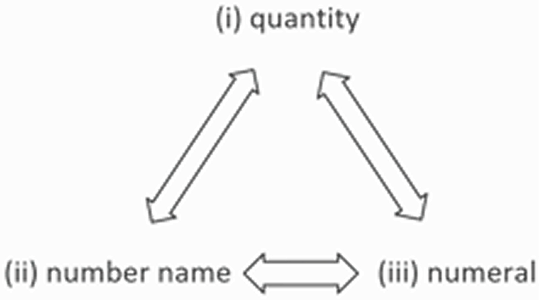
The home page is simple, uncluttered, inviting you to explore their free mathematics resources for students aged 3-18 years. Who is the ‘you’? Teachers, students, and parents – and the tabs on top echo this with additional tabs for Problem-Solving Schools, Events and About nRich. It is interesting that this last tab doesn’t feature the bio-details of those behind the website. Rather than focus on the fact that they are based in the Faculty of Mathematics at the University of Cambridge, it talks about their beliefs, what they think and why they do it and this diagram from the site (see Figure 1) says it all.

I discovered more about these terms as I explored the Teachers pages in some detail. My first hop was to the Early Years section and here I found tabs for Activities, Articles, Children’s Thinking and Professional Development. Of course, I made my way straight to the last tab and signed up for their newsletter (see the tab at the bottom left of the page) which they promised would inform me about upcoming free webinars.
Next, I made my way to the Activities section and again, was impressed by the explanation of their Early-Stage Foundation Activities (EYFS) format. The activities here are built around what children (3-5 years) often do and how the adult could follow up on this. Let’s look at an example from The Mud Kitchen.
| Action: Designate a play-area where a small group of children can freely explore a mud-kitchen | |
|---|---|
| Stimulus | Children often enjoy digging in soil (mud), filling containers and emptying them, engaging in imaginative play and talking freely. |
| Reaction | Adults could provide an assortment of all kinds of objects from a kitchen – pots, pans, a water supply, large and small kitchen utensils, etc. |
| Cues-Describing | What’s over here? |
| Reasoning |
Why do you think this utensil works for this? Can you see anything that can be used there? Why would it be useful? |
| Opening Out | What would you like to do with this? Is that big enough for this? |
| Recording | Would it help to remember this if we took a photo? |
| The Mathematical Journey (Concepts and Vocabulary) |
Counting Same and different Measure |
| Development and Variation | Sand pits, Water play |
| Resources | An outdoor area with soil, Kitchen utensils (pots, pans, spoons, spatulas, etc.), large drum (to use as a table), play cooker, small blackboard, water, plastic tubs, etc. |
Recognising that the three strands of Conceptual Understanding and Fluency, Mathematical Reasoning and Mathematical Mindsets from Figure 1 are woven into this simple everyday activity was an ‘aha’ moment for me! Big words can be tailored to suit small folk 😊
The EYFS format helps to draw these strands out with the stimulus provided by what ‘children often’ (do) and the suggestions provided for the adult reaction. Mathematical Thinking is developed by using cues from the activity for Describing, Reasoning, Opening Out and Recording. Check out the descriptor for The Mathematical Journey which is best described in their own words.
The Development and Variation tab suggests similar activities, songs and poems, and the Resources section describes what exactly is needed for the activity. The activities are arranged by the domains of Number, Measures, Shape and Space, and Pattern. A word of caution-these songs and poems may not be culturally relevant to the Indian context.
What to do, how to do it, why we do it, what it develops and how to develop it further… what more does a teacher need for guidance? If we look at the public school system in India, there will certainly be issues with language. The website does not have translations for its English-language content and resources which are designed for UK/US curricula. School teachers in India may have to use Google Translate to avail of the resources available here. There are plenty of overlaps with the content in the Indian curriculum and teachers will themselves enjoy playing with the activities.
Again, classrooms with limited access to the Internet and to computers for children to use the interactive resources will be underserved by the website. On the plus side, most activities have a downloadable pdf with printable resources which may be used as handouts.
Clicking on the resources under the Teachers tab takes you to articles and activities arranged according to age for Early Years, Primary, Secondary and Post-16. Each activity is also arranged according to Challenge Level-of course this will vary depending on the student’s ability but it is a rough guide for the teacher. Articles on classroom pedagogy, famous mathematicians and mathematical topics help teachers tailor their teaching for their class profile.
While researching for this review, I came across Colin Foster Mathematical Etudes where he suggests ‘lovely, rich’ alternatives to tedious tasks. His suggestions are open-ended though designed around a specific procedure. Drill and practice accomplished in subtle, enjoyable ways – what more can a teacher (or parent or student) want?
I have been personally influenced by Alan Wigley’s article ‘Models for teaching mathematics’ where he cautions teachers about the ‘path-smoothing model’ and offers suggestions for the ‘challenging model’. Issues which are common problems for Indian teachers are mentioned here-paucity of time and vastness of content to cover with students of differing abilities. However, in most Indian classrooms, transactions are teacher-driven, students are very used to following instructions. The suggestions given here may not apply to such classrooms. This brings me to the larger issue of teacher mediation. The activities here are intended for exploration, reasoning and problem-solving. I am not sure if in the Indian classroom, teachers are used to holding back from simplifying, explaining and giving away the solution. If they can be induced to wait, these problems and activities can drive more independent learning and perhaps even get students to enjoy instead of fearing mathematics.
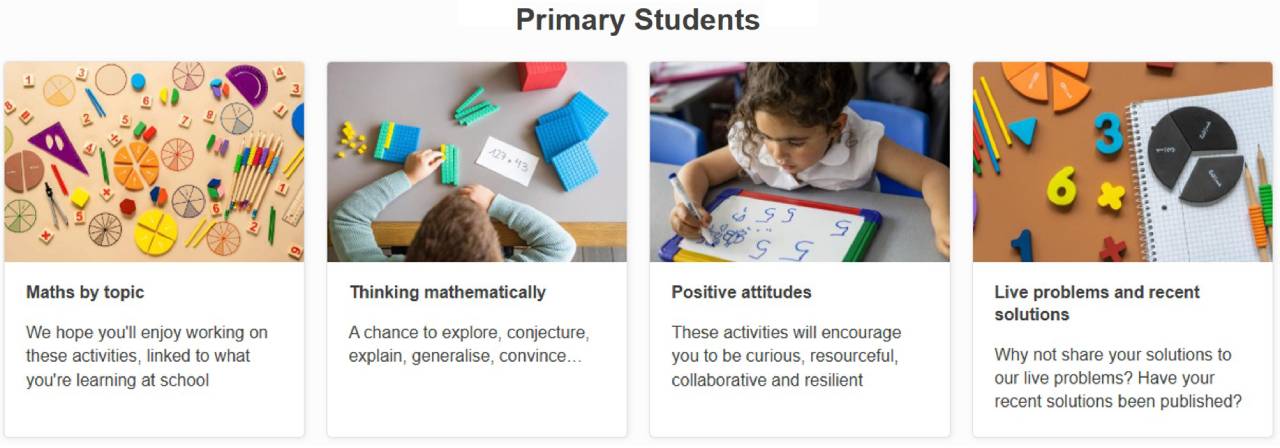
I simply loved the Resources which are provided at the bottom of each section of the Teachers Page; there are printable, interactive and live resources-the last is a set of problems for which students are invited to send in their answers as seen in the last column of this screenshot of the link for Students (there are links for Primary, Secondary and Post-16).
There are many, many interesting activities and I have provided some links at the end of the page, but I want to end this review with seven reasons why I would strongly recommend this website.
- It provides direction: Where do I want to go? What is my ‘horizon’ view for the teaching of mathematics?
- It provides the map: How do I get there? What are the pitfalls and challenges? How can I find ways around these? How can I learn from the experience of others? Look at this map. It links topics taught at the primary level with activities and articles available on the website and illustrates my point without further explanation.
- It provides resources: I found that while these resources may have to be tailored for the Indian context, they can be done so easily and are often low-cost. Also, the interactive activities are fun and easily accessible on the mobile phone. A major drawback is that instructions are in English; however, once these are understood, either by using a web-translator or with the help of an adult, students can stay transfixed for hours, playing at increasing levels of proficiency.
- It demystifies jargon: Terms such as ‘mathematical mindsets’, ‘mathematical reasoning’ and ‘conceptual understanding’ are worthy goals but how can a teacher build these strands into her daily lesson plan? How can a parent engage in meaningful, yet fun play at home?
- It delivers continuous professional development while helping teachers who reach out for that quick idea for the lesson. In addition, articles are in simple language and relate to the problems faced by teachers across the world, while providing interesting solutions and feedback from other teachers who have tried these solutions.
- It encourages students to try problems, document and share their findings and it celebrates good thinking and problem-solving abilities.
- It provides both horizontal as well as vertical content knowledge, enabling the teacher to go wide at a particular age-band while at the same time, connect to what is done in the previous and subsequent age-bands. For example, this article provides a teaching trajectory that helps teachers understand why understanding pattern is such an important pillar of the pedagogy of mathematics and how it can be developed from an early age.
Here are some activities that I would recommend:
| Link | What is it? | Why I like it |
|---|---|---|
| Tidying | It links a simple activity such as tidying up with mathematics | It is in the EYFS format explained above, so the pedagogical aspect is unmissable. And it is linked to good habits that teachers and parents try to inculcate in students. |
| Always, Sometimes or Never |
A list of statements to be classified into Always / Sometimes / Never True |
Conjecturing and generalizing at the primary level becomes possible with such activities |
| Sticky Data | Data Handling exercise with post-its on the floor | It’s doable, it’s interesting and the visuals that emerge lead students onto pictograms and bar charts. In some Indian classrooms this has been tried with stick-on bindis |
| Five steps to 50 | Number skills with kinesthetic activity | Students explore, notice and learn about strategy |
| Less is More | Comparing 2 two-digit numbers | Not as simple as you think, the scoring depends on getting numbers which are as big as possible. |
I hope you enjoy visiting and using these resources as much as I have!