
Interpretation of Divisibility Rules


Divisibility rules which help to quickly identify if a given number is divisible by 2, 3, 4, 5, 6, 8 and 10 are taught in the upper primary classes. However, the conceptual background or the proofs behind the rules are rarely dwelt upon. One of the reasons could be that most of us, i.e., the teachers, are not aware of the logic behind the rules. Even if we are, we may believe that the proofs for these rules are beyond the scope of understanding of children as they involve complex algebraic expressions and interpretation. These two reasons together distance children from learning the logic behind the rules.
This challenged me to put the explanation behind these rules in a simple manner. I shared this with a group of teachers and saw that it helped them further in their classrooms. I used a few basic rules to justify my reasoning:
RULE 1: If any number is divisible by another, all its multiples will also be divisible by that number. For example, if 10 is divisible by 2 then all multiples of 10 viz. 20, 30, 100, 1000 and so on will also be divisible by 2.
Let us take an example to understand this rule. If we say that 10 is divisible by 2, it means that when we divide 10 objects into groups of 2 each, no object is left out. The representation below (Figure 1) depicts the same:
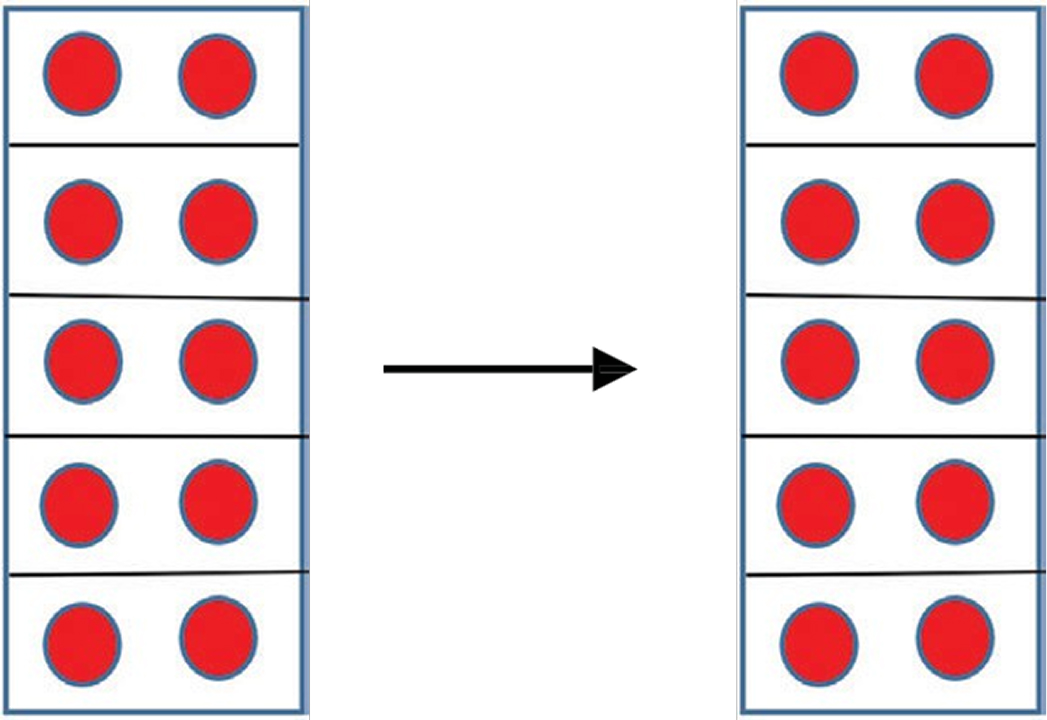
Now, suppose we have objects in any multiple of 10, we can divide the objects into smaller groups of 2 in the same fashion (Figure 2). Similar relationships can be visualized for any number and its multiples.
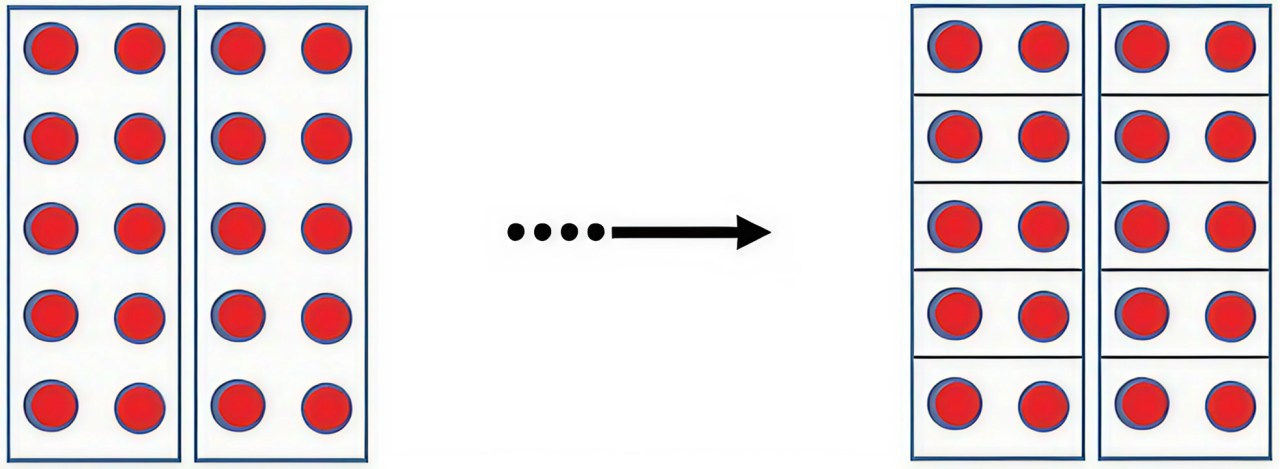
RULE 2: If two or more numbers are all divisible by the same number, then their sum will also be divisible by that number. For example, if 24 and 40 both are individually divisible by 4, their sum i.e., 24 + 40 = 64 will also be divisible by 4. This can be easily shown using counters (Figure 3):
24 = 4 × 6

40 = 4 × 10

64 = 4 × (6 + 10)

This simple representation could be generalized for the combination of three or more numbers. We will be using a few basic expansions of numbers in order to understand how the concept of place value plays an important role in understanding divisibility rules. Let us take an example:
We have a number 13455, which we call thirteen thousand, four hundred and fifty-five. We can expand this number in many ways using the place value concept. So, 13455 can be written in any of the following ways:
- 10000 + 3000 + 400 + 50 + 5
- 13000 + 400 + 50 + 5 = 13000 + 455
- 13400 + 50 + 5 = 13400 + 55
- 13450 + 5; and so on.
Divisibility by 10
Any number is divisible by 10 if the last digit of that number is 0.
Here we would try to understand the divisibility rule for 10 in the first place as this rule will act as the base to interpret the rules for the other numbers.
Observe the way we write the numbers below:
| 1 | 11 | 21 | 31 | 41 | 51 | 61 | 71 | 81 | 91 | 101 | 111 | 121 |
| 2 | 12 | 22 | 32 | 42 | 52 | 62 | 72 | 82 | 92 | 102 | 112 | 122 |
| 3 | 13 | 23 | 33 | 43 | 53 | 63 | 73 | 83 | 93 | 103 | 113 | 123 |
| 4 | 14 | 24 | 34 | 44 | 54 | 64 | 74 | 84 | 94 | 104 | 114 | 124 |
| 5 | 15 | 25 | 35 | 45 | 55 | 65 | 75 | 85 | 95 | 105 | 115 | 125 |
| 6 | 16 | 26 | 36 | 46 | 56 | 66 | 76 | 86 | 96 | 106 | 116 | 126 |
| 7 | 17 | 27 | 37 | 47 | 57 | 67 | 77 | 87 | 97 | 107 | 117 | 127 |
| 8 | 18 | 28 | 38 | 48 | 58 | 68 | 78 | 88 | 98 | 108 | 118 | 128 |
| 9 | 19 | 29 | 39 | 49 | 59 | 69 | 79 | 89 | 99 | 109 | 119 | 129 |
| 10 | 20 | 30 | 40 | 50 | 60 | 70 | 80 | 90 | 100 | 110 | 120 | 130 |
All numbers are made of ones and tens where the number of ones must be less than 10 but the number of tens can be as large as we want. For example, 473 is made with 3 ones and 47 tens, while 6850 is made with 685 tens and zero ones. If children have experience in making numbers with bundles (representing tens) and sticks (representing ones), this would be easy for them to understand. Now the tens are all divisible by ten of course but the ones are not. So, the only way a number would be divisible by 10 is if there are no loose ones (i.e., outside the tens) which is when it has 0 as its ones digit (i.e., the last digit).
Divisibility by 5 and 2
A number is divisible by 5 if the last digit of the number is 0 or 5.
Similarly, a number is divisible by 2 if the last digit of the number is 0, 2, 4, 6 or 8.
One way of looking at these rules can be through the 10 × 10 grid.
Here, multiples of 2 are highlighted in blue, those of 5 in red and those of both 2 and 5 in purple.
| 1 | 11 | 21 | 31 | 41 | 51 | 61 | 71 | 81 | 91 |
| 2 | 12 | 22 | 32 | 42 | 52 | 62 | 72 | 82 | 92 |
| 3 | 13 | 23 | 33 | 43 | 53 | 63 | 73 | 83 | 93 |
| 4 | 14 | 24 | 34 | 44 | 54 | 64 | 74 | 84 | 94 |
| 5 | 15 | 25 | 35 | 45 | 55 | 65 | 75 | 85 | 95 |
| 6 | 16 | 26 | 36 | 46 | 56 | 66 | 76 | 86 | 96 |
| 7 | 17 | 27 | 37 | 47 | 57 | 67 | 77 | 87 | 97 |
| 8 | 18 | 28 | 38 | 48 | 58 | 68 | 78 | 88 | 98 |
| 9 | 19 | 29 | 39 | 49 | 59 | 69 | 79 | 89 | 99 |
| 10 | 20 | 30 | 40 | 50 | 60 | 70 | 80 | 90 | 100 |
A way of justifying these two rules could be through RULE 1 and RULE 2. Any number greater than 10 can be expressed in the form of a sum of a multiple of 10 and the remaining last digit. For example:
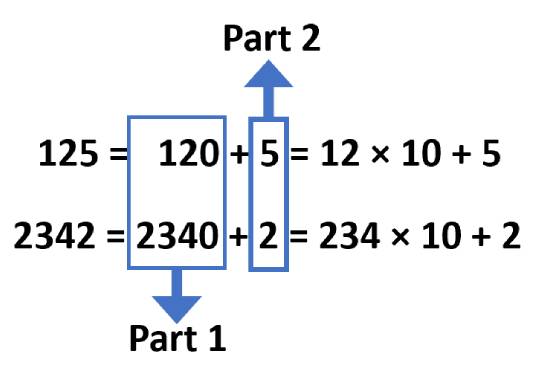
In the case of divisibility by 5, for any such number, Part 1 which is a multiple of 10 is always divisible by 5 (RULE 1), and for the whole number to be divisible by 5, the left out last digit should be divisible by 5 (RULE 2). This is possible only if the last digit is either 5 or 0. Hence, the condition for divisibility by 5.
Can you make a similar argument for divisibility by 2?
Divisibility by 4
A number is divisible by 4 if the number formed by its last two digits is divisible by 4.
This is similar to the divisibility rules of 5 and 2. But here, the last two digits of the number play an important role. The reason for this is that while 4 is not a factor of 10, it is a factor of 100. So, in this case, Part 1 should be a multiple of 100 (instead of 10), and Part 2 is a 2-digit number whose divisibility it remains to be checked.
For example:
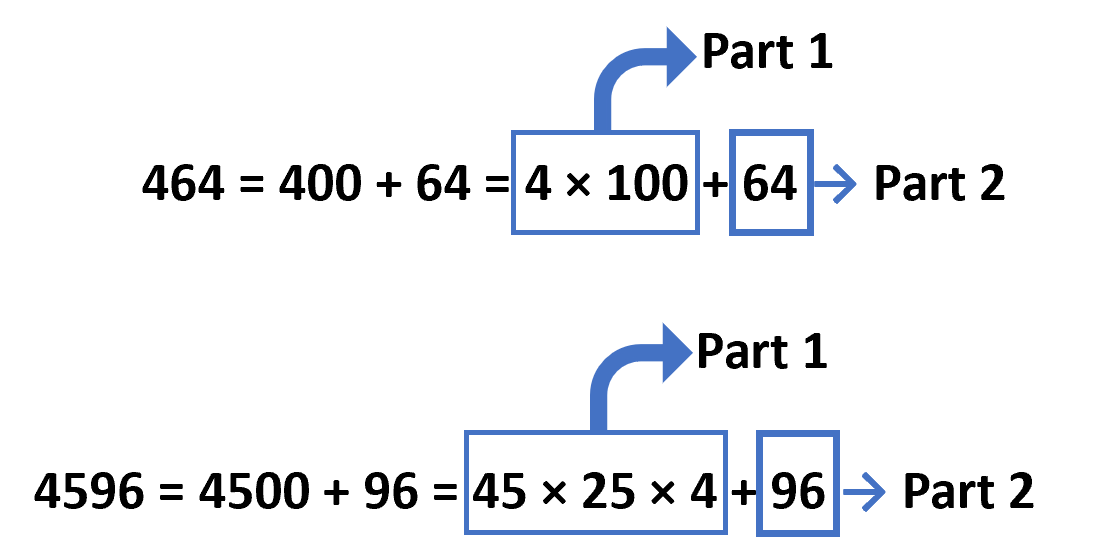
Now can you use similar reasoning to understand the rule for divisibility by 8?
Divisibility by 9 and 3
A number is divisible by 9 if the sum of all the digits of the number is divisible by 9.
Similarly, a number is divisible by 3 if the sum of all the digits of the number is divisible by 3.
Till now, we have been using 10 or 100 as one of the multiples in Part 1 to justify the divisibility rules of 5, 2 and 4. In the case of 9 and 3, Part 1 is written as a multiple of 9, 99, 999, and so on. Let us look through an example:
Take a number, say 873, to check its divisibility by 9.873 = 800 + 70 + 3 = 8 × 100 + 7 × 10 + 3 = 8 × (99 + 1) + 7 × (9 + 1) + 3 = (8 × 99 + 8) + (7 × 9 + 7) + 3 = (8 × 99 + 7 × 9) + (8 + 7 + 3)
Here Part 1 = 8 × 99 + 7 × 9 is clearly a multiple of 9. The remaining part or Part 2 i.e. 8 + 7 + 3 = 18 is the sum of the digits of number 873. (Do you see why you get the digits of the given number in Part 2?) So, to check divisibility of 873 by 3 or 9, we need to check only if the digit-sum 18, is divisible by 3 or 9. Since 18 is divisible by 9 (and therefore by 3 also), 873 is divisible by both 9 and 3.
Similarly, 4,83,720 = 4 × 100000 + 8 × 10000 + 3 × 1000 + 7 × 100 + 2 × 10 + 0= 4 × (99999 + 1) + 8 × (9999 + 1) + 3 × (999 + 1) + 7 × (99 + 1) + 2 × (9 + 1) + 0= (4 × 99999 + 8 × 9999 + 3 × 999 + 7 × 99 + 2 × 9) + (4 + 8 + 3 + 7 + 2 + 0)
Again Part 1 is clearly divisible by 9 and Part 2 is the digit-sum = 4 + 8 + 3 + 7 + 2 = 24, which is not divisible by 9 but is divisible by 3. So, 483720 is not divisible by 9, but it is divisible by 3.
On the other hand, 5273 = (5 × 999 + 2 × 99 + 7 × 9) + (5 + 2 + 7 + 3) and Part 2 or its digit-sum = 5 + 2 + 7 + 3 = 17 is not divisible by 3 while Part 1 clearly is. So, 5273 is not divisible by 3 or by 9.
Now what do you think should be the rule for divisibility by 6? For 12? For 15? For 20?
Some important points to summarise
For each divisibility rule, the idea is to break the number into Part 1 and Part 2 such that
- Part 1 is divisible by the concerned number usually by RULE 1
- Part 2 is very small compared to the original number
- We need to check only Part 2 for divisibility and apply RULE 2 for the whole number as depicted below:
| Number | Part 1 | Part 2 |
|---|---|---|
| 2, 5, 10 | 10m (Multiple of 10) | Remaining last digit in units place |
| 4 | 100m (Multiple of 100) | Remaining last 2-digit part |
| 8 | 1000m (Multiple of 1000) | Remaining last 3-digit part |
| 3 and 9 | 9m (Multiple of 9) | Digit-sum |
So, we have discussed divisibility by 2, 3, 4, 5, 6 (by extension), 8, 9 and 10. Though we have not proved the rules algebraically for any number, these visualizations will provide enough of a spark to the minds of young learners on why such rules/tests work.