
Pentominoes on a Hundreds Grid: An Exploration



Place an ‘L’-shaped pentomino anywhere on a standard hundreds grid so that it perfectly covers five squares. Add up the five numbers it covers. Then, slide the shape to a completely different spot on the grid and add up those new numbers. Do this again and again.
Take a look at Figure 1. The sums of the numbers covered in these four positions are 121, 211, 311, and 346. Do you notice a pattern?
| 1 | 2 | 3 | 4 | 5 | 6 | 7 | 8 | 9 | 10 |
| 11 | 12 | 13 | 14 | 15 | 16 | 17 | 18 | 19 | 20 |
| 21 | 22 | 23 | 24 | 25 | 26 | 27 | 28 | 29 | 30 |
| 31 | 32 | 33 | 34 | 35 | 36 | 37 | 38 | 39 | 40 |
| 41 | 42 | 43 | 44 | 45 | 46 | 47 | 48 | 49 | 50 |
| 51 | 52 | 53 | 54 | 55 | 56 | 57 | 58 | 59 | 60 |
| 61 | 62 | 63 | 64 | 65 | 66 | 67 | 68 | 69 | 70 |
| 71 | 72 | 73 | 74 | 75 | 76 | 77 | 78 | 79 | 80 |
| 81 | 82 | 83 | 84 | 85 | 86 | 87 | 88 | 89 | 90 |
| 91 | 92 | 93 | 94 | 95 | 96 | 97 | 98 | 99 | 100 |
Every single one of these sums is exactly one more than a multiple of 5. In other words, it appears that no matter where you slide this ‘L’ pentomino on the grid, the sum of the numbers it covers will always leave a remainder of 1 when divided by 5.
Would this remainder stay the same if the piece were rotated or flipped?
What about entirely different shapes? And most importantly—why does this happen?
These questions recently sparked a rich mathematical investigation among middle school teachers at the MTAI – IIT Palakkad Teachers Math Circle. The hundreds grid is a familiar, versatile Teaching Learning Material (TLM) widely used in primary classrooms for counting and place value. However, as highlighted in a previous issue of At Right Angles (Jagrati Mehra, March 2025), it can also serve as a powerful springboard for advanced problem-solving. This article reports on how a simple activity, such as placing pentominoes on a grid, evolved into a deep exploration of algebra, symmetry, and mathematical proof.
Starting Off: Concrete Experience
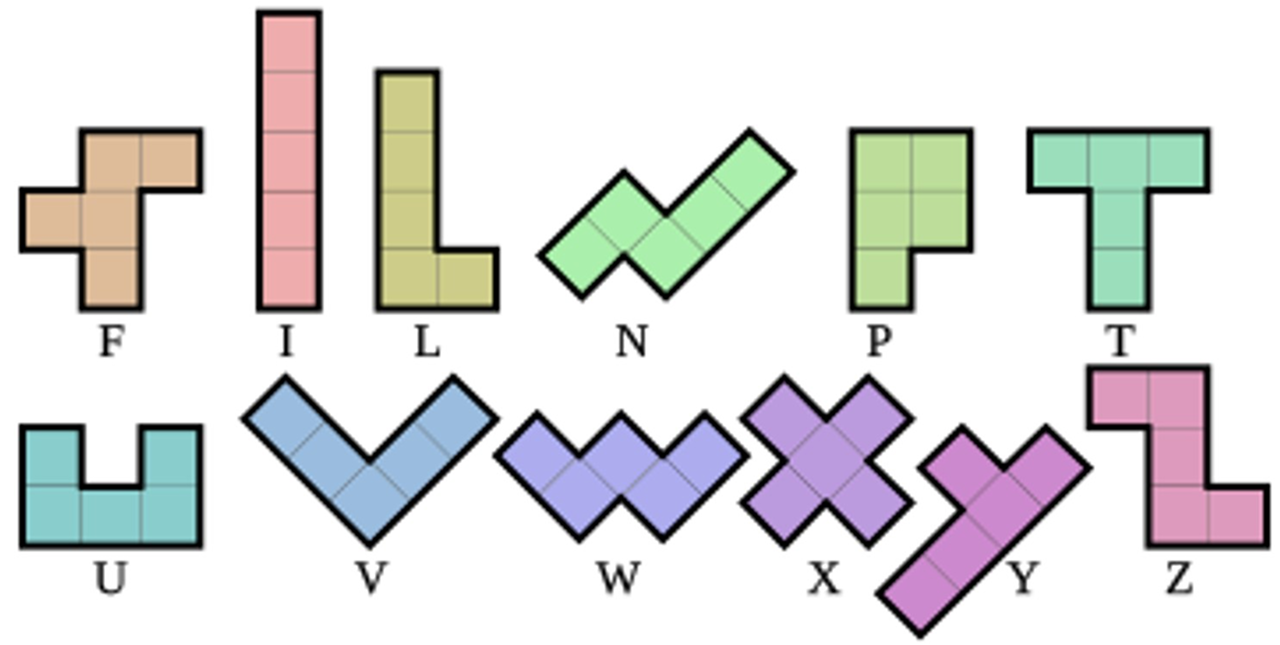
A pentomino is a geometric shape formed by joining five identical squares edge-to-edge. Considering rotations and reflections as identical to the original, there are 12 distinct pentomino shapes, each named after the uppercase letter it resembles.
During the workshop, teachers were handed printouts of the hundreds grids and physical pentomino cutouts to physically play with and explore (Figure 3). Given the freedom to investigate, most teachers instinctively started with the ‘I’ pentomino, perhaps assuming its straight-line geometry would be the simplest to decode.
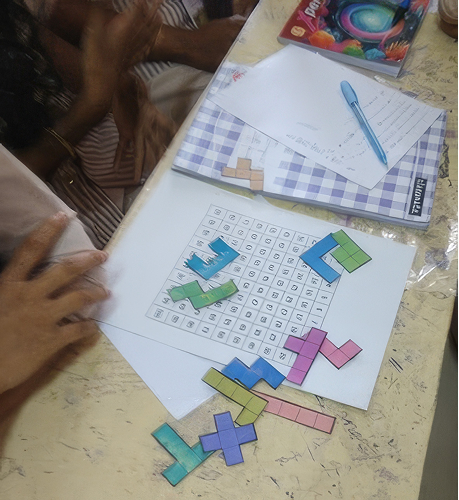
Placing the ‘I’ piece horizontally across different rows, they quickly made a conjecture: the sum of the numbers covered by the horizontal ‘I’ always gives a remainder of 0 when divided by 5.
Can we conclude that this will be true based on the few observations that we make? No – it calls for an explanation or proof. One teacher reasoned that the ‘I’ pentomino covers five consecutive numbers on the grid and that the sum of five consecutive numbers is always divisible by 5. Another teacher came up with an algebraic proof:
The numbers that the ‘I’ pentomino covers can be taken as \(x\) – 2, \(x\) – 1, \(x\), \(x\) + 1, \(x\) + 2. Their sum is 5\(x\) and hence divisible by 5.
But what if the ‘I’ piece is placed vertically? Now, it covers numbers such as 7, 17, 27, 37, and 47. The teachers noted that the difference between consecutive numbers in this sequence is always 10. The sum, therefore, is simply five times the middle number—again, always a multiple of 5.
Finding the Shortcut: Smarter Arithmetic
Having convinced themselves that the ‘I’ piece always yields a remainder of 0 when divided by 5, regardless of its orientation or position, the teachers moved on to the other 11 shapes.
To check their conjectures, many initially reached for calculators to sum the five numbers and divide by 5. However, when challenged to find a method “smarter and faster than a calculator,” a brilliant pedagogical shift occurred.
One group realized they only needed to look at the units digits. Because any number on the grid can be written as 10a + b; the tens component (10a) is already a multiple of 5 and can be ignored. Shortly after, they refined this even further: instead of summing the units digits, they could just “cast out the fives.” They had independently rediscovered a core principle of modular arithmetic: the remainder of a sum is equal to the sum of the individual remainders after casting out the divisors. This leap in logical reasoning dramatically simplified their investigation. For example, in order to calculate the remainder when the sum of numbers covered by the blue pentomino in Figure 6 is divided by 5, all they need to do is to find the remainders when each of the numbers covered is divided by 5 (1, 1, 1, 1, and 2 in this case) and find the remainder when their sum 6 is divided by 5. This is much easier than finding the sum 6 + 16 + 26 + 36 + 37 = 121 and then finding the remainder when that is divided by 5.
From Pictures to Symbols: Proving the Invariance
Through rapid calculation, the teachers established a clear conjecture: The remainder is independent of the piece’s position on the grid. But how to prove it?
Multiple approaches emerged, showcasing different levels of abstraction:
- The Visual/Translational Approach: One group argued dynamically. “If you slide a piece one column to the right, the sum of the five numbers increases by 5 (1 × 5). The remainder doesn’t change. If you slide it down one row, the sum increases by 50 (10 × 5). The remainder still doesn’t change.”
- The “Non-Verbal” Structural Approach: Another group assigned a value of \(x\) to the leftmost column of a shape and added one to the assigned number as they moved one column to the right. They arbitrarily assigned the value 0 to \(x\) and took all numbers in the leftmost column as 0. They then assigned the number 1 to all cells in the second column and the number 2 to all cells in the third column of the shape (Figure 4). Note that they have not marked the 0s below the leading \(x\) in the shapes where there are cells below the marked \(x\). By adding these relative values together, they could find the remainder without needing specific grid numbers.
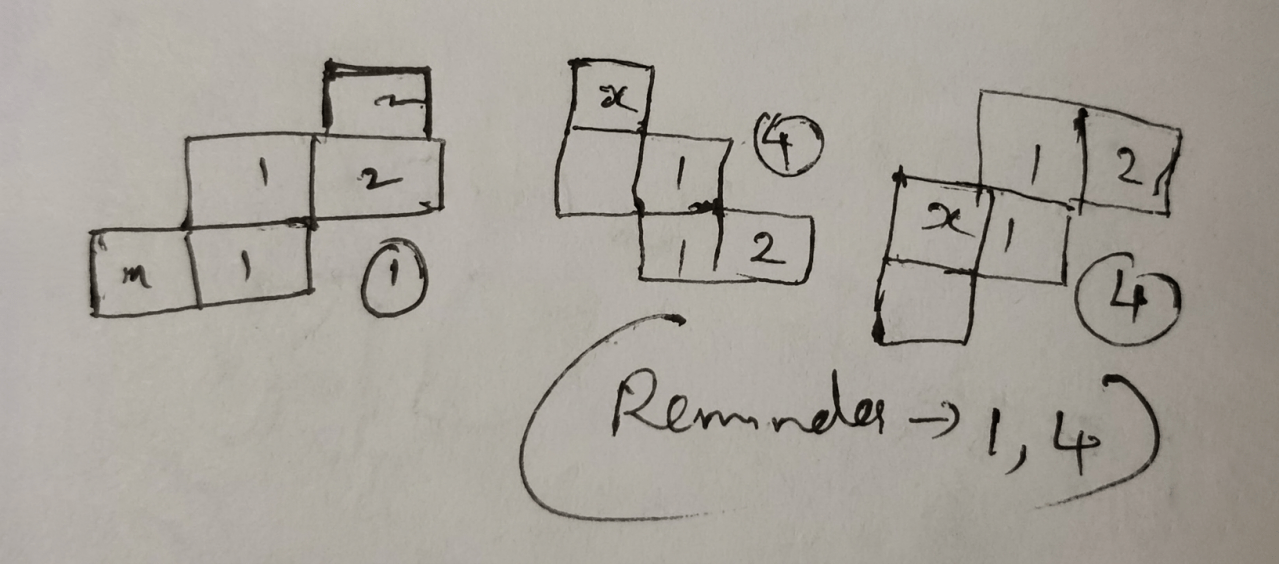
- The Formal Algebraic Approach: Many groups used algebra to lock in their proofs. For the ‘W’ piece, located on the right edge of Figure 4, one teacher explained: “Twice a number, added to twice the next number, plus the next number, gives a remainder of 4.” Written symbolically, if the number in the first column is n, the sum is: 2n + 2(n + 1) + (n + 2) = 5n + 4. Any number of the form 5n + 4 will always leave a remainder of 4 when divided by 5.
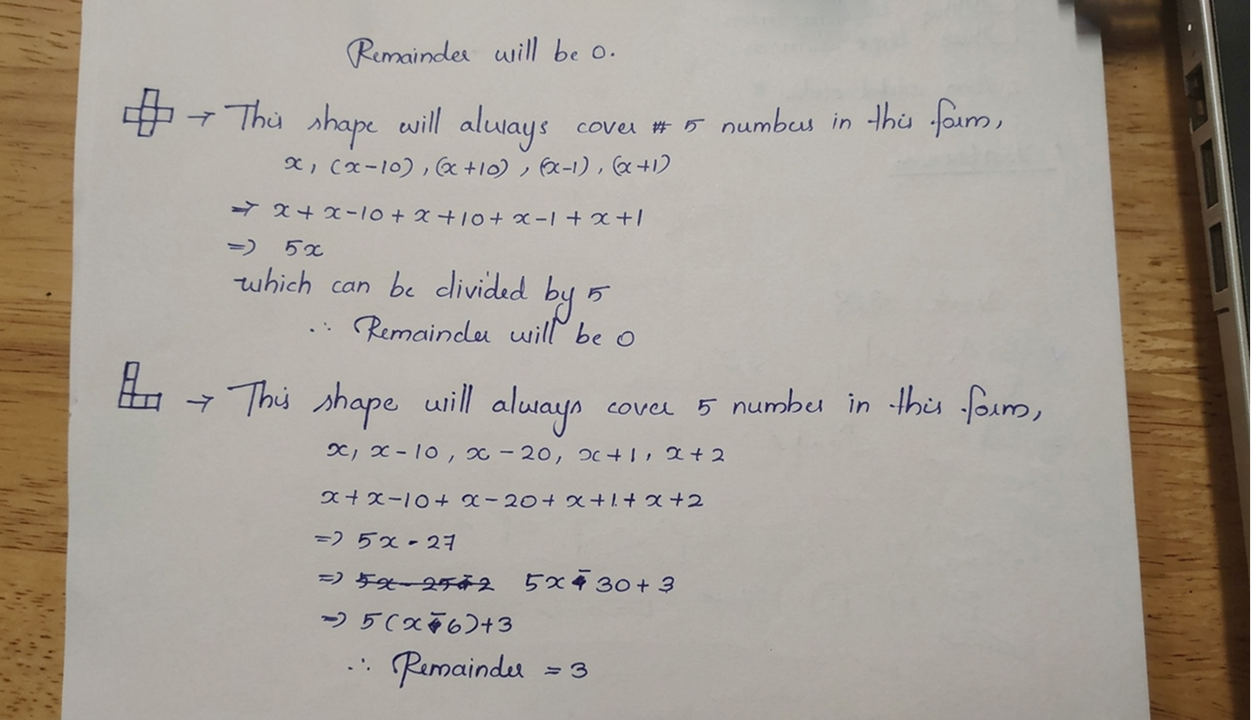
Interestingly, a debate sparked around the algebraic proofs (Figure 5). When setting up the equations, should \(x\) represent the smallest number in the shape, or the centre square? Using \(x\) for the number in the centre square often simplified the final equation, but using \(x\) as the smallest number avoided introducing negative signs (like \(x\) – 10), which some teachers argued was a much friendlier approach for middle school students.
The Twist: Orientation and “Sundaran” Shapes
While sliding a piece around the grid didn’t change its remainder, the teachers made a fascinating discovery: the remainder does change if the piece is rotated or flipped. Exploring the eight possible orientations for a single piece (four rotations, each with a flipped counterpart), a beautiful symmetry emerged. The teachers noticed that if a piece yields a certain remainder, reflecting it horizontally or vertically produces a remainder that perfectly complements it to 5. For example, if the original ‘L’ piece gives a remainder of 1, the flipped ‘L’ piece (Figure 6) gives a remainder of 4 (since 1+ 4 = 5).
| 1 | 2 | 3 | 4 | 5 | 6 | 7 | 8 | 9 | 10 |
| 11 | 12 | 13 | 14 | 15 | 16 | 17 | 18 | 19 | 20 |
| 21 | 22 | 23 | 24 | 25 | 26 | 27 | 28 | 29 | 30 |
| 31 | 32 | 33 | 34 | 35 | 36 | 37 | 38 | 39 | 40 |
| 41 | 42 | 43 | 44 | 45 | 46 | 47 | 48 | 49 | 50 |
| 51 | 52 | 53 | 54 | 55 | 56 | 57 | 58 | 59 | 60 |
| 61 | 62 | 63 | 64 | 65 | 66 | 67 | 68 | 69 | 70 |
| 71 | 72 | 73 | 74 | 75 | 76 | 77 | 78 | 79 | 80 |
| 81 | 82 | 83 | 84 | 85 | 86 | 87 | 88 | 89 | 90 |
| 91 | 92 | 93 | 94 | 95 | 96 | 97 | 98 | 99 | 100 |
Even more intriguing were the pieces that completely resisted this change. The ‘I’, ‘X’, and ‘Z’ pentominoes stubbornly yielded a remainder of 0 in every possible position and orientation. Noting a specific, inherent symmetry to these pieces, the teachers affectionately dubbed them “sundaran“—meaning “beautiful.” When trying to mathematically define what made a shape sundaran, they ultimately described it as having “a sort of balance to the left and right, and top and bottom,” pushing at the edges of formal rotational symmetry.
Into the Classroom
Activities like these demonstrate to students that mathematics is far more than a set of memorized procedures. It is about the joy of noticing patterns, asking why they happen, and finding convincing ways to explain them.
This specific pentomino task is a pedagogical goldmine. It requires very little prerequisite knowledge, allowing students of all levels to jump right into concrete play. Yet, it scales beautifully, guiding learners from basic arithmetic patterns into algebraic expressions, providing a gentle, intuitive segue into modular arithmetic.
Furthermore, the exploration doesn’t end when the bell rings. The bounds of the problem can easily be stretched to keep curious minds engaged:
- What happens if we use a different grid, like a standard 7-day calendar?
- What if we explored triominoes or tetrominoes instead?
- What patterns emerge if we divide the sum by 3, or 10, instead of 5?
- What if we looked at the remainder of products rather than of sums?
Both author and participating teachers have since taken this task into their own classrooms. The results were unanimous: students are entirely capable of uncovering these algebraic truths, proving that when we give learners the right tools and a good mystery, they will eagerly step into the shoes of a mathematician.
Acknowledgements
Thanks to all the teachers who participated enthusiastically in the workshop sharing their work and insights freely. Thanks to MTAI and IIT Palakkad for support in organising the programme. The task was inspired by Liljedahl, P., Chernoff, E. & Zazkis, R. Interweaving mathematics and pedagogy in task design: a tale of one task. J Math Teacher Educ 10, 239–249 (2007).