
A Review of the New NCERT Math Textbooks for Grades 1 and 2



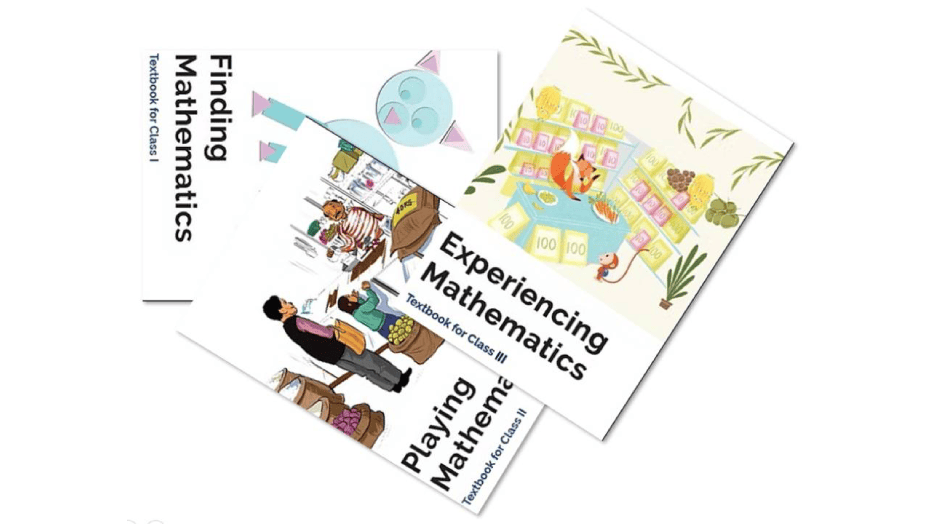
The new NCERT Grade 1 and 2 textbooks are noticeably more vibrant, structured, well-organized, and holistic than their previous versions. The foreword and “About the Book” sections effectively communicate the context and objectives behind the revisions.
Based on the principles and objectives enunciated under NEP 2020 — as well as on research from a range of disciplines (including neuroscience and early childhood education), on experiences and accumulated knowledge from the ground, and on the aspirations and goals of our Nation — the National Curriculum Framework for Foundational Stage (NCF FS) was developed and released on 22 October 2022. Subsequently, textbooks have been developed to bring to life the curricular approach of the NCF-FS. The textbooks attempt to connect to the children’s real life by recognizing their learning in the classroom and the significant learning resources in the family and the community. ― Joyful Mathematics, 2023
The textbooks incorporate a wide range of themes, including subtly highlighting the relevance of elders (especially grandparents) and inclusivity of differently abled individuals, sensitivity towards nature, awareness of social issues, and the promotion of values such as sharing, curiosity, and observation skills. Aligned with the NCF-FS’s play-based approach to learning, the Joyful Mathematics textbooks for grades 1 and 2 feature numerous activities designed to be conducted both inside and outside the classroom, supporting the goal of experiential learning for holistic development.
Mathematical concepts have been introduced through clear, contextual illustrations. These images support comprehension and also enhance children’s visual and reading skills. Specific examples, accompanied by images, are provided later in the article. Oral discussions with children have been integrated into the chapters to encourage them to verbalize and express their thought processes. The books have been designed to be text-cum-workbooks, to offer children opportunities to draw, colour, and write. However, some teachers note that the space for solving problems, typically found in a standard workbook, is somewhat limited.
“There is no space for completing activities. It should either be provided in the textbook, or if it becomes bulky, a separate workbook with questions.” ― Garima Bhatt, Azim Premji School, Uddham Singh Nagar, Uttarakhand
About the amount of practice itself, about 13% of the teachers who participated in the survey (the summary of which is shared in the end) want to reduce the amount of practice, while 48% of them want to increase practice questions. Some teachers mentioned the need for more practice for specific reasons.
“There is a need for highlighting the importance of practising procedural aspects of mathematics at this stage. Textbooks could include first, importance of practice with reasons and also include specific suggestions, resources for teachers to give that practice for their students.
There is also no mention of Fact fluency in the textbooks and creating Fact sheets at the end of the textbook such as addition facts and subtraction facts could help students develop fact fluency which might get missed when conceptual understanding is overemphasised.” ― Anagh, Azim Premji School, Bengaluru, Karnataka
“For a diverse class with varied learning levels, it’s good to have different levels of questions for practice. I understand that a textbook has its own limitations and cannot fulfill everyone’s demands but it can be better if it includes more practice questions of different levels. For each activity/concept, there is a description, pictures and then the ‘Let us do’ section which includes 3-4 questions based on the activity, which can be increased. Kids usually enjoy solving the textbook more than working in the notebook or worksheets.” ― Aakanksha, Azim Premji School, Barmer, Rajasthan
The books have various activities that are intended as suggestions. The idea is to encourage teachers to create their own activities and supplement them with local toys, games, or materials found in the child’s immediate environment, to facilitate hands-on learning with concrete objects. Teachers have the flexibility to adapt, modify, and tailor the activities according to their specific context, as long as the focus remains on developing the key competencies for children at this stage.
The extent to which a teacher can create a world-class learning experience, aligned with the vision outlined in the NCF-FS document, depends on factors such as teacher capability, intent, availability of resources, and mentorship. According to the survey we conducted, 80% of teachers reported conducting additional activities, such as simulating a shopping experience with tokens and fake money, counting with fingers, stones, counters, and dice, or exploring the concept of heavy and light through hands-on experiences. These efforts are certainly a step in the right direction!
Now, let’s take a look at the chapter structure. Each chapter (in both grades) provides regular instructions on what teachers should do (Figure 1), along with talking points and opportunities for discussion on varied topics such as trains, flags, animals, sharing, Ekta Diwas, balanced diets, and the ill effects of overeating.
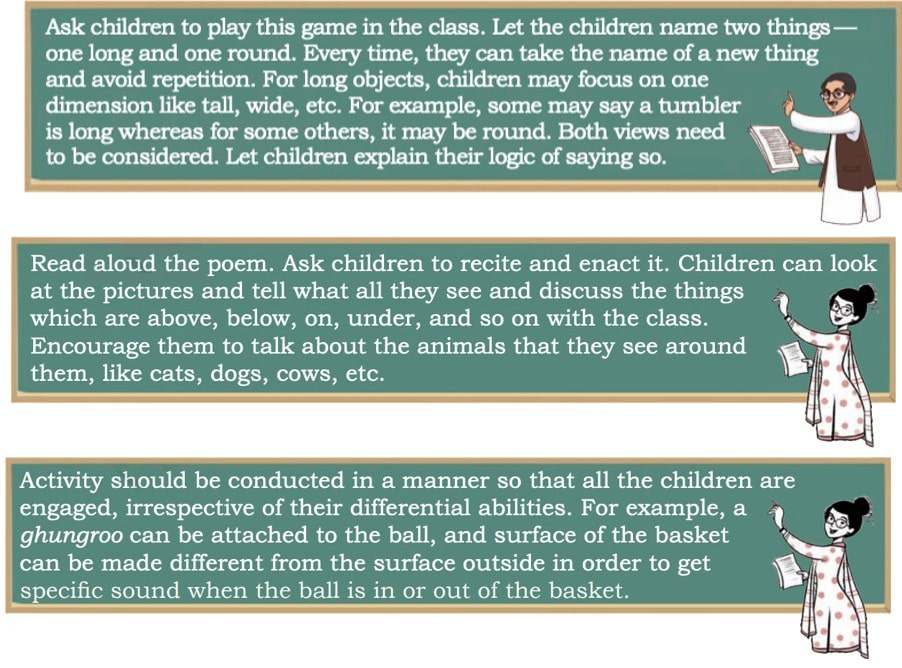
There are activities designed to expand vocabulary, promote national integration, and foster patriotism (Figure 2). Sections like “Think and Answer” serve as comprehension checks, while game ideas (such as finding a hidden object through verbal instructions or throwing a ball into a basket) and poems (with follow-up questions for understanding) encourage active participation. In one activity, children line up like a train, reciting a rhyme and identifying relative positions (Figure 3).
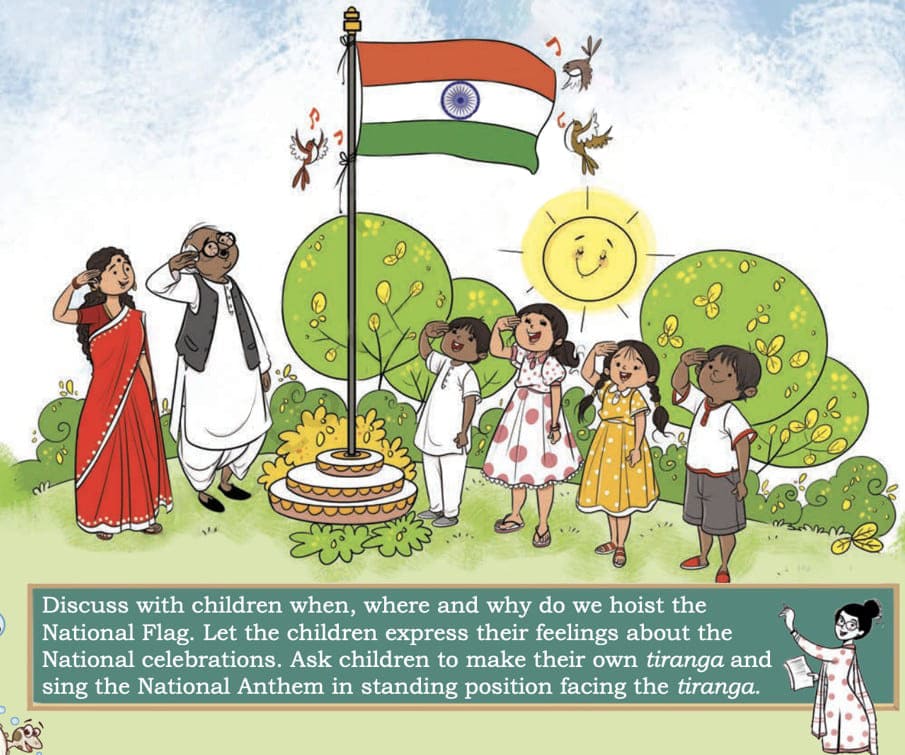
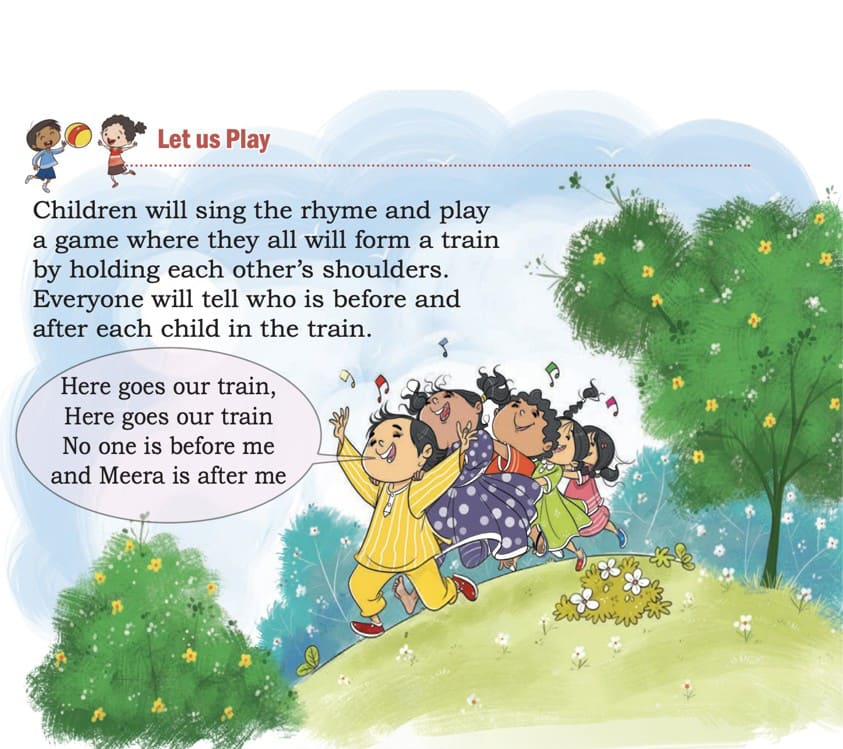
Project work is another key element in the new textbooks which encourages students to apply mathematical concepts in creative and practical ways. It promotes experiential learning by connecting math to everyday life, encourages teamwork, develops critical thinking and problem-solving skills.
Chapters conclude with a project or real-world problem-solving activity like, measuring items at home, creating number patterns, or measuring the quantities etc. ― Sonia Kundu, APS, Uttarkashi, Uttarakhand
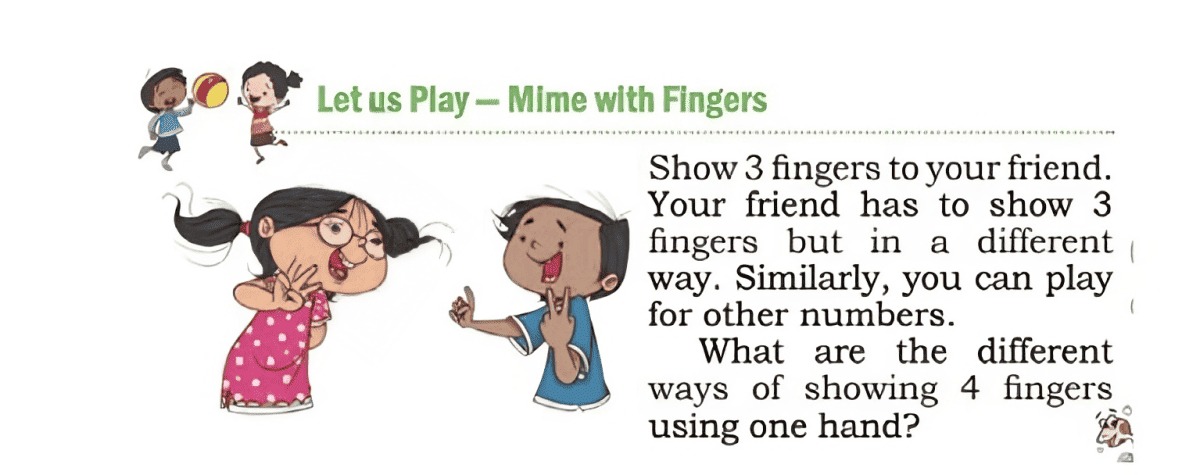
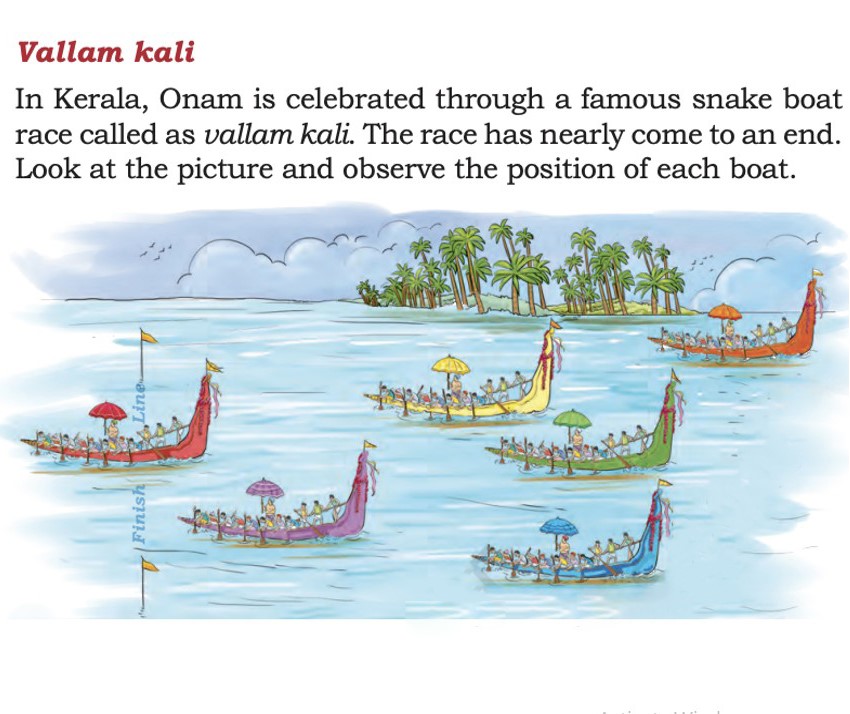
Along with project work (such as making a list of items to buy and noting down their costs while shopping) (Figure 4a), chapters include fun activities (like showing the number 3 or 4 in different ways with fingers) (Figure 4b), and an introduction to various cultures and places (such as Dal Lake in Kashmir, shadow games from Karnataka, Garba from Gujarat and snake boat race from Kerala) (Figure 4c).

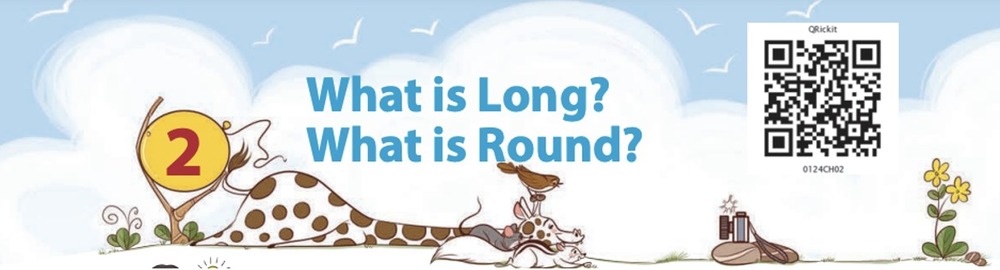
The start of each chapter has a QR code to scan on the top. It helps the teacher access e-resources such as audios, videos, multimedia, texts etc. related to the themes given in the chapter. For example, the QR code in Chapter 2, Grade 1 (What’s Long What’s Short) takes one to an audio resource (the entire chapter read out) and a video resource that has the story of “Wise Grandmother” in cartoon form, followed by questions and exercises that are covered in the chapter, in an interactive format.
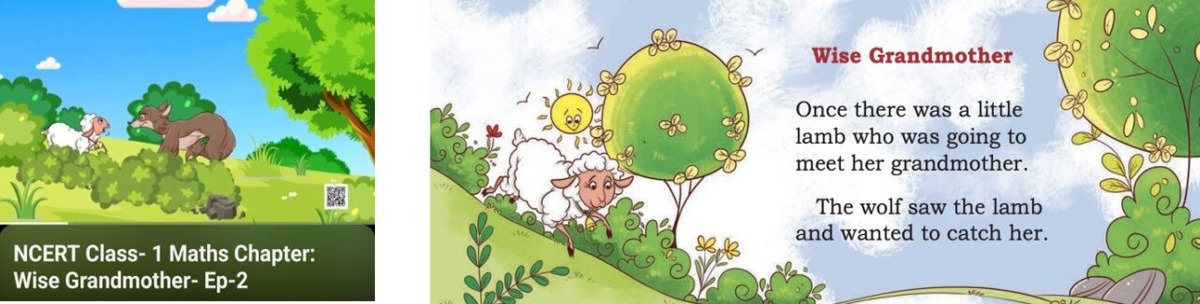
60% of the teachers surveyed claim to have made use of this digital content. Teachers have mentioned that the activities and the audio resources are beneficial and make learning easier. The additional resources give them the confidence to explain correctly. However, a couple of teachers mentioned that phones/ internet are not allowed in the school and so they are not able to use this facility while in school.
A few teachers were interviewed to get their perspective on the textbooks, its implementation and their experience with students. We present this to you in the form of a Whatsapp chat, telephonic interview and a documented report of the conversations.
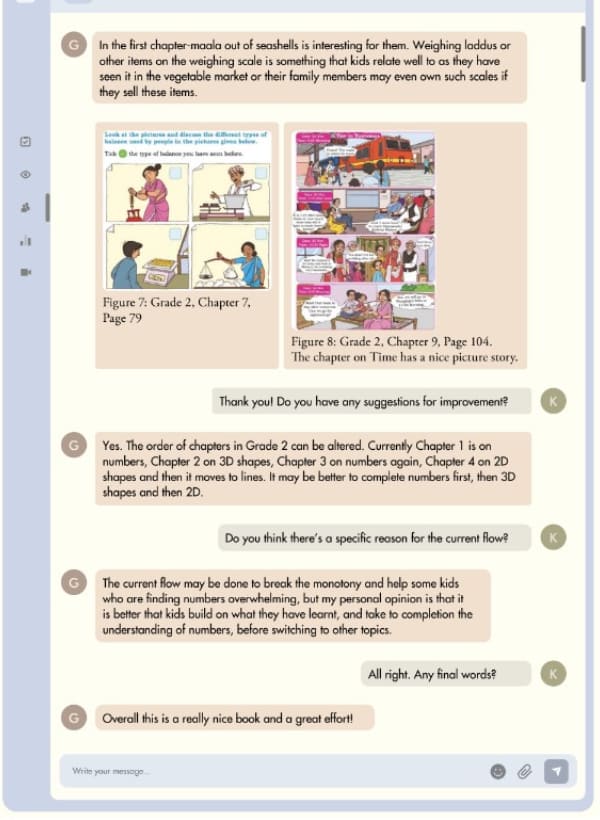
Kshama Chakravarthy’s WhatsApp Chat with Garima Bhatt, Teacher at Azim Premji School, Uddham Singh Nagar, Uttarakhand, Teaches Grade 2-5
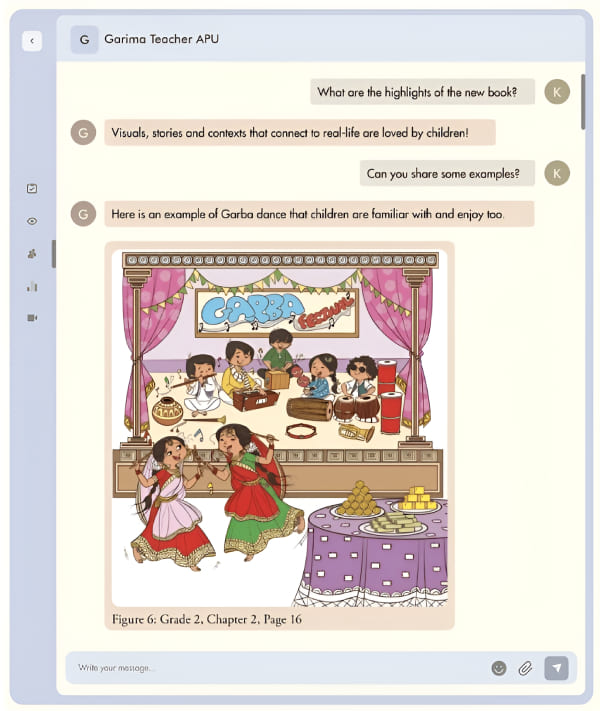
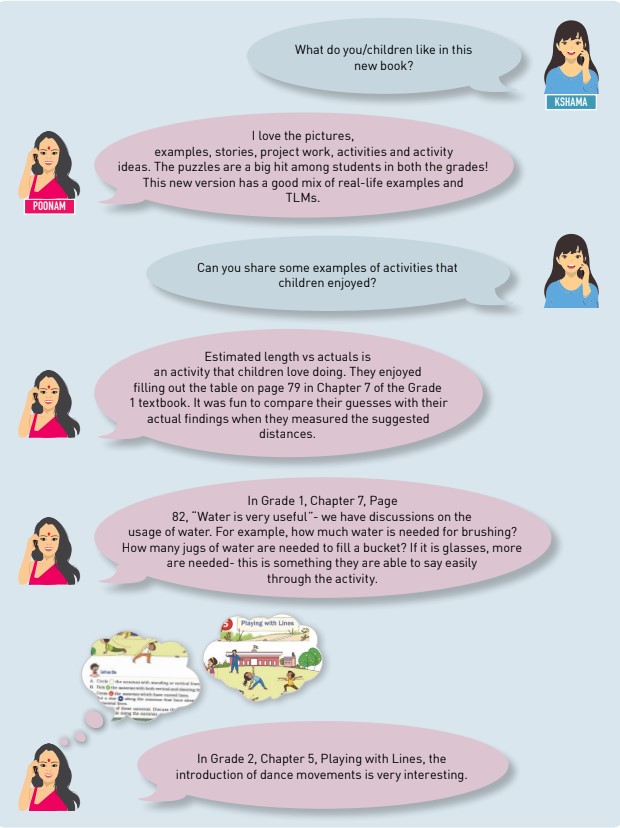
Kshama Chakravarthy’s Phone Conversation with Poonam, Teacher at Azim Premji School, Uddham Singh Nagar, Uttarakhand, Teaches Grades 1 and 2
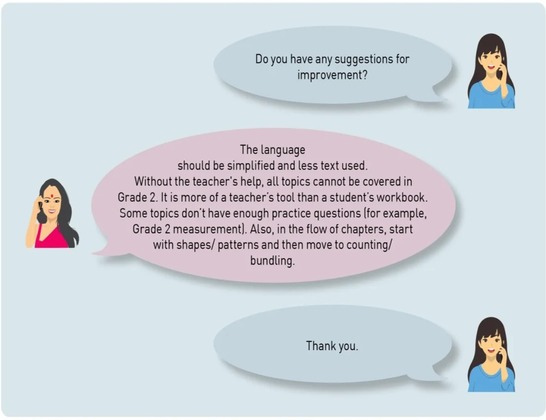
Here’s another teacher in the survey who talks about the language difficulty:
“The linguistic aspects of teaching mathematics can be improved by giving specific vocabulary, phrases and sentence constructions that would help students develop practice of them consistently. There are many words which are not understandable across India (diyas, nimbu pani, bindis) and could be avoided especially in the English version of the book.” ― Anagh, Azim Premji School, Bengaluru, Karnataka
Documented report of Kshama Chakravarthy’s conversation with Bharathi. G. S and N. Pushpalatha, Teachers at Karnataka Public School, Sarakki, Bengaluru, Teach grades 1 and 2
Kshama Chakravarthy: What are your thoughts about the new version of the text books?
Bharathi: We commend the effort gone into the making of the new version. However we feel that in the Karnataka government schools scenario, where most students come into Grade 1 with no prior exposure to language or learning, these textbooks become very difficult for the teacher to use. Teachers have a lot more work to do and a lot of hand holding is required for students.
K: Hmmm.. So, is the language and vocabulary difficult?
Pushpalatha: Yes, the text should be much less and illustrations self explanatory wherever possible.
K: Okay. What do you think about the way the topics are covered?
B: The way the concepts are introduced and taught is very nice, where children learn a lot without actually realising that they are learning.
K: Can you explain this further?
B: By this we mean that the concepts are taught through examples, stories, TLMs etc. so students don’t feel overwhelmed or fixated on the fact that they are learning something new or difficult. Grouping in tens and ones are introduced by different means.
K: Do you find anything needing attention?
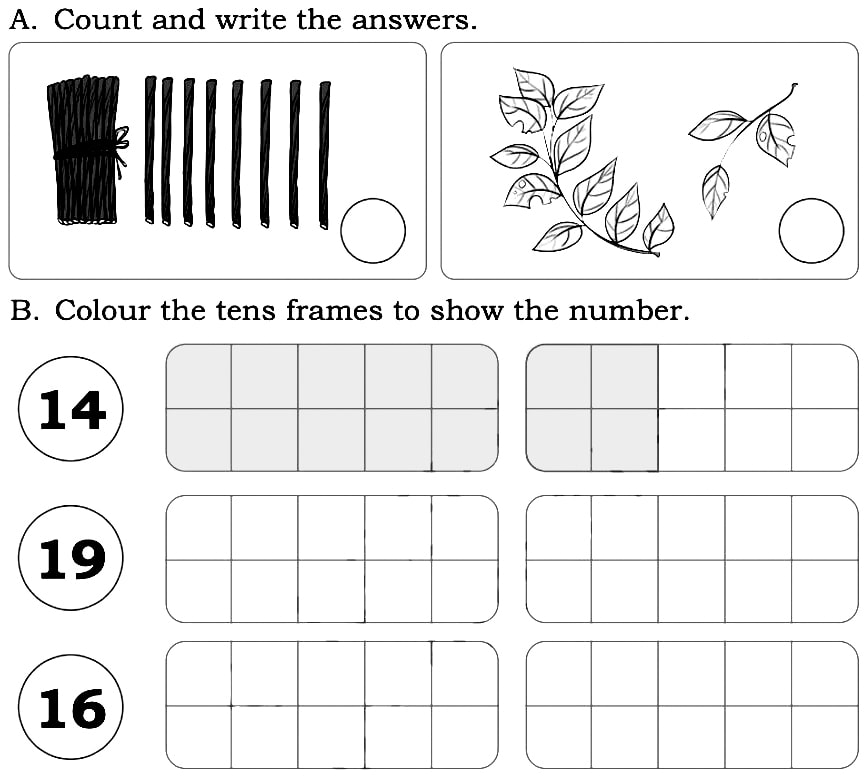
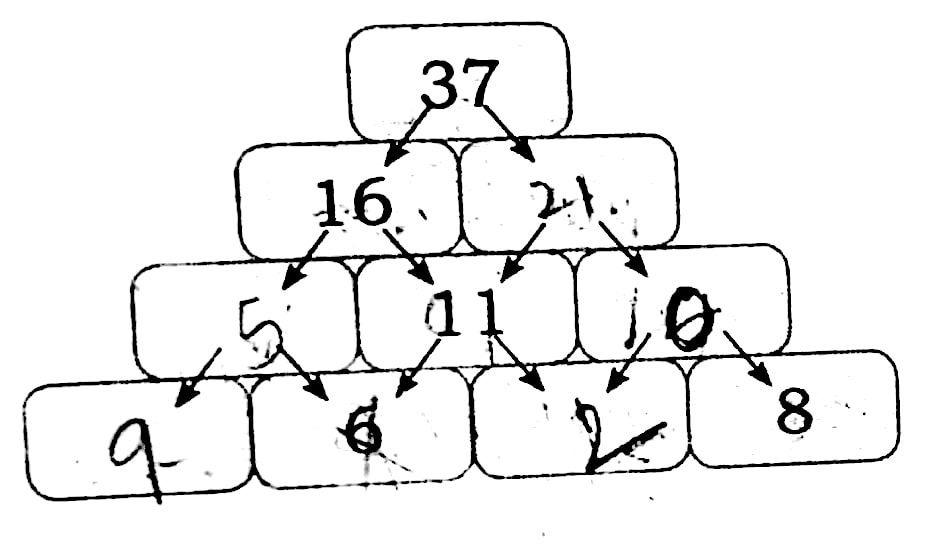
P: There is an error in the book that needs to be corrected. You will notice that based on the entries made in the third row, the fourth row cannot be filled with the numbers that they have printed. (See Figure 10)
P: Also, the government schools are to use the bilingual books (English and Kannada), and the problems appear in both languages with the working/ solution to be provided each time, which is time consuming and irritating for the student. The suggestion is to ask the question in both languages and provide one single answer box/ working steps. (See Figure 11)

K: How about asking students to answer it just once?
P: We try They don’t like leaving an empty box so they end up writing it in all of them, wasting time in the class. A change within the book makes it easier.
Note: The issue of bilingual textbooks falls under the purview of the state and not the NCERT. For the sake of preserving the conversation it has been retained here.
Having read snippets from different teachers about their experiences, let us now look at a detailed report shared by a teacher from APS, Uttarakhand, Ms. Sonia Kundu.
The Positives of the New Textbook (Grade 1)
Key Features of New Mathematics Textbooks
The revamped textbook aims to create a holistic and engaging learning experience for students by integrating innovative methods, interactive tools, and real-world applications. These features encourage curiosity, promote active learning, and develop a deeper understanding of mathematical concepts. Here are a few things that stand out for me in the new version.
- Concept’s introduction
Concepts have been introduced in simple ways, with visuals and game ideas making it easy for the child to understand. Here are a few examples.
Perceptual subitizing: It is intuitive. We can look at a small group of objects and instantly know how many there are without having to count. Grasping that numbers are made up of tens and ones is a foundational concept, paving the way for the understanding of larger numbers. Having a sense of “ten” as a group is essential for developing place-value understanding and performing mental calculations. This is dealt with well in the textbook.

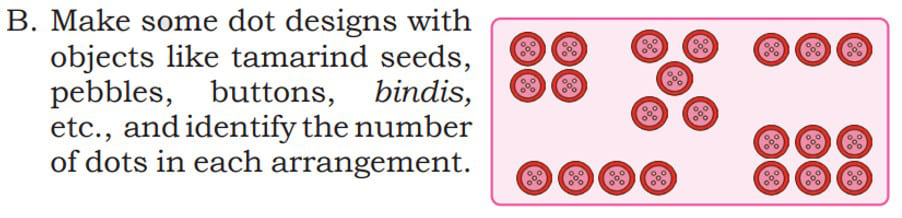
Conceptual subitizing: It involves recognizing a set of objects as made up of smaller groups. Take the example of dice: when a 6 appears, we might see it as two groups of three, which we understand to make six.
Numbers can be grouped and perceived in various ways. For instance, the number 8 can be thought of as 3 and 5 combined or as 4 and 4. Building skills in conceptual subitizing is crucial as it lays the foundation for many other mathematical concepts, such as composing and decomposing numbers, relationships between numbers and so on.
Use of Tens Frames: Tens frames are simple powerful tools that help students visualize numbers and understand place value.
The textbooks use tens frames for activities such as grouping, addition, subtraction, and identifying number patterns and provide a structured way to represent numbers. Tens frames prepare students for understanding place value by showing how numbers can be grouped in tens and ones. For example, seeing “13” as a full ten-frame (10) and three additional counters supports the idea of “1 ten and 3 ones”, thus promoting a deeper understanding of place value and number sense. It encourages grouping and “making tens” for easier mental calculations (Figures 9 and 12).
- Interesting Facts to Surprise Children
To spark curiosity and make learning enjoyable, the textbooks incorporate interesting and surprising facts which fosters a connection between mathematics and the real world.
Examples in the textbooks: Discussion about Sun temple, world’s highest statue etc.

- Interactive Pictorial Expressions
Visual aids and pictorial representations help make abstract concepts more concrete and relatable, by providing simple analogies. For example, colourful images, diagrams, and infographics for concepts like symmetry, shapes, and measurements, comic-style explanations for word problems and reasoning questions.
- Inclusion of Suggestive Activities
Hands-on interactive activities are thoughtfully incorporated throughout the chapters to encourage active participation and provide opportunity for trial and error.
Examples in the Textbooks
- Using dice for addition or subtraction games
- Counting and grouping with objects like beads or sticks
- Drawing number lines and solving puzzles based on them
- Well-Designed Flow of Concepts
The concepts in the new textbooks are structured in a logical manner, topics are introduced gradually, from simple to advanced/ complex ones. Chapters are interlinked, enabling students to build on previously learned ideas and see connections between different mathematical concepts, fostering a deeper and more integrated understanding.
- Prevents cognitive overload by introducing concepts incrementally.
- Reinforces prior knowledge while building new skills.
- Reasoning Questions
The inclusion of reasoning-based questions encourages students to think critically and justify their answers.
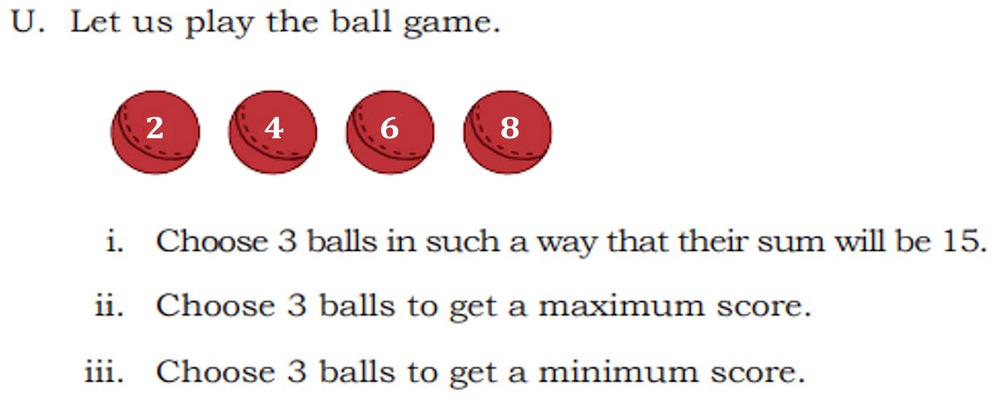
- Enhances logical reasoning and analytical thinking.
- Develops deeper conceptual understanding rather than rote learning.
- Games that promote Learning
Math-based games make math enjoyable and help reduce any fear or anxiety about the subject. They also encourage students to interact with their classmates, making learning a shared experience. It builds confidence and strengthens their understanding of key ideas. For example: Board games for arithmetic practice, puzzles for critical thinking, interactive group games for fostering collaboration.
Specific examples
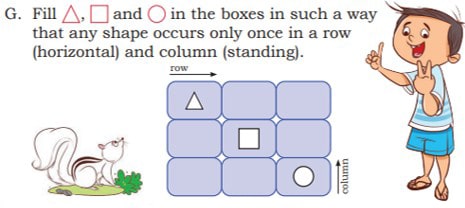
Textbook based activities
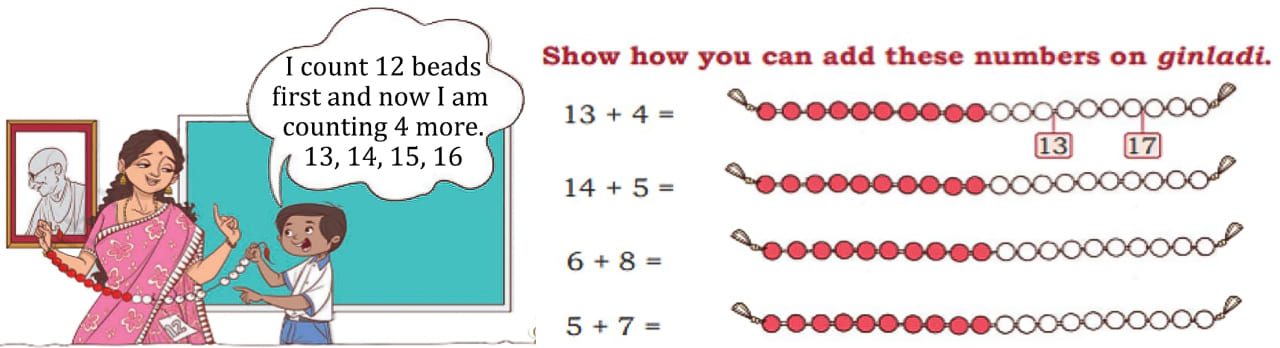
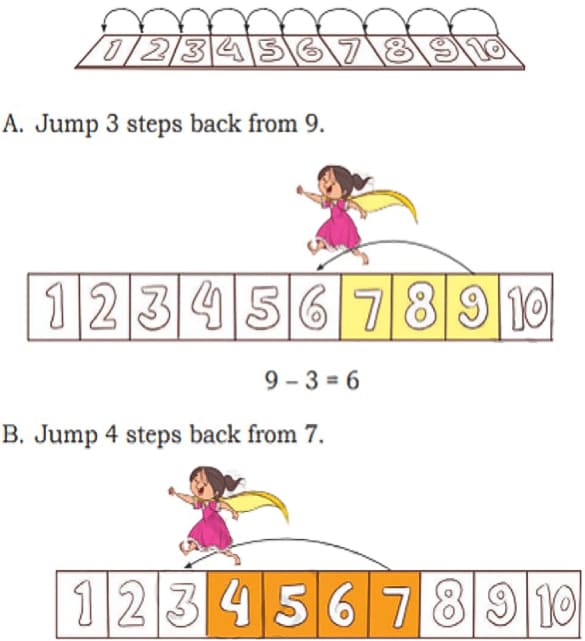
This page introduces addition and subtraction using visual tools like beads and number strips to make concepts engaging and relatable. Addition is shown through counting forward with beads, where children visualize sums by adding beads on a “ginladi” (e.g., 13 + 4 = 17). Subtraction is demonstrated as hopping backward on a number strip, illustrating how numbers decrease by taking steps back (e.g., 9 − 3 = 6). These activities provide a hands-on approach, reinforcing the concepts of sequential counting, addition, and subtraction, while transitioning students from concrete to abstract understanding.
Hop backwards on the number strip.
Suggestions for improvement
| Current Issue | Suggested Improvement |
|---|---|
The instructions lack clarity for situations when a number is rolled but all corresponding boxes have already been coloured.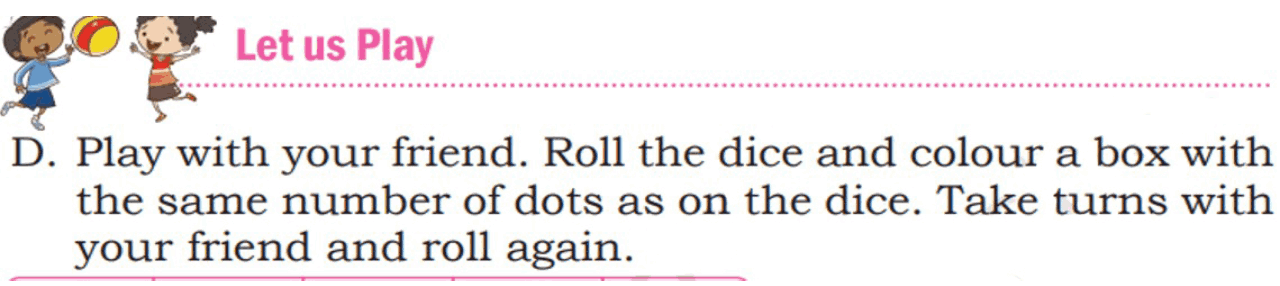 Figure 18: Grade 1, Chapter 4, Page 34 | Add this line: “If you roll a number and all the corresponding boxes are already coloured, skip your turn.” This ensures a smoother activity flow without confusion. |
The limited space in the provided picture results in overlapping lines, making it difficult to understand the concept.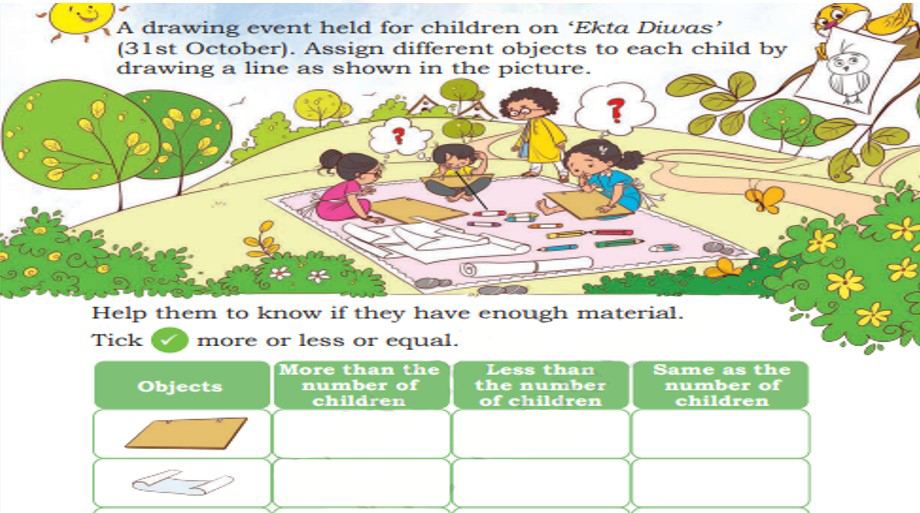 Figure 19: Grade 1, Chapter 3, Page 23 |
|
Students tend to focus on counting all the images at once instead of understanding the relationship between the two groups, leading to errors.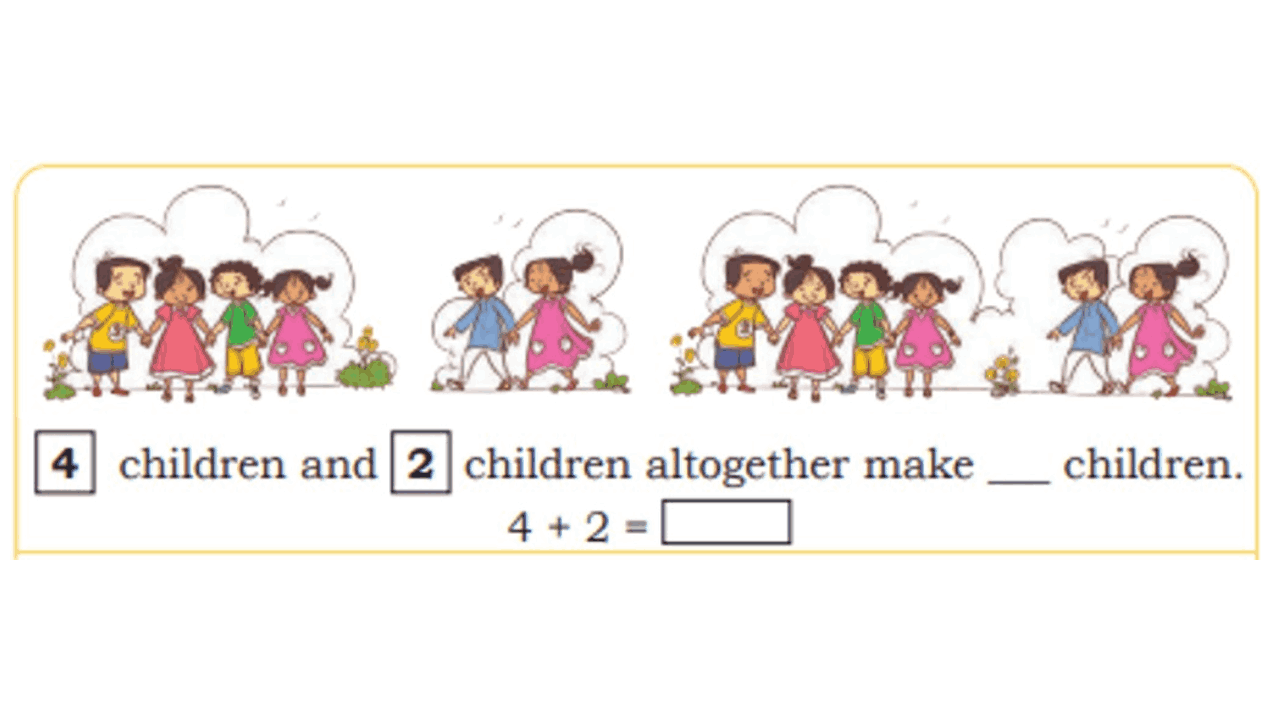 Figure 20: Grade 1, Chapter 5, Page 49 |
|
Let us now look at the details from the survey that was taken by 90 teachers across the country, which gives us a flavour of how teachers perceive the new version of the Math textbooks of grades 1 and 2.
|
Have you taught students of Grade 1 or 2 from the old NCERT Math textbook?
90 responses 
|
Which version of the Math textbook is more visual (more pictures)?
70 responses 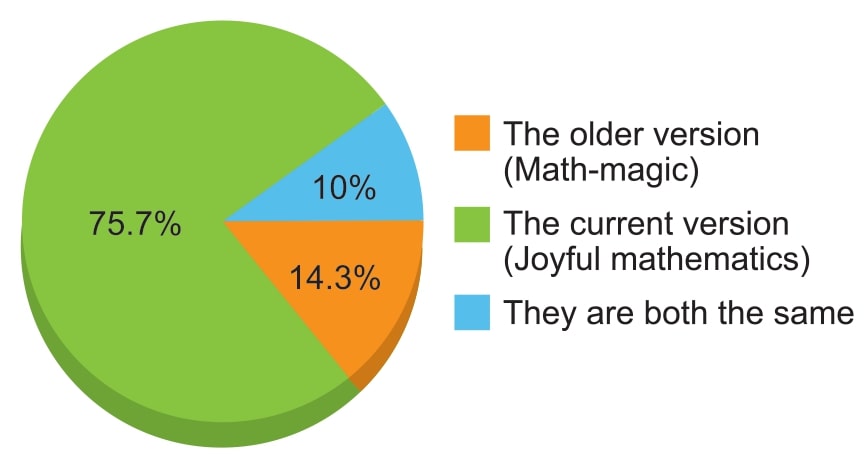
|
|
Which version of the Math textbook is more engaging?
70 responses 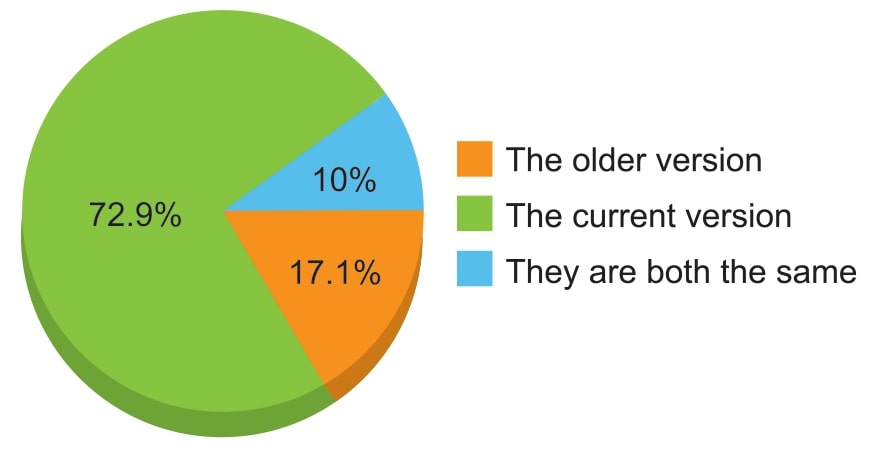
|
Which version has more instructions for the teacher?
70 responses 
|
|
In which version do you think students enjoyed more?
70 responses 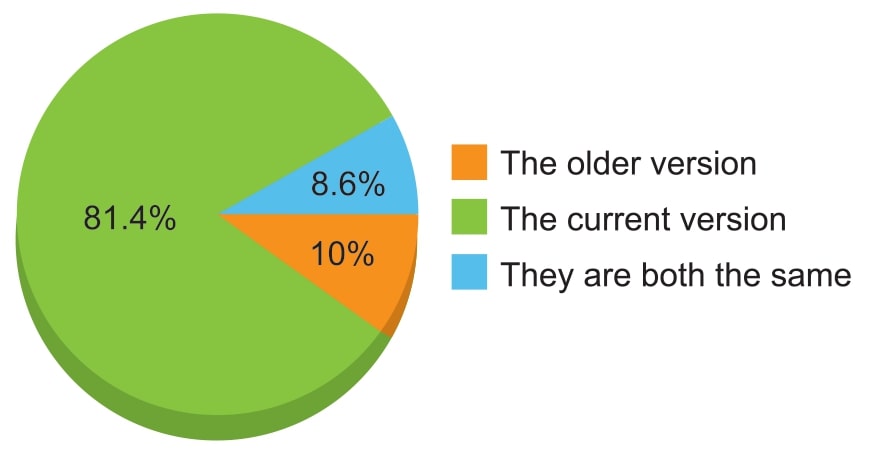
|
Which version do you prefer?
70 responses 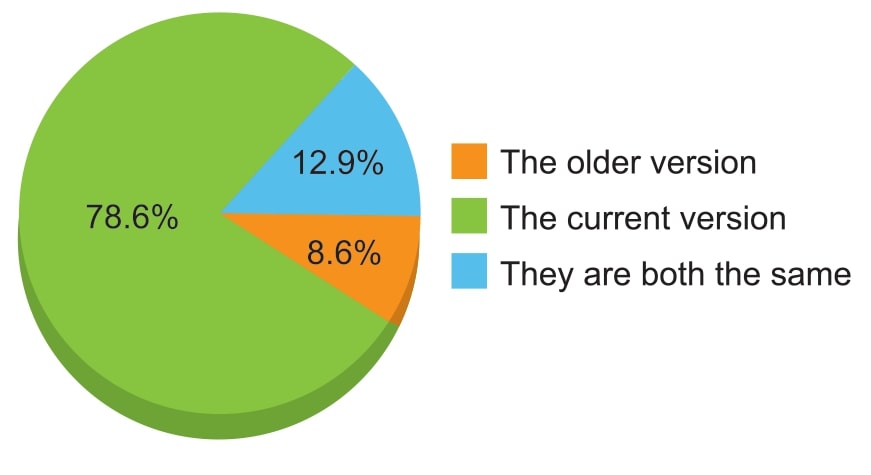
|
Top 3 good things in the new version:
| Top 3 things to change/ do differently in the new version:
|
| On a rating of 1 to 5, how much would you rate the current Grade 1 Math textbook? 80 responses 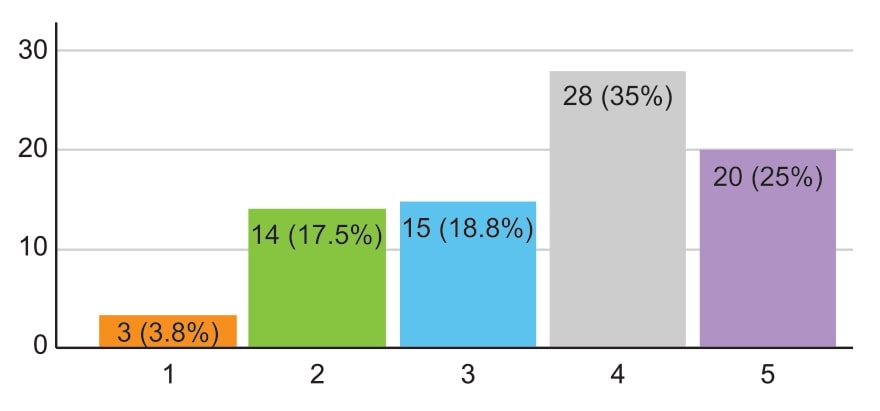
60% have given a rating of 4 or above for the new version of the Grade 1 textbook | On a rating of 1 to 5, how much would you rate the current Grade 2 Math textbook? 84 responses 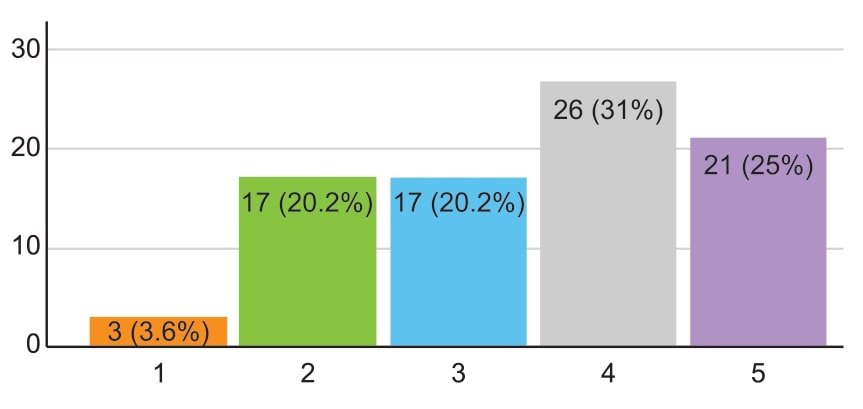
56% have given a rating of 4 or above for the new version of the Grade 2 textbook |
The new NCERT Math textbooks for Grade 1 and 2 have been well-received by teachers who have praised the thoughtful design and approach embedded in the chapters. From easy access to additional materials through simple QR codes, to clear instructions, the teachers feel that the textbooks offer a range of engaging learning methods, including stories, rhymes, poems, pictures, real-life activities, cultural references, and project work within each chapter. Additionally, the inclusion of puzzles has sparked excitement among both students and teachers alike.
However, there are some suggestions for improvement, particularly regarding the flow of the chapters and the amount of text in Grade 2, the space allocated for practice exercises, the number of practice questions, as well as the need for clearer guidance for teachers on the significance of certain concepts and different methods for teaching them. These areas could be explored further in the next iteration of the textbooks.
In conclusion, the new version of the textbooks is a promising step forward, fostering a more interactive, hands-on, and holistic learning experience. While there are areas for refinement, the positive feedback from teachers and the innovative features of the textbooks suggest that they are on the right track towards making mathematics a more joyful and meaningful experience for young learners.
- Joyful Mathematics: Class 1 (2023), NCERT https://ncert.nic.in/textbook.php?aejm1=0-13
- Joyful Mathematics: Class 2 (2023), NCERT https://ncert.nic.in/textbook.php?bejm1=0-11
- The National Curriculum Framework for Foundational Stage (NCF-FS) (2023)