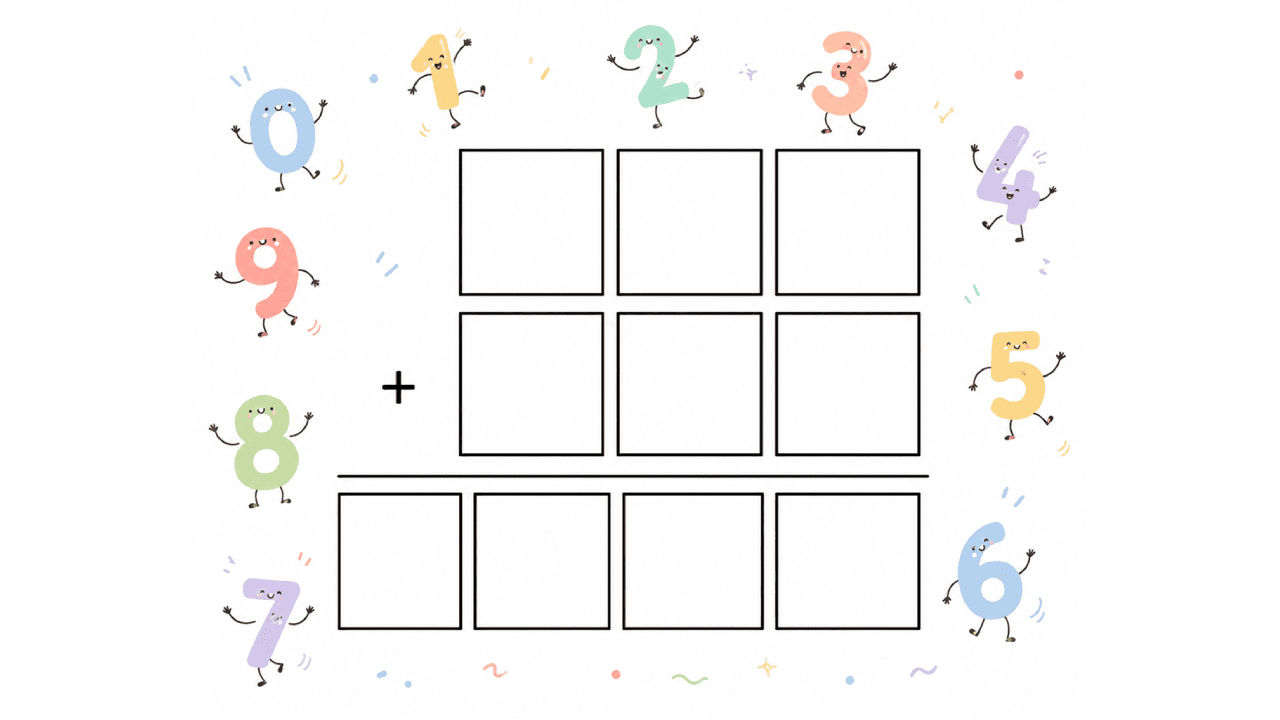

Star Problem


Recently my students and I were exploring the chapter Prime Time in the new NCERT (National Council of Educational Research and Training) textbook Ganita Prakash for Class 6. The chapter covers the concept of different sets of numbers including prime numbers, composite numbers, co-prime numbers, etc.
As prescribed by the textbook, we worked on multiples using the suggested game “Idli-Vada”. Then for factors we used the Jump Jackpot number line activity. As the students were familiar with the concepts of factors and multiples from Class 5, these activities provided a quick review and reinforcement for them. We then moved on to prime numbers and using the 10 by 10 hundreds grid, found the prime numbers using the “Sieve of Eratosthenes” method described in the chapter.
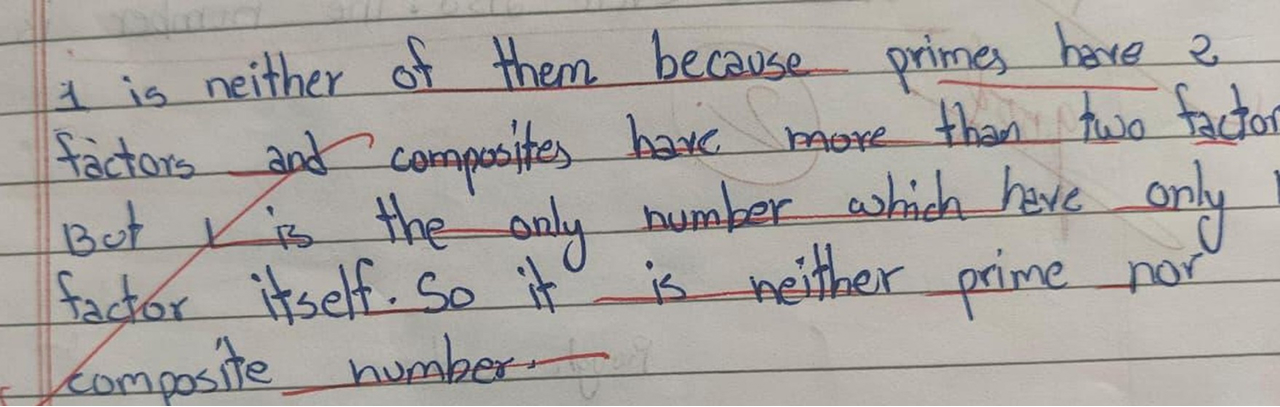
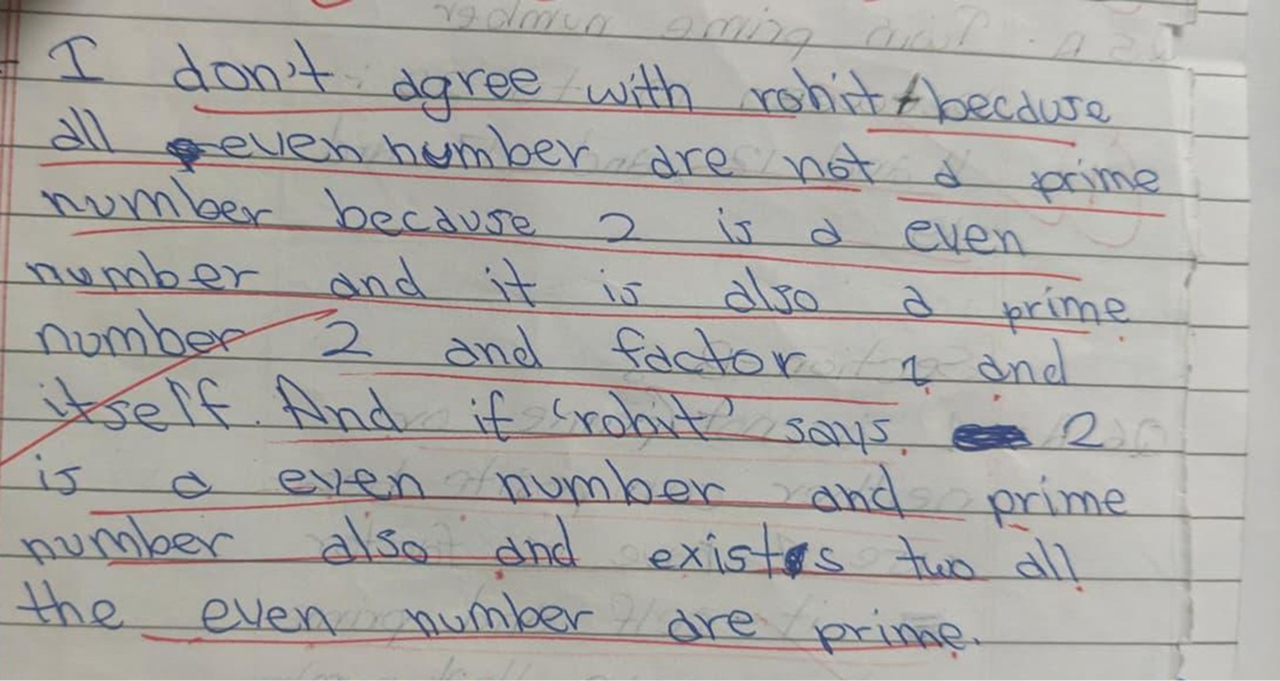
As assessment, I administered a class test, and the results were quite satisfying, indicating that the students were able to understand the concept of prime numbers. The students responded well on questions such as –
- Is 1 prime, composite or neither? Explain why.
- Rohit says, “All even numbers are composite.” Is it correct or not? Explain your answer using examples.
A few samples of their answers are given below –
Co-prime exploration
After understanding prime numbers, we moved on to co-prime numbers. NCERT suggests that students should be encouraged to read the textbook and to ensure this, I got the students to read page 115, where a modified version of the Jump Jackpot game is given.
In this activity, treasures are kept on two numbers. Jumpy gets the treasures only if he is able to reach both the numbers with the same jump size. Jump sizes of 1 are not allowed. The question asked where Grumpy should place the treasures so that Jumpy could reach at most one of them. The example given – of placing the treasures on 4 and 9, rather than on 12 and 36, illustrated a winning strategy for Grumpy.
After students played a few rounds of this game, the concept of co-prime numbers was explained. Co-prime numbers were defined as “two numbers having no common factor other than 1“. Many students connected Grumpy’s winning strategies to this definition but a few of them were not sure about it.
The next day, we worked on a different activity for which some guidelines were given in the textbook under the heading ‘Co-prime Art’. The activity was based on what will be called star-problem sheets; these sheets contain a circular number line with a finite number of dots. I gave the following (more detailed) instructions.
- Use the number of dots on the circle as your first number.
- Then choose any second number (let us call it m), that is smaller than the first number.
- Connect the dots by going round the circle starting with the first number and moving in equal steps of size m.
- Repeat this process till
Case 1: The matching pattern covers all the dots without skipping any.
Case 2: The matching stops or repeats before covering all the dots.
Statement: In Case 1, the numbers are co-prime. If the jumps stop, or move in a repeating cycle (Case 2), then the numbers are not co-prime.
The students understood the instructions and started working in groups. A few work samples are given below.
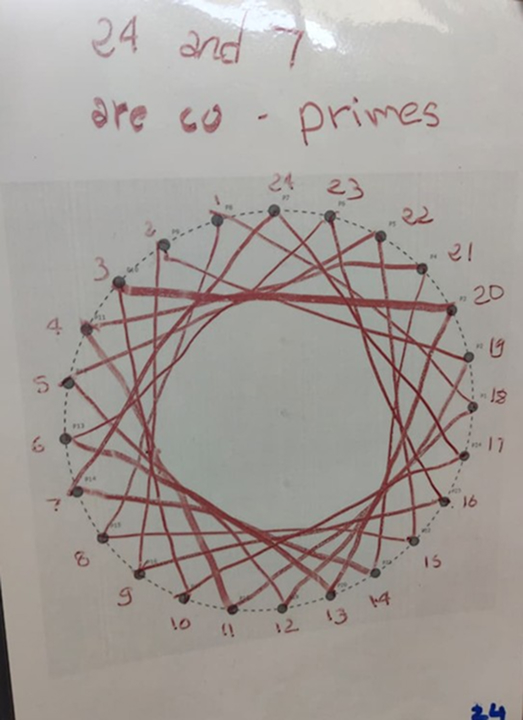
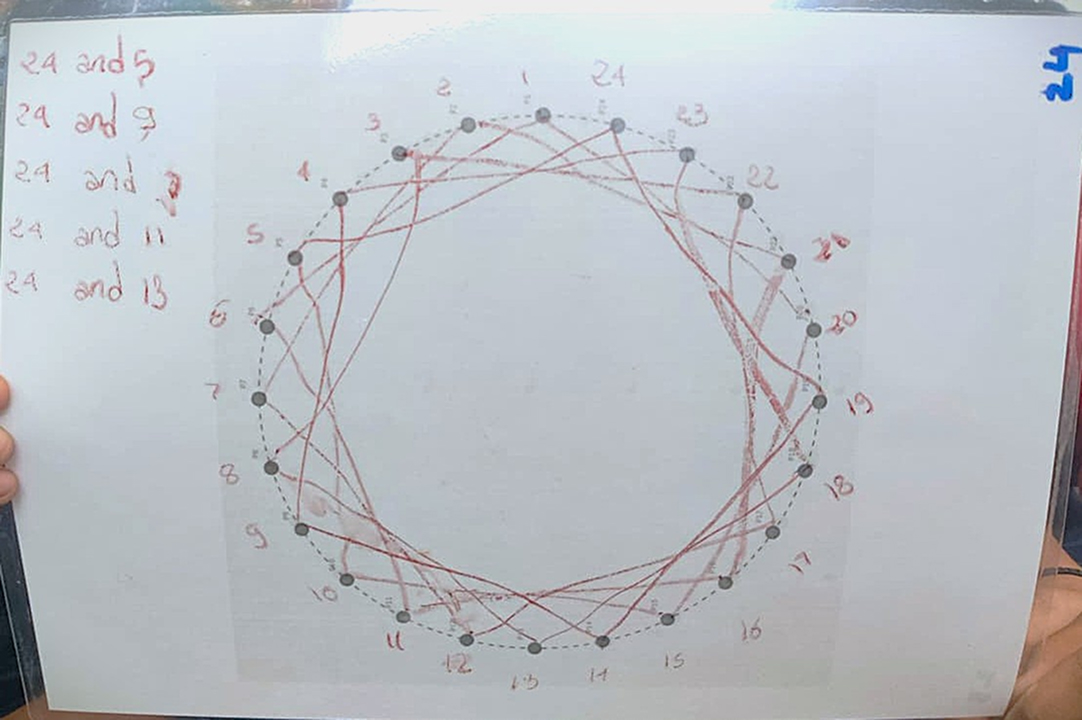
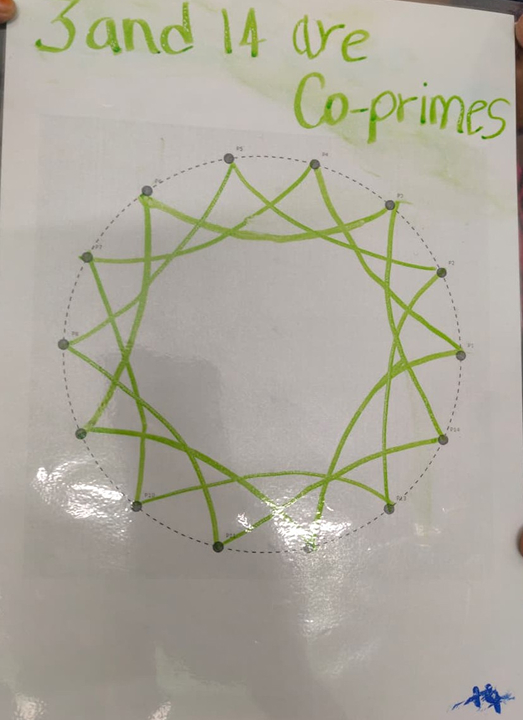
But I soon realised that though they were able to do the activity, they did not know the reasoning behind it. In the remaining part of this article, an exploration has been designed, which prepares students to build further on the exercise that they had undertaken.
The star-problem activity gives students an opportunity to explore co-prime numbers through movement and patterns. This exploration was extended by asking them to carefully record what they notice when the number of dots and the jump size are changed.
For example, consider a circle with 6 dots. We start from one dot and keep jumping by the same number of steps, this time with arrows indicating the direction of jumps. The pictures below show what happens for different jump sizes.
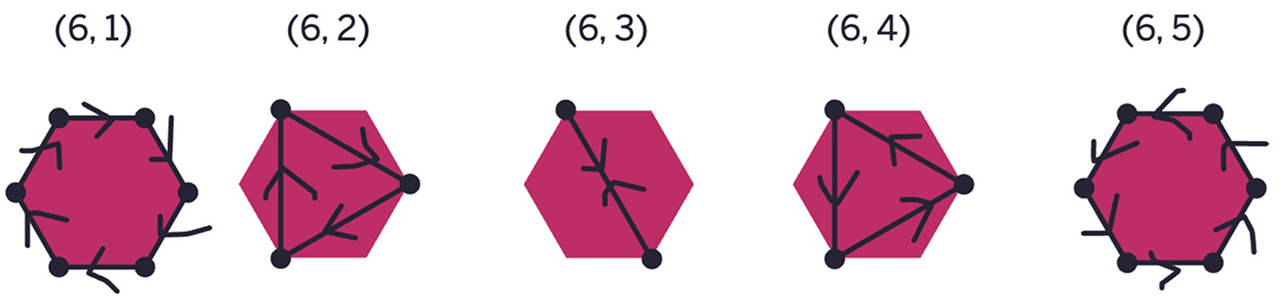
Students can observe that some jump sizes allow the path to visit all dots, while in other cases the path repeats without reaching all dots.
The following observation sheet can be used. (Table 1) The first few rows are filled as examples.
Observation Sheet: Exploring Patterns on a Circle
Choose a number of dots on the circle. Choose a jump size and connect the dots by repeatedly making the same jump, keeping a record of the direction of the jump. Record your observations.
| Number of dots on the circle | Jump size | Does the pattern reach all dots? | Number of dots reached | Gap between two connected dots | Similar to another figure in the table? |
|---|---|---|---|---|---|
| 6 | 1 | Yes | 6 | 1 | Jump size 5 gives the same drawing in the opposite direction |
| 2 | No | 3 | 2 | Jump size 4 gives the same drawing in the opposite direction | |
| 3 | No | 2 | 3 | None | |
| 7 | 1 | ||||
| 2 | |||||
| 3 | |||||
| 8 |
After completing more examples, students can discuss:
- For 6 dots, and different jump sizes.
- Which jump sizes helped you reach every dot?
- What is the connection between 6 and such numbers?
- Which jump sizes make the path repeat the same circuit?
- What is the connection between 6 and these numbers?
- Compare:
- 6 dots with jump size 1
- 6 dots with jump size 5
- What is similar? What is different?
- What patterns did you notice with:
- 5 dots
- 7 dots
- 8 dots
- 9 dots
- When the path does not reach all dots:
- What is the smallest gap between any two points that are connected in the process?
- Now, try different dots as the starting points. How many different groups of dots are formed in this case?
- When the jump size is same as the smallest gap between any two points that are connected in the process:
- When we have 6 dots, what are the different jump sizes for which this happens?
- When we have 8, 10, or 12 dots, what are the different jump sizes for which this happens?
- When we have 24 dots, can you predict the jump sizes for which this will happen?
- Before actually drawing, can you predict what will happen for different jump sizes when the number of dots is 10, 11, or 12?
After the activity, I picked a pair of students who had chosen 15 dots with a jump size of 2. They were confident that 15 and 2 were co-prime as all the dots had been connected. But when asked to explain why, the confidence gave way to silence. I then guided their thinking through a second round of recording. This time they numbered the dots. The jump started from the last dot (which had the same number as the number of dots on the circle). They entered their observations in Table 2.
| Number of dots on the circle | Jump size | Numbers of the connected dots and gap between connected dots | Numbers of the dots not touched | Observation |
|---|---|---|---|---|
| 15 | 3 |
3, 6, 9, 12, 15
Gap 3 |
1, 2, 4, 5, 7, 8, 10, 11, 13, 14 |
The connected dots are all multiples of 3. 15 is a multiple of 3. The gap 3 is a common factor of 3 and 15. |
| 15 | 6 |
6, 12, 3, 9, 15
Gap 3 |
1, 2, 4, 5, 7, 8, 10, 11, 13, 14 |
The connected dots are all multiples of 3. 6 and 15 are multiples of 3. |
| 15 | 2 |
2, 4, 6, 8, 10, 12, 14, 1, 3, 5, 7, 9, 11, 13, 15 Gap 1 |
All the dots are connected. The only common factor between 15 and 2 is 1. The gap of 1 gives the only common factor. 15 and 2 are co-prime. |
Then, the students began to see that the gap between connected dots reflected the common factor of the two numbers. When two numbers share no common factor, every dot finds its place in the chain. These two numbers would then be co-prime.
Complete the Sentences
Based on your observations:
- A path reaches every dot when_______.
- The smallest gap between connected dots gives information about________.
- The number of dots visited depends on________.
- Additional Question: If the jump size is changed to the number of dots minus the jump size, the________.
- The smallest gap between the dots in a pattern equals the jump size if________.
This extension helps students move from simply drawing patterns to noticing numerical relationships. The completed sentences will help students make observations and conjectures.
- A path reaches every dot when the number of dots and the number representing the jump size have no common factors.
- The smallest gap between connected dots gives information about a common factor of these two numbers.
- The number of dots visited depends on the number of common factors between the number of dots and the number representing the jump size.
- Additional Question: If the jump size is changed to the number of dots minus the jump size, the dots visited remain the same but the direction reverses.
- The smallest gap between the dots in a pattern equals the jump size if and only if the jump size is a factor of the number of dots. So, the HCF of two numbers is the same as one of them if and only if the smaller of the two is a factor of the other.
Rather than defining pairs of numbers as co-prime or not co-prime based on doing a prescribed art activity, it would be better to lay the foundation for understanding factors, Highest Common Factor, and co-prime numbers by such explorations. This would help students observe, document, conjecture, and later, even prove.
Acknowledgement
The author acknowledges and is grateful for the significant inputs by Ajaykumar K, Swati Sircar and Kshama Chakravarthy.