

This is the first of a set of problems gleaned from various sources by A. Ramachandran.
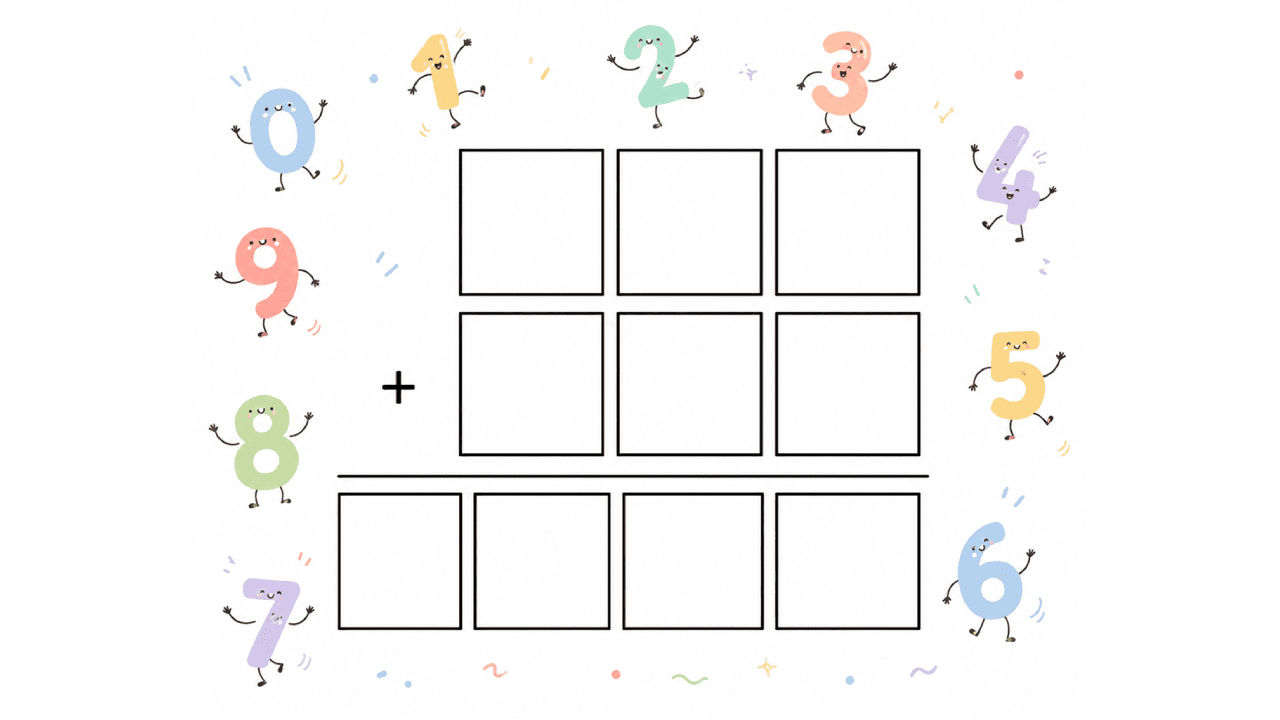
The challenge is that each of the ten digits 0–9 must be used exactly once across the two 3-digit addends and the 4-digit sum.
Neither three-digit addend nor the four-digit total can begin with 0.
Open-ended problems such as this one are not very common in the primary classes, and it has been noticed that even adults tend to take some time to arrive at a correct solution. When this problem was given to a group of Classes 4 and 5 children with digit cards, most began by guessing. In this part of the article, we present the problem with some pedagogical strategies which are aimed at building structured problem-solving skills.
This digit-card puzzle is best carried out with square cardboard cutouts bearing the digits. Here is a template for the same. Children can place the cards in the blank spaces to get a valid addition problem.
Pedagogical Strategies
- Stating the problem and the constraints. This will help students to be clear about what the question is asking. Looking for correct solutions using trial and error will not only clarify acceptable solutions but also close some possibilities.
- Not stopping at one correct answer. Focusing on the product limits the potential of the problem. When a process which yields multiple solutions is discovered, students understand the power of generalisation.
- Giving time and opportunity for thought. Such problems may be given for students to solve over several days and are a good opportunity for pair work- leading to productive arguments, conjecture, mathematical communication and reasoning.
- Asking for all possible solutions. When students are able to close the gate of the solution set, the teaching moments which can be mined from this problem will be maximised.
- Using the principles of computational thinking which means breaking the task into smaller parts, spotting patterns, following a systematic search, and checking and fixing errors (debugging).
- Using good trigger questions. When students appear to have arrived at a stalemate, good questions can help them to refocus and redirect their thought processes. Some suggestions are given below:
- Where can the 0 go?
- What is the maximum sum of two single-digit numbers?
- What must the thousands digit of the total be?
- When will there be a carry-over when two single-digit numbers are added?
- Scaffolding their problem-solving with thought-provoking examples, such as: Suppose the hundreds digits of the 3-digit addends are 3 and 8, and the hundreds digit of the sum is 2. Can you fill the remaining blank spaces with 0, 1, 4, 5, 6, 7, 9 (no repetition allowed).
- Generating new solutions from one solution using the properties of commutativity and associativity of the addition of numbers. (For example, if 347 + 859 = 1206, then is it possible to switch around any of the digits of the addends to get the same total?)
Further Reading
Jennie Pennant’s article, Developing Excellence in Problem Solving with Young Learners, speaks about the stages of problem-solving including ‘getting started’, ‘working on the problem’, ‘digging deeper’, and ‘reflecting’. In another article the observations made by Deloache and Brown (1987) described three problem solving strategies adopted by four- to seven-year-olds making a train track circuit.
- Brute force: trying to hammer bits so that they fit
- Local correction: adjusting one part, often creating a different problem
- Dismantling: starting all over again
- Holistic review: considering multiple relations or simultaneous adjustments, for example, repairing by insertion and reversal.
It is interesting to think that these very strategies may be used to solve pen-and-paper problems like the one posed in this article. ‘Brute force’ in this case would be to insert digits randomly and arrive at a solution with endless trial and error. ‘Local corrections’ would involve deviating from a blocked path and trying a fix with a minor tweak. ‘Dismantling’ is to start over and over again – (hopefully, learning from previous attempts). The aim of the exercise would be to help students view the problem and its solution holistically and to relish the process of building their problem-solving muscles.
We look forward to responses which detail students’ thinking processes as they tackle this problem. Send them in to AtRightAngles.editor@apu.edu.in A follow up article featuring innovative contributions and a complete solution is in the pipeline!
Acknowledgements
Swati Sircar, Mohan R and Sneha Titus made significant contributions to this article.