Getting in Shape!


My original plan was as follows :
Lesson Objectives : By the end of the unit, students should be able to :
- Know the difference between a circle and a triangle, square or rectangle.
- Find similarities and differences between a triangle and a rectangle.
- Understand how different shapes can be composed to make figures of familiar objects.
Accordingly, the day-wise activity plan was :
Day 1 : Trace out different selected shapes and cut them out. Then, using the following questions, sort out the shape cutouts into 4 groups – circle, square, rectangle and triangle :
- What kinds of lines do we see in the tracing of the shapes?
- Which shapes, when traced, create straight/curved lines?
- Which shapes have equal/ unequal sides?
- How is a circle different from a square, rectangle or triangle?
- How is a triangle similar to a rectangle? How is it different from a rectangle?
End with a rhyme about shapes.
This lesson went beautifully according to plan and so did most of the next day for which the plan is given below.
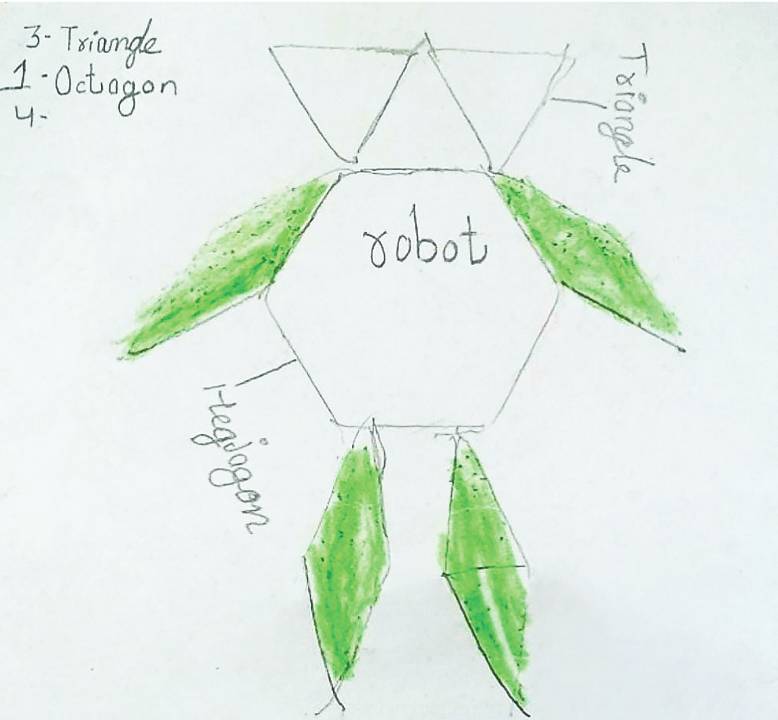
Day 2 : Put students in groups of say 5, and give each group a random collection of shapes from several kits such as :
- Rangometry\(^1\) – A collection of 2D shapes made of Ethyl Vinyl Acetate (EVA) that stick to the board when dipped in water – developed by Jodo Gyan.
- Tessellation kit – collections of regular polygons (pentagons, hexagons, etc.,) with the same side-lengths.
- Aakar Parivar – collection of 5 shapes (circle, semicircle, square, rectangle, equilateral triangle – each in a different colour and each in 5 sizes).
- Random shapes found in the classroom – one of these was an annulus (a doughnut shape).
Ask them to create figures of familiar objects and using the kits get them to draw the same on paper. Then have discussions on :
- What shapes did you use to make the boat?
- Why did you use that shape?
- What is the difference between the shape you selected and the shape you did not?
- What made it more suitable for the figure?
The groups were heterogeneous in terms of the abilities of the students. Each group had to make 5 figures- a car, a boat, a rocket, a cake and a robot.

They got 5 minutes for each figure. The order of the figures for each group was determined by me to ensure that no two groups were working on the same figure simultaneously. These objects were also chosen based on the students’ familiarity with them and the ease of making. The idea was to show that the objects in our surroundings are represented by putting different shapes together. It took longer than the expected 25 minutes due to the usual aspects of group work. They took time to settle down and work together, some groups wanted more materials. They were also interested in the figures the other groups were assigned, while each group took turns to make each of the figures. However, once they started making the pictures, they got fully involved. Then, they drew the same on a piece of paper provided to them at the start of the class. Some drew freehand while some traced the actual pieces. The decision was left to them.
I noticed that they were keenly interested in the figures made by the other groups. When they exchanged shapes with other groups to execute their own ideas, they were taking inspiration from each other and exchanging resources without the class breaking into chaos. Since we ran out of time, discussions were postponed to the next day. This meant deferring the original plan which was :
Day 3 : Tangrams – use the shapes of the given tangram set to make shapes of increasing complexity.
Days 4 – 6 : Various explorations and discussions with shapes, followed by textbook exercises for formative assessment on Day 7.
Day 3 started with a discussion based on the pictures drawn by the students. Since the pieces involved many polygons and other shapes that were new to them, it opened a floodgate of questions and steered the discussion in a different direction.
We started finding different 4-sided shapes, when a student discovered a shape that looked like half a hexagon! Can you guess which 4-sided shape it was?

Now this good observation took the discussion towards symmetry and paper folding was brought in to show how this shape is half of a hexagon. We took a rectangular piece of paper and folded it along the horizontal mid-line. Then we opened the sheet of paper and folded the four corners so that they touched this crease. Next, we folded along the crease, and got the same shape!

And then the students just took over! One student got stuck with the idea that the isosceles trapezium looked more like half an octagon rather than half a hexagon. How can you show that the quadrilateral in Figure 5 is actually half of a hexagon?
Misconceptions such as “hexagons must have all sides (and angles) equal” surfaced and were discussed.
The students then started experimenting with the folds and soon had created an octagon. Then one student figured out how to unfold one flap and convert an octagon into a heptagon.

And once someone did it, several tried to replicate the same. And their enthusiastic eagerness to know the names of these shapes (with 7 sides and 8 sides) made it impossible to carry on with the planned activity. So, I went into the terminology of octa for eight, bringing ‘octopus’ into the discussion as an example. Thus, the paper folding activity took a life of its own, completely initiated and owned by the students! Here are some of the pictures related to the activity.


Seeing those shapes, another student casually dropped the observation that the hexagon looked a little bit like a circle. And others felt that is true for the octagon too. The board got filled with various polygons as the discussion continued.
As the students got more involved, and excited, all wanted to be heard – either to ask a question or to share an observation. It became impossible to address each question, and they got impatient. So, I had to pause and ask them to write down their questions. But it was the end of the class by then, and this became the homework. Feel free to guess how sincerely these Class 3 students did their homework!

Upon reflection, we realized the following :
- Though there was chaos, it was from too much eagerness to share their findings/questions. So, it was from deep engagement and active participation of the students in their own learning. And therefore, it was very different from unproductive distraction and disruption. The takeaway for us was that while the chaos needed to be contained, the students should not be scolded for making too much noise.
- Giving freedom to the students was helpful. Those who could, drew freehand, and those who needed could trace to get more exact shapes. And on Day 3, their creativity, curiosity, observation and questions spearheaded the class.
- They were not reluctant to learn from each other and this shared learning helped them to progress faster.
- They figured out how to modify one shape into another through folding, thereby getting the sweet taste of discovery.
- Their discoveries and curiosity took them far beyond their grade level.
- They voiced their observations without hesitation and thus the teacher could build on that and more importantly, address misconceptions. So, in several ways, these classes were child centric.
- Planning could be improved by allocating more time for the activity on Day 2.
- If too many want to speak at the same time, the teacher needs to immediately channel that to writing. It is important that the teacher articulates that in this way, s/he can get everyone’s thoughts, and then respond accordingly. This explanation should help the students realize how writing helps in communicating each of their thoughts to the teacher, which can’t be done by expressing orally given the limited class time. Usually when students see the reason behind any action, they resist less. Especially if the reason is connected to their need to be heard. It is also a good idea to get them to write down their thoughts from the Preparatory stage. Such habits are easier to build when they are younger and will have a lot of benefits later. A good way to get students started on this habit is to make a list on the board, giving students time to share their suggestions individually and then edit the list collectively.


If you want to have similar fun with shapes, then you should definitely have a collection of objects that can be used to trace shapes. These shapes can also be generated by paper. It is not important to introduce the names pentagon, hexagon, etc. One can stick to 5-sided shape, 6-sided shape, etc., initially. We hope to share a worksheet based on such paper folding activities in the near future.
\(^1\)Reviewed in the July 2023 issue of the magazine.