
Exploring Polyominoes and Nets of a Cube: A Classroom Reflection with Class 4 Students


Description of the exploration
The objective of the activity was to introduce students to polyominoes, explore relationships among different polyominoes, and develop spatial reasoning by wrapping shapes around a cube and identifying which hexominoes form the net of a cube. While NCERT formally introduces nets of a cube in Class 7, this activity served as an exploratory learning experience for Class 4 students, offering early exposure through hands-on investigation using polyominoes.
The activity was conducted over three one- hour sessions, providing students with adequate time to explore, discuss, and reflect on their mathematical thinking.
Session 1: Introducing Parent–Child Relationships among Polyominoes
The first session began with a simple task: students were asked to join two squares edge-to-edge and determine in how many ways this could be done. Students initially joined the squares in multiple orientations—vertically, horizontally, diagonally, and in some cases, point-to-point. This provided an opportunity to reiterate the instruction that squares must be joined edge-to-edge.
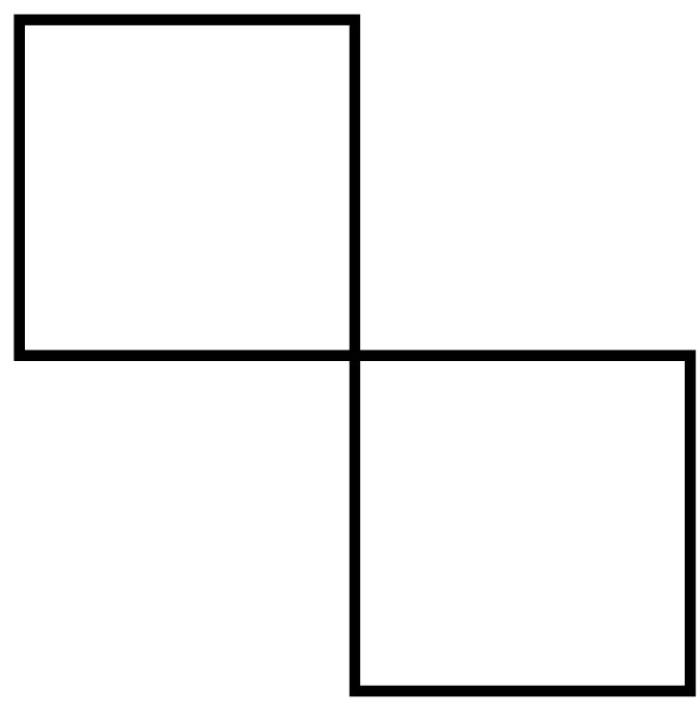
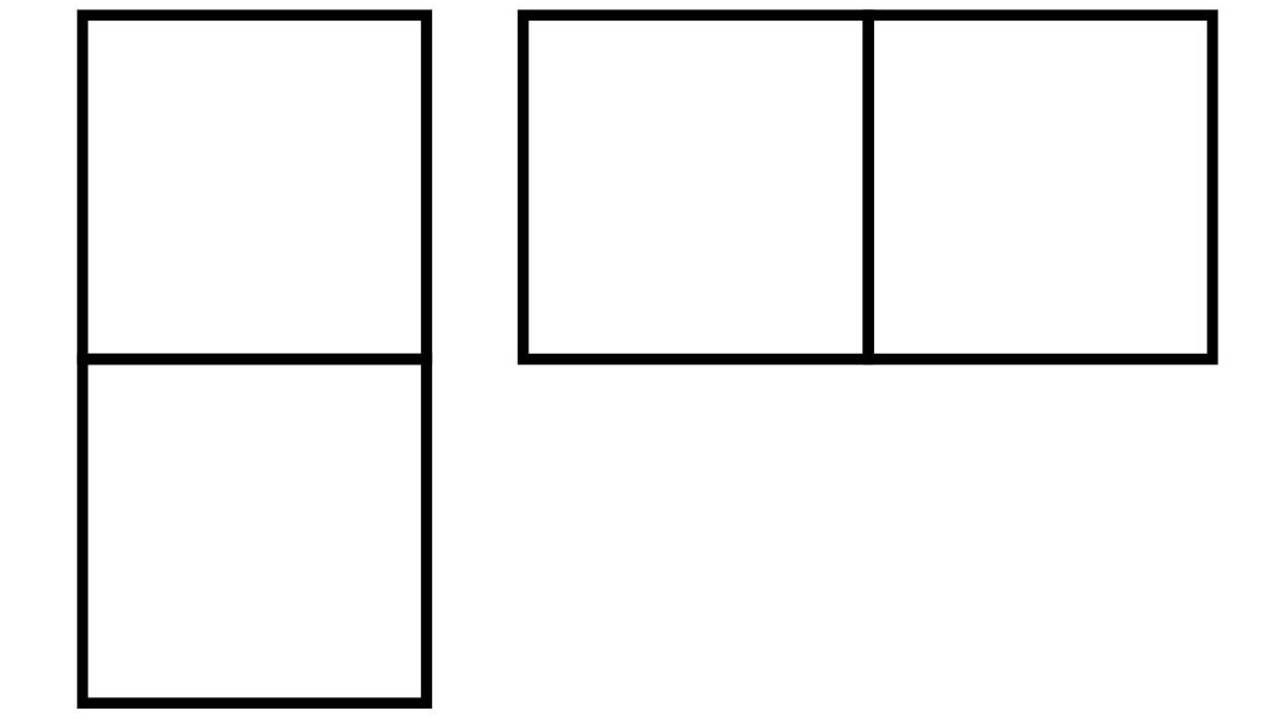
A follow-up question—“Are these different shapes, or can one be rotated to form another?”—prompted students to reflect on rotation and uniqueness. Through discussion, students concluded that despite different orientations, there was only one unique arrangement, as the other one was the rotation of it. Similarly, shapes that can be transformed into one another through reflection are regarded as the same. In other words, mirror images are not counted separately.
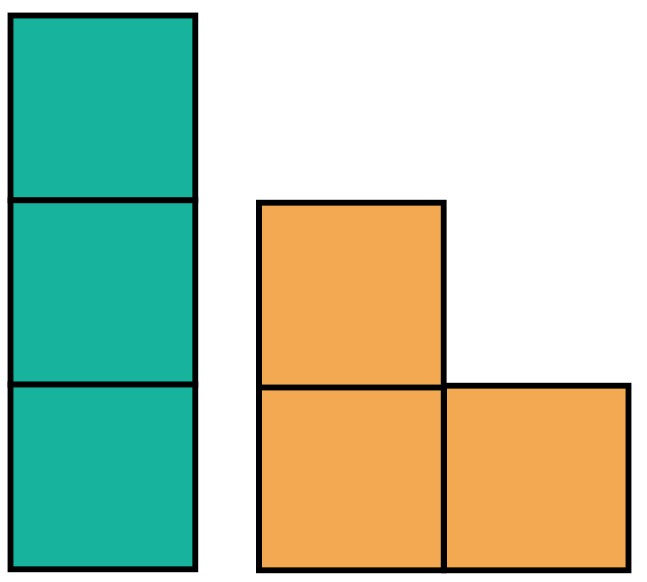
At this stage, formal terminology was introduced: monomino, domino, tromino, tetromino, pentomino, and so on, emphasizing that the number of unit squares determines the name. Students were then asked to draw trominoes. Although this was assigned as an individual task, students naturally engaged in peer discussions—comparing shapes, identifying rotations, and recognizing repetitions.
Through these discussions, students discovered that there are only two distinct trominoes.
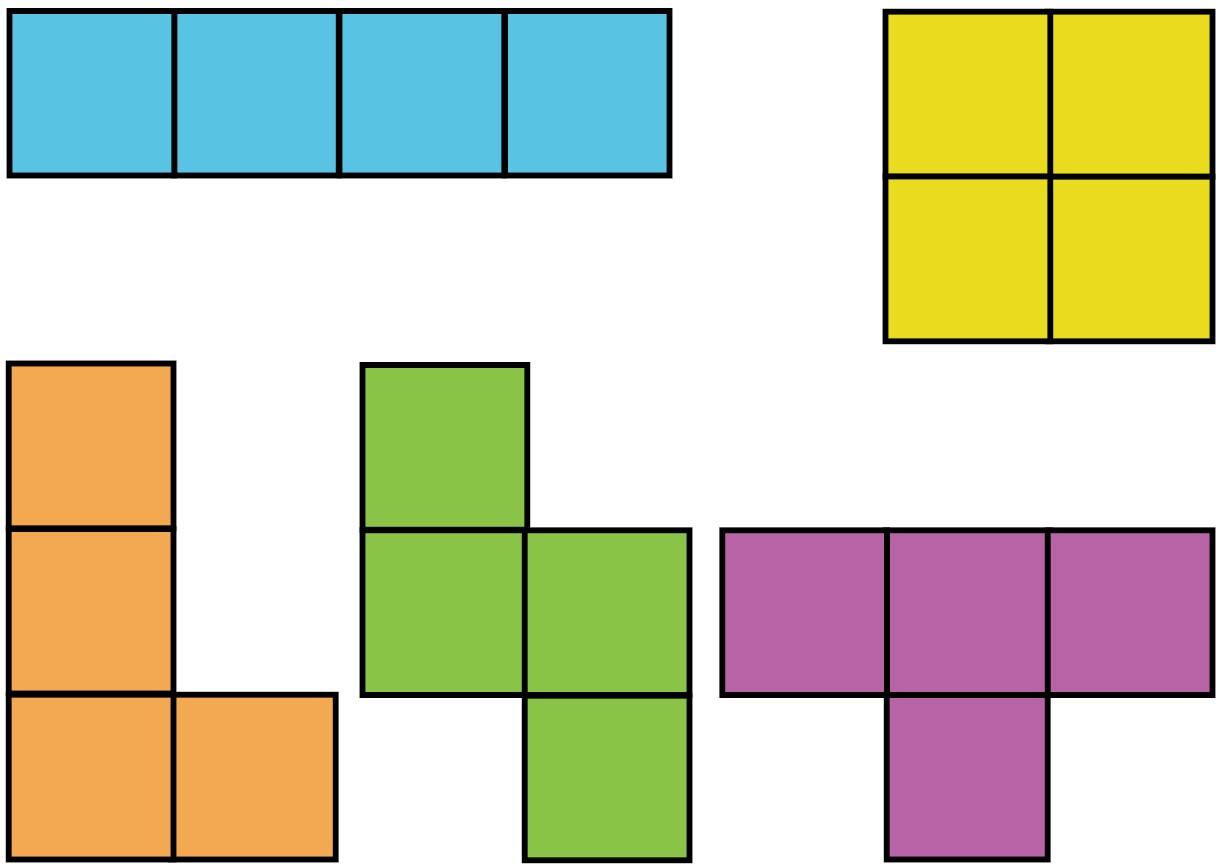
Next, students were asked to construct tetrominoes. Working collaboratively, they realized that there are exactly five unique tetrominoes, accounting for rotations and reflections.
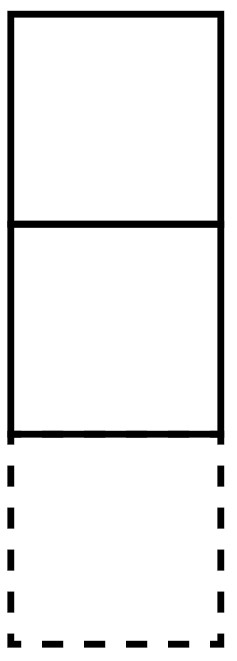
In an attempt to construct trominoes, one of the students came up with the following response, where the student tried to add a square to the domino, to form a tromino.
When students suggested adding a square to obtain a new shape, the idea of building larger polyominoes from smaller ones was introduced. In this process, adjoining one or more squares to an existing polyomino results in a new polyomino. In this context, a parent polyomino refers to an existing polyomino from which a new one is generated by adjoining one or more squares. The resulting larger polyomino is referred to as the child. This led to several insightful student observations; two such realizations were:
- A single parent polyomino can have multiple child polyominoes
- A child polyomino can have more than one parent
They represented these relationships visually using arrows on the board, as shown in Figure 6.
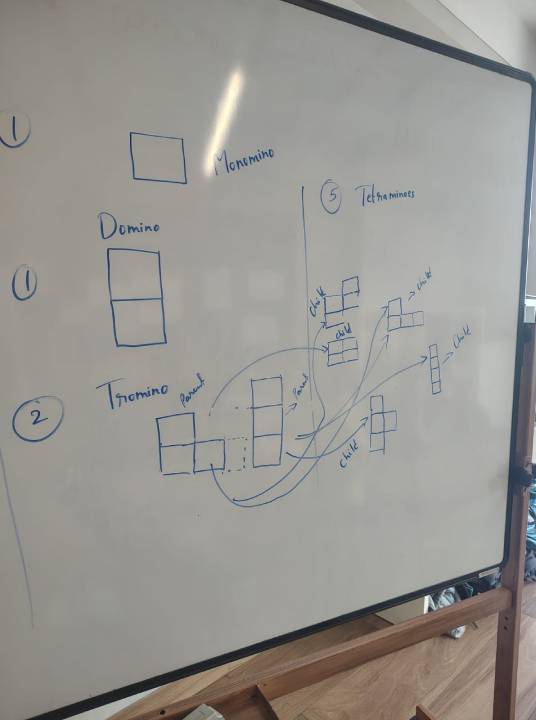
Let us examine the relationships they observed:
Students noticed that the L-shaped tromino could act as a parent to four different tetrominoes, depending on where the additional square was placed (Fig. 1.7).
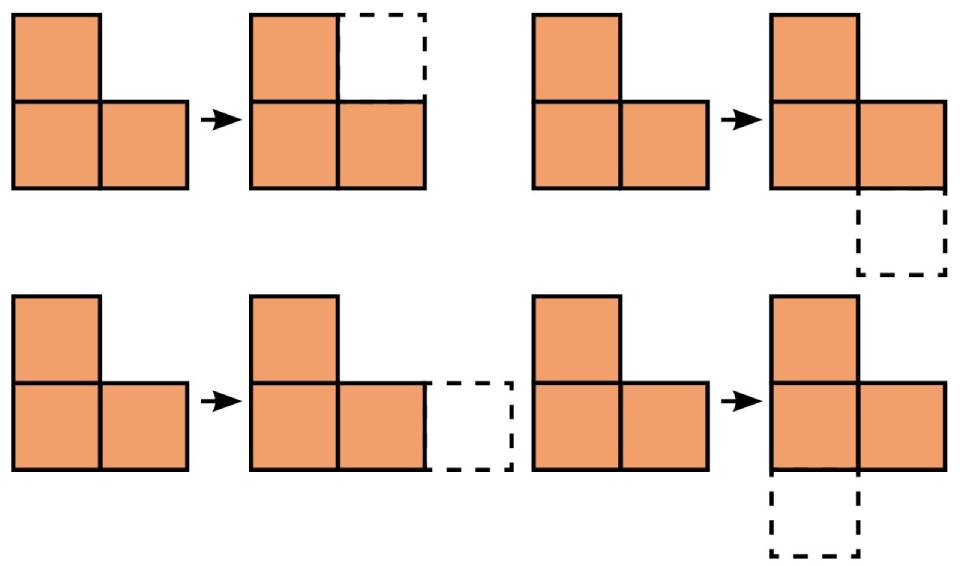
This helped students realize that a single polyomino can produce multiple child polyominoes.
Similarly, when considering the I-shaped tromino as the parent, students found that it could generate three different tetrominoes, as shown in Figure 8.
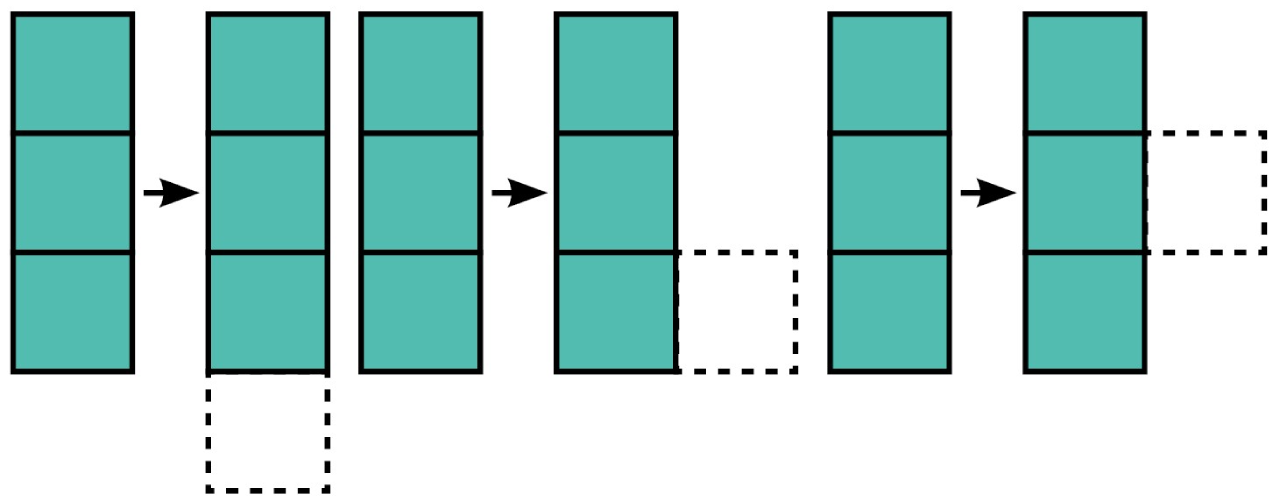
From Figures 7 and 8, students observed that two tetrominoes — the L-shaped and T-shaped — can be formed from both trominoes. This helped them realize that a single child polyomino can have multiple parent polyominoes.
The discussion concluded with a student insightfully remarking:
“The monomino is the parent of all polyominoes”.
Exploring Pentominoes: Multiple Approaches
When asked to draw pentominoes, students adopted different strategies. Some rearranged five squares repeatedly to explore various combinations, while others extended tetrominoes by treating them as parents and generating child pentominoes. Several students illustrated parent–child relationships after drawing the pentominoes, using arrows and rough work (Figures 9 to 11).
These varied approaches highlighted students’ growing comfort with systematic reasoning, spatial visualization, and recognition of rotational equivalence.
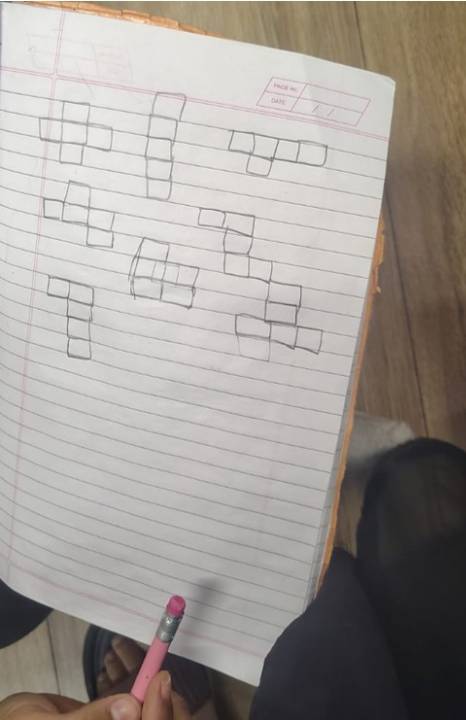

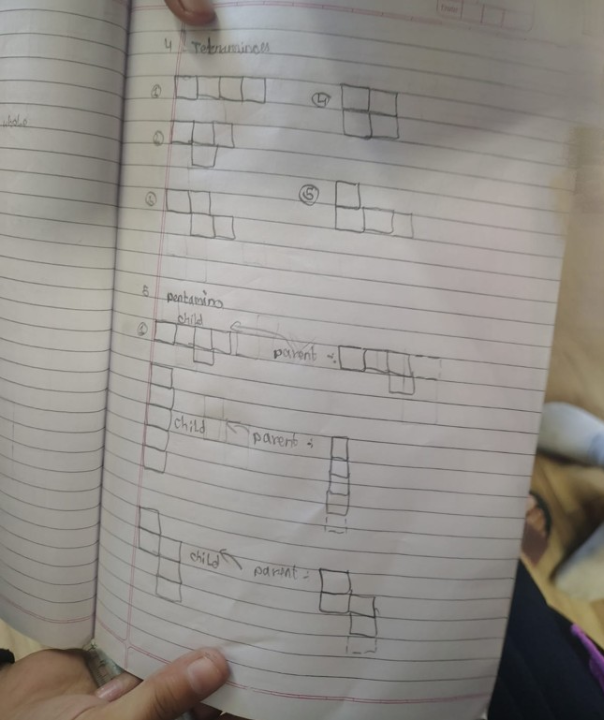
When some students felt they had exhausted all possibilities (and a few produced repeated shapes), I asked them how they could be certain that no additional pentominoes existed. This prompted initial attempts at justification. Students began informally examining the positions of the five squares and comparing shapes to see whether a new drawing was genuinely different or simply a rotated or reflected version of an existing one. Although this reasoning was not fully systematised at the time, the discussion introduced the idea of checking for duplication under symmetry and encouraged them to think beyond trial-and-error generation.
Session 2: Wrapping tetrominoes around a Cube
The second session focused on wrapping polyominoes around a cube. In this article, “wrapping” is defined as covering as many faces as possible, even if some faces remained uncovered; however, one face cannot be covered more than once, that is, overlapping is not allowed. Initially, many students interpreted “wrapping” as completely covering all six faces of a cube exactly once. This led them to reason using factors and multiples, concluding that:
- A tromino could be used twice to cover six faces
- A tetromino could not be used, as it would leave faces uncovered
This misinterpretation, however, proved productive. It revealed how students shifted their reasoning from orientation to numerical properties. Then, the meaning of the word “wrapping” in this context was clarified. The reason for this was to use the parent-child connection to generate hexominoes that were possible nets for the cube.
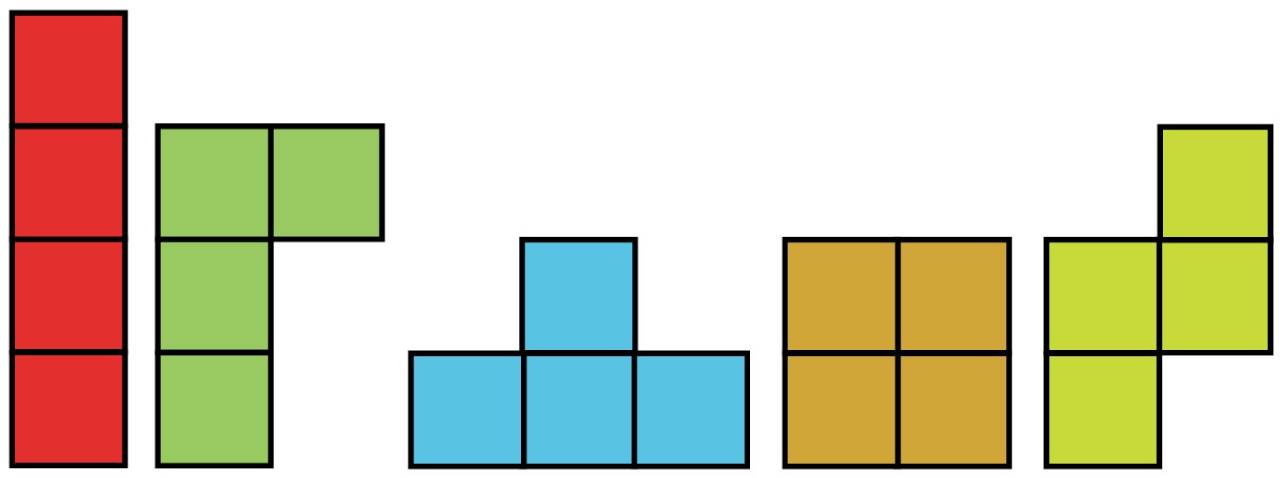
Students were asked to draw tetrominoes on grid paper, the teacher then cut them out, and attempted to wrap them around a cube. With physical cut-outs in hand, students began reasoning more effectively about orientation and spatial fit. Through exploration, they discovered that four out of the five tetrominoes could be wrapped around a cube, while one could not (Figure 12).
Although making cut-outs enhanced understanding, it was time-consuming since scissors could not be distributed amongst students.
Session 3: Hexominoes and Nets of a Cube
To manage time more efficiently in the third session, students drew hexominoes in their notebooks while pre-prepared cut-outs were provided. Drawing all possible hexominoes proved challenging, but students were paired to encourage discussion. Partners debated whether shapes were rotations of one another and identified repeated forms.
Students were given approximately 35 minutes for this task, and interestingly, some were able to construct all 35 unique hexominoes (Figure 13).


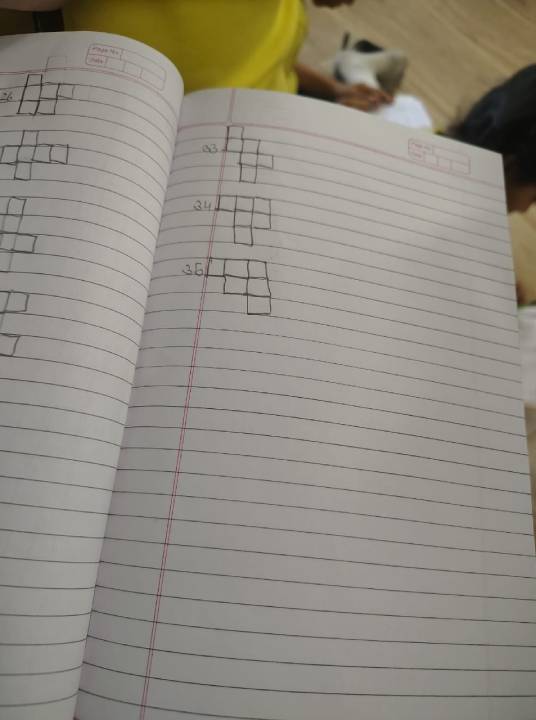
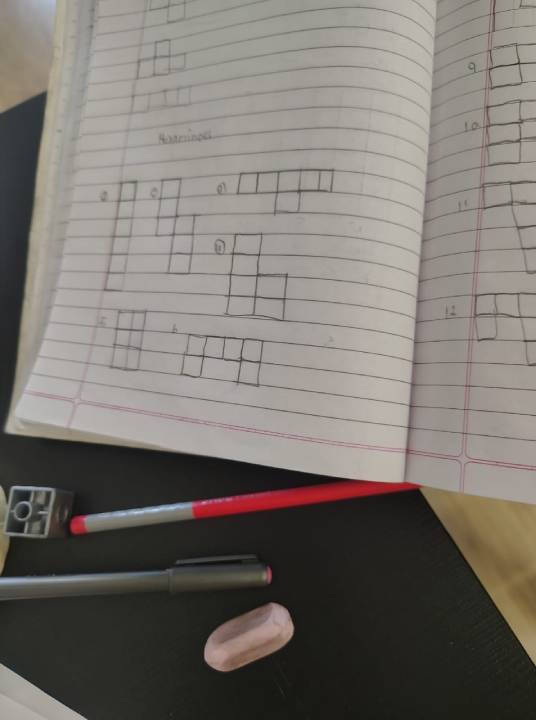
Using hexomino cut-outs and cubes, students tested which shapes could wrap around a cube, setting aside those that could not. Out of the 35 possible hexominoes, they discovered that only 11 could form a cube. At this point, the formal idea of a cube net was introduced.
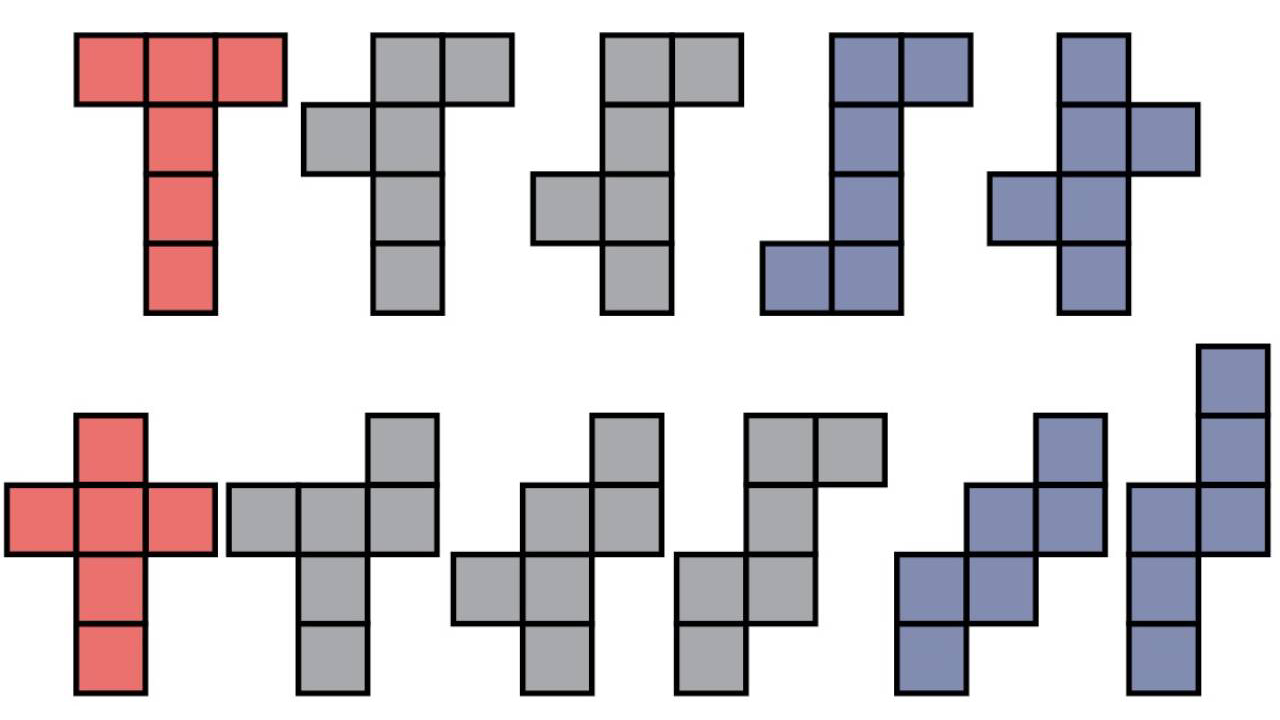
Students then folded their nets, experiencing the transition from 2D shapes to 3D structures firsthand. Watching flat shapes transform into cubes marked a moment of excitement and accomplishment. The completed cubes became not just mathematical objects, but tangible celebrations of their exploration and learning — a meaningful takeaway from the activity.
Across the session, it was common to see pairs of students often asking questions such as, “What if we add the square in another position?” and discussing whether two shapes were genuinely different or merely rotations or reflections of one another.
During the activities on wrapping and tetrominoes, I provided linking cubes to help students test their constructions. However, this occasionally led to confusion, as the size of the linking cubes did not always match the dimensions of the paper cut-outs. I encouraged students to focus less on the exact size and instead consider whether the shape could conceptually wrap or cover the surface if scaled appropriately.
While attempting to wrap nets, when a square was left uncovered, students experimented by rotating the cut-out, repositioning the leftover flap first, and then attempting to fold it again. These trial-and-adjust strategies reflected their developing spatial reasoning and persistence.
Reflections and Learning Outcomes
Overall, the activity was highly engaging and intellectually enriching. Students demonstrated:
- A clear understanding of rotation and uniqueness
- Improved spatial reasoning while wrapping polyominoes
- Meaningful connections between 2D shapes and 3D objects
- Collaborative reasoning and mathematical communication
Suggestions for Future Implementation
Based on classroom observations, the following improvements are suggested:
- Prepare polyomino cut-outs in advance to save time and maintain engagement
- Ensure sufficient cube nets so all students can actively participate
- Pose more probing questions, such as:
- Why do you say one shape is a rotation of another?
- How can we be sure two hexominoes are genuinely different?
- Have you encountered other situations in which the child is bigger than the parent?
Such questions could deepen students’ conceptual understanding and mathematical justification skills.
Conclusion
This three-session exploration using polyominoes offered Class 4 students a powerful and intuitive pathway to understanding nets of a cube well before formal curriculum introduction. By progressing from simple polyomino constructions to wrapping hexominoes around cubes, students developed strong spatial reasoning, an understanding of rotation and equivalence, and the ability to systematically explore mathematical possibilities. The use of parent–child relationships further deepened their structural thinking and pattern recognition.
Most importantly, discovering through hands-on investigation that only 11 out of 35 hexominoes form cube nets transformed an abstract idea into concrete understanding. Folding successful nets into cubes provided a celebratory closure to the learning journey, reinforcing the connection between 2D shapes and 3D objects while fostering confidence, curiosity, and meaningful mathematical engagement.
Reference and citations
- Figure 3: Images of trominoes. Source: Wikipedia contributors, 2025, Tromino.
- Figure 4: Images of tetrominoes. Source: Alchetron, 2024, Tetromino.
- Figure 6: Students’ observation on parent-child relation. Source: Author’s classroom, 2026.
- Figure 7: Construction of tetrominoes using L-shaped tromino. Source: Adapted from Wikipedia contributors, 2025, Tromino.
- Figure 8: Construction of tetrominoes using an I-shaped tromino. Source: Adapted from Wikipedia contributors, 2025, Tromino.
- Figure 9: Drawing of pentominoes without using parent- child relation. Source: Author’s classroom, 2026.
- Figures 10-11. Drawing of pentominoes using parent-child relation. Source: Author’s classroom, 2026.
- Figure 12: Images of tetrominoes. Source: Puzzle Genius, n.d., Tetromino.
- Figure 13: Images of hexominoes. Source: Author’s classroom, 2026.
- Figure 14: Images of hexominoes that are nets of cube. Source: Adapted from Wikipedia contributors, 2025, Hexomino.