
Word Problems on Addition and Subtraction


A word problem is simply a mathematical question embedded in a simulated real world situation described with a narrative or story. This is unlike a ‘bare problem’ which is a mathematical question expressed as mathematical symbols or equations. In word problems, the concepts, ideas or models are used to understand real-world phenomena. Word problems are an integral part of school mathematics, especially in the lower classes. Students begin to appreciate that mathematics is contained not only in symbols and abstractions, but may be situated in real world scenarios.
A well-crafted word problem can bring a meaningful real-world context to the learner. It should inspire children to solve problems which they perceive to be important and useful. Any word problem that does not have a suitable context connected to a student’s immediate life may not inspire and invite students to solve it. Certainly, word problems can narrate contexts which can bring value to human lives. Narratives of children making diyas and selling in the market, students collecting money to help an orphanage, girls farming to break the gender stereotype, etc., are examples of the same. Children can also be inspired to look around them and create word problems based on their immediate environment. This article will focus on difficulties that students face when solving word problems and describe pedagogical strategies to address them.
Difficulties children face with word problems
Children’s ability to solve word problems depends on their ability in mathematical literacy as revealed in PISA (2003, p 24). Mathematical literacy includes the ability to use mathematical knowledge and skills appropriately. It combines understanding mathematical concepts, interpreting data, recognizing patterns, applying mathematical reasoning and using arithmetic operations.
When given a word problem to solve, children need to understand and interpret the situation, translate it into a bare sum and then solve it. Thus, solving arithmetic word problems demands two different abilities, the first is to translate between language and mathematical symbolism and the second is to execute arithmetic operation(s). What should be presented first to students? A bare sum or a word problem? (It is a ‘chicken or the egg – which came first’ situation.)
Many children who are good at solving bare sums cannot solve word problems, i.e., given a mathematical expression or equation, they can simplify it and arrive at the correct answer. What happens when they encounter a word problem? If children cannot relate the problem to their day-to-day experiences, the point of using word problems is missed. They will see it as yet another hurdle in mathematics. Language too plays a key role in the framing of word problems. Students struggle with understanding what the problem statement is, translating it to the right mathematical language and with interpreting what mathematical operation is required to solve the problem.
It has been observed that in an attempt to help students attempt word problems confidently, undue emphasis has been placed on ‘keywords’, such as ‘more’, ‘took away’, ‘altogether’, ‘difference’, ‘remaining’, ‘left’, etc. This leads students to misinterpret the real-world situation and apply inappropriate operation(s) to solve the problem.
In addition, narratives may have details which are not necessary for the solution of the problem. Children find it difficult to identify and disregard irrelevant information.
Let’s illustrate through an example how undue emphasis on the keywords could mislead students.
| Problem 1 | Problem 2 |
|---|---|
| Habiba, a 10-year old girl has 9 guavas. Kalyani, a 11-year-old girl has 5 more guavas than Habiba. How many guavas does Kalyani have? | Habiba, a 10-year old girl has 9 guavas. Habiba has 5 more guavas than Kalyani, a 11-year-old girl. How many guavas does Kalyani have? |
| Additional or Irrelevant information– Habiba is 10 years old, and Kalyani is 11 years old. Key word– More (Student has been taught to do addition on identifying this keyword) | |
| Translated to expression: 9 + 5 Operation: 9 + 5 = 14 | |
| Answer: Kalyani has 14 guavas | |
| Check: Habiba has 9 guavas, and Kalyani has 5 more- 14 is 5 more than 9. Correct: The keyword strategy has worked. | Habiba has 5 more guavas than Kalyani- Habiba has 9 and Kalyani has 14 guavas. Error: The keyword strategy has not worked. |
Table 1: Illustration of errors due to focus on keywords.
Thus, the major challenges students face when attempting word problems include:
- Relating to the context described by the problem.
- Comprehending the word problem, especially if unfamiliar vocabulary or complicated sentence structure is used.
- Choice of the correct arithmetic operation.
- Undue emphasis on keywords.
- Inability to identify unnecessary or additional information, and to abstract useful information.
- Difficulty in framing mathematical expressions and equations.
- Difficulty in using arithmetic operations correctly.
In order for the teacher to help students attempt word problems confidently, they must teach them how to deal with each of these challenges explicitly. But first, the teacher must understand the importance of framing mathematical expressions and equations. In addition, they must know the different types of word problems that the child may encounter at this stage.
Expressions and Equations
Mathematical equations and expressions are an intermediary step between a narrative of the word problem and its solution.
A mathematical expression is a combination of numbers, variables and operators which represents some mathematical value.
For example: \(3 + 2\) (numbers and operation of addition) \(3x + 5\) (numbers, variable and operations of addition and multiplication)
A mathematical equation is a statement that represents the equality of two different expressions.
For example: \(4\ + \) ___ = ___ \(+\ 6\) (The expression \(4\ +\) ___ is equal to the expression ___ \(+\ 6\)) \(3x + 2 = 11\) (The expression \(3x + 2\) is equal to \(11\))
Each addition or subtraction expression can be converted to two equations.
For example: –
- The expression \(27 + 54\), can be converted into the equation \(27 + 54\) \( = 81\) which can be viewed in two ways as follows:
- \(27\ + \) ___ \( = 81\) and
- ___ \( +\ 54 = 81\)
- \(81 – 54\), this expression can be converted into the equation \(81 – 54\) \(= 27\) and this can be viewed in two ways as follows:
- \(81\ – \) ___ \(= 27\) and
- ___ \( -\ 54 = 27\)
Types of Word Problems
There is a pattern to all varieties of word problems that are created. Carpenter et. al. (1983) proposed four kinds of word problems for the operations of addition and subtraction. They are: Combine, Compare, Change and Equalize. Nesher, P., Greeno, J. G., & Riley, M. S. (1982) further classified combine, compare and change into 14 subcategories in their work. Based on this classification, the following tables have been drawn up
| Problem 1: Sita has 5 mangoes and Rahim has 3 mangoes. How many mangoes do they have in total? Problem 2: Sita has 5 mangoes. Sita and Rahim have 8 mangoes in total. How many mangoes does Rahim have? Suggested Strategy: Use modelling to represent the number of mangoes that each of them have and then ask students to frame the problem statement. | |
| Type: Combine 1 General Description: Questions about the final set (whole) | Type: Combine 2 General Description: Questions about the subset (part) |
| Example: Sita has 5 mangoes and Rahim has 3 mangoes. How many mangoes do they have in total? | Example: Sita has 5 mangoes. Sita and Rahim have 8 mangoes in total. How many mangoes does Rahim have? |
| Representation Sita 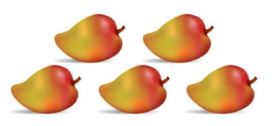 Rahim 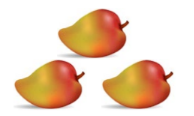 | Representation Sita Sita & Rahim 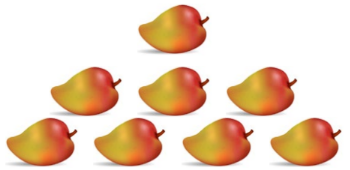 |
| Framing the Problem Statement Question for discussion: What is required to be found? Answer: The total number of mangoes. | Framing the Problem Statement Question for discussion: What is required to be found? Answer: The number of mangoes that Rahim has. |
| Expression: 5 + 3 | Equation: ___ + 5 = 8 OR 8 – 5 = ___ |
| Answer: Sita and Rahim have 8 mangoes in total. | Answer: Rahim has 3 mangoes. |
| Check: Check answer by confirmation with problem statement. | |
| Problem 3: Rudra has ₹10, and he got ₹20 more from his parents for the upcoming festival. How much money does he have now? Problem 4: Rudra has ₹10 with him. His parents gave him some money for the upcoming festival. Now he has ₹30 with him. How much money did his parents give him? Suggested Strategy: Use role play to show the transactions and then ask students to frame the problem statement. | |
| Type: Change 1 General Description: Increasing, questions about the final set. | Type: Change 2 General Description: Increasing, questions about the change. |
| Example: Rudra has ₹10 with him. And he got ₹20 more from his parents for the upcoming festival. How much money does he have now? | Example: Rudra has ₹10 with him. His parents gave him some money for the upcoming festival. Now he has ₹30 with him. How much money did his parents give him? |
| Representation using role play Rudra  Parents 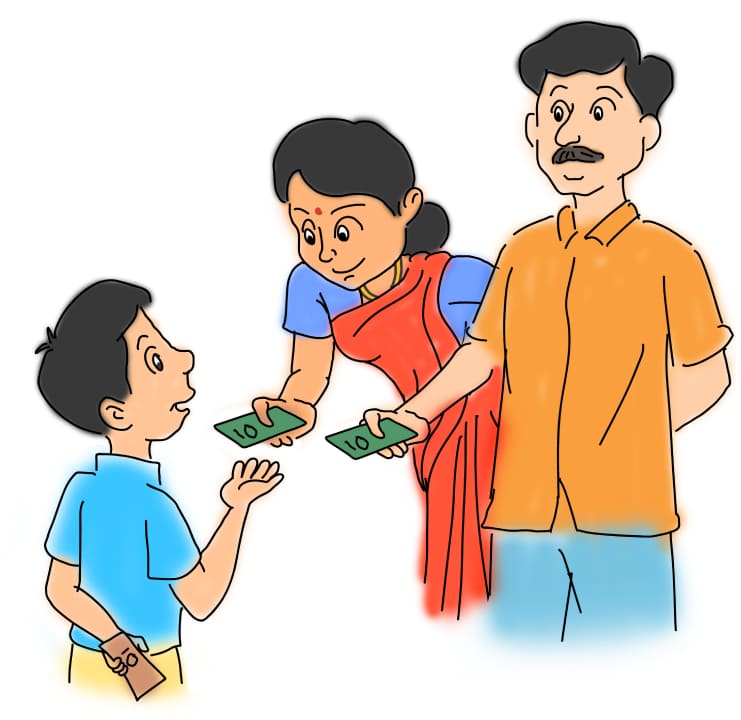 | Representation using role play Rudra = 10 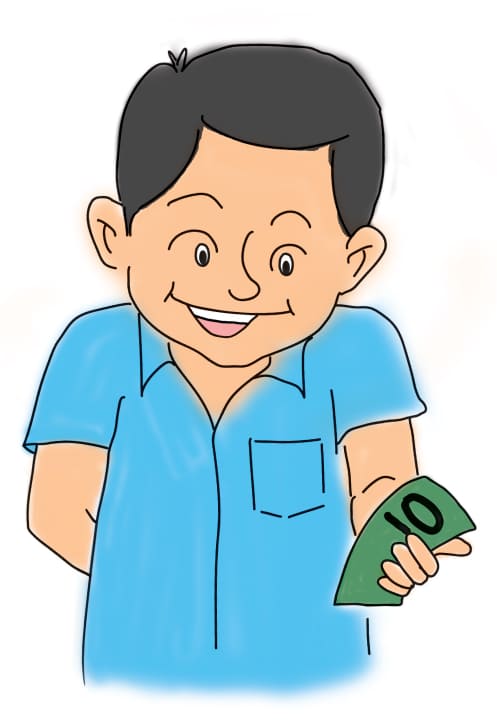 Parents = ? 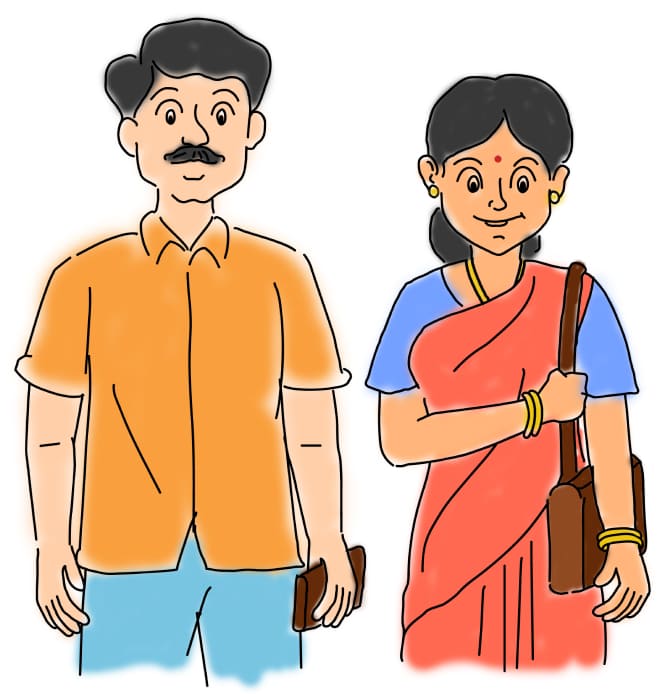 Total = 30  |
| Framing the Problem Statement: Question for discussion: What is required to be found? Answer: How much money does Rudra have for the festival? | Framing the Problem Statement: Question for discussion: What is required to be found? Answer: How much money did Rudra get from his parents? |
| Expression: 10 + 20 | Equation: 10 + ___ = 30 OR 30 – 10 = ___ |
| Answer: Rudra has ₹30 to spend at the festival. | Answer: Rudra’s parents gave him ₹20. |
| Check: Check answer by confirmation with problem statement. | |
| Change 3 | Increasing, questions about the initial set | Rudra has some money with him. His parents gave him ₹20 for the upcoming festival. Now he has ₹30 with him. How much money did he have in the beginning? |
| Change 4 | Decreasing, questions about the final set | Rudra has ₹30. He spent ₹20 buying a toy. How much money does he have now? |
| Change 5 | Decreasing, questions about the change | Rudra has ₹30. He spent some money buying a toy. He has ₹10 now. What is the price of the toy? |
| Change 6 | Decreasing, questions about the initial set | Rudra has some money with him. He bought a toy for ₹20. Now he has ₹10 with him. How much money did he have in the beginning? |
| Title | General Description | Word Problems |
|---|---|---|
| Compare 1 | Mentioning ‘more’, questions about the difference set | Habiba has 9 guavas and Kalyani has 5 guavas. Who has more guavas and how many more? |
| Compare 2 | Mentioning ‘more’, questions about the ‘compared set’ | Habiba has 9 guavas, and she has 4 guavas more than Kalyani. How many guavas does Kalyani have? |
| Compare 3 | Mentioning ‘more’, questions about the ‘referent set’ | Kalyani has 5 guavas, and Habiba has 4 guavas more than Kalyani. How many guavas does Habiba have? |
| Compare 4 | Mentioning ‘less’, questions about the difference set | Habiba has 9 guavas and Kalyani has 5 guavas. Who has less guavas and how many less? |
| Compare 5 | Mentioning ‘less’, questions about the ‘compared set’ | Kalyani has 4 guavas less than Habiba. Habiba has 9 guavas. How many guavas does Kalyani have? |
| Compare 6 | Mentioning ‘less’, questions about the ‘referent set’ | Kalyani has 5 guavas, and she has 4 guavas less than Habiba. How many guavas does Habiba have? |
A fourth category i.e., Equalisation problems are also mentioned in the literature. Change and Compare Problems may be converted into Equalisation problems. For example, the Change 2 problem given above: Rudra has ₹10 with him. His parents gave him some money for the upcoming festival. Now he has ₹30 with him. How much money did his parents give him? may be changed to Rudra wants ₹30 for the upcoming festival to buy a toy. He has ₹10 with him. How much does he need from his parents?
Similarly, the Compare 1 example given above Habiba has 9 guavas and Kalyani has 5 guavas. Who has more guavas and how many? maybe rephrased as Kalyani has 5 guavas. Habiba has 9 guavas. How many more guavas does Kalyani need to obtain to have the same number of guavas that Habiba has?
In both problems, the expression that is formed:
Given quantity + __ is set equal to another given quantity.
While students should not be burdened with understanding the different categories of word problems, it certainly helps a teacher to know these categories. Firstly, by knowing the category (s)he can generate multiple problems for practice. Secondly, by giving students two problems in two categories to solve, (s) he can use the representations to familiarise students with the difference between the two problems. Here is where the steps of framing the problem statement, forming the expression and solving the problem become much more meaningful to the child. Finally, identifying categories in which students have difficulties as well as vocabulary which students cannot comprehend helps in formative assessment allowing the teacher to design remedial work which can help with specific difficulties.
To summarise the steps to solve a word problem, the teacher should train students to:
- Read and comprehend the word problem as a whole. (Avoid focusing too much on keywords) The student should be very clear as to what the problem is and what is required to be found. Writing the problem statement helps students to do this.
- Draw a diagram or a model which can depict the situation. Teachers need to use and demonstrate an effective model using sketches or manipulatives to solve the word problem. Role play can also help students understand the problem.
- Segregate the information which is required to solve the problem.
- A word problem might have information which is not important to solve problems. Students should be able to identify and ignore this.
- Translate the narrative to mathematical equations or expressions When students understand what is given and what is missing, they are able to do this easily.
- Use arithmetic operations to solve the problem.
Conclusion
To empower students to solve word problems a teacher needs to explicitly model how to comprehend the word problem as a whole, how to choose an effective model or diagram or representation, sense the number quantitatively, identify type of word problems, convert the situation to mathematical expression or equation and do operations.
It is important to introduce all operations in a real world situation and then help them to figure out how to solve them, giving both understanding and procedure. Children have an intuitive sense of addition and subtraction before they come to school although they will not be able to articulate as they have already experienced adding (Jodna) and subtracting (nikalna) in their day to day play activities. It is important to bring students’ familiar context into mathematics through word problems just to help them to understand that it is not a different world but an extended world with symbols, notations and procedures.
- Nesher, P., Greeno, J. G., & Riley, M. S. (1982). The development of semantic categories for addition and subtraction. Educational studies in mathematics, 13(4), 373-394.
- Carpenter, T. P., Hiebert, J., & Moser, J. M. (1983). The effect of instruction on children’s solutions of addition and subtraction word problems. Educational Studies in Mathematics, 14(1), 55-72.
- Menon, U. (2007). Word Problems and activities – Designing the curriculum. In Proceedings of the conference epiSTEME (Vol. 2).