
Generalising a Square Root Problem


At Azim Premji School in Dhamtari, Chhattisgarh, I observed a grade 8 mathematics class where the teacher used a novel method to introduce square roots. He employed a visual way of solving a problem involving square roots which was different from traditional methods. In this article, I attempt to generalise the method, developing a connection between this visual approach and the traditional method.
The teacher began the lesson with the following question:
I bought 1000 saplings to plant them in a rectangular array such that the number of rows are the same as that of columns. If I were to do so, how many more saplings would I require to fulfil my condition?
Let us see how we would have solved the problem traditionally. This would suggest that we are looking for the next square number after the largest 3-digit one. The requirement for equal rows and columns indicates that we are looking at square numbers. Why the largest 3-digit one? While solving this question by long division method, we can find that the result will be the square root of the largest perfect square less than 1000, which is the greatest 3-digit perfect square. Following this logic, we need to find the next square number after the largest 3-digit one which is nothing but the smallest 4-digit square number. If 1000 is subtracted from this number we get the number of saplings needed.

Figure 1 shows the long division method to find the square root of 1000. Here if we take a square of 32 and subtract 1000 from it we have the answer.
\(\mathbf{32^2 – 1000 = 24}\) Hence, \(\mathbf{24}\) is the answer.
Now, if we try to generalise this method by taking 1000 as \(N\) and 31 as \(m\). The equation can be reformulated as \((m+1)^{2} – N\) = number of saplings needed. Note that here one needs to do a 2-digit by 2-digit multiplication after performing the long division.
As a prerequisite, the class had enough practice in solving questions such as identifying the largest or smallest 3-digit or 4-digit square numbers. Most of the students in the class attempted to solve it by using a long division method of finding square roots, and some were successful in solving it.
However, the teacher did not use exactly this way of explanation which involves the largest 3-digit square number and smallest 4-digit square number.
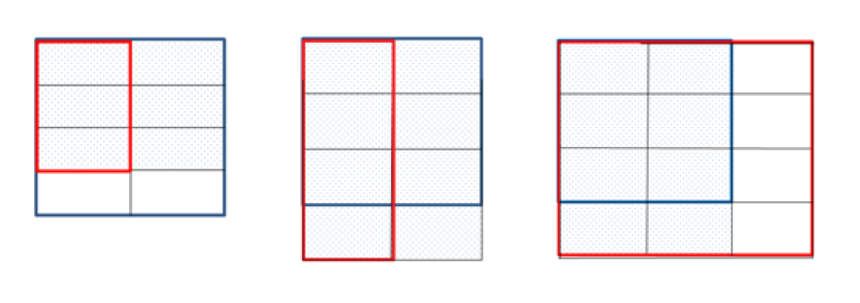
Instead, he drew a diagram similar to Figure 2 and said that using 1000 saplings only the square of 31 by 31 can be formed with few saplings remaining, precisely equal to the remainder, which can be arranged on the sides. This gave a hint to students to find the square of 32 which will be the total number of saplings and subtracting 1000 from this will give the number of saplings to be bought. Now this visual way can be extended to find the answer to the question where we don’t need to find the square of 32.
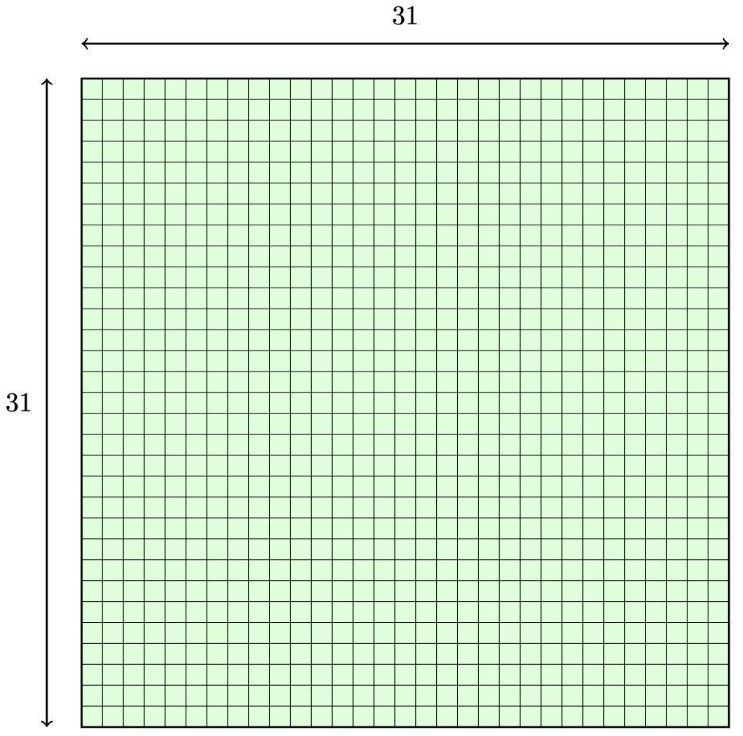
Let us assume that the number of saplings with us is \(N\), which is not a perfect square, and \(m^{2}\) is the largest perfect square less than \(N\). Now after arranging the saplings in m by m square, the remaining saplings are \(N – m^{2}\). Remember how it was done in the previous question, \(1000 – 31^{2} = 39\), the remainder in the long division method.
Now exactly m saplings out of these remaining saplings can be arranged on one of the sides. So after arranging that, we have now \((N – m^{2}) – m\) saplings left, i.e., \((1000 – 31^{2})-31=39 – 31=8\) in the previous question. Recall that \(39 – 31 = 8\) were the plants planted on the other side of the square. See Figure 3.
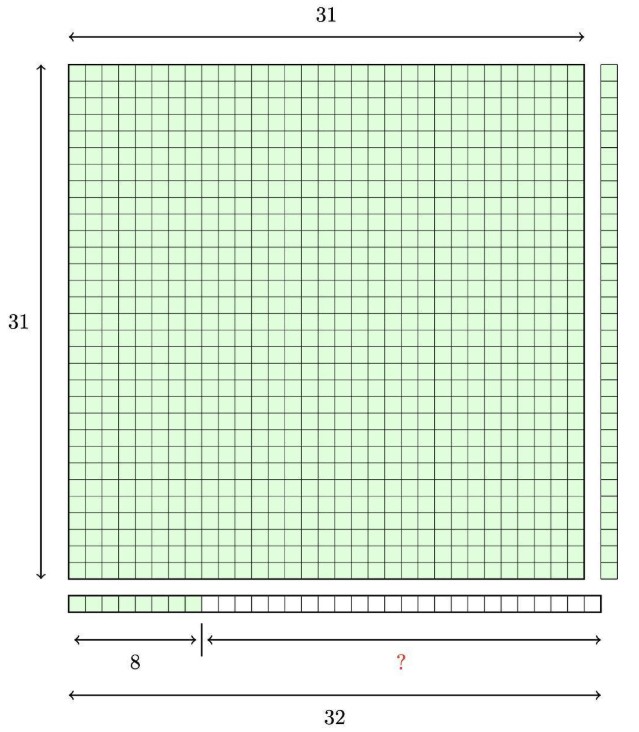
But note that the other side has \(m+1\) units in total. So we need to buy \((m + 1) – [(N – m^{2}) – m]\) saplings. In the previous example, we should have bought \((31+1) – 8 = 24\) saplings.
However, if we began with \(990\) saplings instead of \(1000\), our reasoning will not work. This is because we would then have \((N – m^{2}) – m < m\), which means we would not have filled either of the additional sides. This can be addressed as follows. Instead of planting all the plants first on one side of the square, we can plant saplings one by one on both sides (See Figure 4).
In general, this means we have \(m+m+1=2m+1\) slots on the sides of square. If we plant them using the \(N – m^{2}\) of the remaining saplings, then the number of required saplings to be bought should be bought should be \(2m+1 – (N – m^{2})\)
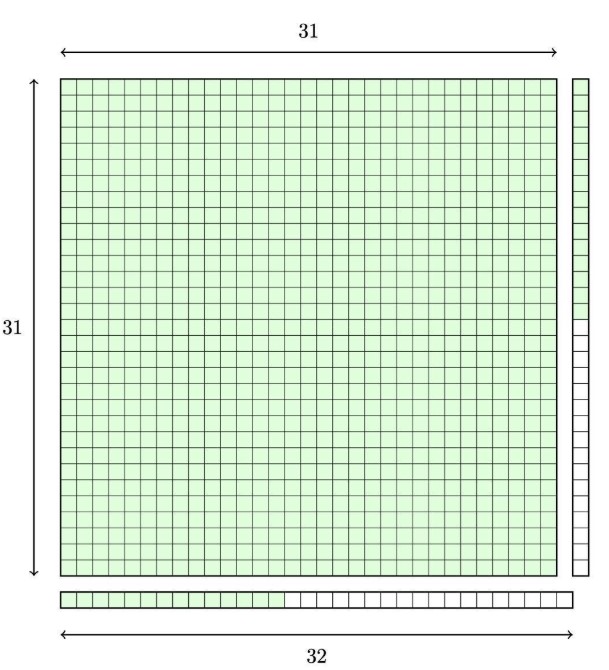
Note here that students only need to perform addition and subtraction instead of multiplication. As these are simpler operations compared to multiplication there are fewer chances of mistakes. This also provides them with an opportunity to visually verify that \((m + 1)^{2} – N\) is same as \(2m+1 – (N – m^{2})\).