
Dienes Blocks and Static Beads: A Comparative Analysis


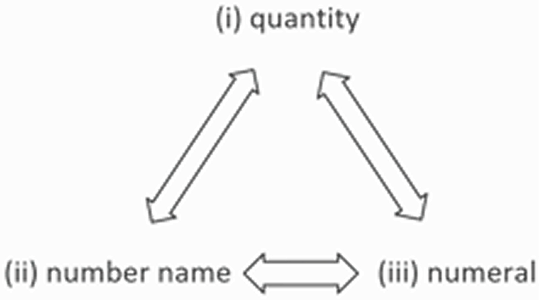
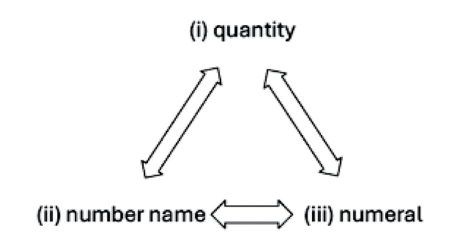
When a child is introduced to numbers, it is very important to establish a 3-way connection among
- The quantity represented
- The number name and
- The numeral or the symbolic representation (Figure 1).
Base-10 blocks play an important role in grasping the idea behind place-value or how we write numbers by making bundles of tens. While the most useful ones are the two-dimensional base-10 blocks, popularly known as the flats-longs-units (FLU), there are two versions of three-dimensional blocks conceived by different people. We have already discussed FLU [1] and how it generalizes into algebra tiles [2] in the March 2024 and the July 2024 issues respectively of At Right Angles. This time, we will look closely at the 3D avatars.
Dienes Blocks
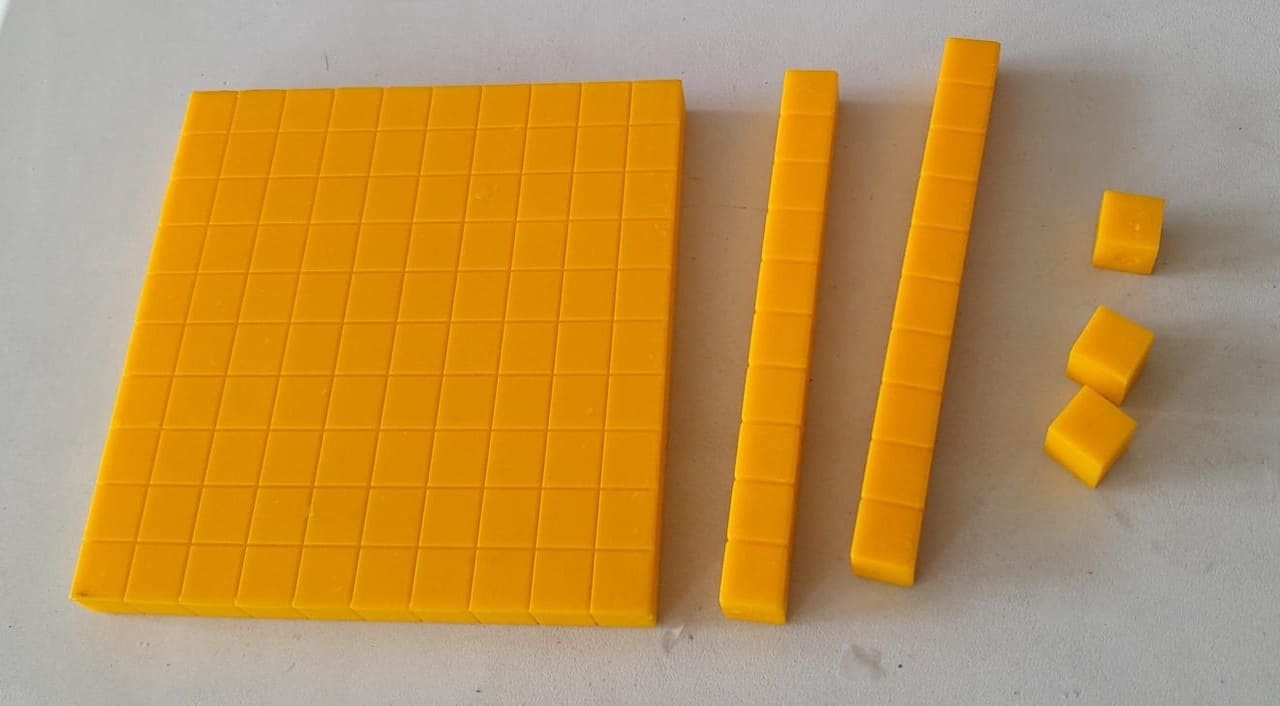
The Hungarian mathematician, Zoltan Dienes (1916-2014), popularized the 3D base-10 blocks. The unit is a small cube, usually 1cm × 1cm × 1cm. The ten is a long cuboid (sometimes called a rod) 10cm × 1cm × 1cm with grooves so that one can easily see that it is 10 units lined up. The hundred is a flat cuboid (often called a plate) 10cm × 10cm × 1cm, with grooves indicating that it is both 10 tens and 100 units. These three blocks are essentially the same as FLU, but with unit thickness (Figure 2).
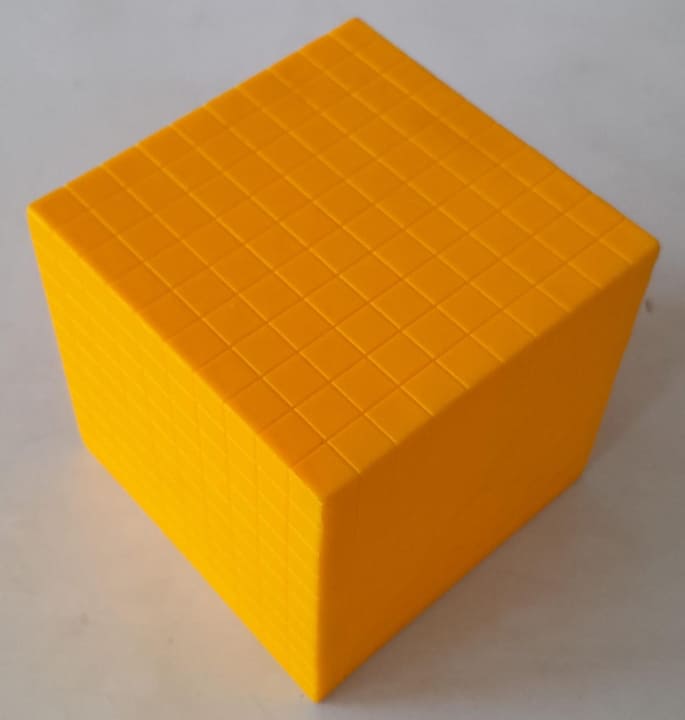
The thousand is a bigger cube 10cm × 10cm × 10cm with grooves on all six faces. One can stack up 10 hundreds and see that their combined volume is the same as the thousand cube (Figure 3). Since each block (except the unit) can be exchanged with 10 of the smaller blocks, i.e., 1 thousand = 10 hundreds, 1 hundred = 10 tens, 1 ten = 10 units, all blocks should have the same color irrespective of size.
Online version
Many online versions including the ones in Mathigon Polypad: Number Cubes, have different colours for blocks of different size. This can be very confusing when a purple thousand splits into 10 green hundreds or 10 orange units merge to a blue ten (Figure 4).

Thankfully, the user can change the color (Figure 5). But whenever a block is split further or 10 blocks of a kind are merged together, the resulting block(s) resume their assigned colors. So, while these can be very useful for generating pictures for worksheets etc., young learners may raise legitimate questions about the color changes if they play with these online blocks themselves.

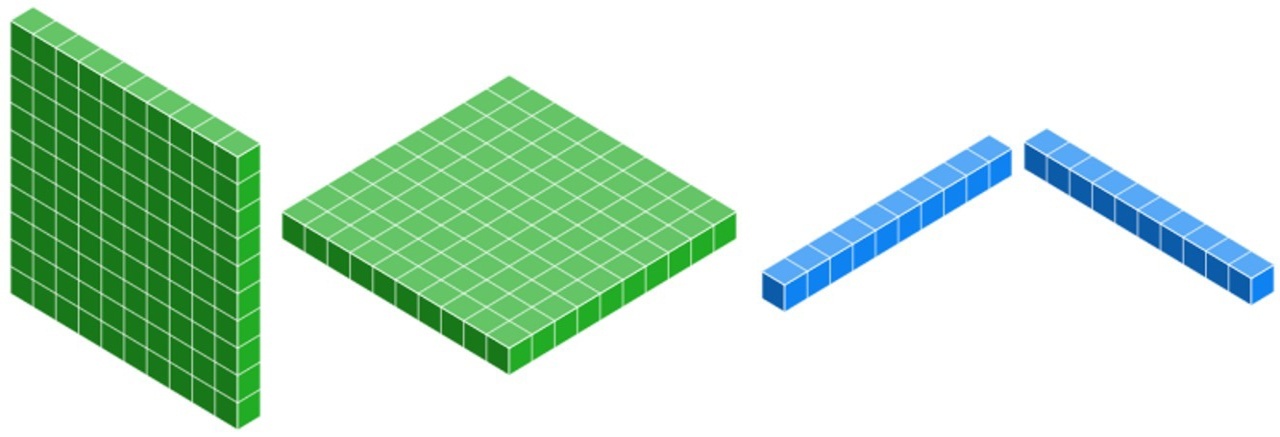
Another interesting aspect of the polypad version is that the orientation of each type of block is fixed, i.e., the ten always stands and does not lie down, the hundred always stands facing right and never faces left! But it also allows one to create a new block by choosing the dimensions (1-10). So, 1 – 10 – 10 generates a plate facing left; 10 -10 -1 is a plate lying down; 10 – 1 – 1 and 1 – 10 – 1 are rods lying in different orientations (Figure 6).
Static Beads
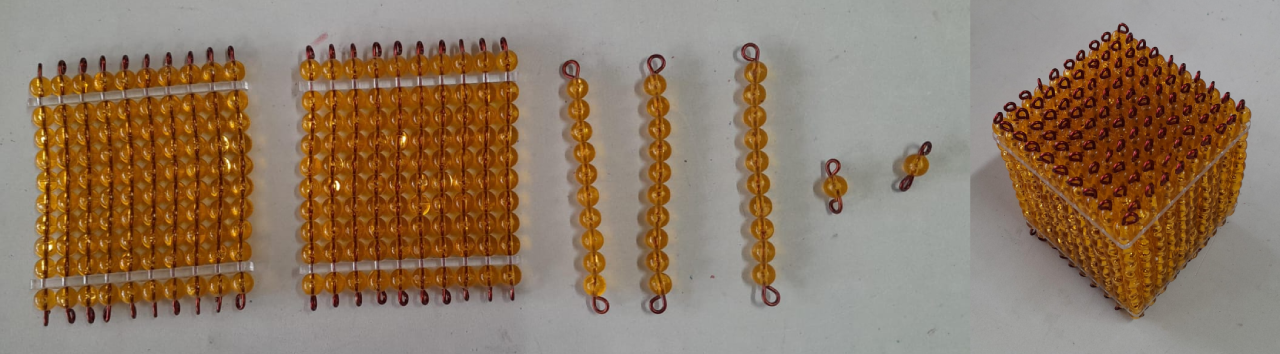
Maria Montessori (1870-1952), an Italian physician and educator, developed a whole range of materials for teaching children as well as pedagogy and philosophy of education known as the Montessori method. One such set is the static beads or golden beads (Figure 7). Unit or one is a single (golden) bead, the wire prevents it from rolling away and provides two handles on either side. Ten is 10 such beads strung in a line (called a string). Hundred is 10 such strings joined to form a flat structure (called a square).
So, there are actually \(10 \times10 = 100\) beads in the hundred. Finally, thousand is \(10\) such squares joined to form a cube. So, there are actually \(10 \times 100 = 1000\) beads. One can see that the thousand is clearly 10 layers of beads, each layer being a hundred. Also, a learner can feel how heavy the thousand is compared to a hundred, or a ten, or a unit. So, the static beads set is not only visual but also a tactile material. These have been used by learners at the preprimary stage (3-5yrs) for decades.
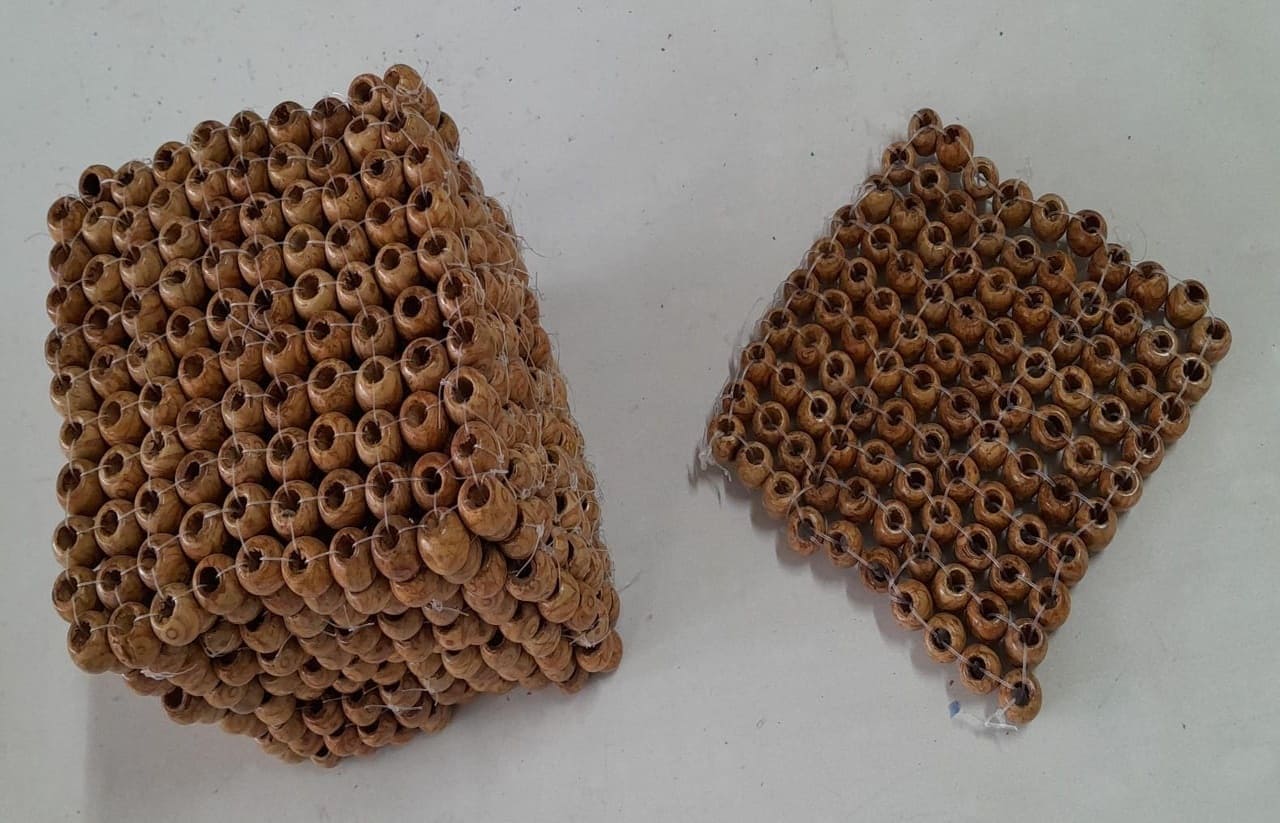
However, it is more expensive and difficult to make. So, after the introduction, static beads are sometimes replaced by wooden blocks. There are circles drawn on the blocks to represent the beads (Figure 8).

The manufacturing of static beads can be made easier if plastic threads are used instead of metal wires (Figure 9). The tens, the hundreds and the thousand would be less rigid, but serve the same purpose. And it is possible to make the thousand in a way such that the 10 layers are very clear (Figure 10) thanks to the idea of Anupama S M, Azim Premji University.
Possible extensions
The smaller three Dienes blocks have all the advantages of FLU. But these are more tedious to make because of the third dimension. The thousand, which really uses the third dimension, however, does not help young learners get a sense of 1000. Many see it as 600 since each face is a hundred. While adults and older learners can think in terms of cuboid volume as length × width × height, i.e. 10 × 10 × 10 = 1000, the young learners find it too difficult to grasp. Moreover, the blocks usually available in the market are hollow. So, weight-wise the thousand is not the same as 10 hundreds or 100 tens, since 10 hundreds and 100 tens have more partitions inside the big 10 × 10 × 10 cube.

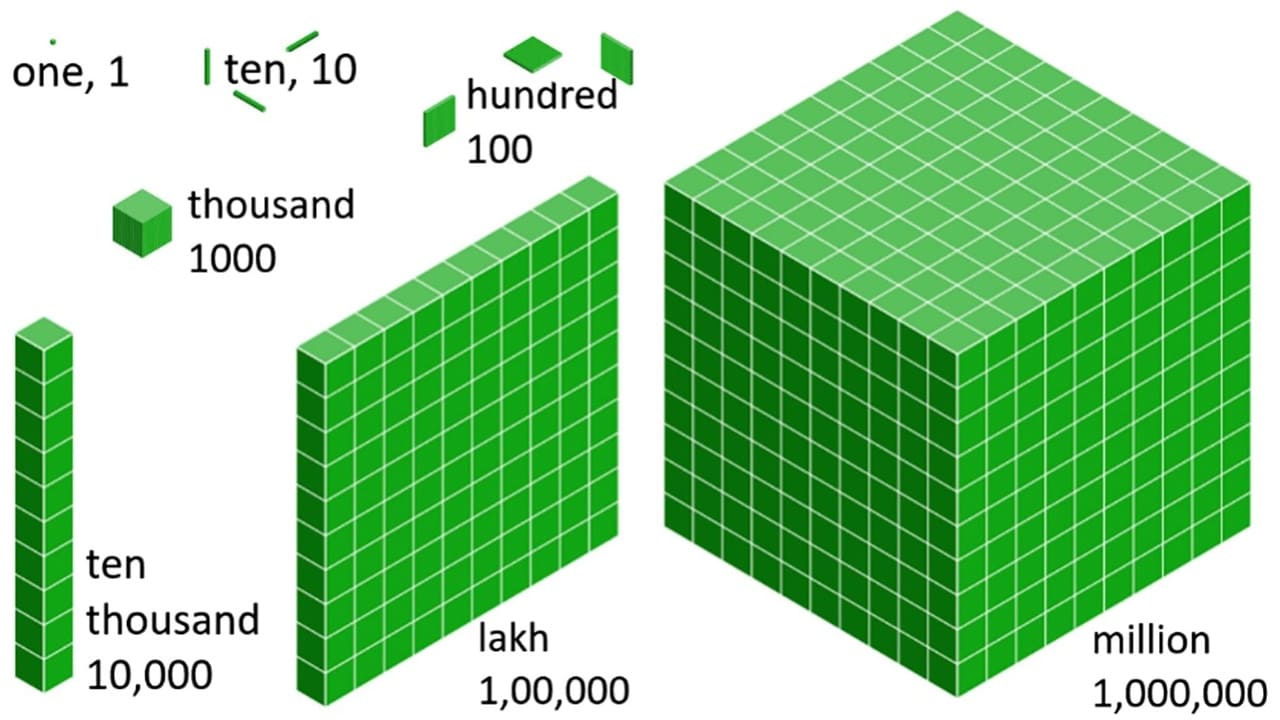
However, 3D base-10 blocks can be useful in giving a sense of how the quantity increases with each digit, i.e., a sense of the exponential growth: 1(cube) → 10 (rod) → 100 (plate) → 1000 (bigger cube) → 10,000 (bigger rod) → 1,00,000 (bigger plate) → 10,00,000 (even bigger cube). Such models can be made with wood or other material and can explain why the comma comes twice in writing a million. So, 3D base-10 blocks or cuboids are quite helpful at the middle school stage (Class 6-8) but not at the Foundational one (pre-primary and Class 1-2) or even in Class 3. Even if models can’t be made, visuals such as Figure 11 can provide a similar sense to most learners.
These can also be extended for decimals, which was used in Decimal Division [3] published in the March \(2024\) issue of At Right Angles.
In contrast, static beads can be extended (in theory) for bigger numbers. But it would be a very tedious job. More importantly, since the learners are much older by then, they are expected to abstract out and use volume formula and measurement instead of depending on counting. So, there is hardly a need to make similar models for 5- or 6-digit or bigger numbers. And since it is practically impossible to split a single bead, this model cannot be extended for decimals.
| Dienes Blocks | Static Beads | |
|---|---|---|
| Credited to | Zoltan Dienes (1916–2014) | Maria Montessori (1870–1952) |
| Chronological order | Came later | Came earlier |
| Conceptually | Based on volume | Based on count |
| Makes sense to | Older learners, Class 4–5, 9+ yrs | Pre-primary stage learners, 3+ yrs |
| Manufacturing | Easier | Labour intensive and material intensive |
| Cost | Less | More |
| Extension(s) | Can be extended to bigger numbers and decimals | Can be extended to bigger numbers (in theory), not possible to extend to decimals |
In short, Dienes block is more extendable and meaningful in the long run. But it does not provide a sense of \(1000\) adequately to young learners. Static beads do a much better job of communicating to them. So, one should choose between these two based on the age of the learner.
- Review of Flats-Longs-Units: https://publications.azimpremjiuniversity.edu.in/5568/1/13_FLU-review.pdf
- Review of Algebra Tiles: https://publications.azimpremjiuniversity.edu.in/5703/1/16_Algebra%20Tiles.pdf
- Division with Decimals: https://publications.azimpremjiuniversity.edu.in/5563/1/08_Division%20with%20Decimals.pdf