
Division with Multi-Digit-Divisors


This article is an account of a teacher’s work with class 5 post her reading of the article ‘Thoughts on the Division Operation’, from the July 2015 issue of At Right Angles.
Brief Recap: Division is different from addition, subtraction and multiplication in many ways. It is also the most complicated of these four operations mainly because the algorithms for the other three do not require any estimation no matter how large the numbers dealt with are. However, the standard algorithm of long division requires estimation and demands a deeper engagement with a process that navigates many iterations of “if this, then do that”.
The current NCERT textbooks do not deal with multi-digit divisors at the preparatory level (till Class 5). Neither do they deal with it later, i.e., at the middle stage (Class 6-8). So, should we teach this at all? Is it needed when calculators are everywhere, even on the ‘un’smart phones?
There are two reasons to still teach these:
- While we may not need to divide by a big number like 365, it is important to know how we can if needed. The process (involving estimation) to divide by a 2-digit number extends for any larger divisor. So, learners should be exposed to division involving 2-digit divisors.
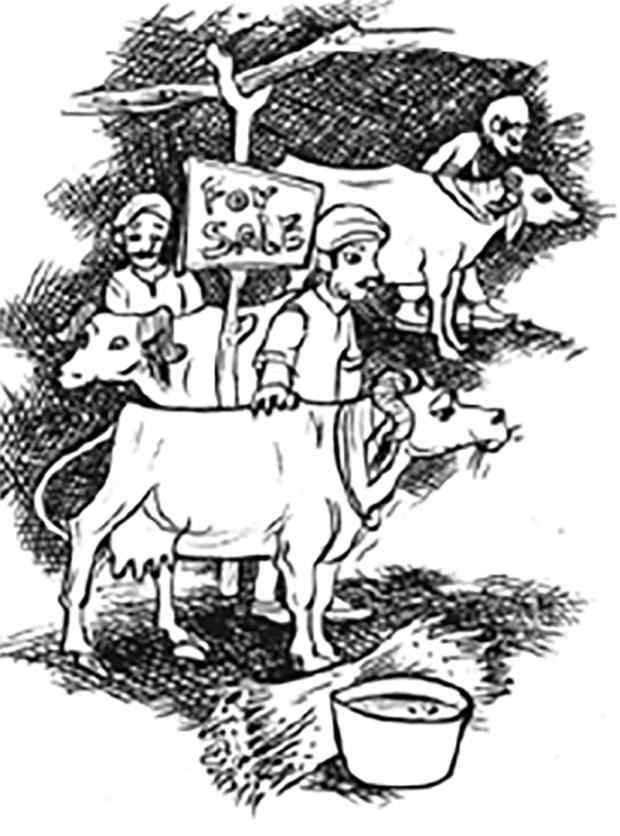
- A more practical reason, however, is that learners are often expected to divide by a 2-digit number in school. Learners are not allowed to use calculators. Here are some examples:
|
7. A milkman sold two of his buffaloes for ¥ 20,000 each. On one he made a gain of 5% and on the other a loss of 10%. Find his overall gain or loss. (Hint: Find CP of each) |
| 10. The population of a place increased to 54,000 in 2003 at a rate of 5% per annum i. find the population in 2001. ii. what would be its population in 2005? | |
| Chapter 8: Comparing Quantities, Class 8, NCERT textbook Ex. 82,Q7 Ex. 8.3, Q10 |
Other examples may be found in:-
- Mensuration – Finding the radius of a circle given its circumference, e.g., finding the radius of acircle made by bending a 40cm wire.
- Data Handling – While calculating the mean, e.g., finding the mean of 23 items totalling 4178
Given below is a short narrative from the teacher’s experience in doing the problem on Data Handling in her Class 8 mathematics class.
 Teacher |
We have 23 items with a total weight of 4178 kgs, can anyone estimate the mean weight? You need to explain how you estimated. |
 Student A |
Less than 200 kgs. Because 23 × 200 is 4600 kg. |
 Student B |
More than 150 kgs. Because 23 × 100 is 2300 kg, and so the average must be closer to 200 kg than 100 kg. |
|
Teacher |
Excellent thinking! I notice that you are using products of multiples of 10s and 100s, to make your estimates. Now, let’s see if you can use this to your advantage in dividing by 23. Why don’t you round off 23 to the nearest multiple of 10, i.e. 20? Now make an estimate for the first digit of the quotient, i.e., divide 41 by 20. |
 Student C |
We get 2, I can see that we are already going away from the estimated answer! |
|
Teacher |
That’s observant. So let’s check by multiplying 23 by 2, we get 46 and as you said, that’s more than 41. |
|
Student B |
So, the first digit is 1 and the remainder is 41 − 23 which is 18. Do we bring down the next digit as we do for single-digit division? |
|
Teacher |
Yes, we get 187 and we again try 20 × 9 which is 180. |
|
Student A |
Oh, so we try 23 × 9 which is 207 and so we then try 23 × 8 which is 184, that’s so close! |
|
Teacher |
So, the first two digits of the quotient are 1 and 8 and we get a new remainder of 3, we bring down the next digit 8 and divide 38 by 23. |
|
Student B |
I get a quotient of 181 and a remainder of 15. So, my average is about 181 kg, in fact about 181.5 kg because 15 is more than half of 23! |
|
Teacher |
Yes, we can continue with decimal division, but for now, this is a great idea of the mean weight. What do you think these 23 items are? |
 Student D |
Well… maybe some sort of animal? Like dolphins? My favourite animals! |
|
Teacher |
That’s a great suggestion! I know that some motorcycles weigh about 200 kg. Try and find out some other ‘items’ that weigh 200 kg and let’s discuss tomorrow why they would need to find the average weight of these 23 items! Create your reasons! Can we debate the ethics of the scenarios you create? |
Hearing this narrative, we at Math Space decided to write down the basic recipe for tackling a 2-digit divisor. Here it is:
- Round off the divisor to the nearest multiple of 10.
- Estimate the quotient (or quotient digit) at that step using the estimate.
- Calculate the product of the quotient digit and the actual divisor.
- Check
- For rounding up: if dividend – quotient digit × divisor > divisor: increase quotient digit by 1 and repeat step 3
- For rounding down: if quotient digit × divisor > dividend: decrease quotient digit by 1 and repeat step 3
- Complete the division step with the (modified) quotient.
Since there are so many possible cases, (and later we will see just how many there are), here are some examples. In this article, we will restrict ourselves to 3-digit ÷ 2-digit. The rest can be generalized as discussed later.
There are multiple possibilities for 3-digit ÷ 2-digit involving:
- Rounding up
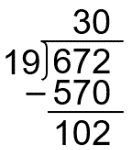
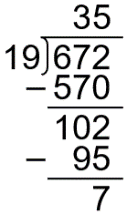
Example 1: 672 ÷ 19
|
Round up the divisor to the nearest multiple of 10: 19 rounded off to 20 |
Estimate the quotient (or quotient digit) at that step using the estimate. 672 ≈ 600, i.e., 6 hundreds 672 ≈ 670, i.e., 67 tens 672 ÷ 20 (or 600 ÷ 20) ≈ 30 = 3 tens |
|||||||||
|
|
|||||||||
|
|
|||||||||
Think about this: How will this change if the divisor is 17 instead of 19, i.e., 672 ÷ 17?
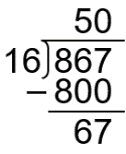
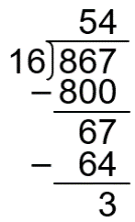
Example 2: 867 ÷ 16
|
Round up the divisor to the nearest multiple of
10: 16 rounded up to 20 |
Estimate the quotient: 867 ≈ 800, i.e., 8 hundreds 867 ≈ 860, i.e., 86 tens 867 ÷ 20 (or 800 ÷ 20) ≈ 40 = 4 tens |
|||||||||||||
|
|
|||||||||||||
|
|
|||||||||||||
What if the dividend is 863 instead of 867, i.e., 863 ÷ 16?
- Rounding down
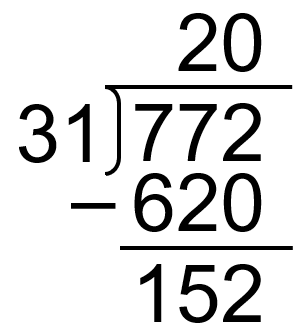
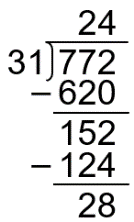
Example 3: 772 ÷ 31
|
Round up the divisor to the nearest multiple of 10: 31 rounded down to 30 |
Estimate the quotient: 772 ≈ 700, i.e., 7 hundreds 772 ≈ 770, i.e., 77 tens 772 ÷ 30 (or 700 ÷ 30) ≈ 20 = 2 tens |
|||||||||||
|
|
|||||||||||
|
|
|||||||||||
How will this change if the dividend is 779 instead of 772, i.e., 779 ÷ 31?
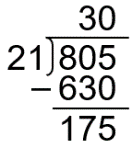
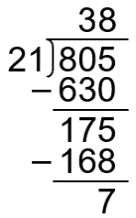
Example 4: 805 ÷ 21
|
Rounding: 21 rounded down to 20 |
Estimating quotient 805 ≈ 800, i.e., 8 hundreds, i.e., 80 tens 805 ÷ 20 (or 800 ÷ 20) ≈ 40 = 4 tens |
|||||||||||
|
|
|||||||||||
|
|
|||||||||||
Find the difference if the dividend is 604 instead of 805, i.e., 604 ÷ 21?
Examples of divisions with single-digit quotients were discussed in the previous article. The following table summarizes all \(2 \times 2 \times (1 + 2) = 12\) possibilities with one numerical case each.
EQ = estimated quotient, FQ = final quotient
| 1-step division, 1-digit quotient | 2-step division, 2-digit quotient | ||||
|---|---|---|---|---|---|
| Examples | Step 1 | Step 2 | Examples | ||
| Divisor rounded up | FQ = EQ | 243 ÷ 37 | FQ = EQ | FQ = EQ | 672 ÷ 19 |
| FQ > EQ | 672 ÷ 17 | ||||
| FQ > EQ | 256 ÷ 36 | FQ > EQ | FQ = EQ | 863 ÷ 16 | |
| FQ > EQ | 867 ÷ 16 | ||||
| Divisor rounded down | FQ = EQ | 254 ÷ 31 | FQ = EQ | FQ = EQ | 779 ÷ 31 |
| FQ < EQ | 772 ÷ 31 | ||||
| FQ < EQ | 256 ÷ 33 | FQ < EQ | FQ = EQ | 805 ÷ 21 | |
| FQ < EQ | 604 ÷ 21 | ||||
Step 1 of the recipe can be modified as follows for bigger divisors:
If the divisor has n-digits, then round it off to the nearest multiple of \(10^n\) .
The rest of the steps remain as they are.
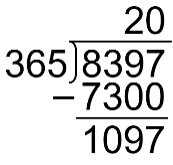
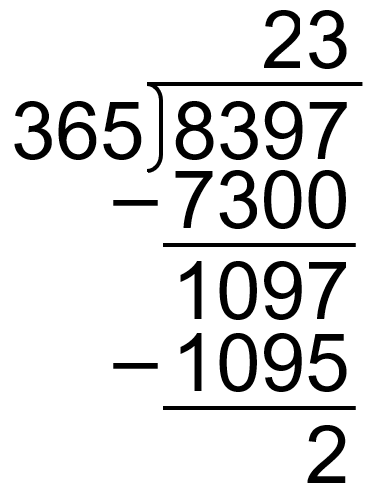
For example, let us consider, \(8397\) ÷ \(365\)
| Rounding: |
365 rounded off to 400 8397 ≈ 8000, i.e., 8 thousand 8397 ≈ 8300, i.e., 83 hundreds |
|||||||||||||
|
|
|||||||||||||
|
|
|||||||||||||
We hope that this will help learners navigate the complexity generated by multi-digit divisors, especially the estimation and the nuances it brings along. Notice that as each digit of the quotient is obtained, the recipe focuses on its place value, something that the teacher chose perhaps, to ignore during her discussion with the students.