
Shuffling towards Mathematics: UNO as a Classroom Tool


What is UNO?
Created by Merle Robbins in 1971, UNO is a colourful and exciting shedding-type card game. The goal? Be the first to get rid of all your cards in this fast-paced game.
Here is the quick game overview:
- Players: 2-10.
- Objective: Discard all your cards to win.
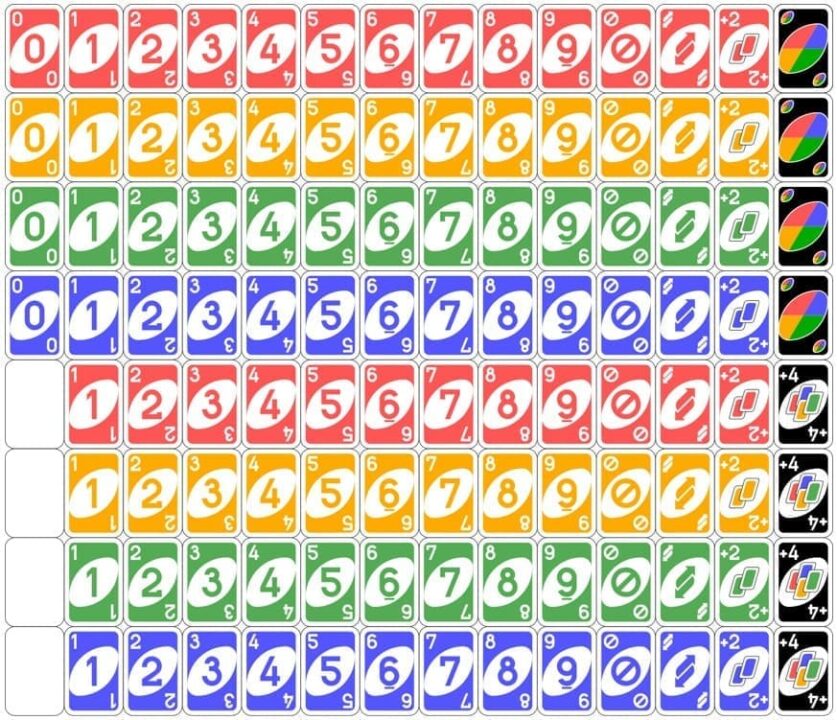
- Deck: 108 cards in four colours (red, yellow, green, blue), with numbers 0-9 and special action cards. (See Figure 1)
- Rules: Match either the colour or the number of the top card in the discard pile. If you can’t play, draw a card. Still stuck? Skip your turn!
- Special Cards
- Skip: The next player skips their turn.
- Reverse: Change the direction of play.
- Draw Two: The next player draws two cards.
- Wild: Choose the colour to continue.
- Wild Draw Four: Choose the colour and make the next player draw four cards.
A UNO like multiplication game
In a resource-crunch classroom, it is of course difficult to buy UNO cards and use them. In such situations, the teacher can come up with UNO alternatives designed specifically to teach a concept in the classroom. In this section, I describe a UNO like multiplication game I designed and the classroom experience that resulted from it.

Making the cards:
- Take an ivory sheet is of dimension \(56\)cm x \(71\)cm.
- Mark the ivory sheet on every \(5\)cm horizontally and make lines.
- Mark the ivory sheet on every \(7\)cm vertically and make lines.
- This will give us \(110\) rectangles of size \(5\)cm x \(7\)cm, which is enough to make \(2\) sets of cards.
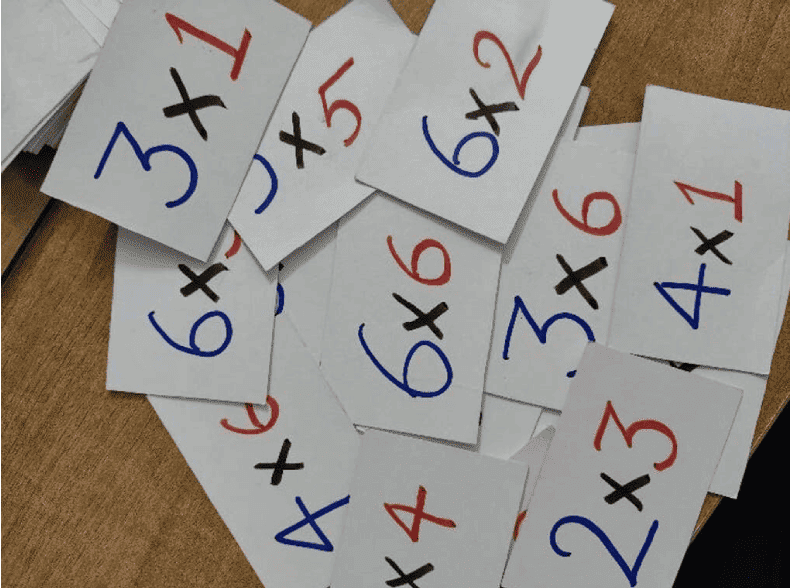
- Cut the rectangular cards and write multiplication facts on them.
- Avoid repetitions due to commutative property. For example, if you have made \(2 × 5\) then avoid making \(5 × 2\).
- The multiplication fact cards will look like those in Figure 3.

Rules for the game
Rules for this game are quite similar to the UNO game.
- The cards should be shuffled properly and distributed equally to the members. It can be either \(5\) or \(7\) cards per person. The rest of the cards are placed in a Draw Pile face down.
- The game opens with a card from the draw pile.
- The next card should have the same product as the last card, or the next card must have one of the factors of the last card on the floor. For example, if the last card is \(7 \times 8\), then the next card must either have \(7\) or \(8\) as a factor, or the same product as \(7 \times 8\), and can then be discarded.
- If both are not possible then the player draws a card from the draw pile.
- The players should announce the factors and their product aloud while throwing the card. If the player misses this or says the wrong product and the other players catch this, the player has to pick two extra cards from the deck.
- The player who finishes his/her cards first will be the winner of the game.
Experience of using this in class – How did the students respond?
The cards were introduced to fifth-grade students who were having difficulty with multiplication. They saw it as a fun activity and began playing. Initially, they took some time to grasp the rules, but once they got the hang of it, they realised that knowing their multiplication tables was essential to winning. This naturally motivated them. On the first day, the game took a long time to finish because they didn’t know the products of the cards they had. However, as they continued playing, they gradually understood the game and started learning the tables on their own.
This activity made it easier to discuss multiplication tables with students. Instead of asking them to chant and memorise the tables, the game naturally motivated them to learn. Regular play can further enhance their computational skills. The game also helps students recall multiplication facts more effectively and improves their ability to retain information.
Dos and Don’ts for any teacher who wants to use this in class
To help young students in grades \(2\) and \(3\) understand the concept of multiplication, teachers should use real-world examples and physical objects to explain it as repeated addition. Introducing the term “times” to describe multiplication makes the concept clearer. This game can then be used to make learning multiplication tables fun and interactive. For older students in grades \(4\) and above, the game can serve as an enjoyable way to practise multiplication facts, encouraging them to memorise and use their tables more effectively.
Here are some dos and don’ts for teachers while students play this game:
- Ensure students understand what the cards represent.
- Brief the students about the rules of the game before they begin.
- Teachers should play the game once or twice to ensure students understand how it works.
- Motivate them during the game to find answers and participate actively.
- Arrange students in groups of \(4\) or \(5\) to play. If the class is large, create multiple groups to give more students a chance to participate.
- Ensure the game is played smoothly, keeping the students focused and engaged.
UNO as a classroom tool
In the classroom, games often serve as a bridge between abstract ideas and practical learning. They offer students a fun and interactive way to understand concepts that might otherwise feel challenging. UNO cards, with their numerical values, sequences, and logical rules, are especially suited for teaching foundational mathematical concepts. Their versatility makes them ideal for activities like flashcards or group games. Educators have designed a variety of activities to suit different age groups and skill levels, showcasing how UNO cards can effectively enhance mathematical learning. For more ideas, see the resources listed in the references [1–3].
For Foundational level (Ages 3-8)
- Colour Sorting: Children can sort UNO cards by colour, which strengthens their capacity to distinguish and categorise colours.
- Number Matching: By grouping cards with the same numbers, children develop number recognition and matching skills.
- Number-Object-Numeral Association: Selecting a card, counting out the matching number of objects, and identifying the corresponding numeral help students understand quantities and strengthen their counting skills.
- Friends to 10: This activity involves picking a card and determining the number needed to add up to ten, improving addition fluency.
- Single-Digit Addition and Subtraction: Drawing two cards and either adding or subtracting their values provides practice in basic arithmetic operations.
For Preparatory level (Ages 7–10)
- Times Table Practice: Selecting two random cards and multiplying their values helps reinforce multiplication skills.
- Two-Digit Addition and Subtraction: Using UNO cards to create and solve two-digit addition or subtraction problems enhances computational proficiency.
- Greater Than or Less Than: Comparing the values of two cards to determine which is greater or lesser fosters number sense and understanding of numerical relationships.
These activities demonstrate the adaptability of UNO cards as educational tools, making mathematics accessible and enjoyable for students at various learning stages.
Conclusion
The UNO-like multiplication game transforms the often monotonous task of learning multiplication tables into an exciting, interactive experience. Blending gameplay with educational objectives naturally motivates students to practice and master their tables while fostering quick thinking, concentration, and collaboration. The activity encourages active participation, making it far more engaging than traditional rote learning methods.
- Kunova, J. (2024, April 2). UNO Cards: 22 Awesome Ways To Use Them in Maths. Rainbow Sky Creations. https://bit.ly/4aAUcpr
- Porter, R. (2021, October 28). Fun Math Games to Play with Uno Cards. Tickled Pink in Primary. https://bit.ly/40NNclS
- Winter, H. (2023, November 12). Fun Learning Math Activities with Uno Cards. Happy Tot Shelf. https://bit.ly/4jtRGWj