
Crafting Questions for Diverse Learning Goals


Typically, the questions we use in exams are straightforward and lack thought-provoking elements. Children are naturally curious thinkers, and a direct mathematical question doesn’t always spark their curiosity. Effectively designed questions with specific purposes, such as promoting appreciation of concepts, developing skills, and understanding new properties, can significantly benefit students. These types of questions should be part of our assessments in order to enhance the student’s deep understanding of concepts and to shift away from rote learning methods.
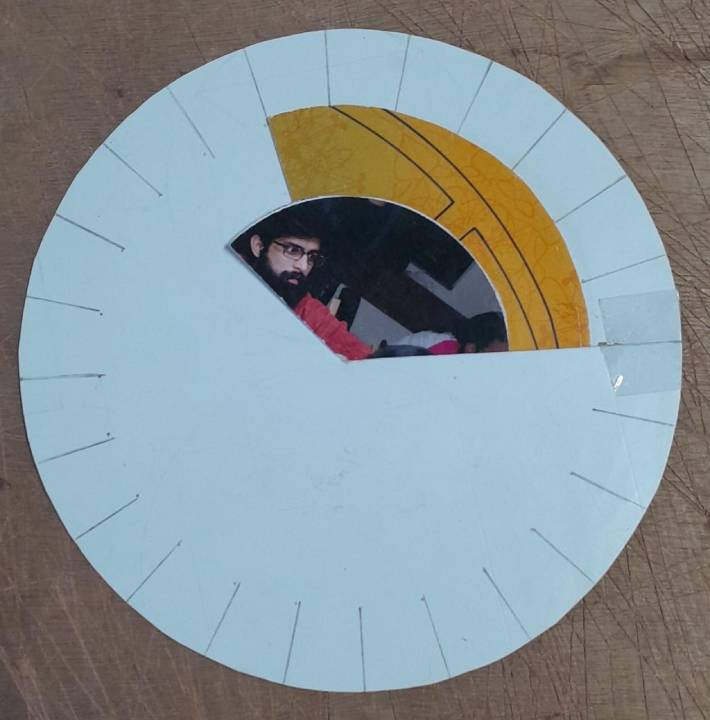
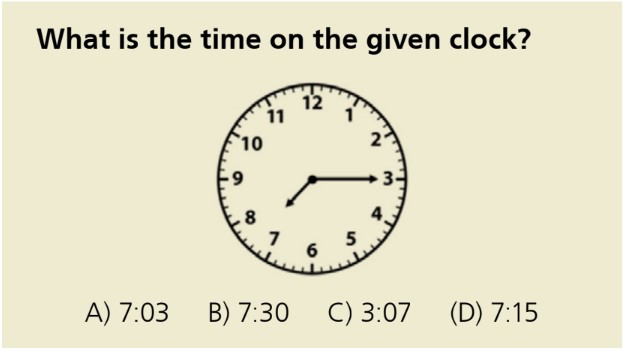
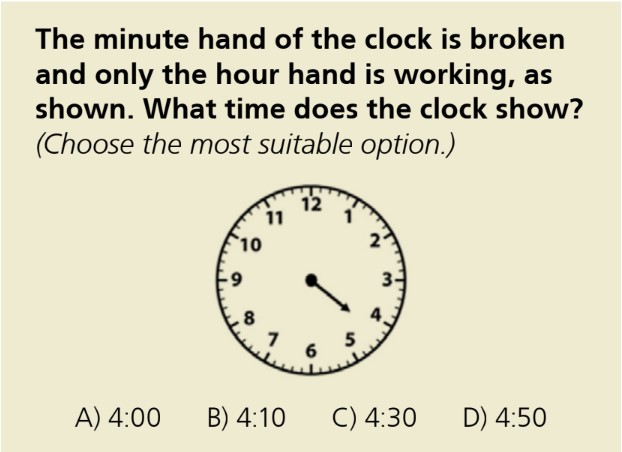
Consider the two questions given in Figure 1 and Figure 2. Figure 1 is a standard question for selecting the correct time. Although it is a good diagnostic question, it does not involve any thinking elements. The question is slightly modified by removing the minute hand from the clock, as shown in Figure 2. This question encourages thinking and teaches us how to estimate time.
Most of the tests conducted nowadays are based on memorising facts rather than understanding concepts. With the introduction of the National Education Policy (NEP) in 2020, new initiatives are being taken to reform education systems and shift the objective of assessment towards higher- order thinking with PARAKH (Performance Assessment, Review, and Analysis of Knowledge for Holistic Development). PARAKH aims to assess a student’s overall development, taking into account not just their academic performance but also their cognitive, social, and emotional growth.
At Open Door Education (www.opendooreducation.in), we create questions that not only assess understanding but also inspire students to think creatively when solving problems. We design a variety of questions that appreciate concepts and help students to develop a deeper understanding of them. In this article, we showcase some of our questions to demonstrate how thoughtfully designed questions with various objectives can spark discussion and how a range of questions on a specific topic can be developed to assess mastery.
Designing Questions That Encourage Thinking
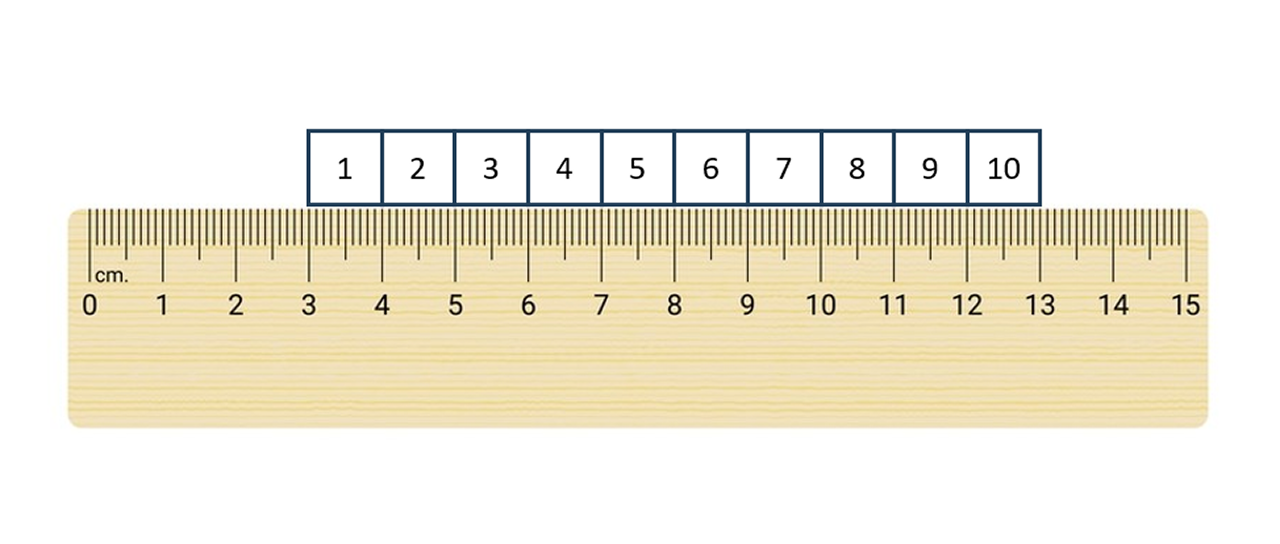
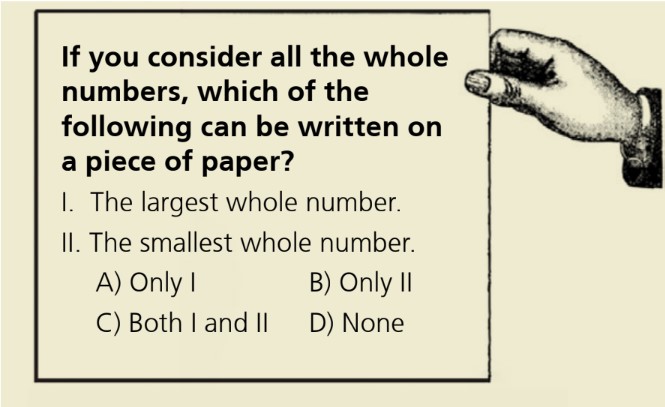
The question shown in Figure 3 is designed to indirectly teach students that “the set of whole numbers has no largest element.” When students attempt this problem, they typically begin by writing down the largest number they can think of. However, they soon realize that they can always choose a number larger than the one they just wrote, leading them to understand that there is no largest whole number. This question demonstrates how presenting a mathematical problem in a different manner can transform it into a more interactive and engaging activity.
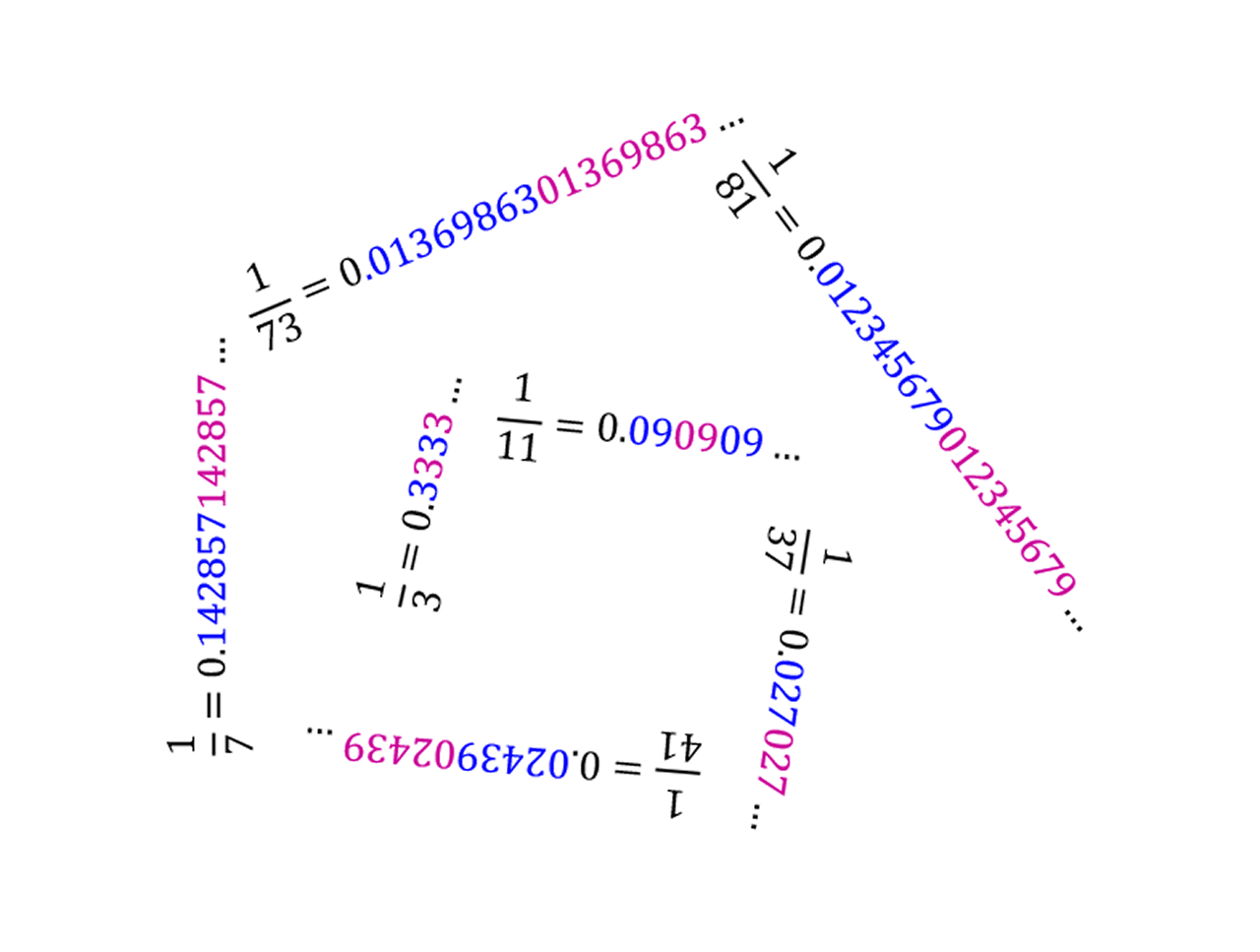
In mathematics, there are two important numbers: \(0\) and 1. 0 is defined as the additive identity for whole numbers, and \(1\) is known as the multiplicative identity for whole numbers. It will be interesting to understand the significance of these technical terms by solving a question. We have designed a question (Figure 4) for Class \(6\) students that highlights the application of these mathematical terms.
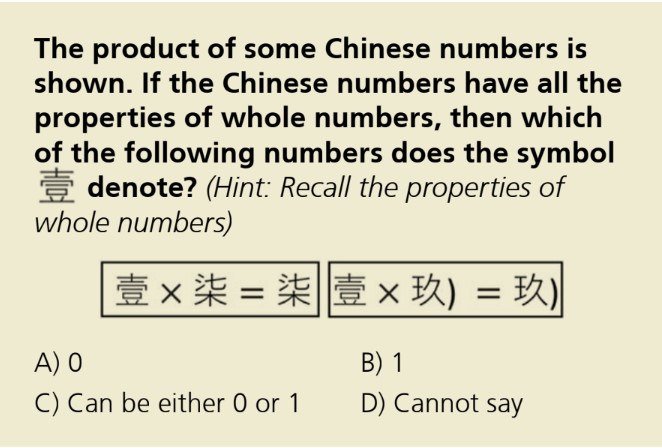
If x and y are any whole numbers then \(x + 0 = x\) and \(y \times 1 = y\). We see adding \(0\) to any whole number will result in the same number and multiplying \(1\) with any whole number will result in the same number. Looking at the bigger picture, we can conclude that this property of numbers applies to any numerical system. To solve the question in Figure 4, students just need to observe the patterns in these symbols and know that \(1\) is the multiplicative identity.
Now, let’s explore how we can use a question to help students discover some interesting properties.
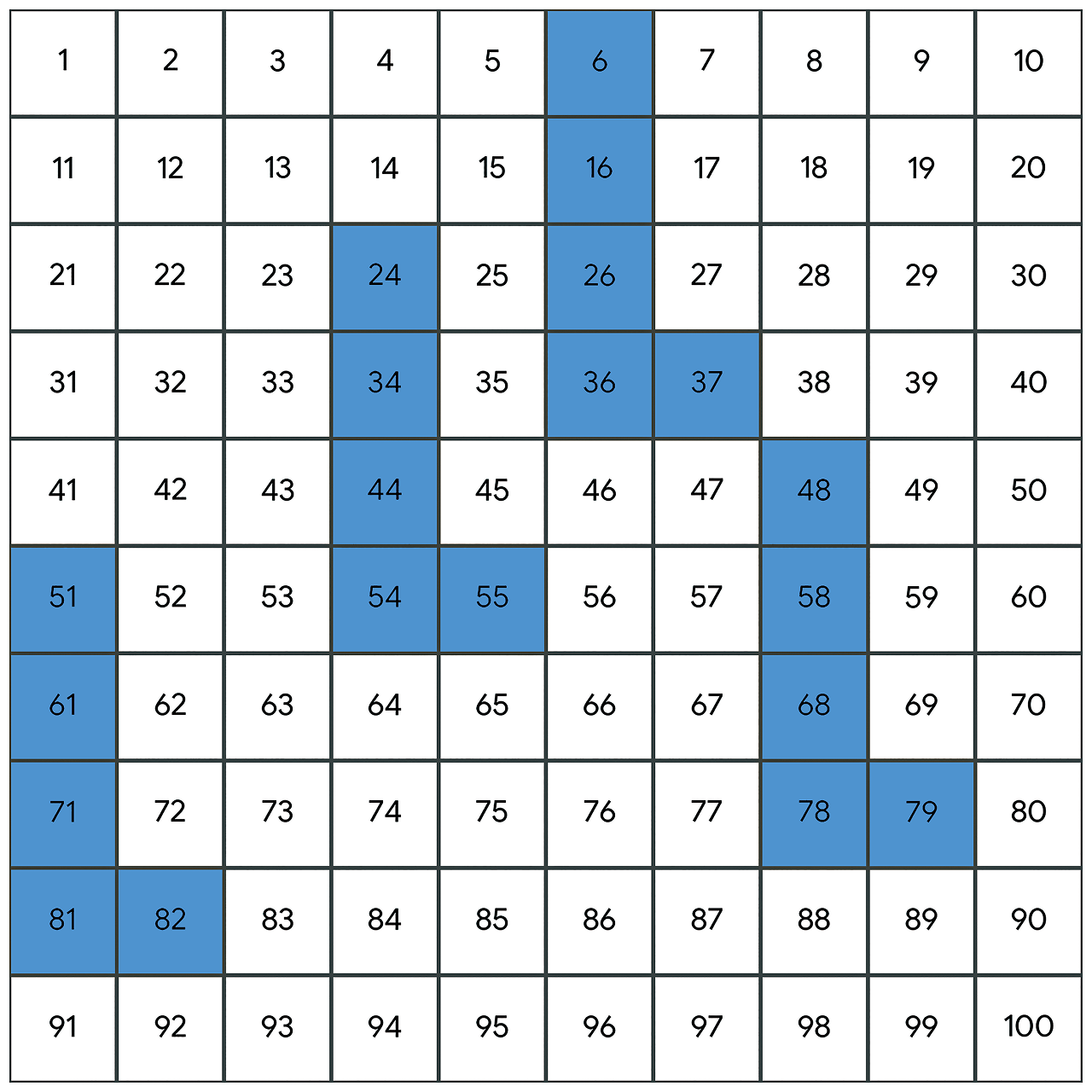
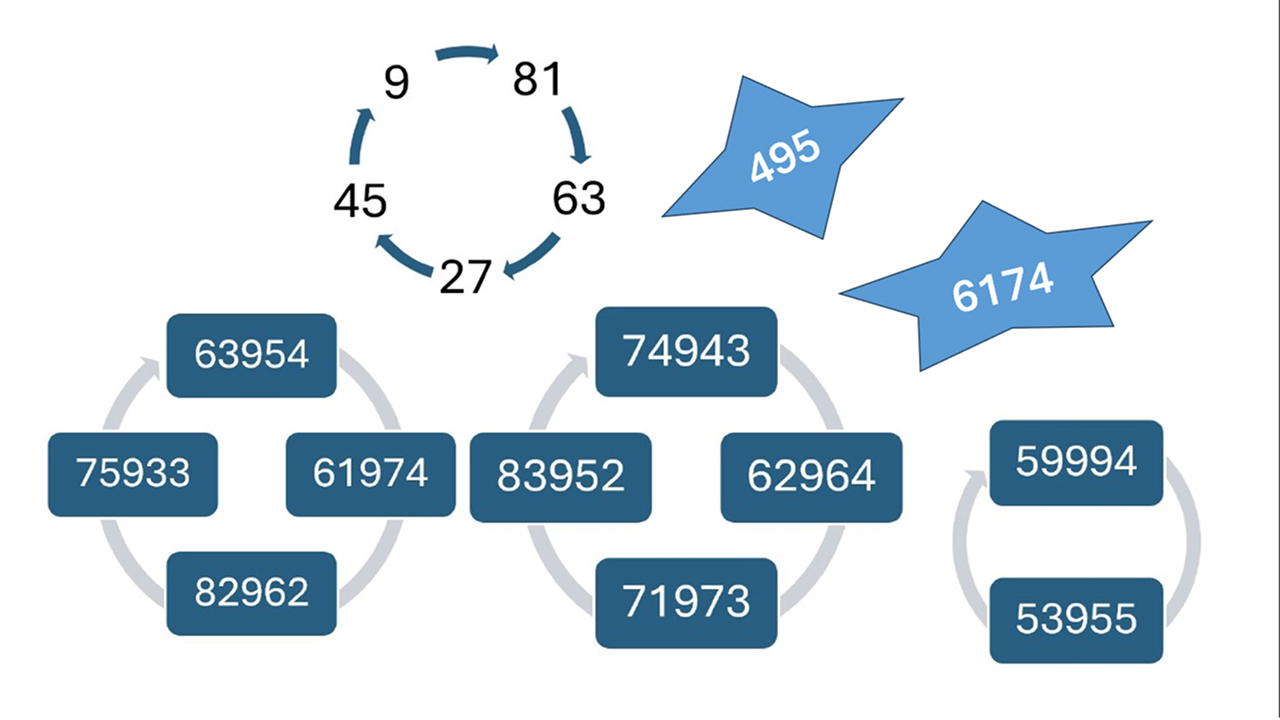
We know that a number is divisible by \(3\) if the sum of its digits is divisible by \(3\). A simple observation is that even if we shuffle the digits and form a new number, the number will still be divisible by \(3\) because the sum of the digits will remain the same. The question in Figure \(5\) is posted for 5th graders in some schools. Although the question is simple, it encourages students to explore and discover fascinating mathematical properties. For example, the question in Figure 6 presents a slightly more challenging and modified version of the question for the students.
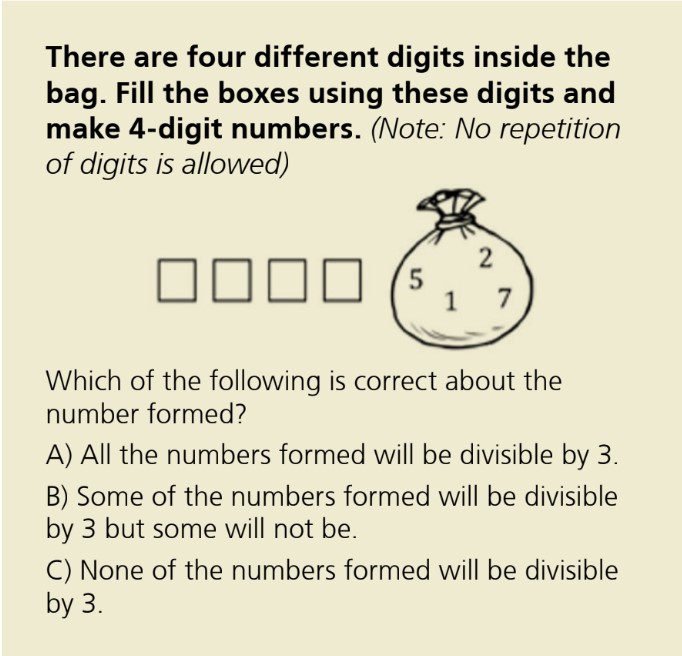
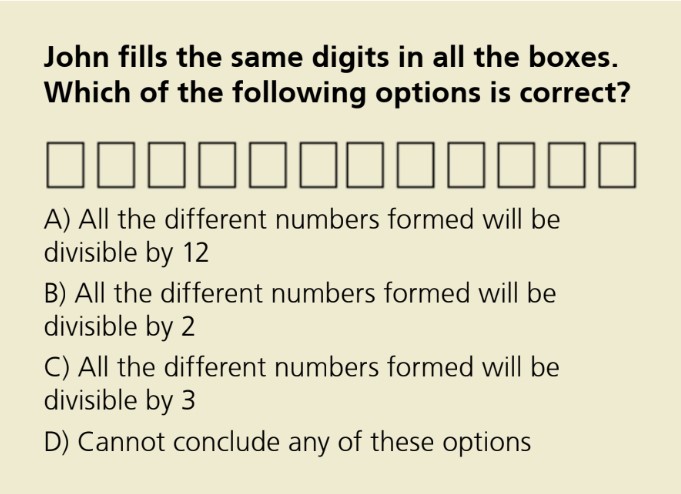
What interesting properties do you observe when solving the question in Figure 6?
Fraction Problems with Varying Difficulties for Primary Students
To evaluate mastery of a topic, it is essential to use a variety of questions with different difficulty levels. Developing multiple questions for a single concept can be challenging. Additionally, each question should incorporate elements that potentially identify some misconceptions or difficulties. By diversifying how questions are presented and adding new visuals, we can develop a wide range of questions on a specific topic, see Figure 7. Questions 1-10 are designed around fractions and have different difficulty levels. The questions include multiple-choice (MCQ) and interactive drag-and-drop types.
Each of these questions has a specific objective along with some distractors. Q1 focuses on whether students understand how to represent fractions. Q2 tests the misconception that to represent a fraction in the given figures, the shaded parts must be equal.
Some students might be confused about how to represent a full or whole part when dealing with fractions. Q3 aims to determine whether students understand how to represent a whole (or “full”) in the context of fractions.
Although Q4 is fairly straightforward, many students hold misconceptions about representing fractions in the context of objects. In this question, students might mistakenly select 3/4 as the fraction representing blue pens, assuming they should place the number of blue pens in the numerator and the red pens in the denominator.
Interestingly, dividing a symmetrical shape in half is easier than dividing an asymmetrical one. Q5 is an interactive question designed to illustrate this concept. Q6 is a misconception question that tests whether students understand how to correctly represent the fraction 1/2. Students might choose the answer ‘Yes’ by thinking that the figure is divided into two parts; however, they usually miss the point that the divided parts must be equal.
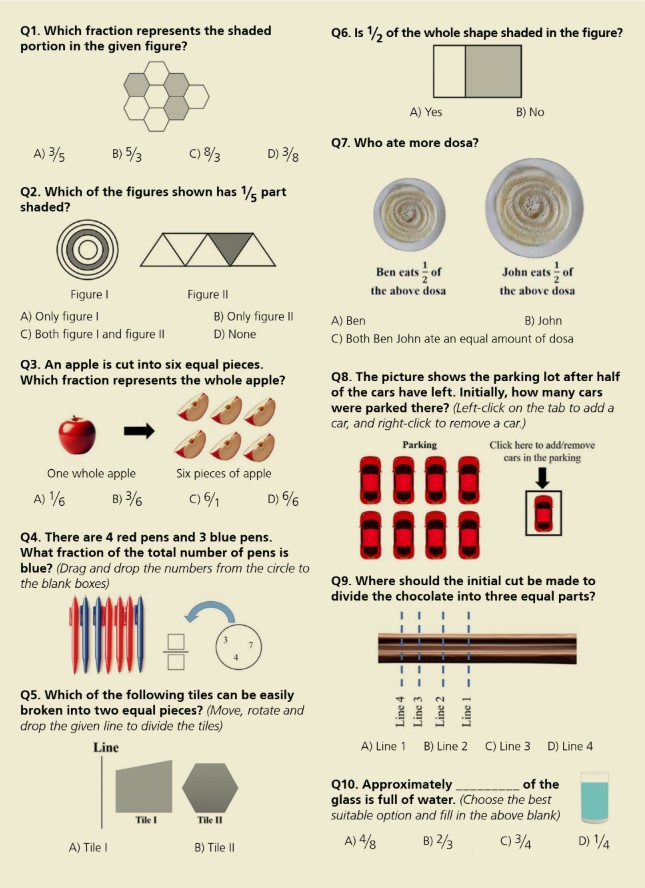
It is worth considering whether half of two similar objects of different sizes are equal. Q7 addresses the idea that, numerically, halves are equal; however, half of two similar objects of different sizes are not equal. Q8 is an interactive question that explores whether knowing half of a number allows us to determine the whole.
Most of the time, we are asked to calculate one-third of an object; however, in Q9, it becomes interesting to consider where the first cut should be made if we want exactly one-third of an object. Lastly, Q10 is a question on the estimation of fractions.
We observe the creation of various questions around a single concept, which not only assesses student’s understanding of fractions but also encourages them to think more deeply when tackling specific problems.
Conclusion
Question design plays a crucial role in helping students achieve diverse learning objectives. There is significant potential to craft various questions to fulfil multiple learning purposes. The purpose of assessments should extend beyond testing student’s knowledge to also include questions that challenge their thinking and spark curiosity.