
Making Summative Assessments Meaningful at the Preparatory Stage



While formative assessments take place regularly and are integrated into everyday classroom interactions, summative assessments are carried out at the end of a unit, or during mid-term or end-term periods. These summative assessments should provide a clear picture of the child’s readiness to progress to the next grade or the subsequent unit in the syllabus. It is important to note that assessments are objective and guided by the prescribed competencies (stage specific learning achievements that are observable and can be assessed systematically [2]). If any learning gaps are identified, it is essential that schools offer targeted support and bridging opportunities to help the child. But very often, summative assessments are the bottom line, the labelling factor with which the child goes into the next class. With such high stakes at risk, the final examination becomes an annual torture session for children as well as parents. Can something be done differently? We begin this article with a look into a classroom.
The following vignette illustrates the observations of a teacher administering formative assessment in her class and the contrast she notices during summative assessment.
A teacher’s reflections on learning and assessment
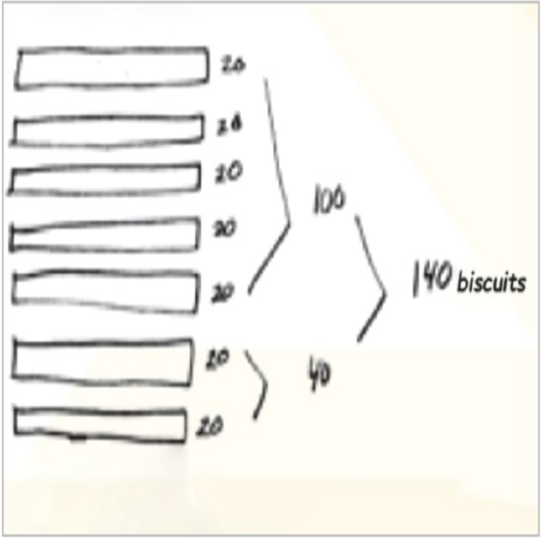
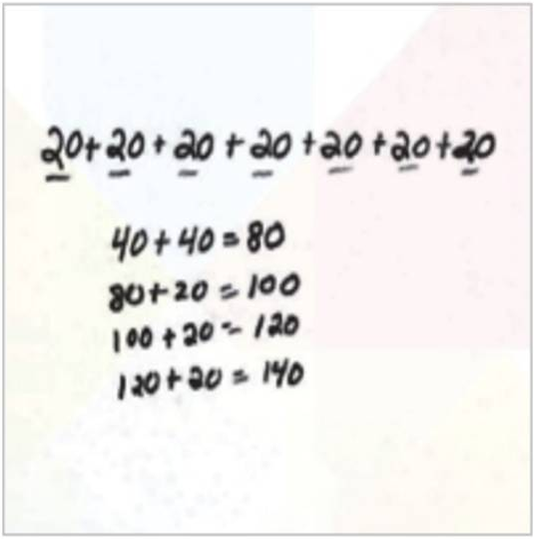
Mrs. T teaches Mathematics in Class 3. She wants her students to be able to visualize arithmetic operations and relationships among them using math vocabulary. She uses the opportunity of an upcoming picnic to pack biscuits for it and makes 7 packets, each containing 20 biscuits. Next, she asks them to show how they would find the total in different ways:
Abhiraj starts with a sketch of 7 biscuit packets with 20 biscuits each. He then groups the packets and finds the total in three steps. Parth uses numerals which he then adds cumulatively, again by grouping. Mala splits each pack into 2 and then adds. Mrs. T walks around asking, “How many twenties are there?”, “How many biscuits in each packet?”, “How did your method help you arrive at the total quickly?” She encourages students to talk with assigned partners and keeps a ear open for correct usage of mathematical vocabulary. She gives immediate feedback, pointing out when a representation is correct, asking guiding questions when it is unclear and pointing a student to a classmate’s correct representation when it is wrong. Children share their ideas, compare methods, and change or correct their approach [1]. By the end, she is aware that most students can present visual representations of numerical facts and relationships, can do repeated addition, and explain their thinking confidently using appropriate mathematical vocabulary. She is also able to identify which students can do more than this and which students need help in specific areas.

Later that month, Mrs. T conducts a summative assessment on arithmetic operations for the same class using a worksheet. As the students received the paper, a few of them looked nervous. The feeling of being ‘tested’ made them anxious, in contrast to the playful, hands on learning they had experienced earlier. Mrs. T notices their tension and gently reminds them to take their time and think through each problem carefully.
Seeing the nervousness of her otherwise confident students, Mrs. T begins to question whether summative assessments should exist at all at the Preparatory Stage. Formal summative assessments play an important role, but high stakes summative assessments might induce stress and shift the focus from joy of learning to performing for grades. Children are still developing their cognitive skills such as comprehension, problem solving, reasoning, etc., and affective skills such as cooperation, teamwork, self-awareness, etc. So far, she has conducted summative assessments mainly through traditional written examinations. In contrast, her experience with informal, formative assessments in the classroom has been very positive. She can identify misconceptions, provide timely feedback and make early adjustments in her pedagogy to support learning. Could there be a middle ground where summative assessments are low stakes and seamlessly integrated with ongoing formative assessments?
The Preparatory Stage (Grades 3–5, ages 8–11) is a crucial phase in a child’s learning journey, bridging the playful experiences of the Foundational Stage and the more formal learning of the Middle Stage. Children begin engaging more deeply with subjects such as Languages, Mathematics, Art, Physical Education, and The World Around Us, transitioning from “learning through play” to structured experiences. At this age, they are naturally curious, increasingly independent, and eager to explore ideas logically. Hands- on activities, collaborative tasks, and guided reflection support their developing capacity for abstract thinking and understanding of structured concepts.
There is also a transition from low-stakes assessment (minimal consequences, primarily used to support learning, provide feedback, identify gaps, and guide instruction) to high-stakes assessments (carrying significant consequences for students, teachers, or schools; results may determine promotion, certification, admissions, or accountability decisions).
In this article, we explore these questions about summative assessments at the Preparatory Stage and provide suggestions for making them more effective and meaningful. Using examples, we unpack complex terms such as cognitive and affective skills. Different methods of administering summative assessments are also suggested.
Nature of summative assessment
Research and policy evidence [3] suggest that summative assessment can play an important role at the Preparatory Stage if it is carefully designed and used alongside ongoing formative practices. Formative assessment supports ongoing feedback, motivation, and self-regulation, while summative assessment provides reliable evidence of learning across all subjects and helps with accountability and curriculum planning. Moreover, when summative assessments go beyond rote memorization to include tasks that assess application, analysis, and higher-order thinking, they encourage deeper understanding and long-term learning.
According to the National Curriculum Framework for School Education 2023 [2], written tests may be introduced at this stage, but assessment should not rely on tests alone. Other methods, such as portfolios, peer and self-assessment, and teacher observations, should also be used to get a complete picture of student learning. When summative assessments are visualized as a broader process, they can serve several useful purposes.
Summative assessments are used to-
- Track student progress against prescribed competencies.
- Provide opportunities for students to synthesise their learning- i.e., to bring together, connect, and integrate what they have learned across a unit or topic, rather than to simply recall isolated facts. This is a higher order thinking skill.
- Determine whether students are ready to progress to the next stage.
- Communicate and report students’ progress to parents, administrators, and other stakeholders.
Overall, both research and policy support a balanced approach: summative assessments add value at the Preparatory Stage when they are integrated into a varied, developmentally appropriate assessment system that prioritizes ongoing, low-stakes, formative and child- centred practices to support learning and inform teaching.
Key principles of summative assessments
- Whether the aim is to guide teaching through formative assessment or to check progress through summative assessment, teachers need strong knowledge of the mathematics curriculum, an understanding of how students think, awareness of different assessment methods, and the ability to interpret information from many sources. This knowledge (known as PCK or Pedagogical Content Knowledge) is essential for collecting useful information and drawing accurate conclusions about student learning.
For instance, while discussing fractions, a teacher notices that some students believe that 1/8 is bigger than 1/4 because “8 is bigger than 4.” Because the teacher understands common misconceptions in math, she can quickly address this during class (formative assessment). Later, when she conducts a short quiz at the end of the unit (summative assessment), she uses her knowledge of assessment methods to design questions that check conceptual understanding, not just procedural steps. For example, instead of simply asking students to add 73 and 52, she could ask students to add any 2 two-digit numbers to get a three-digit number. - Summative assessment could be comprehensive and multidimensional, using a variety of methods- such as teacher observations, written work, oral responses, and performance-based tasks- to capture the full range of student learning. It could also be continuous and cumulative, i.e., incorporating short, age-appropriate written tasks alongside ongoing oral and performance-based evaluations.
For example, at the end of a unit on basic geometry, a teacher could use multiple methods to assess student learning. She could observe students as they identify and classify shapes during hands-on classroom activities, review their written work where they draw and label shapes, ask them to explain properties of shapes orally, and also give a small project in which students create a simple 2D shape using paper or clay. Short quizzes could also be included throughout the unit to track progress. By combining observations, written tasks, oral responses, and performance-based activities, the teacher gains a comprehensive picture of each student’s attainment of geometry competencies. - Summative assessments should assess how well students have attained the stage-specific competencies. They should not be used to label or compare children. (Such assessments are described as criterion referenced which aims to report student learning with respect to the stage specific competencies [2].)
For example, at the end of a Preparatory Stage mathematics unit on addition and subtraction, the teacher gives a worksheet with problems aligned to the competencies. Each student’s response is evaluated against the desired competencies, such as solving two-digit subtraction or word problems. The results show what each child has mastered and what needs more practice, without ranking students against one another. - Summative assessments should be conducted internally by teachers so that they can be appropriately contextualized according to students’ backgrounds and prior knowledge. At this stage, assessment should not be an external imposition by bodies such as educational boards or school systems; instead, it should be an integral part of the learning process.
Some factors that could enable quality summative assessments
The transition to this sort of imaginative summative assessment is not easy. But it is desirable. What is needed is a systematic plan and approach towards making summative assessments truly meaningful as a process in the child’s learning trajectory. It would mean doing a few things and doing them differently.
- Teachers would need orientation on the possibilities of various tools and methods that can be used for summative assessments. Unfortunately, summative assessments have only been equated with paper and pencil tests. That mindset needs to change. While using multiple methods, the teacher has to also develop some kind of rubrics or detailed scoring guides/marking schemes to ensure objectivity in the assessment process as well as synthesize the learning of her students.
- Synthesis of such learning can then be used for lesson planning and for working with specific children in areas where they are yet to develop mastery. We call this as formative use of summative assessments. This principle is also suggested in the NCFSE. Such a process helps in blending the summative assessments with the teaching learning process and provides direction to the formative assessments that a teacher can undertake subsequently.
(Editor’s Note: While such lesson plans are beyond the scope of this article, we plan to include such plans in follow-up articles.) - Reporting of summative assessments should also be done beyond marks and grades. There should be qualitative descriptions of the child’s competencies that is easy to understand. For instance, with reference to Figure 1, at the end of the first 3 months in grade 3, Abhiraj, Parth, and Mala can confidently represent 20 × 7 using pictures. Abhiraj grouped the 20s into larger place-value units (such as hundreds), Parth showed the idea through repeated addition, and Mala broke 20 into 10 + 10 to build her solution. Their strategies revealed clear understanding; however, they were still developing the mathematical vocabulary needed to explain their representations clearly.
Such descriptions not only indicate what a child can do, it also gives direction to future course of action. - Professional learning communities of math teachers may be initiated at the school level, or a region level to brainstorm ideas, build collective resources like activity and question banks. There could be periodic documentation of best practices that can be published and shared with the larger math community of educators.
- The school should play a role in sensitizing parents to understand the capabilities of their children and that these cannot be defined by marks, numbers and grades. Very often parents demand comparison and ask how their child is doing in relation to others. This sort of mindset and expectation often limits the purpose of summative assessments to the numerical score obtained. It is imperative that schools also conduct camps and orientations for parents to understand the need for making a transition in the summative assessment processes for better student learning.
In conclusion, summative assessments at the Preparatory Stage need not be abandoned, but thoughtfully reimagined to align with children’s developmental needs and the goals of meaningful learning. When designed as low-stakes, criterion- referenced, and teacher-led processes, they can complement formative assessment and support deeper understanding rather than rote performance. Integrating multiple methods of assessment allows teachers to capture a holistic picture of children’s competencies while preserving the joy of learning. Such an approach also enables assessment to inform instruction, provide targeted support, and guide future learning. Ultimately, balanced and child-centred summative assessments can strengthen teaching– learning processes and ensure that assessment remains a tool for growth rather than judgment. More details on summative assessment strategies and tools can be found in the companion article titled ‘A lens to look at summative assessment in Math‘, where most of the enabling factors have been illustrated.
- Adapted from Formative assessment Vignettes in this handout
- NCERT. (2022). National Curriculum Framework. New Delhi
- NCERT Taras, M. (2005). Assessment–summative and formative–some theoretical reflections. British journal of educational studies, 53(4), 466-478