
Money Matters for Young Learners
A Review of Personal Finance Handbook for Grades 1 & 2 by National Finance Olympiad

A child counting coins at a neighbourhood shop, comparing the prices of two snacks, or watching a parent scan a QR code to make a payment—these are familiar experiences for many children today. Financial ideas also emerge in children’s interactions with one another. They negotiate the exchange of toys or stationery with friends, decide whether something is worth trading, and judge whether an exchange is fair. Such everyday experiences involve notions of value, fairness, choice, and negotiation, providing rich opportunities to develop financial thinking from an early age. They also draw upon mathematical ideas such as counting, comparison, arithmetic operations, and estimation. These authentic contexts make money a meaningful theme through which young children can develop mathematical understanding, and it is therefore not surprising that money finds a place in the primary mathematics curriculum across boards.
In recent years, several organisations and publishers in India have developed books and programmes aimed at introducing financial literacy to school-going children. Table 1 lists a few such initiatives and the age groups they target.
| Publisher/Organisation | Series/Programme | Intended group |
|---|---|---|
| National Centre for Financial Education | Money Smart School Program | Classes 6–10 |
| Pratham Books | Rupaiya Paisa series | Ages 9–12 |
| National Finance Olympiad | Personal Finance Handbooks | Classes 1–8 |
According to their X (formerly Twitter) page, the National Finance Olympiad (NFO) is an organisation dedicated to promoting financial literacy among students through structured competitions and learning. The Personal Finance Handbooks for Grades 1 and 2 developed by the National Finance Olympiad are reviewed here as one example of these emerging initiatives and are of particular interest because they attempt to introduce personal finance concepts in the early primary years. The books aim to make children financially confident and responsible. Self-published by the National Finance Olympiad, their vision statement says that their products are thoughtfully designed to test students’ real world finance acumen and concept application. It aims to make finance easy and fun for students and thus to shape a generation of financially aware citizens.
The handbook includes friendly characters, simple language, day-to-day examples and playful activities that claim to match the child’s attention span and learning style. It familiarises students with various finance-related terms like savings, income, budget, and digital payments. There is an accompanying handbook that includes parent-child activities (Figure 1).
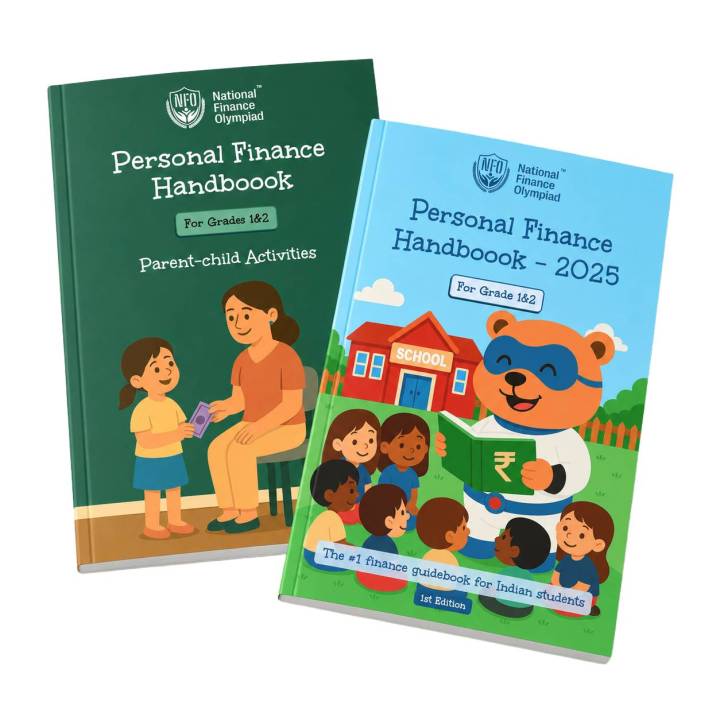
The friendly guide, money pal, and the go-to narrator is Gebby the bear. The book, meant for classes 1 and 2, has 8 chapters. Each chapter explains a new concept, followed by a story to convey the idea better, and then a small activity to do (match correctly, cut the picture and paste in the right place, and so on). Answers to all the questions and activities are provided at the end. A brief overview is provided in the table below.
| Chapter Number | Chapter Name | Key Ideas |
|---|---|---|
| 1 | Money Here, Money There! |
|
| 2 | Work Mode: ON! |
|
| 3 | Where Did My Money Go? |
|
| 4 | Every Rupee Counts! |
|
| 6 | Think Twice, Spend Wise! |
|
| 7 | Goodbye Piggy, Hello Bank! |
|
| 8 | Money Here, Money There, Money Everywhere! |
|
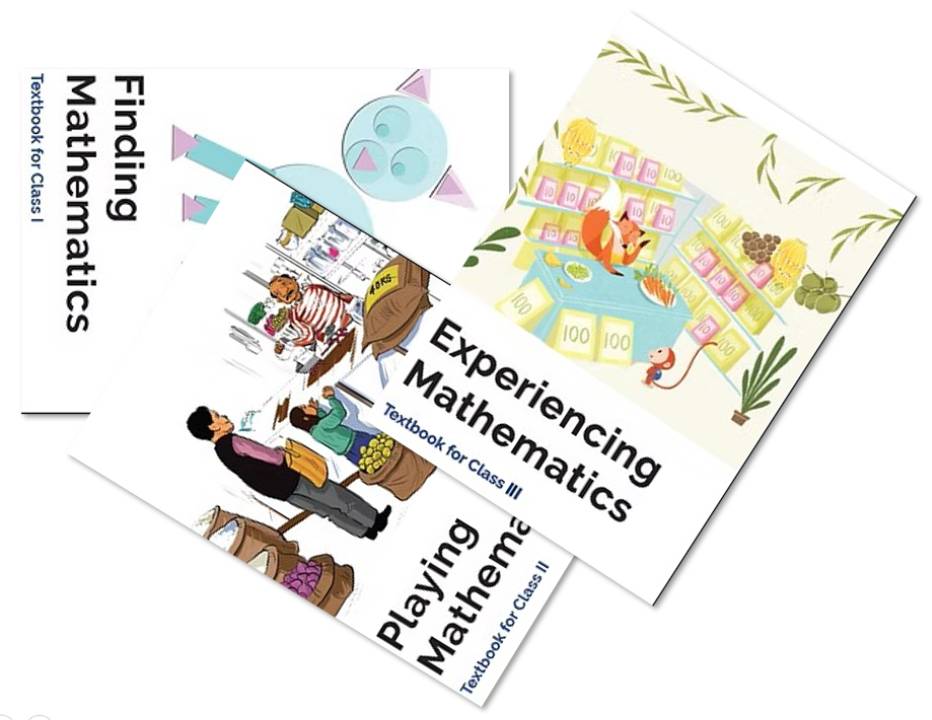
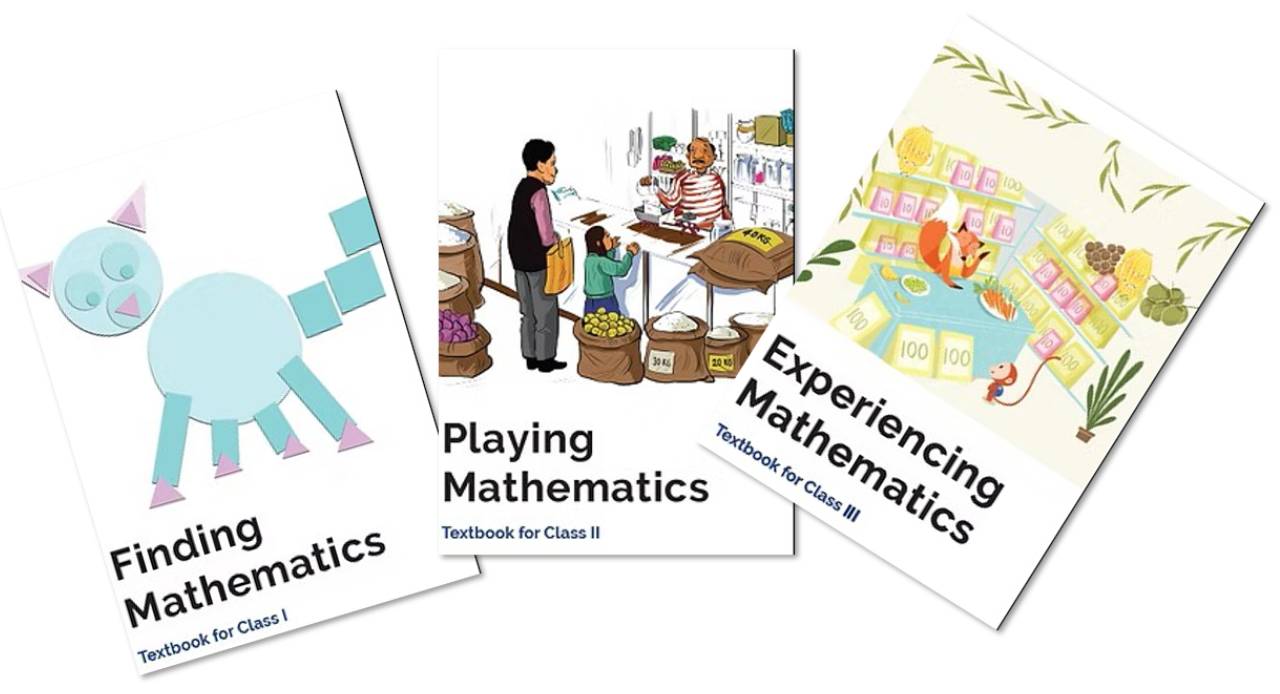
The breadth of topics covered here is noteworthy. To appreciate what is distinctive about the handbook, it is useful to compare it with how money is addressed in the NCERT mathematics textbooks for classes 1 and 2. The NCERT Foundational Stage Learning Outcomes document says that by Class 2, students should be able to “add up notes and coins to form amounts up to `100” [2]. In Class 1, the chapter on money deals with recognising notes and coins and forming different combinations to make a given amount (up to `20) (Figure 2).
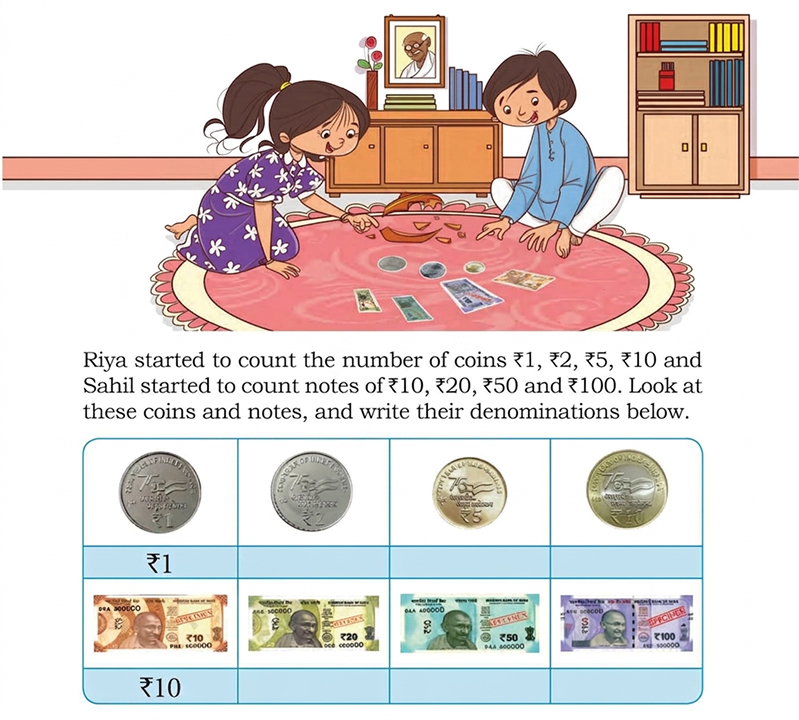
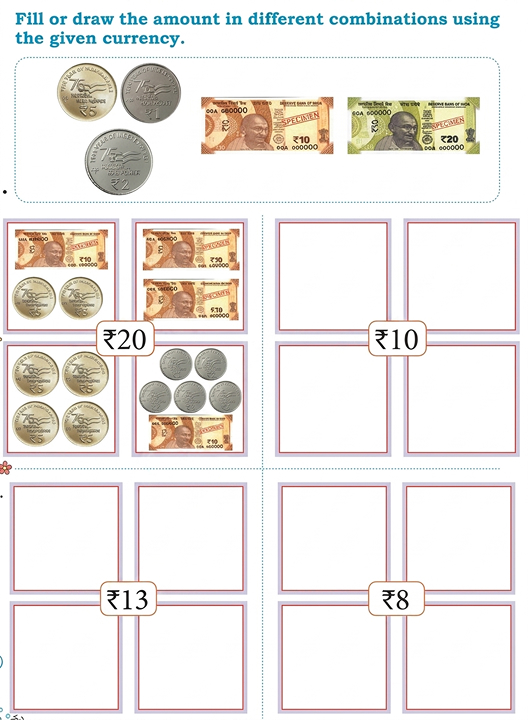
The chapter includes pretend play in which children create paper currency and engage in role-play as shopkeepers and customers.
In Class 2, the chapter is called “Fun at the Fair”, where a story is built around children going to the fair and playing different games and rides with the money that their parents have given them (Figure 3).
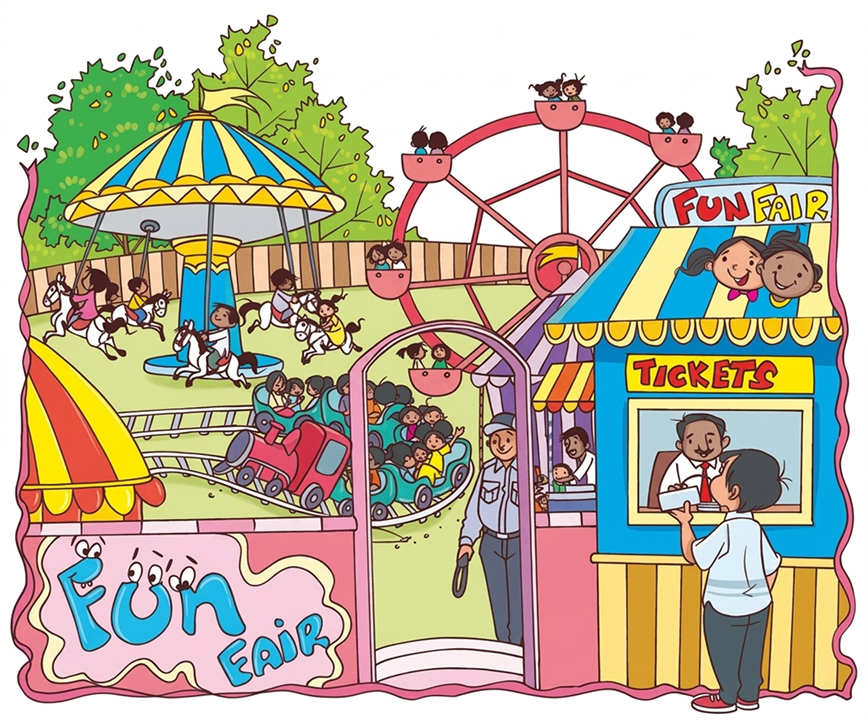
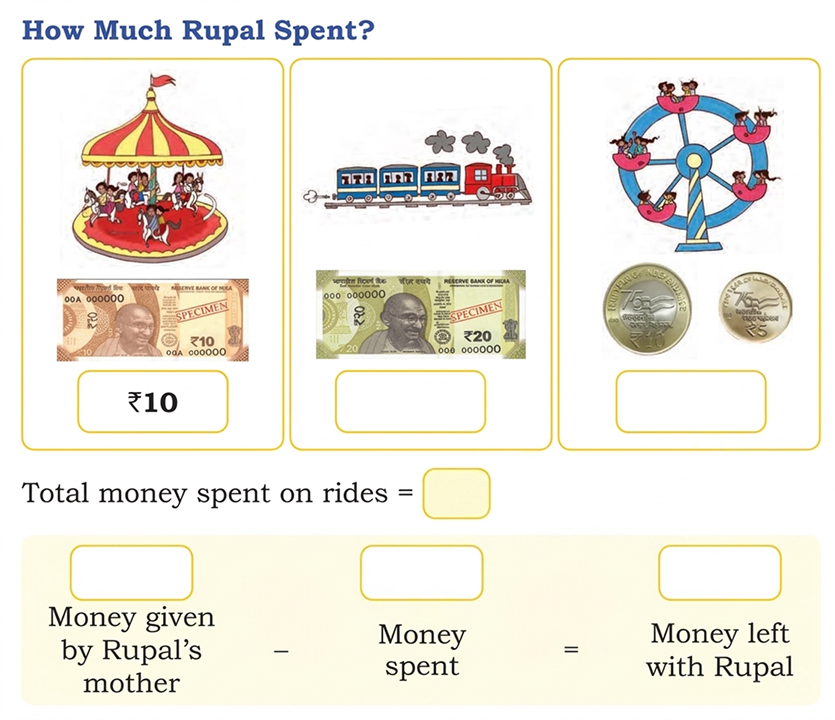
This chapter covers different ways of paying the same amount and ends with simple addition and subtraction problems involving money.
Where the handbooks add value beyond the textbook
While the NCERT books introduce children to notes and coins, combinations of amounts, and simple transactions, the handbook extends the discussion to broader ideas of earning, saving, budgeting, and financial decision-making. The following aspects of the handbook are worth noting.
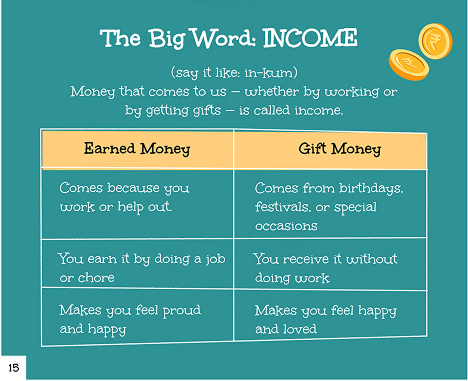
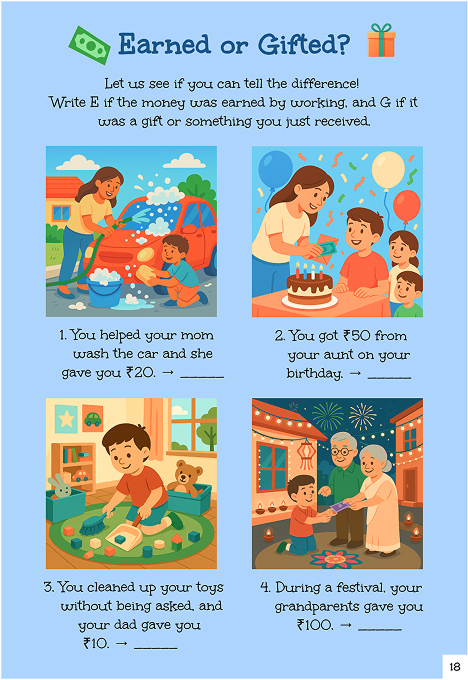
- The idea of “income” is introduced as money that comes to us- either by working or by getting gifts. The differences between these two kinds of income are also listed. This is followed up by an activity where children should identify if the income mentioned in each situation is earned or gifted (Figure 4). In a typical math textbook, this bit is taken for granted (of course the focus is on the calculations!).
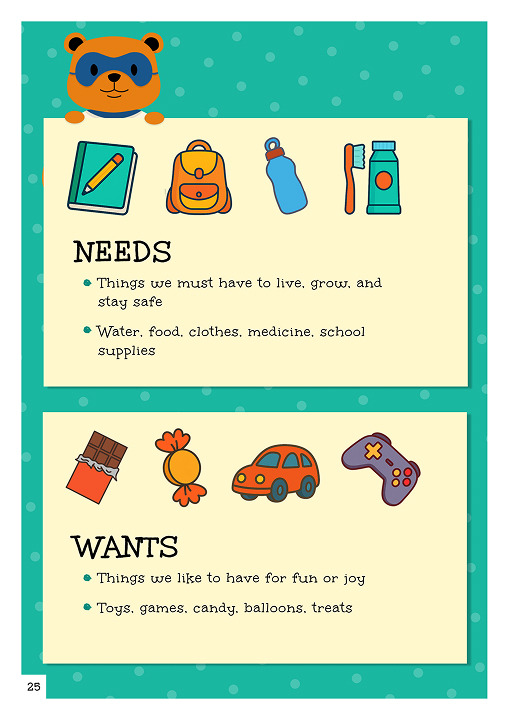
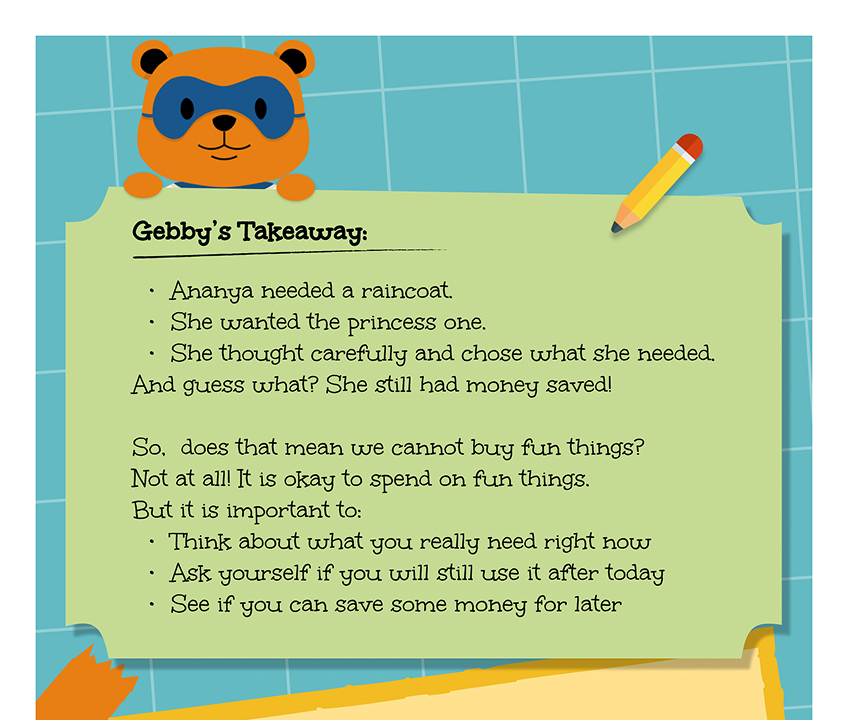
- The distinction between needs and wants. This is one of the most relevant sections in the handbook. In today’s “instant” age, everything is available at the click of a button, with little emphasis given to whether it is really needed. With adults getting into this mode of “buy what you see”, children are also growing up getting whatever they ask for, sometimes without even having to wait for it! There is a small story to drive home the point, through choices that Ananya makes (Figure 5).
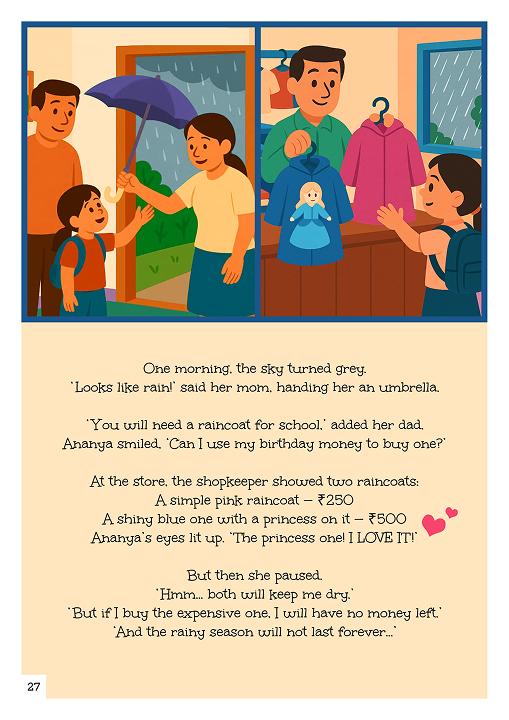
The story is followed by a useful question (and a response): Does this mean one cannot buy fun things? (Figure 6)
- An important companion to the handbook is the parent-child activities book, which attempts to extend the ideas shared in the primary handbook beyond reading and classroom discussion. It actively involves the parents (or adults at home) in the child’s understanding of the concept, and rightly so, as the topic of money and spending is so central to the home environment.
Areas that need strengthening
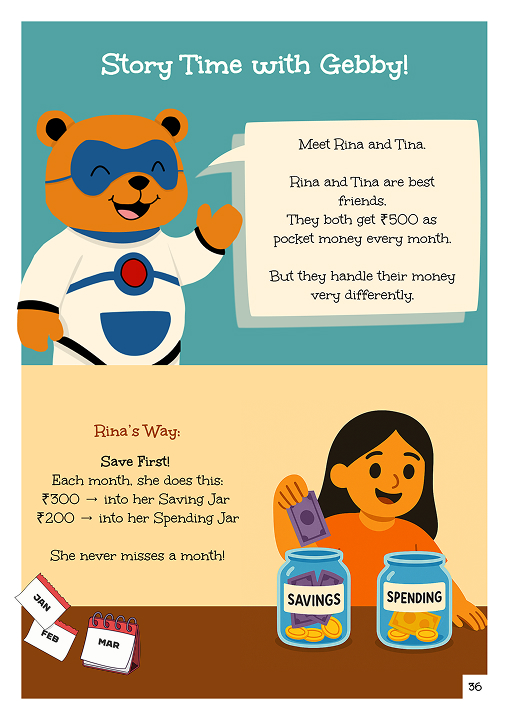
- The chapter on savings talks about “Smart Savers”. The idea of saving first and then spending is introduced (Figure 7). The emphasis on being a ‘Smart Saver’ may inadvertently suggest that saving is always the better choice. It may be useful to acknowledge that people make different decisions about spending and saving depending on their needs and priorities.
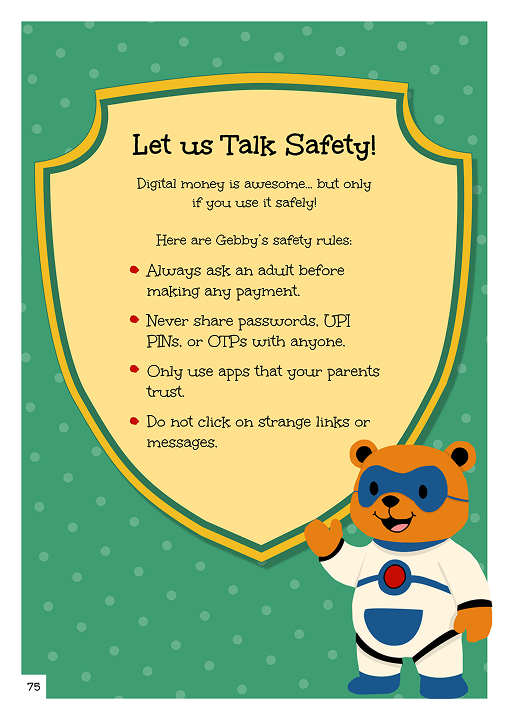
- In keeping with the times, digital money and digital payments are covered in the last chapter. It should be made explicit that young children (6 and 7-year olds in this context) are not expected or advised to use apps or make digital payments on their own (or even under supervision). The first and third points under safety (Figure 8) may convey otherwise.
- Each activity in the parent-child activity handbook mentions the goal, set-up, and activity flow, with clear instructions on what to do. “Time needed” could be a good addition to this list, for parents to know how much time needs to be devoted for this. Certain activities involve having to head to the store or the bank, so some heads up may help parents/ adults at home plan better.
- The activity for Chapter 5 requires the child to think of a “goal” (a toy, a trip, or a backpack, bicycle, etc.), list down its cost, how much they can save, and by when they can achieve the goal (Figure 9a). This requires delayed gratification, cost estimation, record keeping, decision making, prediction-which are a lot for children at that age to take in, and higher math skills than they can cope with! The same can instead be tried out in the form of pretend play- A toy costs, say, `50, and the child has `5. How much more is needed to buy the toy? It is now a simple subtraction problem, or counting backwards by 5 from 50. If the child gets `5 every month, how many months are needed to be able to buy the toy, if all the amount is saved? Repeated addition (5 + 5 + …) till 50 is reached. How much time is needed if only `3 is saved every month? (3 + 3 + 3…) till 50 is reached. How many 3s are needed to reach 50? This helps the child understand the idea by breaking it down into simpler steps instead of being overwhelmed by the task.
- The activity for Chapter 6 helps the child plan their money wisely using a budgeting rule (The 50 / 30 / 20 Rule)- 50% of income for needs, 30% for wants, and 20% for savings (Figure 9b). Again, a lot to process. Percentages as a concept is way above their level for 6-7 year-olds to understand, and the onus is on the adults to explain. If the idea is that adults plan this entirely, create and compare actual expenses with estimates, calculate the percentages for needs, wants, and savings, then the bigger question is whether parents or adults at home will take time out of their routine and schedule to do this, and then get the child to merely track and fill the sheet. The child is no longer an active participant. Instead, with small amounts like 20 or 50 as the limit, the child can be asked to choose from a few objects within that budget, taking into consideration needs and wants, all done in the form of pretend play.
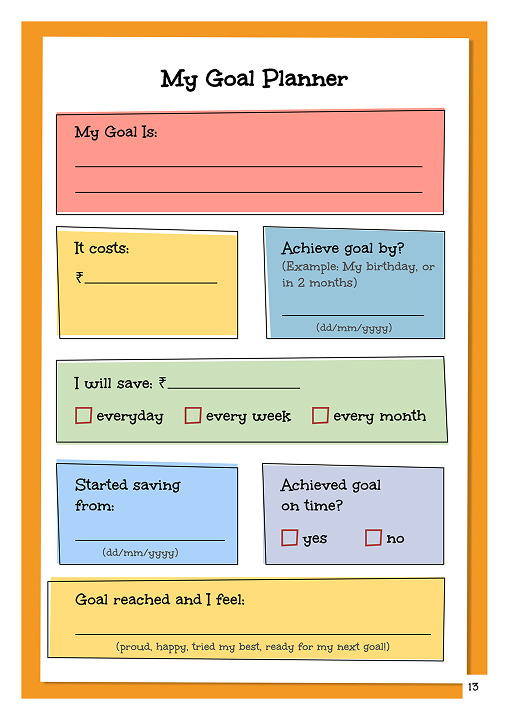
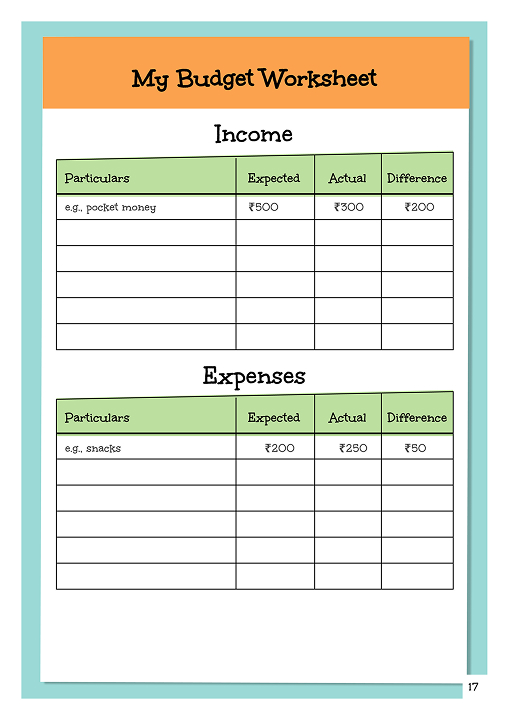
In their current form, the goal planner activity and 50/30/20 rule worksheet may be overwhelming and confusing for the child. Sustained saving towards a goal may be difficult for many children of this age, even with adult support. The activities as they exist right now could be moved to the higher grades, where children can be involved directly.
Conclusion
Taken together, the handbook and the parent-child activities book show how financial literacy can be meaningfully integrated into a child’s everyday experiences. Children in both urban and rural settings will be able to relate to the ideas and concepts, except maybe digital payments, in case they are not exposed to it widely in their region. Rather than focussing narrowly on financial terminology or basic operations, the books encourage young learners to think critically about choices, resources, and responsibility. However, this needs to be toned down to make it age-appropriate, as discussed in detail in the earlier section.
As an introductory text for grades 1 and 2, the primary handbook offers teachers and parents a useful starting point for nurturing financial awareness from an early age. In its current form though, it serves as a useful supplementary conversation-starter, and not a stand-alone mathematics resource. Teacher notes are definitely needed to provide additional instructions, address sensitive issues around money, provide alternative suggestions to activities, and guide the teacher, so as to do justice to the book. Currently it relies a lot on teacher’s adaptation of the material for age, context, and access, which means that the experience is not standardised.
Images from the Personal Finance Handbook for Grades 1 & 2, reproduced with permission from the National Finance Olympiad (NFO).