
Measuring the Gap


Measurement is a basic skill, and measurements determine daily decisions. So, it is not surprising that the NCF (National Curriculum Framework) 2023 continued to give it importance even at primary school. As students, we have been taught the measurement of length by cramming the standard values (such as, 1 m = 100 cm). But current pedagogy begins with the child’s perspective – using non-standard units such as handspan and foot length and then reasoning out the need for standard units and associated vocabulary, symbols and conventions. This article is based on Jivesh’s first experience of introducing the concept of measurement of length to his Class 3 students.
When I started teaching, I was confident that a story related to the history of measurement would set the stage to achieve my learning objectives. For non-standard units, I would explain that in ancient times people lacked measuring tools and used units like ‘Paatha’ (a unit used in hilly regions to measure roughly 2 kg of weight). I emphasized that technology later led to precise, standardized tools. Over time, I realized that while this historical context might aid sixth graders, it often confuses third graders. More importantly, I learned that non-standard units are not just relics of the past; they remain relevant today. We don’t always carry a ruler, but we often estimate using hand spans, foot spans, cubits, etc.
Planning based on Learning Outcomes
These are the first few Curricular Goals and Competencies related to the measurement of length for the preparatory stage as per the NCF 2023.
| Curricular goals | Competency | Learning Outcome |
|---|---|---|
| Understand measurable attributes of objects and the units, systems, and processes of such measurement, including those related to distance, length, weight, area, volume, and time, using non-standard and standard units. |
C-3.1 “Measures in non-standard and standard units and evaluates the
need for standard units”
C-3.2 “Uses an appropriate unit and tool for the attribute (like length, perimeter, time, weight, volume) being measured” |
Understands the importance of standard units over non-standard units;
(e.g., in case of length measurement, can tell the situations where
they would face difficulty using non-standard units)
Knows and uses appropriate standard units and tools to measure length (centimetres and metres) |
Note: The Learning Outcomes were retrieved from the Elementary School Learning Outcomes (2017) found at.
At the start of the unit, I checked the prior knowledge of the students. I found that 95% of the class could compare lengths, sort objects from shortest to longest/highest, and arrange objects in increasing or decreasing order of length.
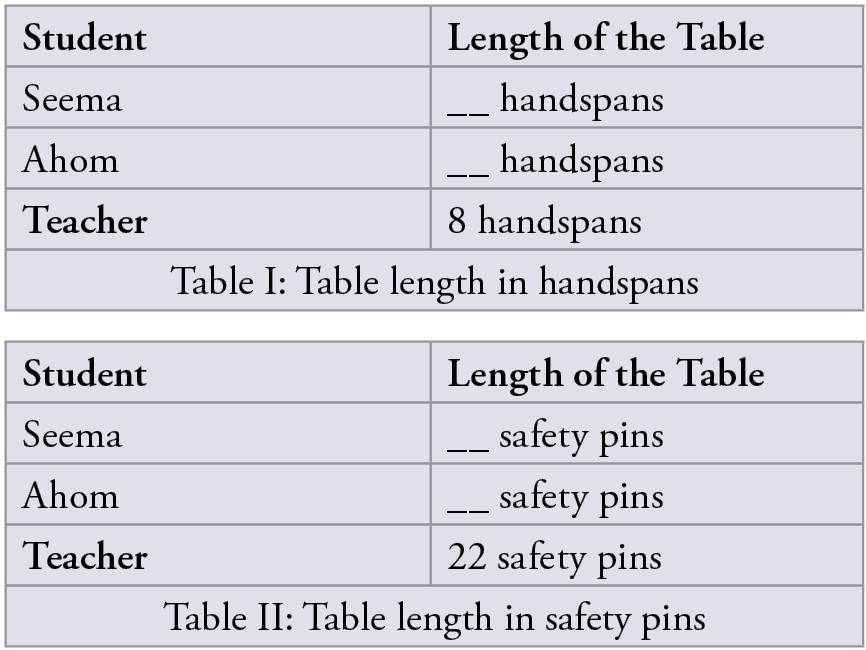
We started with a hands-on activity. Each pair of students was given an activity sheet (shown in Figure 1) and a box of closed safety pins.
They were first required to measure the length of their tables using their handspans and to enter their findings in Table I. Then they had to measure the same length using the safety pins and enter their findings in Table II. I tried to pair shorter students with taller counterparts for this activity which used non-standard units.
The students were able to observe that though they were measuring the same table there was a difference in the number of handspans from person to person. However, there was no difference in the number of safety pins, provided the measurement was done correctly. (I used the opportunity provided by some errors to illustrate how mistakes could be made.)
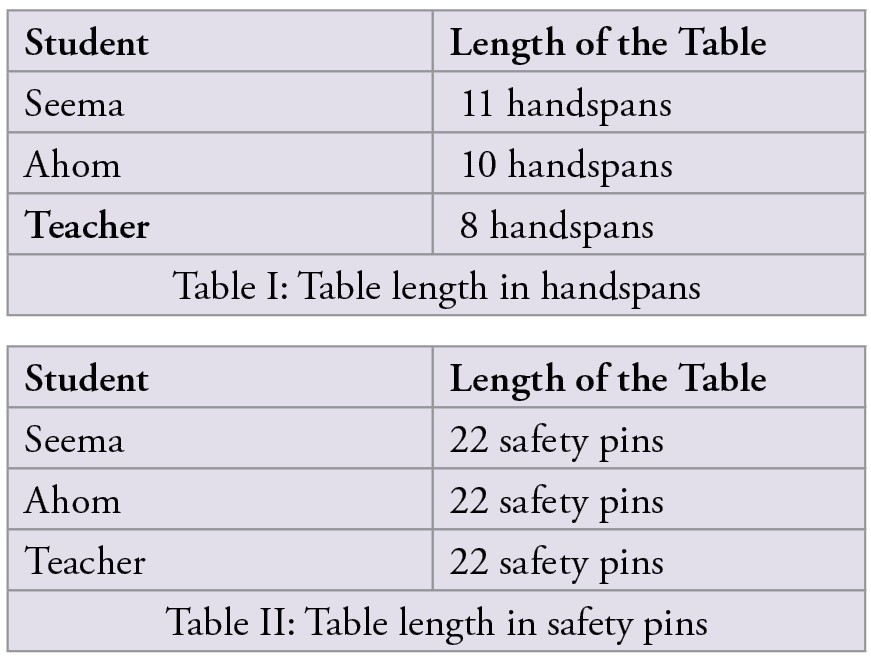
In both parts of the activity, we used non-standard units (NSU). But the difference was that the NSU was uniform in the case of the safety pins and non-uniform in the case of the handspans. The class was transitioning from NSU to SU via uniform units.
In both the activities, after measuring, if the end of the object’s length was less than the length of a handspan or a whole safety pin, most students became confused. They wrote measurements such as “Five and a half safety pins.”
Consider Figure 3. The lengths of pens A and B were both measured as “Three and a half safety pins,” but when compared, the two lengths were not actually equal.
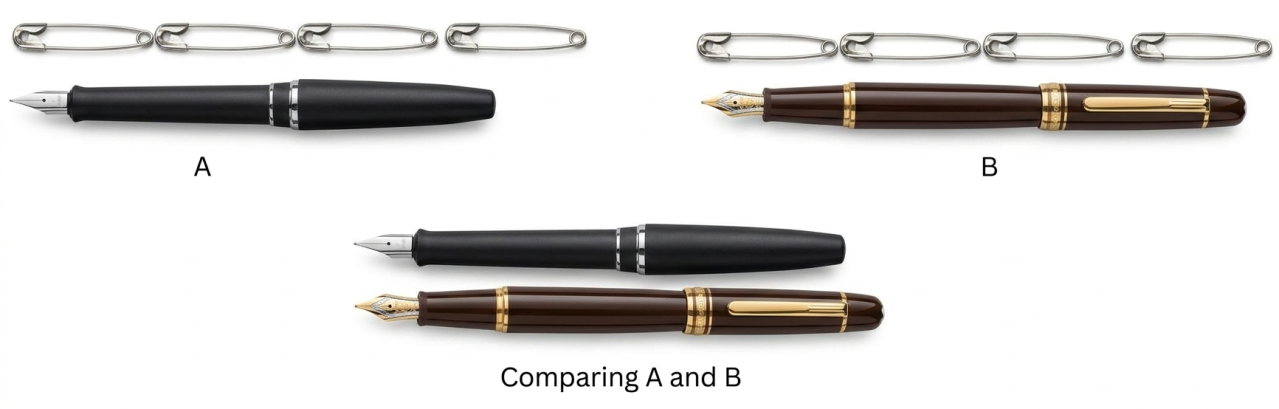
At that point, I had to leave the question in the students’ minds. Safety pins don’t have sub-units, and hence accuracy is compromised but this was something I could address only after standard units were brought in.
Standard Units
Now it was time for standard units, and we started with a “Long” shown in Figure 4.

I was lucky to have square-grid notebooks with exactly 1 cm grids. Usually, the grid size is larger in such notebooks. So, I made the Longs with sheets from unused pages. Alternatively, Dienes’ Blocks can be used since that’s a perfect 1 cm grid by design. If such blocks are not available, then one can easily make 10 cm × 1 cm strips from card/boxes/stiff paper. Using the 1 cm × 1 cm squares for each cell helps the transition to standard units very well.
We asked the students to measure different objects such as crayons, sharpeners, erasers and pencils using this teaching learning material (TLM). They were instructed to measure by counting the gaps between the lines.
The Long was then marked with numbers (1 to 10) and students were asked to measure objects with the Long and also with a ruler.

Later, the ruler is connected with the Long for an Aha! moment in Figure 6.
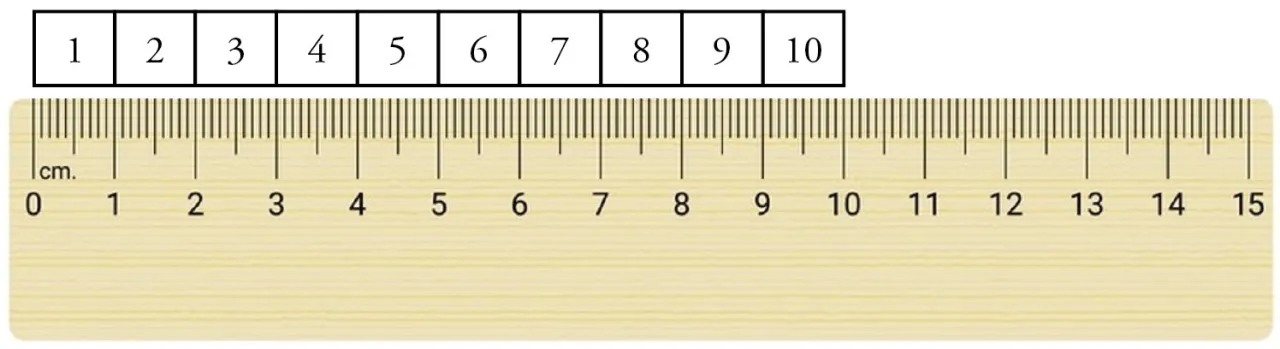
Figure 6: The Long becomes the 10 centimetre scale
Challenges that I encountered
- Students faced difficulties with the non-standard units. This part took longer than I expected.
- The students were confused when the ruler was introduced, especially whether measurement began from 1 cm or from the 0 cm mark.
- Students did not understand that the object’s length was not increased when it was shifted as shown in Figure 7.
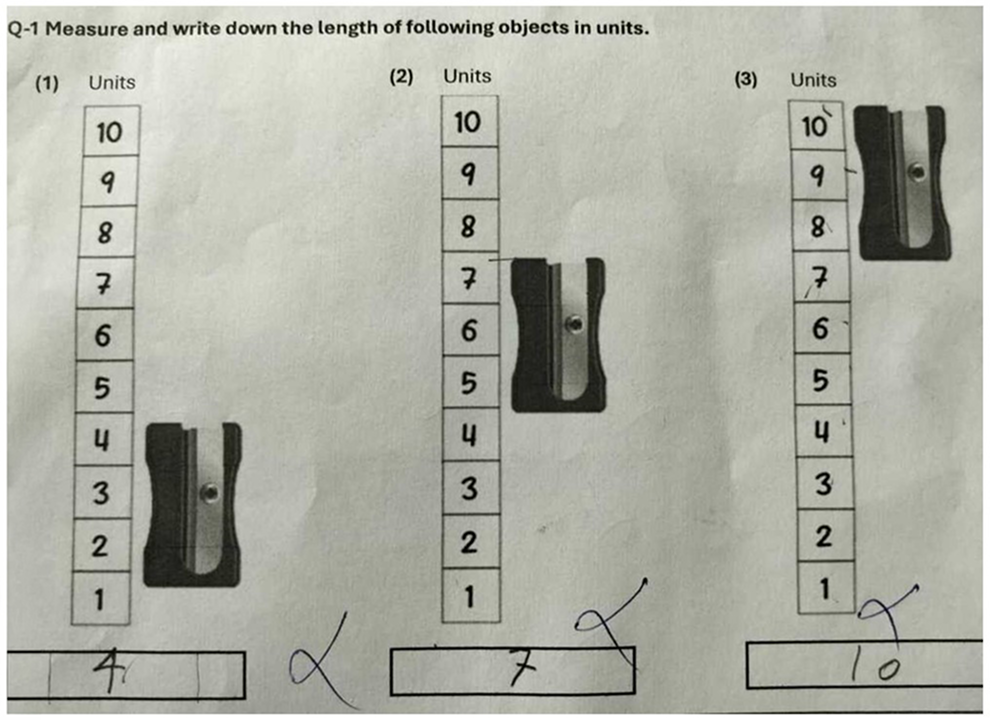
I realised that an error had crept in due to how the squares on the long were numbered.
Editor’s note: What was needed at this point was the following explanation:
- The square marked 1 starts at 0 on the scale and ends at 1 on the scale. So, the length of a side of this square is the same as the gap between 0 and 1 on the scale.
- The square marked 2 starts at 1 on the scale and ends at 2 on the scale. So, the length of these 2 squares is the gap between 0 and 2 on the scale.
- Similarly, the length of squares 1-5 is the gap between 0 and 5 on the scale.
- And the length of all 10 squares is the gap between 0 and 10 on the scale.
- So, we have to start from 0 on the scale.
It was also important to discuss how the length of something doesn’t change if we shift it along the scale. For example, check Figure 8.
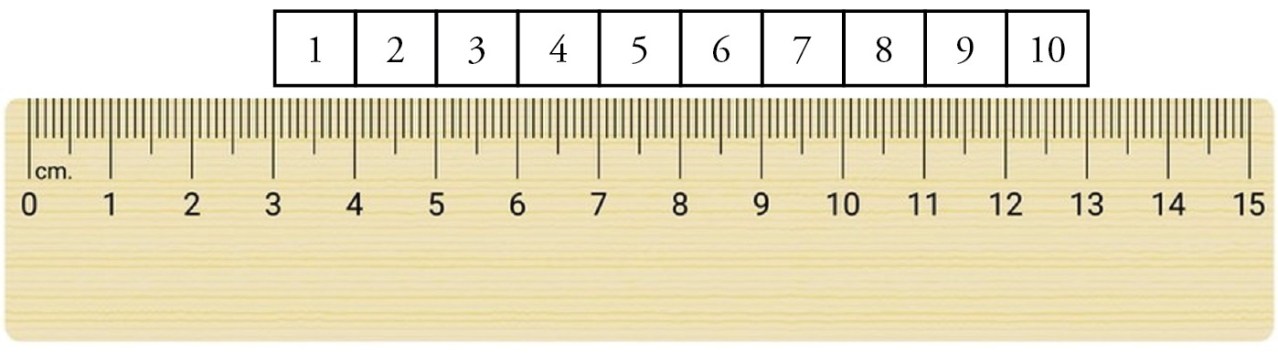
It is the same strip of 10 squares. So, the length has to be the same. But now it matches the gap between 3 and 13 on the scale. Note that there are 13 such intervals (0 to 1, 1 to 2… 12 to 13) between 0 and 13 on the scale and 3 such intervals between 0 and 3. Now, the 10 intervals between 3 and 13 overlap with the strip. So, we ignore the first 3 intervals (or take them out) from the 13 intervals. Therefore, we have to subtract 3 from 13 to get the length of the strip, i.e., the length of the strip is 13 cm – 3 cm = 10 cm.
Conclusion
For an adult who was used to years of measuring lengths, I found it a challenge to predict the difficulties that students have with the skill. This was why I estimated a shorter time to complete this unit. But I am glad that I was able to zoom in on specific difficulties and give students both practical as well as pen and paper exercises that addressed the hard spots that were thrown up in class. Very often, it is difficult to find a worksheet that addresses the difficulties which have been noted in a specific group of students. The accompanying worksheet was designed by Kshama Chakravarthy, with this objective. The notes below the questions explain the thinking behind them. Helpful suggestions for creating more such questions are also given.